
SK Hynix

Search documents
Pure Storage(PSTG) - 2026 Q1 - Earnings Call Transcript
2025-05-28 22:02
Financial Data and Key Metrics Changes - Q1 revenue grew by 12%, reaching $830 million, with an operating profit of $83 million and an operating margin of 10.6% [23][28] - Subscription services revenue in Q1 reached $406 million, up 17%, representing over half of total revenue [25] - Annual recurring revenue (ARR) grew 18% to $1.7 billion, while total remaining performance obligations (RPO) grew 17% to $2.7 billion [25][26] - Total gross margin improved to 70.9%, with subscription services margin at 77.2% [26][27] Business Line Data and Key Metrics Changes - TCV sales for Storage as a Service solutions jumped 70% to $95 million, driven by large Evergreen One deals [23] - Product margin rose by 1.1 points sequentially to 64%, with expectations for mid-60s product gross margin for the year [27] Market Data and Key Metrics Changes - U.S. revenue was $531 million, growing 9%, while international revenue was $248 million, growing 21% year over year [26] - The company added 235 new customers, achieving a penetration rate of 62% of the Fortune 500 [26] Company Strategy and Development Direction - The introduction of Fusion 2.0 has been well received, with nearly 100 customers using or testing it [8] - The company is focusing on modernizing IT infrastructure and breaking down data silos, with a strong emphasis on AI and high-performance computing [10][15] - A major agreement with Nutanix was announced to integrate their cloud platform with Pure Storage, enhancing virtualization solutions [12] Management's Comments on Operating Environment and Future Outlook - The near-term view for the year remains largely unchanged despite increased uncertainty in the macro environment [18] - The company expects to deliver 1 to 2 exabytes of solutions to Meta in the second half of the year, with production validation testing on schedule [16][39] - Management remains confident in the ability to outpace competition and grow market share [19][30] Other Important Information - CFO Kevan Krysler will be leaving the company, with a transition plan in place [20] - The company returned $120 million to shareholders through share repurchases and paid $61 million in employee award withholding taxes [29] Q&A Session Summary Question: Update on hyperscale opportunity with Meta - Management indicated that the evaluation and testing process with Meta is on track, with expectations for significant progress in the second half of the year [39][40] Question: Size of the newly announced AXA offering - The opportunity is seen as niche but substantial, targeting government and large-scale GPU clusters, with margins expected to be at or above company standards [45][46] Question: Changes in buyer behavior during macro uncertainty - Management noted no significant changes in customer sentiment or purchasing behavior in Q1, with broad-based strength across sales [51][54] Question: Clarification on subscription margins amid tariff costs - Management expressed confidence in managing tariff costs without significantly impacting subscription gross margins [93] Question: Revenue contribution from Meta's 1 to 2 exabytes - Some de minimis revenue contribution has been contemplated in the annual guide, primarily through a licensing fee model [72] Question: Time to close larger deals - Management reported that larger deals are tracking as expected, with solid momentum continuing into Q1 [78] Question: Comparison of project timelines with Meta and others - The lengthy timeline is attributed to the design cycles of hyperscalers, which include multiple components beyond storage [84][86]

Pure Storage(PSTG) - 2026 Q1 - Earnings Call Transcript
2025-05-28 22:00
Financial Data and Key Metrics Changes - Q1 revenue grew 12% year-over-year, reaching $830 million, with an operating profit of $83 million and an operating margin of 10.6% [22][24] - Subscription services revenue increased 17% to $406 million, representing over half of total revenue, while annual recurring revenue (ARR) grew 18% to $1.7 billion [23][24] - Total remaining performance obligations (RPO) grew 17% to $2.7 billion, indicating strong renewals and new commitments [23][24] - Total gross margin improved to 70.9%, with subscription services margin at 77.2% [24][25] Business Line Data and Key Metrics Changes - Storage as a Service (SaaS) solutions saw a 70% increase in total contract value (TCV) sales, reaching $95 million, driven by large Evergreen One deals [22][23] - Product margin rose 1.1 points sequentially to 64%, with expectations for mid-60s product gross margin for the year [25][26] Market Data and Key Metrics Changes - U.S. revenue grew 9% to $531 million, while international revenue increased 21% to $248 million year-over-year [24] - The company added 235 new customers, achieving a penetration rate of 62% within the Fortune 500 [24] Company Strategy and Development Direction - The company is focused on modernizing IT infrastructure and breaking down data silos, with a strong emphasis on AI and high-performance computing solutions [7][9] - Strategic partnerships with companies like Nutanix and SK Hynix are aimed at enhancing virtualization and flash storage capabilities [10][15] - The company is committed to maintaining pricing predictability for customers amid tariff-related changes, leveraging its Evergreen model [17][18] Management's Comments on Operating Environment and Future Outlook - Management expressed confidence in the company's ability to navigate macroeconomic uncertainties while maintaining strong performance [16][28] - The company anticipates continued growth in the second quarter, projecting revenue of $845 million, a 10.6% year-over-year increase [28] Other Important Information - Kevin Chrysler, the CFO, will be leaving the company, with a transition plan in place to ensure continuity [19][20] - The company reported a strong balance sheet with $1.6 billion in cash and investments, and operating cash flow of $284 million [26] Q&A Session Summary Question: Update on hyperscale opportunity with Meta - Management indicated that the evaluation process with Meta is on track, with expectations to deliver one to two exabytes in the second half of the year [36][38] Question: Size of the newly announced AXA offering - The company views the AXA offering as targeting niche markets, with expectations for margins to be at or above standard company margins [42][43] Question: Changes in buyer behavior during macro uncertainty - Management noted no significant changes in customer sentiment or purchasing behavior in Q1, with broad-based strength across sales [50][52] Question: Revenue contribution from Meta's project - Some de minimis revenue contribution from the Meta project has been included in the annual guidance, primarily through a licensing fee model [69][70] Question: Clarification on subscription margins amid tariff costs - Management expressed confidence that subscription gross margins would not be significantly impacted by potential tariff costs due to operational efficiencies [90][91] Question: Investment expectations for future hyperscaler wins - The company expects to see leverage in design and investment requirements as more hyperscalers are added, reducing costs for future projects [93][94] Question: Revenue linearity throughout the quarter - Management reported typical revenue linearity throughout the quarter, with strong performance sustained [97][98]
Exclusive look at the making of High NA, ASML's new $400 million chipmaking colossus
CNBC· 2025-05-22 12:11
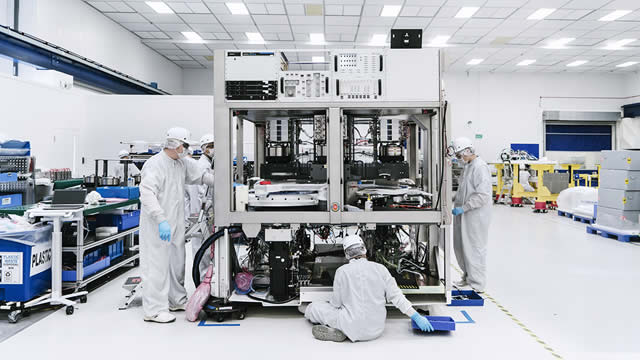
Core Insights - ASML has developed the High NA machine, the world's most advanced and expensive chipmaking machine, with a cost exceeding $400 million, which is set to transform microchip production [1][4][12] - The first commercial installation of High NA occurred at Intel's Oregon chip fabrication plant in 2024, with only five machines shipped to date [3][4] - High NA is expected to be utilized by all ASML's EUV customers, including major chipmakers like TSMC, Samsung, and Micron, enhancing chip production efficiency and yield [4][21] Technology and Development - High NA machines are larger than a double-decker bus and consist of four modules manufactured in different locations, requiring significant logistics for delivery [2] - The technology behind High NA allows for higher resolution projections of chip designs, reducing the need for multiple patterning and improving yield [7][13] - ASML's High NA machines have shown significant improvements over previous EUV machines, with Intel reporting a 100% increase in reliability and Samsung noting a 60% reduction in cycle time [6][7] Market Position and Strategy - ASML holds a dominant position in the EUV lithography market, being the exclusive manufacturer of these machines, which are essential for producing advanced microchips [4][5] - The company sold 44 EUV machines in 2024, with a starting price of $220 million, while its older DUV machines accounted for 60% of its business [16][17] - ASML's sales to China peaked at 49% of its business in Q2 2024, but are expected to normalize to 20%-25% in 2025 due to U.S. export controls on EUV technology [17][18] Future Outlook - ASML plans to ship at least five more High NA systems in the current year and aims to ramp up production capacity to 20 machines in the coming years [24] - The company is also developing the next generation of machines, Hyper NA, expected to be needed between 2032 and 2035, with draft optical designs already in progress [23][24] - ASML is establishing a training center in Arizona to train 1,200 individuals annually on EUV and DUV technologies, addressing the growing demand for skilled labor in the semiconductor industry [23]


摩根士丹利:半导体生产设备-行业展望
摩根· 2025-05-22 05:50
Investment Rating - The industry investment rating for Semiconductor Production Equipment is Attractive [2]. Core Insights - The semiconductor manufacturing equipment market is expected to experience growth driven by advancements in generative AI and increased demand for high-performance computing [117]. - The report highlights a shift in capital expenditure trends, with significant investments anticipated in both front-end and back-end processes, particularly in response to evolving technology needs [117]. - The report notes that while there are uncertainties regarding US tariffs and restrictions on China, the overall growth potential of the semiconductor manufacturing equipment market remains strong [117]. Market Environment - The semiconductor production equipment market is projected to see low-single digit negative growth in 2025, influenced by various factors including demand fluctuations in China and global market dynamics [19][22]. - The report indicates that sales of wafer fabrication equipment (WFE) to China are expected to slow down, with significant implications for the market outlook [22]. - The demand for advanced packaging technologies, such as CoWoS, is increasing, driven by the need for high-performance computing solutions [38]. Capital Expenditure Trends - Capital expenditure (capex) for DRAM is expected to decrease in China while increasing outside of China, with NAND investments rebounding [17]. - The report anticipates that capex directed at HBM4 will ramp up fully from the second half of 2025, reflecting the growing demand for high-bandwidth memory in AI applications [36]. - The CHIPS Act is expected to significantly impact the back-end equipment market, with substantial subsidies allocated to enhance domestic semiconductor manufacturing capabilities [39][40]. Technological Advancements - The concept of chipletization is highlighted as a key trend, offering advantages such as reduced chip area and improved yields, which are critical for enhancing semiconductor performance [15]. - The report discusses the emergence of new technologies, including glass substrates and photoelectric fusion, which are expected to drive innovation in semiconductor manufacturing [36]. - The introduction of advanced packaging methods, such as Panel Level Packaging (PLP), is noted for its potential to improve manufacturing efficiency and output [99].
半导体生产设备行业展望
Morgan Stanley· 2025-05-22 00:50
Investment Rating - The industry investment rating for Semiconductor Production Equipment is Attractive [2]. Core Insights - The semiconductor manufacturing equipment market is expected to experience growth driven by advancements in generative AI and increased demand for high-performance computing [117]. - The report highlights a shift in capital expenditure trends, with significant investments anticipated in both front-end and back-end processes, particularly in response to evolving technology needs [117]. - The report notes that while there are uncertainties regarding US tariffs and restrictions on China, the overall growth potential of the semiconductor manufacturing equipment market remains strong [117]. Market Environment - The WFE (Wafer Fabrication Equipment) market is projected to see low-single digit negative growth in 2025, with specific segments like NAND and foundry showing varied growth rates [19][22]. - Sales exposure to China is expected to decline, with significant implications for companies like Kokusai Electric, SCREEN Holdings, and Tokyo Electron, whose sales to China as a percentage of total sales are forecasted to decrease [22][21]. - The demand for advanced packaging technologies, such as CoWoS (Chip on Wafer on Substrate), is anticipated to increase, driven by the need for high-performance computing solutions [38][117]. Technology Trends - The concept of chipletization is gaining traction, allowing for reduced chip area and increased yields, which is crucial for optimizing semiconductor production [15]. - The report discusses the impact of the CHIPS Act, which is expected to significantly boost the back-end equipment market, growing at twice the rate of the front-end equipment market [39][40]. - Innovations in packaging technologies, such as PLP (Panel Level Package) and HBF (High Bandwidth Memory), are highlighted as promising developments that could enhance production efficiency [99][101]. Future Outlook - The semiconductor production equipment market is poised for transformation, with generative AI driving new demands and opportunities for innovation [117]. - The report emphasizes the importance of sustainability in investment, particularly in the context of AI and semiconductor demand, as companies like Microsoft plan to increase their capital expenditures significantly [36][86]. - The anticipated growth in mobile HBM (High Bandwidth Memory) capacity for edge AI devices is projected to ramp up significantly from 2025 onwards, indicating a robust market for related production equipment [81][84].
金十图示:2025年05月15日(周四)全球主要科技与互联网公司市值变化


news flash· 2025-05-15 02:58
金十图示:2025年05月15日(周四)全球主要科技与互联网公司市值变化 | (S 艺电 | 383 | + -1.23% | 147.23 | | --- | --- | --- | --- | | Zscaler | 378 | + -0.22% | 244.45 | | Advantest | 369 | + -1.77% | 50.32 | | PNG Block | 359 | ↑ 0.57% | 58.5 | | HubSpot | 353 | + -0.33% | 670 | @ JIN10.COM 金十数据 | 一个交易工具 | DUUNIII . CUIII Adobe | 1702 | | 399.47 | | --- | --- | --- | --- | | 德州仪器 | 1701 | -0.46% | 187.34 | | | 1687 | -0.47% | 118.89 | | 高通 | 1679 | 1.08% | 152.98 | | 小米 והו | 1616 | 1 0.47% | 6.45 | | ≤ 索尼 | 1203 | 1.39% | 24.88 | | Shopi ...

国泰海通:HBM产品不断迭代 产业链将持续发展
智通财经网· 2025-05-13 01:59
Core Insights - HBM (High Bandwidth Memory) is a crucial technology for AI servers and is expected to be widely adopted in the autonomous driving market in the future [1] - China's HBM industry is developing, with HBM2 and HBM2E currently in mass production, and HBM3 and HBM3E expected to achieve breakthroughs by 2026E/2027E [1] - SK Hynix is the global leader in the HBM market, holding a 55% market share, followed by Samsung at 41% and Micron at 3% [1] Group 1 - SK Hynix launched the world's first TSV-based HBM product in 2013 and has since introduced several generations of HBM products, including HBM2, HBM2E, and HBM3 [1] - In April 2023, SK Hynix completed functionality verification of a 12-layer HBM3 product (24 GB), and in August 2023, it launched the high-performance 8-layer HBM3E product [1] - The company plans to start mass production of the 12-layer HBM3E product (36 GB) in October 2024 and is developing a 16-layer HBM3E product with a capacity of 48 GB [1] Group 2 - SK Hynix's HBM stacking technology has evolved from TC-NCF and MR-MUF to Advanced MR-MUF, with significant developments in wafer-level packaging (WLP) and TSV technology since around 2000 [2] - The 12-layer HBM3 and HBM3E products utilize Advanced MR-MUF technology, and the upcoming 16-layer HBM3E product will also employ this technology [2] Group 3 - Both Samsung and SK Hynix have established their own HBM supply chains, with Samsung relying on Japanese and Korean equipment suppliers, while SK Hynix partners with HANMI Semiconductor and others [3] - HANMI Semiconductor holds approximately 65% of the global TCBonder market and nearly 90% in the HBM3E TCBonder sector, indicating a strong position in the supply chain [3]

国泰海通|电子:AI发展的关键,HBM产品不断迭代
国泰海通证券研究· 2025-05-12 15:12
报告导读: HBM 是 AI 、高性能计算、智能驾驶等的核心产品, DRAM 堆叠工艺的发展 尤为关键。目前海外 HBM 龙头公司 SK Hynix 已迭代到 HBM3E ,我国较之仍有不小的 差距,我们认为产业链相关的设备、材料公司将持续发展、力争不断实现技术突破。 投资建议。 HBM(高频宽存储器,High Bandwidth Memory)是将DRAM通过先进封装技术堆叠而成, 与GPU整合于同一块芯片上;目前AI服务器是HBM最重要的市场,未来智能驾驶汽车市场也会大量采用 HBM。我国HBM产业不断发展,目前能实现规模量产的是HBM2、HBM2E,有望在2026E/2027E分别 实现HBM3、HBM3E突破。虽然我国的HBM产业发展较海外龙头公司落后较多,但我们认为伴随下游 Fab、设计公司、设备公司、材料公司的共同努力,本土HBM产业会不断向前发展,其中核心之一便是键 合堆叠环节的突破。 SK Hynix为全球HBM龙头。 根据SemiWiki援引Trendforce数据,2023年全球HBM市场SK Hynix、 Samsung、Micron的市占分别为55%、41%、3%。SK Hynix 2 ...

摩根大通:先进封装-解决半导体性能瓶颈
摩根· 2025-05-12 03:14
Investment Rating - The report does not explicitly provide an investment rating for the advanced packaging industry. Core Insights - Advanced packaging is essential for overcoming semiconductor performance bottlenecks, enabling higher speeds and efficiency through enhanced interconnect density and improved thermal management [1][4][8]. - The advanced packaging market is projected to grow at a compound annual growth rate (CAGR) of approximately 12% from 2024 to 2029, with high-end performance packaging expected to grow at a CAGR of 37% [4][54][55]. - Hybrid bonding technology is highlighted as a key evolution in semiconductor performance, offering significant advantages in terms of cost, efficiency, and application potential [4][89]. Summary by Sections Advanced Packaging Key to Future Scaling - Moore's Law has led to increased transistor density, but performance metrics like single-thread performance and power efficiency have not kept pace, creating bottlenecks [7][11]. - Advanced packaging addresses these limitations by improving interconnect density and thermal management, allowing chips to operate at higher speeds [8][11]. Semiconductor Architecture Evolution - The shift from monolithic System-on-Chip (SoC) designs to 2D chiplets allows for modular chip design, optimizing cost and performance [16][21]. - 2.5D and 3D packaging techniques enhance data transfer efficiency and increase transistor density [25][26]. Bonding and Packaging Technologies - The evolution of bonding technologies from wire bonding to hybrid bonding reflects the industry's need for higher precision and density in interconnects [62][64]. - Hybrid bonding enables direct copper-to-copper interconnects, significantly reducing latency and increasing interconnect density [95][89]. Market Growth and Trends - The advanced packaging market is expected to reach $84 billion by 2029, driven by innovations in AI, 5G/6G, and autonomous driving technologies [54][40]. - High-end performance packaging, particularly in segments like 3D NAND and HBM, is projected to contribute significantly to market growth [55][48]. Adoption of Hybrid Bonding - Hybrid bonding is currently limited to high-end applications but is expected to see wider adoption due to its performance advantages over traditional methods [4][89]. - Companies like AMD and Intel are early adopters of hybrid bonding, indicating a trend towards its increased use in advanced semiconductor applications [4][89]. Competitive Landscape - The advanced packaging equipment market features several competitors, with BE Semiconductor (Besi) noted for its strong position in hybrid bonding [4][54]. - The report emphasizes the need for semiconductor manufacturers to invest in advanced packaging technologies to remain competitive [84][85].
摩根士丹利:半导体行业_尽管有关税担忧,存储市场持续强劲,上调美光科技预期数据
摩根· 2025-05-12 01:48
Investment Rating - The industry view is rated as Attractive [6] - Micron Technology Inc. (MU) price target reduced from $112.00 to $98.00 [6] - SanDisk Corporation (SNDK) price target reduced from $84.00 to $70.00 [6] Core Insights - Memory pricing has significantly improved recently, driven by strong demand in the AI sector, particularly for DRAM and NAND [3][4] - Micron's direct AI revenue is expected to grow 2-2.5 times over the next three quarters, contributing significantly to pricing and margins [9][30] - The demand for DRAM is anticipated to increase due to higher content in devices, particularly in Apple's iPhone lineup, which could lead to a 22% growth in DRAM demand [40][41] Summary by Sections DRAM Market - Recent checks indicate a positive outlook for DRAM, with expectations of volume growth in the low teens for DRAM and over 20% for NAND [3] - AI demand is a core driver for Micron, with expectations that tight DRAM supply will persist, making Micron's stock appear undervalued [3][4] - Micron's HBM revenue is projected to grow significantly, with estimates of $7.2 billion over the next twelve months [30] NAND Market - NAND volumes have been weak outside of AI markets, but improvements are expected as demand from datacenters remains robust [4][5] - The impact of higher smartphone memory content is significant, with potential growth in NAND demand driven by Apple's increased storage requirements [43][46] Financial Estimates - Micron's revenue estimates for August and November have been raised, with DRAM revenue expected to reach $8.3 billion in August, a 20.9% increase quarter-over-quarter [52] - Adjusted EPS estimates for Micron have been increased to $2.47 for August and $2.77 for November, compared to consensus estimates of $1.94 and $2.41 respectively [52] - SanDisk's valuation is seen as attractive, trading at 3x trailing peak earnings, with expectations of improved industry dynamics leading to higher profitability [55][61]