lululemon athletica inc.

Search documents
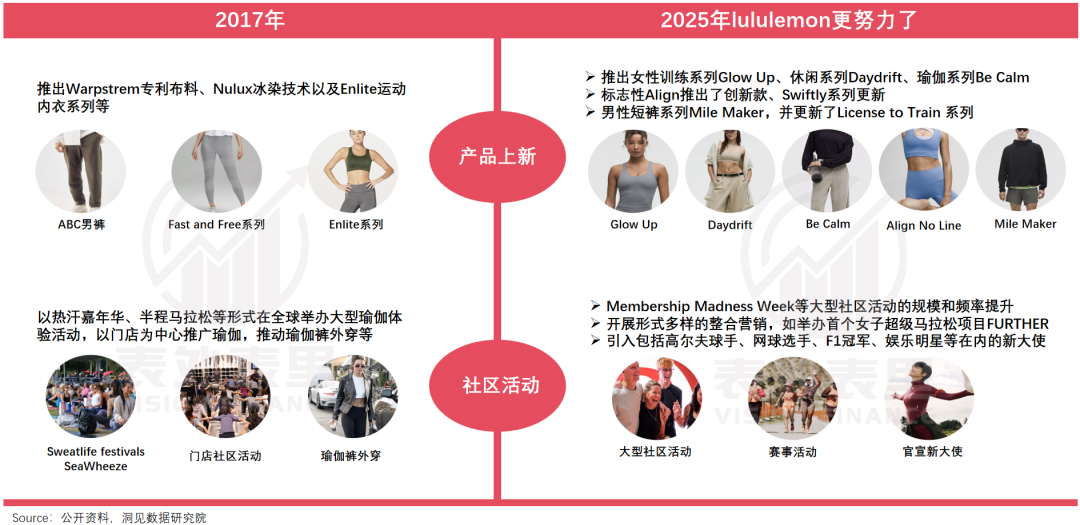
lululemon在北美,正沦为“妈妈品牌”
虎嗅APP· 2025-10-24 16:02
Core Insights - Lululemon is facing a significant decline in its market position, reminiscent of its struggles in 2017, with a 70% drop in stock price from last year's peak [4][6][22] - The brand's identity as a premium athleisure label is being challenged by emerging competitors like FP Movement, which has seen a 34% increase in sales in 2024 [9][19] - The shift in consumer preferences towards comfort and practicality, particularly among the North American Gen Z, is impacting Lululemon's sales and brand perception [11][13][15] Market Performance - Lululemon's North American market, which contributes 70% of its revenue, is experiencing negative growth across multiple business metrics, while the Chinese market remains strong [6][22] - The brand's sales of tight-fitting leggings are declining, with a reported 8.2 percentage point drop in their market share for activewear bottoms compared to 2022 [15][19] Competitive Landscape - FP Movement and other niche brands are redefining athletic fashion with looser silhouettes, leading to a perception shift where Lululemon is seen as a brand for older demographics [9][11][15] - New entrants like Baleaf and Glowmode are successfully capturing market share by addressing specific consumer needs, such as functional pockets in yoga pants, and offering competitive pricing [29][32][34] Brand Identity and Consumer Perception - Lululemon's once-strong brand identity is eroding as it faces increased competition and a shift in consumer values towards comfort over status [19][35] - The brand's recent legal actions against competitors for imitation have backfired, leading to increased interest in alternative products among consumers [24][26] Strategic Challenges - Lululemon's product innovation has stagnated, with minimal changes to core product lines, leading to consumer fatigue [36] - The company has raised prices in response to increased production costs, further distancing itself from price-sensitive consumers [36][40] Future Outlook - The founder of Lululemon, Chip Wilson, has publicly criticized the company's current trajectory, emphasizing the need for innovation and brand reputation as key metrics for success [43]



Majid Al Futtaim Lifestyle CEO on expanding Abercrombie & Fitch’s regional reach
Gulf Business· 2025-10-24 05:17
Core Insights - Majid Al Futtaim Lifestyle is focusing on regional expansion through digital growth, omnichannel innovation, and stronger brand partnerships, highlighted by the collaboration with Abercrombie & Fitch Co. and the launch of dedicated e-commerce platforms in Saudi Arabia and Qatar [2][5][26] - The company is leveraging data, technology, and cultural relevance to redefine modern retail in the Middle East, particularly in response to evolving consumer expectations [3][10] Expansion and Partnerships - The expanded partnership with Abercrombie & Fitch Co. marks a significant milestone in Majid Al Futtaim's long-term retail strategy, emphasizing sustainable growth and trust built over 16 years [5][26] - The launch of dedicated e-commerce platforms for Abercrombie & Fitch and Hollister in Saudi Arabia and Qatar is a natural progression in the company's omnichannel strategy, integrating physical retail with digital convenience [6][26] Omnichannel Strategy - Majid Al Futtaim views online and offline channels as a connected ecosystem, aiming to provide a seamless customer journey across various platforms [11][15] - The company has seen a revenue uplift of over 10% within the first year of launching e-commerce platforms for lululemon, demonstrating the effectiveness of their omnichannel approach [12] Consumer Insights and Personalization - Advanced analytics are used to understand customer behavior at both market and individual store levels, allowing for tailored product assortments that reflect local preferences [8][20] - Personalization is central to the customer experience, with the SHARE loyalty program and analytics capabilities enabling the company to create relevant and rewarding experiences [17][18] Cultural Relevance and Brand Localization - Majid Al Futtaim ensures that global brands resonate with regional consumers by balancing global identity with local relevance, utilizing data-driven insights to tailor marketing and experiences [19][22] - The introduction of culturally relevant products, such as Abercrombie & Fitch's first Arabic logo, exemplifies the company's commitment to connecting with local audiences [9][21] Future Growth Opportunities - The company has an ambitious development pipeline focused on expanding its presence in high-growth categories and deepening the performance of existing brands [23][24] - Saudi Arabia remains a key strategic market, with plans for further expansion into Diriyah Square and the introduction of new global brands to enhance the existing portfolio [24][25][26]


X @The Economist
The Economist· 2025-10-23 19:50
Market Trends - Lululemon leggings不再是时尚人士的唯一选择,竞争对手正在 gaining ground(获得市场份额)[1] Competitive Landscape - 时尚行业竞争激烈,Lululemon 面临来自其他品牌的挑战[1]
How the NIKE-SKIMS Partnership Could Spark NKE's Next Growth Wave?
ZACKS· 2025-10-23 17:56
Core Insights - NIKE Inc.'s collaboration with SKIMS aims to blend sport performance with pop-culture appeal, targeting a broader consumer base, particularly women who value both function and form in activewear [1][2][8] - The partnership's debut collection features 58 silhouettes that merge NIKE's performance expertise with SKIMS' aesthetic, indicating strong early consumer response [2][8] - This collaboration could serve as a catalyst for growth, expanding NIKE's reach into the premium athleisure market and enhancing its appeal among younger, style-conscious consumers [3] Competitive Landscape - NIKE faces strong competition from adidas AG and lululemon athletica inc. in the global market [4] - adidas is rebuilding momentum through its "Own the Game" strategy, focusing on direct-to-consumer growth and sustainability, while revitalizing classic products [5] - lululemon has evolved into a global performance and lifestyle brand, expanding its offerings and capturing consumers seeking both style and performance [6] Financial Performance - NIKE shares have lost 8.7% year to date, compared to the industry's decline of 11.4% [7] - The company trades at a forward price-to-earnings ratio of 34.92X, higher than the industry average of 29.37X [9] - The Zacks Consensus Estimate for NIKE's fiscal 2026 earnings implies a year-over-year decline of 23.6%, while fiscal 2027 indicates growth of 50.5% [10]

How Costco quietly built a multibillion-dollar clothing empire
CNBC· 2025-10-23 16:00
Apparel Business Size & Growth - Costco's apparel business has reached nearly $10 billion [1] - Costco's apparel sales have grown by almost 40% over the past five years [1] - Costco's apparel segment growth surpasses competitors like BJ's (28%) and Sam's Club (21%) [1] - Costco's apparel segment is larger than brands like Gap, Calvin Klein, Tommy Hilfiger, Abocrombie & Fitch, and Old Navy [2] Inventory & Sourcing Strategies - Costco sources products directly from manufacturers, who create specific lines for the wholesale club [2] - Costco secures licensing deals with major brands to sell their products [3] - Costco acquires overstock or excess inventory from retailers or third-party sellers [3] Market Recognition & Legal Challenges - Men's apparel sales at Costco experienced double-digit growth in the most recent quarter [4] - Lululemon filed a lawsuit against Costco alleging product duplication, indicating increased industry attention [4]


波司登签约Kim Jones,lululemon为何反其道而行?
Yang Zi Wan Bao Wang· 2025-10-23 11:21
Core Insights - The competition in the down jacket market is intensifying, with Bosideng partnering with former Dior designer Kim Jones to elevate its brand image, while Lululemon demonstrates strong performance in China with a 25% revenue growth [1][4]. Industry Overview - The Chinese sportswear market, valued at over 380 billion yuan, has maintained a compound annual growth rate of 7.4% over the past five years, attracting numerous brands [2]. - The high-end down jacket segment is particularly competitive, with international brands like Canada Goose and Moncler leading the market, while local brands like Bosideng aim to carve out their niche [2]. Company Strategies - Bosideng's decision to hire Kim Jones reflects a strategic move towards high-end branding, leveraging the designer's reputation to enhance its market position [3][4]. - In contrast, Lululemon focuses on product experience rather than designer endorsements, showcasing its offerings through relatable marketing campaigns that emphasize functionality and quality [3][5]. Product Philosophy - Lululemon's commitment to product quality is evident in its upcoming Featherweight series, which features high-quality materials and innovative design aimed at enhancing user experience [5]. - The brand's recent financial results indicate a successful strategy, with a 25% revenue increase in China and a 17% growth in same-store sales, underscoring the effectiveness of its product-centric approach [4][5]. Consumer Behavior - Consumers are becoming more discerning, prioritizing value for money over brand prestige, which necessitates that products justify their price points through quality and performance [7][8]. - The current market dynamics suggest that brands must genuinely understand consumer needs and deliver high-quality products to succeed in a competitive landscape [8].

lululemon在北美,正沦为“妈妈品牌”
Hu Xiu· 2025-10-23 00:02
Core Insights - Lululemon is facing significant challenges in the market, with a decline in sales and brand perception as competitors like FP Movement gain traction among younger consumers [1][7][10]. Sales Performance - In Q1 2025, Lululemon's online sales and store traffic both decreased, leading to a 30% year-over-year drop in net profit [2]. - The company's stock price has plummeted approximately 70% from its peak last year, indicating a severe loss of market confidence [7]. Market Trends - The North American market, which contributes 70% of Lululemon's revenue, is experiencing negative growth in several business metrics, while the Chinese market remains a bright spot [7]. - The shift in consumer preferences towards loose-fitting styles, as exemplified by FP Movement's success, is redefining athletic fashion [10][12]. Competitive Landscape - FP Movement's sales grew by 34% year-over-year, and the brand plans to open 300 new stores in North America, highlighting its aggressive expansion strategy [12]. - Other brands like Athleta and Jo+Jax are also redefining athletic aesthetics with loose silhouettes, further challenging Lululemon's market position [13]. Consumer Behavior - The North American Gen Z demographic is increasingly favoring comfort and practicality over the traditional "activewear" aesthetic, leading to a decline in the appeal of Lululemon's signature tight-fitting products [14][19]. - Reports indicate that over half of Gen Z in the U.S. hold multiple jobs, reflecting a shift in lifestyle that prioritizes comfort over luxury [17]. Brand Perception - Lululemon's brand is perceived as outdated among younger consumers, who associate it with older generations, leading to a decline in its aspirational value [14][22]. - The brand's previous image as a luxury activewear label is being undermined by the rise of more innovative and affordable competitors [52]. Product Strategy - Lululemon has attempted to adapt by increasing the proportion of loose-fitting products in its lineup, but its offerings are seen as less innovative compared to competitors [25][26]. - The company has faced criticism for its stagnant product designs and recent price increases, which have alienated cost-conscious consumers [56]. Legal and Market Challenges - Lululemon's recent lawsuit against Costco for selling knockoff products has backfired, driving consumers to seek out these alternatives instead [35][36]. - The brand's unique selling propositions, such as fabric technology, are no longer exclusive, as competitors have begun to replicate these features effectively [40]. Future Outlook - Lululemon's founder has expressed concerns about the company's direction, emphasizing the need for innovation and brand reputation as key metrics for success [64][65]. - The path to regaining high growth is expected to be increasingly difficult amid changing consumer preferences and intensified competition [65][66].
It’s ‘Hard to Have Conviction’ in Lululemon Stock Right Now, According to Analysts. Should You Sell LULU Here?
Yahoo Finance· 2025-10-22 16:10
Core Insights - Lululemon Athletica has experienced significant stock declines in 2025, underperforming the S&P 500, with a year-to-date drop of 54% compared to a 13% gain for the index [3][4] Company Overview - Lululemon Athletica is a Canadian multinational company known for premium athletic apparel, footwear, and accessories, originally focused on yoga but has expanded into running, training, and lifestyle segments for both genders [1] - Founded in 1998 in Vancouver, the company operates over 700 stores across North America, Europe, and the Asia-Pacific regions [2] Financial Performance - In Q2 2025, Lululemon reported earnings per share of $3.10, exceeding analyst expectations of $2.87, while total revenue increased 7% year-over-year to $2.53 billion, slightly below the consensus estimate of $2.54 billion [5] - Comparable sales rose 1%, driven by international markets, particularly China, while the U.S. segment showed flat performance due to soft apparel demand [6] - Operating income decreased by 3% to $524 million, with gross margins contracting by 110 basis points to 58.5% due to increased supply chain and tariff costs [6] - Inventories increased by 21% year-over-year to $1.7 billion, attributed to higher stock builds and slower domestic sell-through [6] Market Dynamics - The company's underperformance is attributed to soft U.S. demand and margin pressures, although rising international revenue suggests a potential recovery path [4] - Digital sales accounted for 39% of total revenue, indicating strong online engagement despite challenges in the retail environment [7] - The balance sheet remains robust, with $1.2 billion in cash and $393 million in available revolving credit capacity [7]
The stock market is about to care about the calendar
Yahoo Finance· 2025-10-22 10:00
Core Insights - The stock market is influenced by year-end tax loss harvesting and portfolio adjustments as the holiday season approaches [1][2] - Significant gains in the stock market have been driven by AI-related trades, with some investors considering profit-taking and tax strategies [2][6] Company Performance - Companies like Palantir (PLTR) and Robinhood (HOOD) have seen substantial year-to-date stock gains, while the worst performers in the S&P 500 are under scrutiny as investors look to mitigate losses [3][5] - The worst-performing stocks include names from various sectors such as consumer, industrial, and services, with examples like Lululemon (LULU), Dow (DOW), and Trade Desk (TTD) [5][6] Market Dynamics - The struggles of underperforming companies are attributed to execution issues, changes in customer demand, and cyclical factors rather than the rise of generative AI [6][7] - Despite the overall positive impact of AI on many companies, tax loss harvesting may increase selling pressure on underperformers, potentially exacerbating their declines [7][9]
与Lululemon短兵相接 Vuori能否在中国掀起后浪?
2 1 Shi Ji Jing Ji Bao Dao· 2025-10-21 23:19
继上海开设3家店铺之后,美国高端运动休闲生活方式品牌Vuori近日在北京正式开出首家线下门店。此举标志着其在中国市场的扩张进入新的 阶段,也昭示其以北京为核心、辐射华北的新战略正式启动。 "我相信中国将成为我们最大的国际市场,我们对在中国的增长非常坚定。"Vuori国际业务高级副总裁Andy Lawrence近日在北京接受21世纪经 济报道记者专访时表示,中国门店及其电商业务整体表现皆超出预期。 Vuori成立于2015年,创始人Joe Kudla因男性瑜伽服饰市场存在供给空白而创立品牌。其名称取自芬兰语"山",寓意平衡运动与日常生活方 式。凭借"高性能服饰与日常穿搭相结合"的定位,Vuori近年来增长迅速,2024年更获得8.25亿美元融资,估值已达约400亿元人民币。 面对Lululemon、Alo Yoga等强劲对手,Lawrence指出,Vuori的差异化优势在于男女产品销售比例接近1∶1,无论是在美国,还是在中国,客群 覆盖更均衡。 对于Vuori在中国的本地化策略,他表示,在产品组合与版型选择上,Vuori会为不同地区和门店做局部调整,未来也可能根据反馈推出"亚洲版 型"的版本。但总体上,当前全球 ...