DeepSeek

Search documents
AI大模型分野:从技术狂热到商业价值回归
Xin Lang Cai Jing· 2025-12-25 12:40
Core Insights - The Chinese large model market in 2025 has undergone a significant "value return," with diminishing marginal effects of technological breakthroughs and a shift towards sustainable business models and deep industry integration [2][11] - The emergence of DeepSeek has disrupted the existing large model market, temporarily dethroning ChatGPT and becoming a global phenomenon [3][12] - The competitive landscape is evolving from a binary narrative of "giants" versus "small tigers" to a more complex, multidimensional competitive stage [3][12] Company Developments - DeepSeek experienced a surge in popularity at the beginning of 2025 but faced a decline in attention by the second half of the year, with updates failing to generate significant market interest [4][13] - The "AI Six Tigers," including Zero One Everything and Baichuan Intelligence, have shifted focus from training large models to practical commercial applications [5][14] - Zero One Everything reported significant revenue growth in 2025, achieving multiple times the revenue of 2024, and successfully launched international projects [6][15] - Baichuan Intelligence has optimized its business focus towards the medical sector, indicating a strategic shift in resource allocation [6][15] Market Trends - The investment landscape has shifted from funding foundational model companies to prioritizing AI applications and infrastructure, reflecting a broader market demand for practical solutions [8][17] - Companies like Zhipu and MiniMax are moving towards IPOs, becoming the first independent large model firms to list in Hong Kong, which is expected to attract significant investor interest [18] - The focus on sustainable revenue growth and reduced losses will be critical for long-term success in the capital markets [18] Technological Insights - The current Transformer architecture may not support the next generation of agents, with research indicating a potential shift towards Non-Linear RNNs for improved performance in long-context environments [19]


Dr. Ed Yardeni vs. Dan Ives: Is 2026 the Year to Rotate Out of Big Tech or Double Down on AI?
Yahoo Finance· 2025-12-25 10:35
Key Points Dr. Ed Yardeni runs his own investment firm, Yardeni Research, while Dan Ives serves as the global head of technology research at Wedbush. Yardeni has long been bullish on the S&P 500 index and tech stocks, but has recently changed course. Ives has consistently been bullish on tech stocks for most of his career, and he views the current artificial intelligence (AI) trade as the fourth industrial revolution. These 10 stocks could mint the next wave of millionaires › Dr. Ed Yardeni of Y ...
AI大模型分野:从技术狂热到商业价值回归|2025中国经济年报
Hua Xia Shi Bao· 2025-12-25 08:16
Core Insights - The Chinese large model market in 2025 is undergoing a significant "value return," with a shift towards sustainable business models and real demand, marking it as a year of entrepreneurial opportunities in global AI applications [2] - DeepSeek emerged as a major player in early 2025, temporarily dethroning ChatGPT in app downloads and gaining widespread attention, but faced a decline in visibility later in the year [3][4] - The competitive landscape is evolving, with the "AI Six Tigers" diversifying their strategies, focusing on practical applications rather than large model training [5][6] Company Strategies - Zero One Wanhua and Baichuan Intelligence have shifted away from training large models, focusing instead on industry applications and commercial viability, achieving significant revenue growth in 2025 [6] - Jiepux and MiniMax are maintaining their focus on large model training while emphasizing commercialization, with Jiepux reporting extensive partnerships in key sectors [6][7] - Yuezhi Anmian is transitioning towards a market-driven approach, appointing a former investor as president to enhance its commercial strategy [7] Market Dynamics - The investment landscape is becoming more cautious, with investors preferring applications and infrastructure over foundational model companies, reflecting a shift in capital towards sectors that provide tangible value [8] - The trend is moving from financing to public offerings, with Jiepux and MiniMax preparing for IPOs, which could attract significant market attention due to the lack of pure AI listings in Hong Kong [9] - The future of AI is expected to see the emergence of "new species" capable of full-loop capabilities across industries, potentially disrupting traditional business models [9][10] Technical Developments - Current Transformer architectures may not support the next generation of agents, with research indicating a potential evolution towards Non-Linear RNNs to address limitations in handling long-context environments [10]

GPT-5争议、开源追赶、能力飞跃:Epoch AI年终报告揭示AI能力加速
3 6 Ke· 2025-12-25 03:36
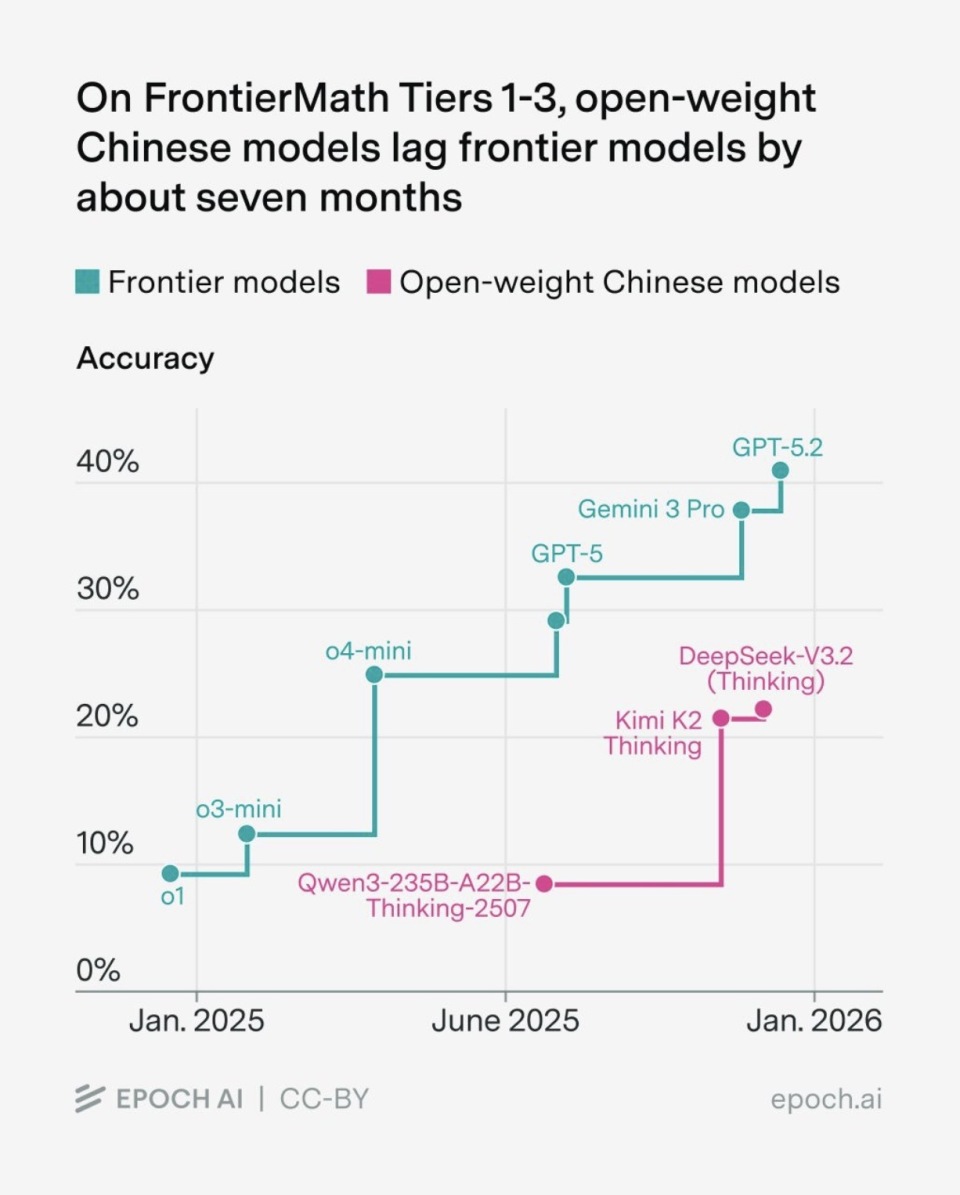
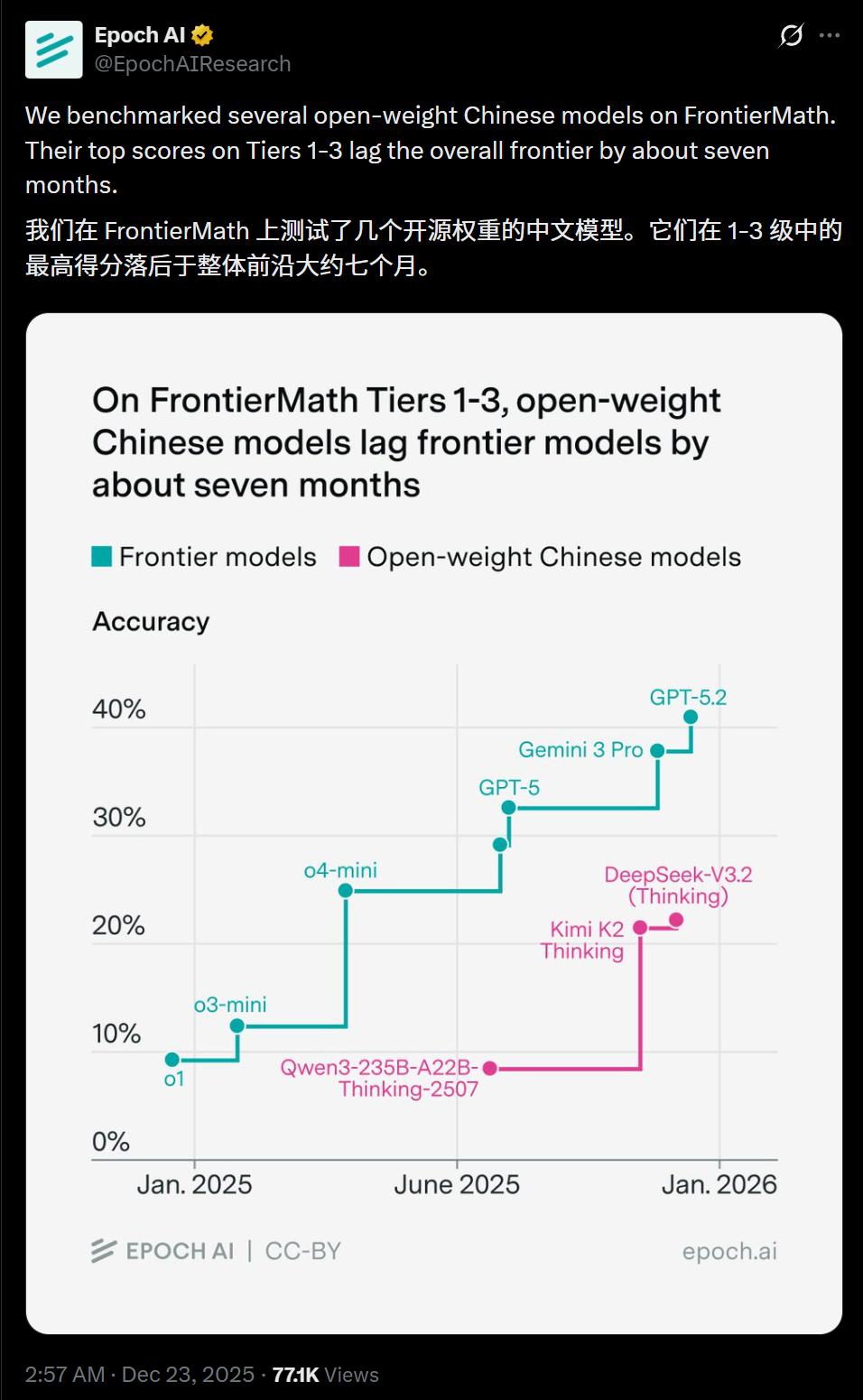
Group 1 - The core viewpoint of the report by Epoch AI indicates that AI models are rapidly improving, with top international models like GPT and Gemini performing well on expert-level mathematical challenges, yet still lacking in full scoring on high-difficulty problems, suggesting room for enhancement in reasoning capabilities [1][6][19] - The FrontierMath test, designed by expert mathematicians, includes 350 problems, with 300 in the basic set and 50 in the extremely difficult category, highlighting the significant challenges faced by AI models [6][8] - Chinese open-source models have made progress but still lag behind international leaders, with the highest score being approximately 2% on the FrontierMath test, indicating ongoing challenges in tackling complex problems [1][6][9] Group 2 - Epoch AI's analysis shows that the performance gap between consumer-grade GPUs running the best open-source models and top-tier models has narrowed to about seven months, indicating a rapid advancement in AI capabilities [30][32] - The report highlights that the cost of inference has dramatically decreased, with the slowest tasks dropping by 9 times per year and the fastest tasks by 900 times per year, driven by market competition and efficiency improvements [26][29] - The AI capabilities are accelerating, with the Epoch Capabilities Index showing that the growth rate of top models has nearly doubled since April 2024, emphasizing the importance of algorithm optimization and data improvements [19][21][23] Group 3 - The report discusses the significant investments in research and development by OpenAI, revealing that a large portion of their budget is allocated to experimental training rather than final model training, underscoring the capital-intensive nature of AI development [33][34] - Epoch AI notes that the performance improvements of models like GPT-5 are substantial, yet the market's reaction has been muted due to the rapid release cycle of intermediate models, which has altered public expectations [39][41] - The analysis suggests that the potential for a national-level AI project, akin to the Manhattan Project, could lead to unprecedented AI capabilities, but it also raises concerns about the feasibility and risks associated with such large-scale investments [53][54]
从OpenAI到DeepSeek,独角兽开始“挑”投资人
阿尔法工场研究院· 2025-12-25 02:33
Core Viewpoint - The article emphasizes that in the current investment landscape, access to top-tier investment opportunities is increasingly restricted to a select group of investors who are on the "trust list" of founders, rather than being solely based on financial capability [4][29]. Group 1: Investment Dynamics - A recent private meeting in Silicon Valley focused on OpenAI's $40 billion funding round, which surpassed all IPOs this year and even exceeded the largest IPO in history by over $10 billion [5][9]. - Only selected private investors, such as SoftBank and Blackstone, were invited to participate in this exclusive funding event, highlighting a trend referred to as "elite internal circulation" [6][8]. - In China, similar dynamics are observed where participation in funding rounds for top unicorns is limited, emphasizing the importance of connections and resources beyond just financial strength [9][10]. Group 2: Historical Context and Evolution - The venture capital landscape has evolved significantly over the past three decades, transitioning from an environment where opportunities were abundant to one where finding quality projects is increasingly challenging [11][18]. - The article recounts how venture capitalists used to approach projects directly, contrasting it with the current scenario where projects often dictate terms and selectively engage with investors [19][27]. Group 3: High Returns from Unicorns - The potential returns from investing in unicorns are substantial, with examples like Tencent, where early investors saw returns of hundreds of times their initial investment [20]. - Recent unicorns like Moer Thread and domestic GPU leader Muxi have demonstrated extraordinary valuation increases, with early investors achieving returns exceeding 6000 times their initial investments [21][22]. Group 4: Changing Power Dynamics - The article discusses a shift in power dynamics where project founders now have the upper hand, often requiring investors to prove their worth before being allowed to engage in due diligence [24][27]. - This shift is exemplified by projects that refuse to open due diligence to any investors, regardless of their reputation, indicating a strong market position [26][28]. Group 5: The Invitation-Only Market - The investment landscape is increasingly characterized by an "invitation-only" model, where only those on the founders' trust lists can participate in lucrative funding rounds [29][30]. - Major firms like Morgan Stanley and Goldman Sachs have adapted by creating private market divisions to cater exclusively to wealthy investors who can connect with top entrepreneurs [29][30]. Group 6: Future Outlook - Companies like SpaceX are setting new valuation records, with recent internal transactions valuing the company at $800 billion, indicating a robust market for top-tier investments [30][31]. - The article concludes that as the industry matures, the best projects will attract capital rather than the other way around, necessitating a shift in how investors approach opportunities [32].

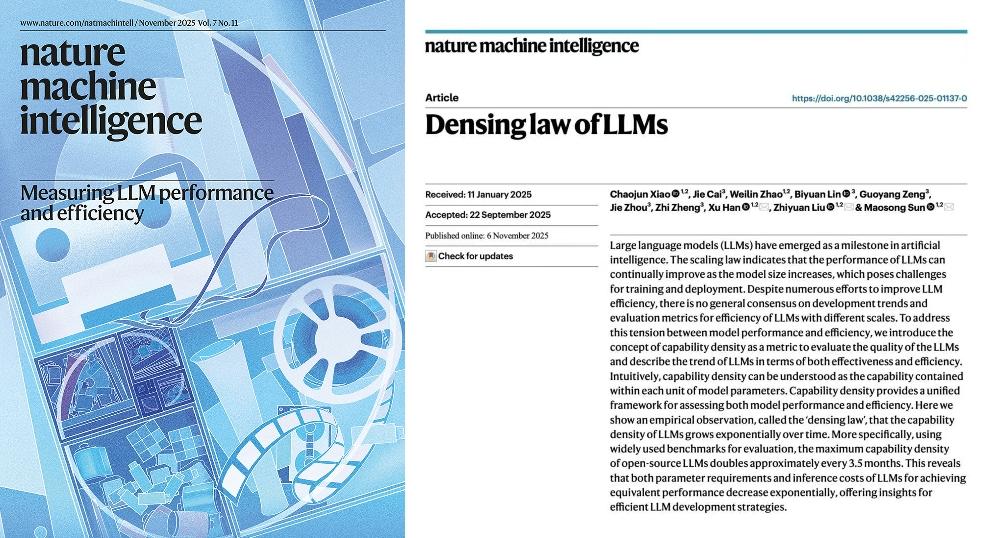
中国大模型团队登Nature封面,刘知远语出惊人:期待明年“用AI造AI”
3 6 Ke· 2025-12-25 01:24
Group 1 - The core principle of the article revolves around the evolution of AI and the emergence of the "Densing Law," which indicates that the capability density of large models doubles approximately every 3.5 months, significantly faster than Moore's Law [5][6][14] - The "Densing Law" suggests that advancements in AI will require less computational power to achieve equivalent performance, with costs potentially decreasing to one-tenth within a year [6][29] - The article highlights the need for a reverse revolution in the industry, where large models must leverage extreme algorithms and engineering to maximize capabilities on existing hardware [4][5] Group 2 - Chinese companies are positioned as key practitioners of this new path, with innovations such as DeepSeek V3 and MiniCPM series models demonstrating significant efficiency improvements [5][11] - The rapid iteration cycle of 3.5 months poses challenges for business models, as companies must recover costs quickly or risk being outpaced by competitors [6][29] - The article emphasizes the importance of efficiency in AI development, particularly in the context of China's limited computational resources, and the necessity for technological innovation to bypass existing limitations [11][12] Group 3 - The article discusses the relationship between the "Scaling Law" and the "Densing Law," suggesting that both are essential for the advancement of AI, with the former focusing on model size and the latter on efficiency [16][17] - Innovations in model architecture, such as the fine-grained mixture of experts (MoE) and sparse attention mechanisms, are highlighted as key developments that enhance computational efficiency [20][21] - The future of AI is envisioned as a collaborative effort between humans and machines, with the potential for AI to autonomously create and improve itself, marking a significant shift in production paradigms [35][36]
白手起家者 vs 继承者们:富豪榜里的新钱旧钱攻防战
Sou Hu Cai Jing· 2025-12-24 13:37
Core Insights - The total wealth of the world's billionaires has surpassed $16 trillion for the first time, with nearly two-thirds of this wealth concentrated in three countries: the United States, China, and India [1][5][6] - Elon Musk's wealth increased by $147 billion over the past year, reaching $342 billion, which is higher than the GDP of nearly 100 countries [1][2] - The number of billionaires has reached 3,028, an increase of 247 from the previous year, with a total wealth increase of $2 trillion compared to last year [1][2] Industry Analysis - The technology sector dominates the billionaire rankings, with the top five positions held by tech moguls: Elon Musk, Mark Zuckerberg, Jeff Bezos, Larry Ellison, and Bernard Arnault [1][2] - The total wealth of the top 15 billionaires is $2.4 trillion, exceeding the combined wealth of the bottom 1,500 billionaires [2] - The financial and investment sector also performed well, with 113 billionaires, whose total wealth grew from $1.3 trillion to $1.5 trillion [4] Geographic Distribution - The United States leads with 902 billionaires, followed by China with 516 and India with 205, together accounting for over half of the world's billionaires [5][6] - New York remains the city with the highest concentration of billionaires, totaling 123 individuals with a combined wealth of $759 billion [6] Emerging Trends - The rise of new billionaires includes 288 newcomers, particularly from the AI sector, with significant contributions from companies like Anthropic and CoreWeave [8] - Notable new entrants in the food industry include founders of popular chains like Cava and Chipotle, while entertainment figures such as Bruce Springsteen and Arnold Schwarzenegger have also joined the ranks [9] Wealth Dynamics - A significant portion of billionaires, 67%, are self-made, indicating a trend towards entrepreneurship rather than inheritance [11] - The number of female billionaires has slightly increased to 406, representing 13.4% of the total, with Alice Walton becoming the richest woman globally [13]
GPT-5被吐槽没进步?Epoch年终报告打脸:AI在飞速狂飙,ASI更近了
3 6 Ke· 2025-12-24 11:17
Core Insights - The core message of the article is that AI development has accelerated rather than stagnated, with significant advancements in capabilities observed in recent months [7][10]. Group 1: AI Model Performance - Epoch AI tested several open-source Chinese models on FrontierMath, revealing that they lagged behind top global AI models by approximately seven months [1]. - The only model to score was DeepSeek-V3.2, achieving a score of about 2% [4]. - While top models like GPT and Gemini performed well on traditional math tests, their accuracy on FrontierMath was still low, indicating that all AI models struggle with complex mathematical problems [5][6]. Group 2: AI Capability Growth - The Epoch Capabilities Index (ECI) indicates that AI capability growth has accelerated since April 2024, nearly doubling the previous growth rate [10]. - Contrary to perceptions that AI progress has slowed since the release of GPT-4, data shows that advancements continue, particularly in reasoning abilities rather than just increasing model size [12]. Group 3: Cost and Accessibility of AI - The cost of AI reasoning has dramatically decreased, with token prices dropping over tenfold from April 2023 to March 2025, making AI more accessible to a broader audience [19]. - High-performance AI models can now run on consumer-grade hardware, suggesting that advanced AI capabilities will soon be widely available [22]. Group 4: Research and Development Trends - A significant portion of OpenAI's computational resources in 2024 is allocated to experiments rather than direct training or inference, highlighting the experimental nature of current AI development [25][28]. - NVIDIA's AI computing power has been doubling approximately every ten months since 2020, indicating rapid growth in the hardware necessary for AI advancements [29]. Group 5: Insights on AI's Future Impact - Epoch AI suggests that the majority of AI's value may come from automating routine tasks across the economy rather than solely from accelerating research and development [49]. - The potential for AI to transform industries may occur gradually over years or decades, rather than through sudden breakthroughs [52].
观察 | 智谱AI的钱到底花哪儿了?
未可知人工智能研究院· 2025-12-24 09:02
Core Viewpoint - The essence of investment is to bet on future value, and the analysis of the company's losses should consider whether the funds have been transformed into valuable resources rather than simply being "burned" [1][4]. Group 1: Financial Analysis - In the first half of 2025, the company's R&D expenses amounted to 1.59 billion RMB, with 1.145 billion RMB (71.8%) allocated to cloud services and hardware purchases, a significant increase from 17.3% in 2022 [8][9]. - The company has accumulated R&D investments of approximately 4 billion RMB (around 600 million USD) over the years, producing competitive models that align with international standards [20]. - The company has achieved a gross profit margin of around 50%, indicating potential for profitability as revenue scales up [42]. Group 2: Resource Allocation and Strategy - The company is systematically converting funds into computing power resources, which are essential for AI model training [10][11]. - The strategy includes a dual approach: expanding API services for developers while also providing localized deployment services for enterprise clients, balancing scale and profitability [35]. - The company has adapted its models to over 40 domestic chip types, indicating a proactive strategy in diversifying computing resources [24][26]. Group 3: Industry Context and Competitive Landscape - The industry is currently in a "arms race" phase, where significant upfront investments are necessary to secure a competitive position [45]. - Different technical routes correspond to different business scenarios; the company focuses on stability and comprehensive support for localized deployments, which require substantial initial investment [32][34]. - The competitive landscape is evolving, with other companies demonstrating lower-cost model training, which pressures the industry to optimize resource utilization [30][31]. Group 4: Future Outlook - Predictions indicate that the cost of computing power will decline, driven by rapid iterations of domestic AI chips and ongoing algorithm optimizations [37][39]. - The company is expected to see a gradual reduction in R&D expense ratios over the next two to three years, enhancing investment efficiency [42]. - Investors are looking at the long-term potential, betting on the company's ability to become a leading player in the AI model sector within three to five years [48].

AI竞赛进入“能效“新阶段:前Facebook隐私主管警示千亿美元基建热潮暗藏电网危机
智通财经网· 2025-12-24 00:54
Core Insights - The next phase of the AI industry's development will focus on enhancing the efficiency of technology applications, as stated by Chris Kelly, former privacy chief at Facebook [1] - Major AI companies are competing to build infrastructure to support AI computing power demands, with a need to optimize high-energy-consuming infrastructure [1] - Companies that achieve breakthroughs in reducing data center costs are expected to emerge as winners in the AI sector [1] Industry Trends - According to S&P Global, a surge in global data center construction is anticipated in 2025, with infrastructure-related transaction volumes exceeding $61 billion for the year [1] - OpenAI has committed over $1.4 trillion to AI investments in the coming years, including significant partnerships with Nvidia, Oracle, and CoreWeave [1] Energy Concerns - The rapid data center construction has raised concerns about the ability of the already strained power grid to support these computing infrastructures [2] - A collaboration between Nvidia and OpenAI announced in September requires at least 10 gigawatts of power, equivalent to the annual electricity consumption of 8 million American households [2] - This power requirement is comparable to the total demand during New York City's peak summer electricity usage in 2024 [2] Cost and Competition - The AI industry is increasingly focused on cost concerns, especially following the announcement of a free, open-source large language model by DeepSeek, which has a development cost of less than $6 million [2] - Chris Kelly anticipates the emergence of several Chinese companies in the AI space, particularly after the recent approval for the sale of Nvidia's H200 chips to China [2] - Open-source models, especially those from China, are expected to provide foundational computing power and capabilities for generative and agentic AI [2]