建发股份

Search documents
刘洪建与厦门建发集团有限公司董事长许晓曦一行座谈
Xin Lang Cai Jing· 2026-02-07 22:52
Group 1 - The core viewpoint of the article highlights the meeting between Liu Hongjian, the Deputy Secretary of the Provincial Party Committee and Secretary of the Municipal Party Committee, and Xu Xiaoxi, the Party Secretary and Chairman of Xiamen Jianfa Group, focusing on deepening cooperation between the two parties [1] - Liu Hongjian expressed gratitude for the support provided by Xiamen Jianfa Group to the economic and social development of Kunming and emphasized the unique advantages of Kunming in terms of location, transportation, tourism resources, and market space [1] - The discussion aimed to expand the depth and breadth of cooperation in various fields, including urban construction and operation, tourism, hotel industry, supply chain operations, exhibition services, healthcare, and home building materials, to achieve win-win development [1] Group 2 - Xu Xiaoxi thanked the Kunming Municipal Party Committee and Government for their strong support for Jianfa Group's development in Kunming and introduced the group's business layout and development plans [2] - Xu Xiaoxi stated that the group will leverage its advantages to participate deeply in Kunming's urban construction and industrial upgrading, contributing to the high-quality development of Kunming [1]

丁祖昱:淡季不冷场,小阳春可期,年初压力大,全年会不错
Xin Lang Cai Jing· 2026-02-05 23:24
Core Viewpoint - The real estate market in major cities has entered a traditional seasonal downturn, characterized by overall cooling, increasing differentiation, and some bright spots. Supply and demand are contracting simultaneously, with developers showing low enthusiasm for sales and buyers exhibiting strong wait-and-see sentiment, leading to a prominent "look but don't buy" phenomenon [3][4]. Supply and Demand Dynamics - The real estate market is experiencing a cyclical downturn, with new home supply and demand both decreasing significantly. In many cities, new home transaction areas have dropped by 30% to 60% month-on-month, and year-on-year figures show a 20% decline, marking the lowest monthly figure in nearly a year [4]. - Developers are entering a rest period, significantly reducing the scale of new launches, with cities like Shenzhen and Nanjing experiencing supply gaps. The average absorption rate for new projects in Shanghai was only 16% in January [4]. Market Differentiation - Differentiation is evident across various dimensions: - Between cities and within city districts, core first-tier and strong second-tier cities (like Shenzhen and Hangzhou) show slightly higher visitor and subscription activity, while weaker second-tier and suburban areas are experiencing significant cooling [3]. - Product differentiation is notable, with affordable housing and high-end projects performing well, while ordinary improvement and suburban affordable housing continue to struggle [3]. - The second-hand housing market is becoming increasingly dominant, with transaction activity significantly outpacing new homes [3]. Land Market Trends - The land market is characterized by slowed supply, bottom-price transactions, and dominance by state-owned enterprises. Most cities are seeing a decline in transaction volume, with only a few core plots attracting interest, primarily from state-owned and central enterprises [5]. High-End Project Performance - High-end improvement projects in core locations are achieving high absorption rates, with cities like Hangzhou and Tianjin reporting rates of 62% and 68%, respectively. Notable projects include Shanghai's Taikoo Li, which sold 50 out of 60 units on the first day, achieving an 83% absorption rate [7]. Second-Hand Market Activity - In January, the transaction area for second-hand homes in 20 major cities reached approximately 1,483 million square meters, a month-on-month increase of 10% and a year-on-year increase of 25%, marking the second-highest level in 13 months [15]. - The second-hand market is showing a trend of stable volume and weak prices, with many cities experiencing price declines, particularly in lower-priced segments [17][20]. Future Outlook - The market is expected to continue its seasonal downturn in February due to the impact of the Spring Festival, with both new and second-hand home transactions likely to decline. However, a recovery is anticipated in March, with the potential for a "small spring" in the market as quality projects are launched [22].

两岸业界共盼“春暖花开”
Xin Lang Cai Jing· 2026-02-05 23:24
2月5日举行的国务院台办新闻发布会介绍,为推动两岸人员往来正常化和各领域交流合作常态化,回应 台湾民众和旅游业界热切期盼,增进两岸同胞利益福祉,大陆方面先后于2024年4月、8月恢复福建居民 赴马祖、金门旅游,受到台湾旅游业界和民众欢迎。一年多来福建居民赴金门、马祖旅游人数累计超20 万人次,为金马旅游业界带来了实实在在的利益,也增进了闽台乡亲的了解与情感。大陆将于近期恢复 上海居民赴金门、马祖旅游,是推动两岸旅游交流合作正常化、扩大两岸交流往来的切实举措,台湾旅 游业界和社会各界给予高度肯定。 两岸旅游业界人士表示,要进一步深化两岸观光旅游交流合作,推动两岸业界加强沟通对接,提供更多 优质产品和服务,为恢复两岸双向旅游创造更好条件和更优环境,期待迎来"春暖花开"。 "这是来自春天的好消息!"台中市旅行商业同业公会监事、台中侨光科技大学休闲与观光事业管理学系 助理教授赖燿村分析,上海人口众多,消费力强,这一举措有望带动金门、马祖观光旅游业发展,促进 当地消费,为旅游业者提供更多商机。同时,旅游是增进两岸理解的重要桥梁,希望更多大陆游客到金 门、马祖,乃至台湾本岛观光。 (来源:中国旅游报) 转自:中国旅游报 ...
近3500亿元“现金红包”集中派送 沪市公司春节前分红火热
Shang Hai Zheng Quan Bao· 2026-02-05 17:52
近期,沪市公司集中派发"现金红包",掀起春节前分红热潮。据上海证券报记者了解,这也是沪市公司 积极响应"春节前分红"号召,以实际行动践行现金分红的稳定性、常态化。 数据显示,在2026年春节长假到来前的最后6个交易日内,兴业银行、中信证券、长江电力在内的近20 家公司将合计派发约258亿元的"现金红包"。拉长时间线来看,从2025年12月起至2026年春节前,沪市 公司合计发放的分红金额将突破3476亿元,有望冲击3500亿元大关,较上年同期的3000亿元再上新台 阶。截至2月5日,上述现金分红已发放3218亿元。 ◎记者 何昕怡 放眼整个银行业的中期分红情况,6家国有大行发放的"红包"金额稳居前列,共计派发中期现金红利 2046.57亿元,分红比例均超过30%,工商银行的中期分红更是高达503.96亿元。 沪市公司稳健经营积极派现 数据显示,截至2月5日,沪市春节前分红已累计发放3218亿元。记者发现,许多传统行业公司在春节前 积极以丰厚分红回馈投资者,包括长江电力、达仁堂等在内的多家公司将在春节前最后一周内发放现金 红包。这批公司通过夯实主业、提升经营质量、完善分红机制,展现出沪市上市公司高质量发展的鲜明 ...



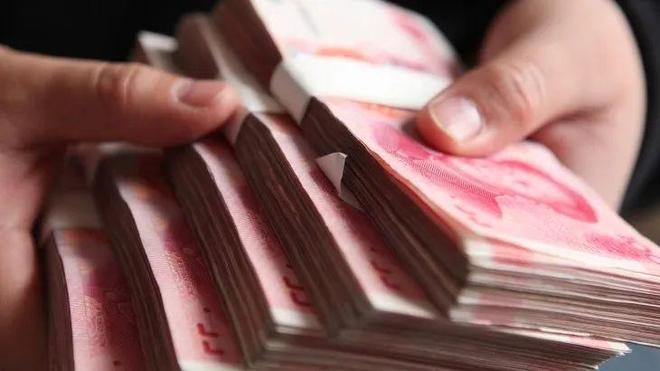
沪市两个多月现金分红近3500亿
Di Yi Cai Jing Zi Xun· 2026-02-05 15:04
2026.02.05 本文字数:1126,阅读时长大约2分钟 作者 |第一财经 黄思瑜 春节前最后几个交易日里,近20家沪市公司将合计发放258亿元春节红包。从2025年12月起至春节前, 沪市合计发放的分红金额合计将突破3476亿元。 在业内看来,银行股在分红节奏和分红频次上的变化,成为"春节前分红"政策落地的一个直观体现,让 投资者更早、更清晰地看到现金回报,无疑是一种对于投资者持股感受的提升与优化。 除了银行业外,还有较多传统行业公司在春节前向投资者发放现金红包,包括长江电力 (600900.SH)、达仁堂(600329.SH)等在内的多家公司将在春节前最后一周内发放现金红包。 其中,长江电力将于2月12日发放2025年中期分红,合计派发超过51亿元。该公司自2016年在国内率先 做出10年期高比例现金分红承诺。根据承诺,2016年至2020年每年每股现金分红不低于0.65元;2021年 至2025年每年现金分红比例不低于当年净利润的70%。近五年,长江电力现金分红金额总计达976.90亿 元。 2月4日晚间,达仁堂也发布了2025年季度权益分派实施公告,将每股派发现金红利2.45元(含税),共 计派发 ...



沪市两个多月现金分红近3500亿
第一财经· 2026-02-05 14:54
Core Viewpoint - The article highlights the significant cash dividends being distributed by companies in the Shanghai stock market, particularly focusing on the banking sector, which is leading the trend of pre-Spring Festival cash distributions to investors [3][4]. Group 1: Cash Dividends Distribution - Nearly 20 companies in the Shanghai market are set to distribute a total of 25.8 billion yuan in cash dividends before the Spring Festival [3]. - From December 2025 to the pre-Spring Festival period, the total cash dividends distributed by the Shanghai market will exceed 347.6 billion yuan, with 321.8 billion yuan already distributed by February 5 [3]. - Industrial Bank is set to distribute over 11.9 billion yuan in cash dividends to A-share investors, with a per-share cash dividend of 0.565 yuan (tax included) [3]. Group 2: Banking Sector Performance - The banking sector is the main contributor to cash distributions, with nine banks, including Industrial Bank, Jiangsu Bank, and China Merchants Bank, announcing a total of nearly 70 billion yuan in cash dividends for the first half of 2025 [3][4]. - China Merchants Bank announced a cash dividend of approximately 25.5 billion yuan (tax included) for A+H shares, with a distribution ratio of 35% [3]. Group 3: Other Industries - Other traditional industries are also participating in cash distributions, with companies like Yangtze Power and Da Ren Tang planning to issue cash dividends before the Spring Festival [4]. - Yangtze Power will distribute over 5.1 billion yuan in cash dividends on February 12, having committed to a high cash dividend ratio since 2016 [4]. - Da Ren Tang announced a cash dividend of 2.45 yuan per share (tax included), totaling 1.887 billion yuan, with a cumulative cash dividend of 5.117 billion yuan since its listing [5]. Group 4: Regulatory Environment and Investor Sentiment - Industry insiders note that the continuous strengthening of cash dividend regulations and disclosure requirements by regulatory authorities is enhancing shareholder return awareness among listed companies [6]. - Investors are increasingly inclined to choose companies that can withstand economic cycles and are willing to consistently return value to shareholders, marking a significant trend in value investing [6].
258亿元春节红包压轴,沪市两个多月现金分红近3500亿
Di Yi Cai Jing Zi Xun· 2026-02-05 12:37
Group 1 - The total cash dividends distributed by nearly 20 companies in the Shanghai market before the Spring Festival will amount to 25.8 billion yuan, with the total dividends expected to exceed 347.6 billion yuan by the end of 2025 [1] - As of February 5, 2025, 321.8 billion yuan has already been distributed, with Industrial Bank set to distribute over 11.9 billion yuan on February 6, 2025, at a rate of 0.565 yuan per share (tax included) [1] - The banking sector is the main contributor to cash distributions before the Spring Festival, with nine banks announcing a total of nearly 70 billion yuan in dividends for the first half of 2025 [1] Group 2 - The change in the dividend rhythm and frequency among bank stocks reflects the implementation of the "pre-Spring Festival dividend" policy, enhancing investor experience by providing clearer cash returns [2] - Traditional companies, including Yangtze Power and Darentang, are also distributing cash dividends before the Spring Festival, with Yangtze Power set to distribute over 5.1 billion yuan on February 12, 2025 [2] - Darentang announced a cash dividend of 2.45 yuan per share, totaling 1.887 billion yuan, with a cumulative cash dividend of 5.117 billion yuan since its listing in 2001 [2] Group 3 - Jianfa Co. announced a cash dividend of 2.00 yuan per 10 shares, totaling approximately 579.9 million yuan, which accounts for 50.49% of its net profit for the first three quarters of 2025 [3] - The continuous strengthening of cash dividend regulations and disclosure requirements by regulatory authorities is enhancing shareholder return awareness among listed companies [3] - Investors are increasingly focusing on companies that can withstand economic cycles while consistently returning value to shareholders, marking a significant path for value investment [3]
沪市主板再添“绿色名片”,林平发展即将登陆资本市场
Zhong Jin Zai Xian· 2026-02-05 05:24
作为工信部认定的"绿色工厂"、国家级专精特新"小巨人"企业,安徽林平循环发展股份有限公司(证券 简称"林平发展",证券代码"603284")已完成申购,即将登陆沪市主板。据公司披露的《发行结果公 告》,此次网上投资者缴款认购的金额达5.67亿元,网下投资者缴款认购的金额达1.42亿元。 林平发展的绿色循环模式,为财务稳健性提供了有力支撑。数据显示,2022年至2024年及2025年1-6 月,公司营业收入分别为28.79亿元、28.00亿元、24.85亿元及12.24亿元;净利润分别为1.54亿元、2.12 亿元、1.53亿元及0.91亿元;扣除非经常性损益后归属于母公司股东的净利润分别为1.28亿元、2.05亿 元、1.66亿元及0.91亿元。整体来看,公司经营基础扎实,盈利能力保持稳定。 为提升综合竞争实力,公司规划通过本次公开发行新股募集资金,用于建设"年产90万吨绿色环保智能 制造新材料项目(二期)"和"年产60万吨生物基纤维绿色智能制造新材料项目"。项目实施后,将推动公司 在瓦楞纸、箱板纸领域实现产能提升与产品升级,进一步满足客户多元化需求,提升产品与服务质量, 发挥规模经济效应,增强组合产品供应能 ...
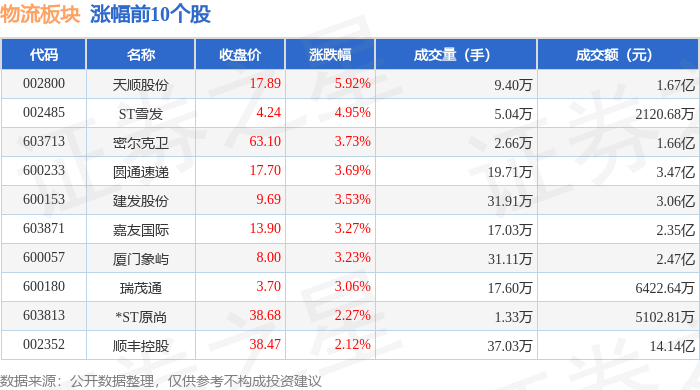
物流板块2月4日涨1.86%,天顺股份领涨,主力资金净流入1.72亿元
Zheng Xing Xing Ye Ri Bao· 2026-02-04 08:56
Core Viewpoint - The logistics sector experienced a rise of 1.86% on February 4, with Tian Shun Co. leading the gains, while the overall market indices also showed positive movement [1]. Group 1: Market Performance - The Shanghai Composite Index closed at 4102.2, up by 0.85% [1]. - The Shenzhen Component Index closed at 14156.27, increasing by 0.21% [1]. Group 2: Top Gainers in Logistics Sector - Tian Shun Co. (002800) closed at 17.89, with a gain of 5.92% and a trading volume of 94,000 shares, amounting to a transaction value of 167 million yuan [1]. - ST Xuefa (002485) closed at 4.24, up by 4.95% with a trading volume of 50,400 shares [1]. - Milkewei (603713) closed at 63.10, increasing by 3.73% with a trading volume of 26,600 shares [1]. - YTO Express (600233) closed at 17.70, up by 3.69% with a trading volume of 197,100 shares [1]. - Jianfa Co. (600153) closed at 69.6, gaining 3.53% with a trading volume of 319,100 shares [1]. Group 3: Fund Flow in Logistics Sector - The logistics sector saw a net inflow of 172 million yuan from institutional investors, while retail investors experienced a net outflow of 70.86 million yuan [2]. - Major stocks like SF Holding (002352) had a net inflow of 165 million yuan from institutional investors, but a net outflow of 16.95 million yuan from retail investors [3]. - Jianfa Co. (600153) had a net inflow of 52.36 million yuan from institutional investors, with a net outflow of 36.65 million yuan from retail investors [3].



申万宏源证券晨会报告-20260204
Shenwan Hongyuan Securities· 2026-02-04 00:43
Core Insights - The report discusses the implementation of the "Tax Law Principle" and its implications for service industries such as internet and finance, indicating that current tax arrangements are unlikely to change significantly in the short term [2][3][12] - The real estate sector is experiencing a favorable shift in financing policies, with REITs and private placements opening new equity financing channels to alleviate financial pressures on real estate companies [3][13] Tax Law Implementation - The State Council approved the "Implementation Regulations of the Value-Added Tax Law of the People's Republic of China" on December 19, 2025, and subsequent announcements have clarified tax details, suggesting stability in tax arrangements for service industries [2][3][12] - The definition of "basic services" in telecommunications is evolving, with mobile data and internet broadband still classified as "value-added services" subject to a 6% VAT rate, while traditional voice services are recognized as "basic services" with a 9% VAT rate [2][3][12] Real Estate Sector Analysis - The financing environment for the real estate industry is improving, with a shift from debt financing to equity financing, including the introduction of REITs and private placements [3][13] - Recent regulatory changes, such as the gradual retreat from the "three red lines" policy, indicate a more supportive financing environment for real estate companies [13] - The report maintains a "positive" rating for the real estate sector, highlighting the potential for recovery in the industry as financing policies become more favorable [3][13] Investment Recommendations - The report recommends several quality real estate companies for investment, including China Jinmao, Poly Developments, and China Resources Land, among others, due to their potential for recovery and attractive valuations [13] - The report emphasizes the importance of monitoring the evolving financing landscape and the impact of government policies on the real estate market [3][13]