Arm

Search documents
美股全线下跌,纳指跌超400点!英伟达市值蒸发超1600亿美元,甲骨文跌超5%,博通跌超4%!美封锁委内瑞拉油轮,原油大涨
Mei Ri Jing Ji Xin Wen· 2025-12-18 00:18
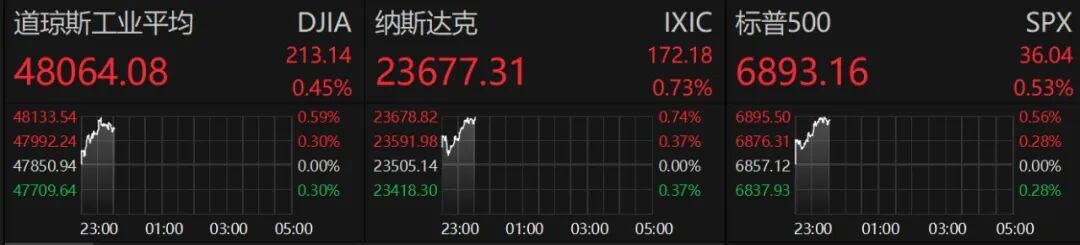
Market Overview - On December 17, US stock indices collectively declined, with the Dow Jones down 0.47%, the Nasdaq falling 418.14 points (1.81%), and the S&P 500 decreasing by 1.16% [1] - Major tech stocks experienced significant drops, including Tesla and Broadcom falling over 4%, Google down over 3%, and Meta and Apple down over 1% [2] Company-Specific Developments - Oracle faced a setback in its ambitious AI infrastructure expansion plan as its largest data center partner, Blue Owl Capital, decided to withdraw support for a $10 billion data center project. However, Oracle stated that negotiations for the project are still proceeding as planned [2] - Nvidia's stock dropped 3.81%, resulting in a market value loss of $164.8 billion (approximately 1160.8 billion RMB) [4] - Medline Inc. had a successful IPO, with shares rising 41.38% on the first day to $41, after pricing at $29, raising $6.26 billion [6][5] Sector Performance - The energy sector saw gains, with ConocoPhillips rising over 4% and ExxonMobil and BP increasing by over 2% [2] - The semiconductor and computer hardware sectors faced significant declines, with companies like AMD and Arm dropping over 5% [2] Geopolitical and Economic Factors - Geopolitical risks, particularly related to Venezuela, have influenced market dynamics, with the price of WTI crude oil increasing by 3% to $56.8 per barrel [7] - The Federal Reserve's stance on interest rates remains cautious, with officials indicating potential for gradual rate cuts amid concerns about the labor market [13]






专家称机器人仍难完成简单的人类动作
财富FORTUNE· 2025-12-16 13:05
2025年12月9日,Skild AI首席执行官迪帕克·帕塔克在旧金山举行的《财富》人工智能头脑风暴大会上发言。图片来 源:Stuart Isett for Fortune 无论是在跑道上奔跑、完成后空翻、随音乐起舞,还是进行踢拳表演,展示人形机器人做出"高难度动 作"的视频越来越多,其表现也愈发惊艳。 然而,在上周二举行的《财富》人工智能头脑风暴大会上,多位嘉宾警告称,不要被这些炫目的动作所 迷惑。一台机器人完成对人类来说都很难的后空翻,确实足够吸睛。但如果让机器人去做爬楼梯、端杯 水这类看似简单的任务,许多当下的机器人仍然很难完成。 红杉资本(Sequoia Capital)合伙人斯蒂芬妮·詹解释说:"看似困难的实则简单,而看似简单的才是真 正的难题。"她转述的是计算机科学家汉斯·莫拉维克的一个经典观察。早在上世纪80年代末,莫拉维克 和其他计算机科学家就注意到,计算机在智力测试中往往表现出色,却无法完成连幼童都能胜任的任 务。 机器人初创公司Skild AI的首席执行官迪帕克·帕塔克解释称,无论是机器人还是计算机,整体而言都擅 长在受控环境中执行复杂任务。他在现场展示了一段Skild机器人在人行道上跳跃 ...

Chiplet,还是软IP?
半导体行业观察· 2025-12-12 01:12
Core Viewpoint - The article discusses the differences between chiplets and soft IP, emphasizing that while both can accelerate time-to-market, they serve different needs and come with distinct challenges in design, integration, and testing [2][20]. Group 1: Chiplet vs Soft IP - Chiplets can be seen as a new type of semiconductor IP, but they differ significantly from the current IP licensing ecosystem, particularly in design integration and verification [2][20]. - Chiplets can be either custom-designed or off-the-shelf, with two camps emerging: one that designs its own chiplets and another that sources components externally [2][20]. - The market for chiplets will coexist with custom chips, with many IP modules becoming off-the-shelf chips that system vendors can mix and match [2][20]. Group 2: Customization and Functionality - The key difference between chiplets and soft IP lies in their customizability; soft IP offers high configurability, while chiplets have fixed functionalities [6][20]. - Chiplets require careful management of startup processes and debugging, which are less of a concern with soft IP [6][20]. - The physical integration of chiplets presents unique challenges, such as managing signal integrity and power distribution, which are not as critical in soft IP [24][20]. Group 3: Testing and Supply Chain - Testing chiplets is more complex than testing soft IP, as chiplets are typically tested independently by suppliers, requiring integration into the overall system testing process [20][20]. - The supply chain for chiplets is more traditional and complex, closely tied to manufacturing nodes and foundries, which increases dependency on suppliers [20][20]. - Built-in self-test (BiST) technology is expected to become more prevalent to address the transparency issues associated with chiplets [22][20]. Group 4: Security and Integration Challenges - Security considerations for chiplets are more challenging than for soft IP, as chiplets have a larger attack surface due to their interconnections and shared resources [20][20]. - Each chip in a multi-chip system must coordinate its security measures, which can lead to inefficiencies if not managed properly [20][20]. - The physical design of chiplets must account for thermal management and signal integrity, requiring advanced modeling tools that go beyond those used for soft IP [24][20].
利空突袭!深夜,暴跌!
券商中国· 2025-12-11 23:27
美东时间12月11日,美股三大指数走势分化,以科技股为主的纳指走低,道指则持续走高,截至收盘,道指大涨1.34%,标普500指数涨0.21%,均创出收盘历史新 高;纳指跌0.25%。 有分析指出,由于甲骨文的财报令投资者对AI投资前景心存疑虑,进而引发了科技股的抛售潮。 其中,甲骨文盘中一度暴跌超16%,截至收盘,跌幅仍达10%,总市值蒸发超688亿美元(约合人民币4900亿元)。 美股市场风格突变! 隔夜美股市场,科技股遭遇猛烈抛售,甲骨文盘中一度暴跌超16%,美股芯片股全线下挫。消息面上,甲骨文最新财报中疲软的云收入和巨额的资本支出计划,重 燃市场对人工智能(AI)投资回报率和债务融资风险的担忧。 资金从科技股流出,涌入对经济和利率更敏感的周期性和价值板块,从而推动道指、标普500指数双双创下历史新高。有分析指出,美股市场仍受益于美联储会议 结果及美联储主席鲍威尔的讲话。鉴于经济与就业仍面临下行压力,预计美联储或将在2026年继续降息。 科技巨头暴跌 | 最高: 201.99 | 今开: 190.62 | 成交量: 1.00亿股 | 换手:3.51% | | --- | --- | --- | --- | ...

Oracle stock plunges 12% on AI jitters — shrinking Larry Ellison's net worth by $34B
New York Post· 2025-12-11 19:32
Company Overview - Oracle's stock experienced a significant decline of over 12%, dropping from approximately $223 to $194 per share, resulting in a loss of $90 billion in market capitalization [1][3][7] - Co-founder Larry Ellison's net worth decreased by nearly $35 billion, falling from $276 billion to $244 billion, which caused him to drop from the second to the third position on the Forbes list of the world's richest individuals [2][5] Financial Concerns - The decline in Oracle's stock triggered a sector-wide selloff in technology stocks, affecting major firms such as Nvidia, AMD, Micron, Broadcom, and Arm, while the Nasdaq index fell by 0.6% [3] - Investors expressed concerns over Oracle's substantial debt, which is reported to be $100 billion, leading to increased purchases of credit-default swaps as a hedge against potential default [4][7] Market Reactions - The rise in credit-default swap prices reached a five-year high, indicating heightened fears regarding Oracle's ability to meet its debt obligations [7] - Despite the negative market reaction, some analysts remain optimistic about Oracle's future, highlighting the $523 billion in business that the company has committed to but has yet to deliver [10]
高通官宣:收购RISC-V芯片公司
半导体行业观察· 2025-12-11 01:23
Core Viewpoint - Qualcomm's acquisition of Ventana Micro Systems demonstrates its commitment to advancing the RISC-V standard and ecosystem, enhancing its CPU capabilities and solidifying its leadership in various business areas during the AI era [2][4]. Group 1: Acquisition Details - Qualcomm has acquired Ventana Micro Systems, integrating its expertise in RISC-V instruction set architecture (ISA) development to bolster Qualcomm's CPU strength [2][3]. - The acquisition allows Qualcomm to complement its ongoing RISC-V and custom Oryon CPU development, aiming to innovate in energy efficiency and performance [3][5]. - Ventana, established in 2018, has developed several generations of high-performance RISC-V CPU designs primarily targeting data center and enterprise applications [3][5]. Group 2: Technical Specifications - Ventana's Veyron V2 chipset design can support up to 32 RISC-V RVA23 compatible CPU cores, with a maximum clock speed of 3.85 GHz and up to 1.5 MB of L2 cache per core, sharing 128 MB of L3 cache [5][6]. - Each core features a 512-bit vector unit based on the RVV 1.0 specification and a custom matrix computation accelerator for AI and machine learning applications, achieving 0.5 TOPS (INT8) per core per GHz [5][6]. Group 3: Future Prospects - Ventana's next-generation Veyron V3 chip design is expected to achieve higher clock speeds of up to 4.2 GHz and enhanced matrix math units supporting FP8 data types [6]. - Qualcomm has not disclosed when it will launch chips based on Ventana's RISC-V IP, but it aims to re-enter the data center CPU market after previous attempts with Arm architecture [6][7]. - The ongoing legal disputes with Arm may lead Qualcomm to further explore RISC-V as a viable alternative if relations deteriorate [7].

深夜美股全线拉升,中国资产,爆发
Zheng Quan Shi Bao· 2025-12-05 23:57
Economic Indicators - The US core PCE price index rose by 0.2% month-on-month in September, aligning with expectations. Year-on-year, it increased by 2.8%, slightly below the expected 2.9% and the previous value of 2.9% [1] - Personal spending in the US increased by 0.3% month-on-month in September, matching expectations, while the previous value was revised down from 0.6% to 0.5% [1] Gold Market - Spot gold prices briefly surpassed $4240 per ounce, with an intraday increase of nearly 1%. The World Gold Council indicated that the market generally expects the upward trend in gold prices to continue, although uncertainties remain high [2] Technology Sector - Arm's stock rose over 2% following an agreement with the South Korean Ministry of Trade, Industry and Energy to train approximately 1400 advanced chip design experts, enhancing South Korea's system-on-chip (SoC) capabilities [4] - Netflix's stock fell nearly 1% as the company announced plans to acquire Warner Bros. Discovery for approximately $827 billion in total enterprise value, maintaining the existing operational model of Warner Bros. [4] - Micron Technology's stock increased by over 3% after the company announced its exit from the consumer business to focus on advanced storage chips for the AI era [4] - SanDisk's stock rose over 1% amid a significant price increase in the storage industry, with SanDisk raising NAND flash contract prices by about 50% in early November [4] AI and Cloud Services - Google's stock rose over 1% after announcing a multi-year partnership with AI programming startup Replit, aiming to enhance its cloud services and challenge competitors in the AI coding market [5] - Baidu's stock increased by nearly 4% as reports highlighted its development of a comprehensive AI stack, including proprietary AI chips and advanced cloud services [7] Automotive Sector - XPeng Motors' stock rose nearly 3% following the launch of a collaboration for a flying car project in Guangzhou [7] - Hesai Technology's stock increased by nearly 3% after the release of a new high-performance intelligent control chip and a safety laser radar update [7]
英伟达(NVDA.US)“现金帝国”浮现:黄仁勋打造AI生态防火墙 未来将用战略投资取代大型并购
智通财经网· 2025-12-05 01:17
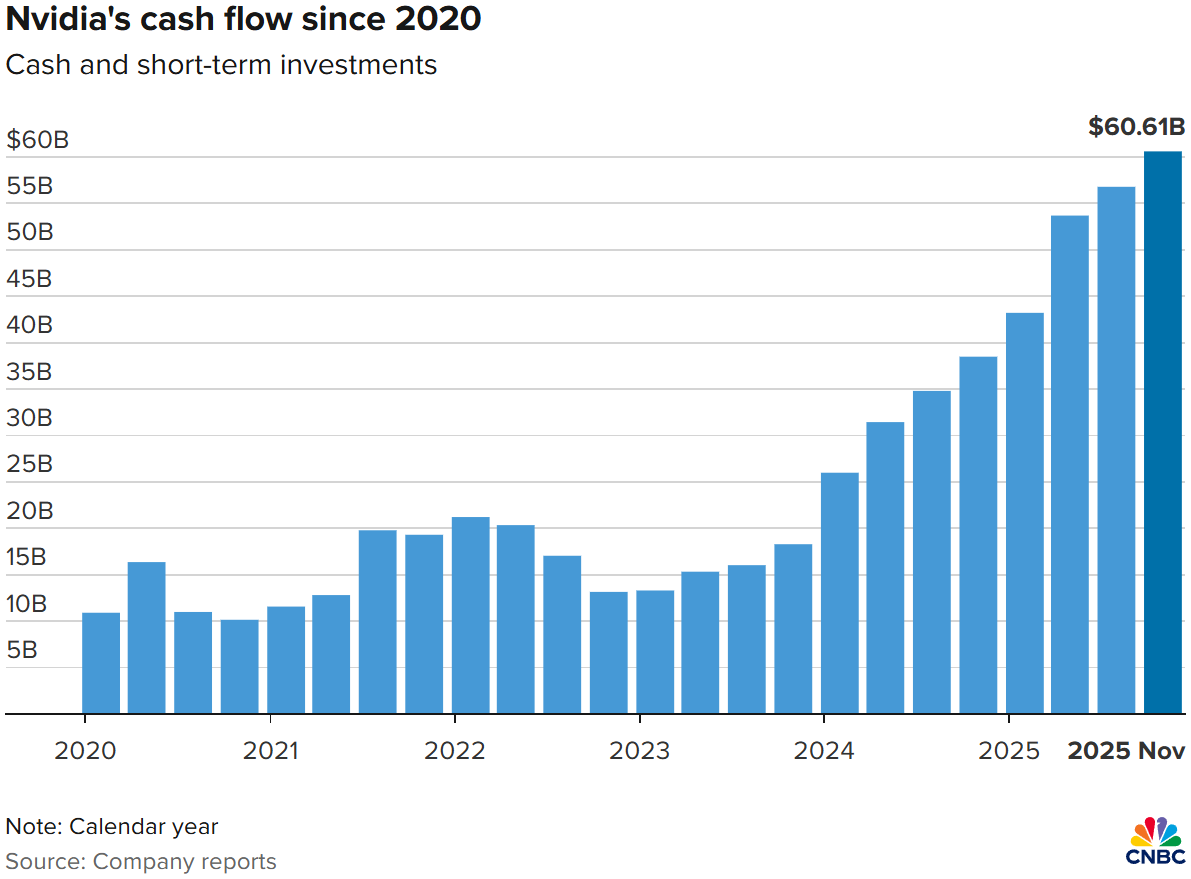
Core Viewpoint - Nvidia is making significant investments in various companies, totaling $18 billion in commitments this year alone, with a focus on enhancing its position in the AI and semiconductor sectors [1][2]. Group 1: Investment Activities - Nvidia announced a $2 billion investment in Synopsys, part of a series of large-scale investments including $1 billion in Nokia, $5 billion in Intel, and $10 billion in Anthropic, totaling $18 billion in commitments [1]. - The company has also committed to investing $100 billion in acquiring shares of OpenAI over the coming years, although a final agreement has not yet been reached [1]. - Nvidia's cash reserves have significantly increased to $60.6 billion as of the end of October, up from $13.3 billion in January 2023, largely due to the success of its chips following the launch of ChatGPT [1]. Group 2: Cash Flow and Share Buybacks - Nvidia is projected to generate $96.85 billion in free cash flow this year, with a total of $576 billion over the next three years [2]. - Analysts expect Nvidia to utilize a portion of its cash for stock buybacks, with the board having authorized an additional $60 billion for this purpose [2]. - The company has already spent $37 billion on stock buybacks and dividends in the first three quarters of the year [2]. Group 3: Strategic Focus and Future Plans - CEO Jensen Huang emphasized the importance of maintaining a strong balance sheet to ensure confidence among customers and suppliers regarding future order fulfillment [3]. - The CFO stated that the primary goal is to ensure sufficient cash is available for timely delivery of next-generation products, particularly in light of demands from major suppliers like Foxconn and Dell [3]. - Huang described strategic investments as crucial for driving additional consumption of Nvidia's chips, particularly as companies like OpenAI grow [3]. Group 4: Historical Context and Acquisition Strategy - Since 2020, Nvidia has seen a substantial increase in cash flow, with investments in private companies totaling $8.2 billion, which have replaced large-scale acquisitions [7]. - The acquisition of Mellanox for $7 billion in 2020 was Nvidia's largest acquisition, laying the groundwork for its current AI server products [7]. - Nvidia faced regulatory challenges in its attempt to acquire Arm for $40 billion, leading to the termination of the deal, and has not completed any large-scale acquisitions since then [7].
英伟达“现金帝国”浮现:黄仁勋打造AI生态防火墙 未来将用战略投资取代大型并购
Jin Rong Jie· 2025-12-05 01:12
尽管涉及巨额资金和众多交易,但英伟达拥有足以开出大额支票的现金储备。截至 10 月底,英伟达拥 有 606 亿美元现金及短期投资。这一数字较 2023 年 1 月的 133 亿美元大幅增长,当时正值 OpenAI 发 布 ChatGPT 不久。三年前 ChatGPT 的发布,是推动英伟达芯片成为最具价值科技产品的关键因素。 随着英伟达从游戏技术制造商转型为美国市值最高的公司,其资产负债表已固若金汤,投资者也越来越 好奇公司将如何运用其巨额现金。 在上个月的财报电话会议上,当被问及公司计划如何运用现金时,首席执行官黄仁勋表示:"没有公司 曾实现我们正在谈论的这种规模的增长。" 根据 FactSet 对分析师的调查,预计该公司今年将产生 968.5 亿美元自由现金流,未来三年自由现金流 总额将达 5760 亿美元。 智通财经APP注意到,本周,英伟达(NVDA.US)宣布将斥资 20 亿美元入股芯片设计公司 Synopsys,这 只是这家芯片制造商今年宣布的一系列大规模投资中的最新一例。 英伟达还表示将投资 10 亿美元入股诺基亚、向英特尔投资 50 亿美元、向 Anthropic 投资 100 亿美元 ——仅这 ...
Nvidia has a cash problem -- too much of it
CNBC· 2025-12-04 12:00
Core Insights - Nvidia has announced significant investments totaling $18 billion in various companies, including a $2 billion stake in Synopsys, a $1 billion stake in Nokia, a $5 billion investment in Intel, and a $10 billion investment in Anthropic, alongside a potential $100 billion commitment to acquire OpenAI shares over several years [1][2][3] Financial Position - As of the end of October, Nvidia holds $60.6 billion in cash and short-term investments, a substantial increase from $13.3 billion in January 2023, following the launch of ChatGPT [3][4] - Analysts project Nvidia will generate $96.85 billion in free cash flow this year and $576 billion over the next three years, with some suggesting the company should allocate more cash for share repurchases [5][6] Share Repurchase Strategy - Nvidia's board increased its share repurchase authorization by $60 billion in August, with $37 billion spent on share repurchases and dividends in the first three quarters of the year [6][7] - The company plans to continue stock buybacks, leveraging its strong balance sheet to instill confidence among customers and suppliers [6][7] Strategic Investments - Nvidia's CEO emphasized the importance of strategic investments in driving AI consumption and expanding the ecosystem of its products, particularly Cuda [8] - The company has made $8.2 billion in investments in private companies, which have replaced traditional acquisitions, with the largest acquisition being the $7 billion purchase of Mellanox in 2020 [9][10] Regulatory Challenges - Nvidia faced regulatory hurdles when attempting to acquire Arm for $40 billion in 2020, leading to the deal's cancellation due to competition concerns [10][11] - The company has not completed any significant multi-billion acquisitions since the failed Arm deal, with the CFO noting that large M&A opportunities are currently limited [11]