
Energy Fuels

Search documents
美国正式公布新版关键矿产清单:首次纳入铜,银铀钾肥也入列
Hua Er Jie Jian Wen· 2025-11-07 00:00
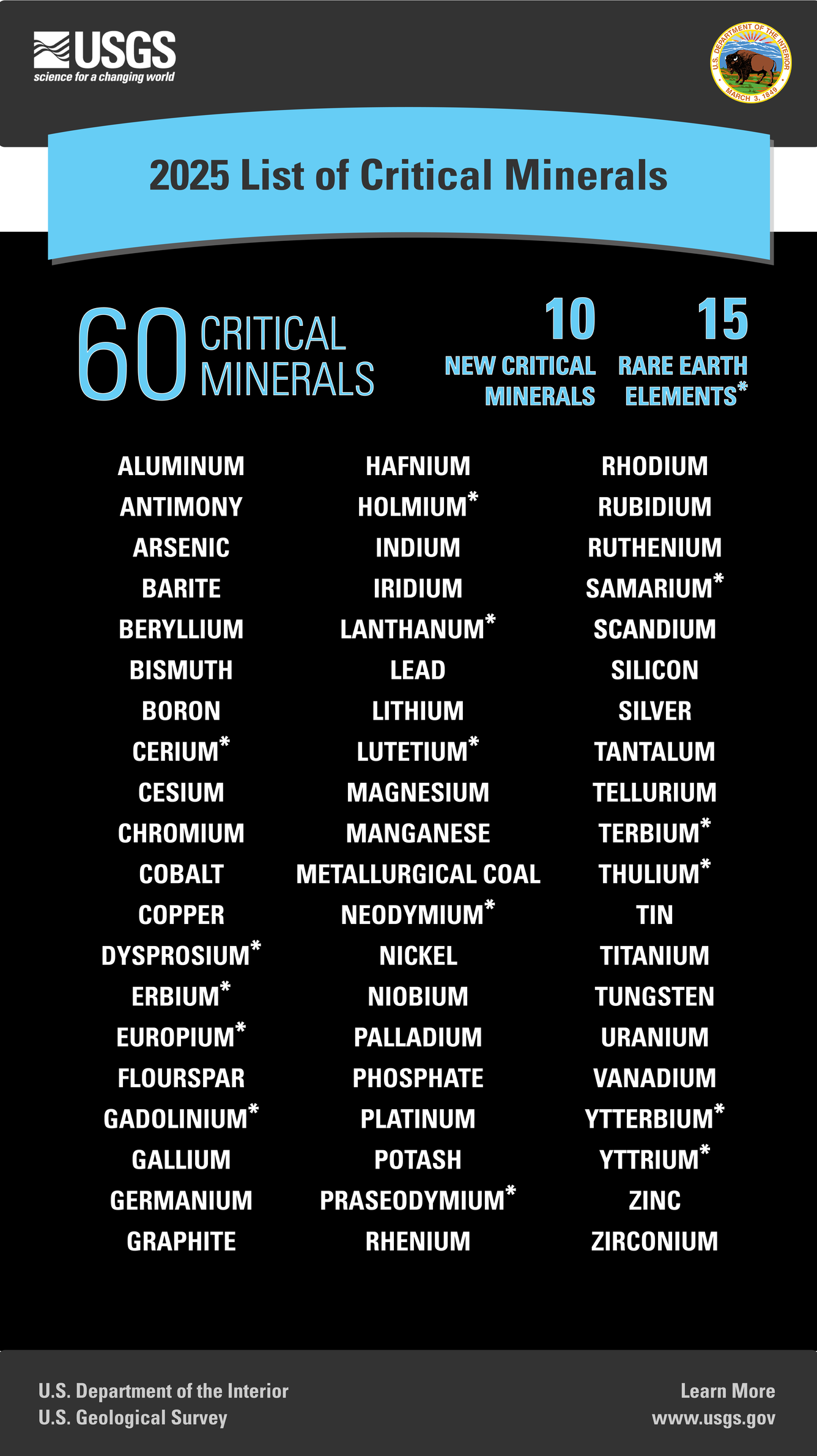
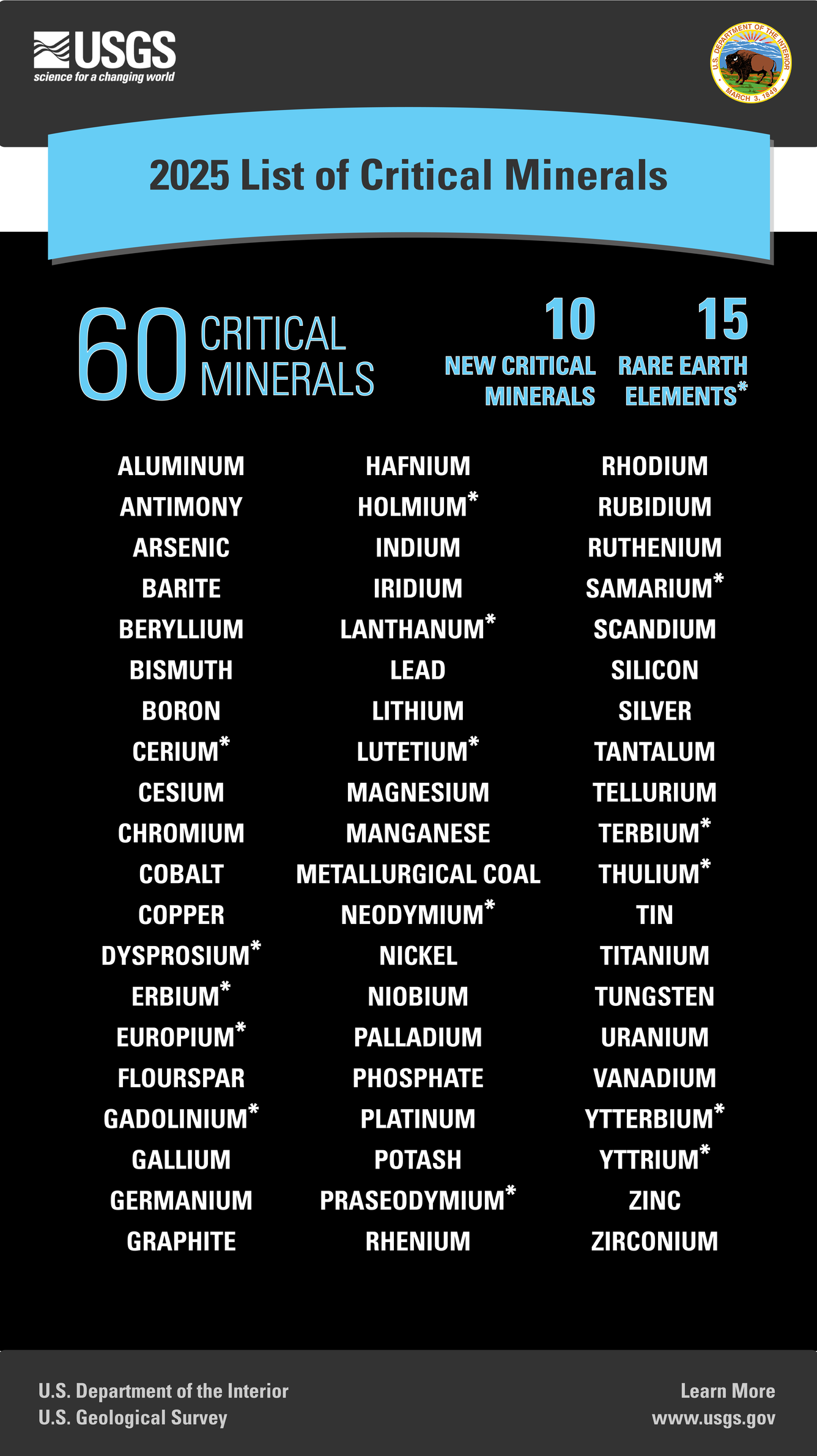
Core Points - The U.S. government has made its largest adjustment to the critical minerals list since its inception, directly impacting the Section 232 investigation announced by the Trump administration in April, which may lead to tariffs and trade restrictions on related products [1] - The updated list now includes copper, uranium, silver, metallurgical coal, potash, rhenium, silicon, and lead, marking a significant change from the 2022 version [1] - This adjustment aims to reduce U.S. reliance on imports and expand domestic production, as stated by U.S. Secretary of the Interior Doug Burgum [1] Group 1 - The inclusion of copper and potash addresses supply chain risks, with copper being crucial for electrification, defense, and clean energy [4][5] - The U.S. imports nearly half of its copper consumption, primarily from Chile, Peru, and Canada, while most global copper refining capacity is concentrated in China [5] - Potash, used mainly for fertilizer production, is largely imported from Canada, with 80% of U.S. usage coming from there [5] Group 2 - The addition of silver has raised concerns among precious metal traders and manufacturers reliant on the material, as the U.S. heavily depends on imports to meet domestic silver demand [6] - Silver's inclusion is a response to potential supply disruptions from Mexico, with the U.S. Geological Survey (USGS) categorizing minerals by risk levels for the first time [6] - The new assessment method considers economic consequences of supply shocks and highlights vulnerabilities from reliance on single domestic producers [6] Group 3 - Metallurgical coal and uranium were added to the final list despite not being included in the draft published in August, indicating a comprehensive evaluation process [7] - Metallurgical coal is essential for steel production, while uranium serves as fuel for nuclear power plants [7] - The USGS removed arsenic and tellurium from the critical minerals list due to decreased supply disruption risks and increased domestic production [7]

Should You Buy, Hold or Sell UUUU Stock Post Q3 Earnings?
ZACKS· 2025-11-06 18:11
Core Insights - Energy Fuels (UUUU) reported a net loss of $0.07 per share for Q3 2025, matching the previous year's loss but beating expectations, while revenues surged 337.6% year over year to $17.7 million driven by increased uranium sales [1][9]. Revenue Performance - Total revenues reached $17.7 million, a significant increase of 337.6% year over year, primarily due to higher uranium sales volumes despite a decline in prices [2][9]. - The company sold 240,000 pounds of uranium at an average price of $72.38 per pound, generating $17.37 million in uranium revenues, compared to 50,000 pounds sold at $80.00 per pound in the same quarter last year [3][9]. Cost Analysis - Costs applicable to revenues increased by 592% to $12.78 million, attributed to higher uranium sold at elevated costs [4]. - Exploration, development, and processing expenses rose 244% year over year to $12.4 million due to increased indirect processing costs and higher headcount [4][5]. - Standby costs increased by 53% to $2.5 million, while selling, general, and administrative expenses rose 109% to $12.6 million due to higher salaries and benefits [5][6]. Operational Highlights - During the quarter, the company mined approximately 465,000 pounds of uranium from its various mines, with the Pinyon Plain Mine showing strong results [7]. - Energy Fuels produced its first kilogram of dysprosium oxide at 99.9% purity, marking progress in Rare Earth Elements (REE) production [7][8]. Future Outlook - The company plans to mine 55,000-80,000 tons of ore containing approximately 875,000-1,435,000 pounds of uranium in 2025, with a target of processing up to 1 million pounds this year [14]. - UUUU expects to lower uranium costs starting in Q4 2025, with projected costs of $23–$30 per pound, positioning it among the lowest-cost producers globally [16][17]. - The consensus estimate for 2026 indicates a revenue increase of 227% to $133.55 million, with expectations of achieving profitability for the first time since its NYSE listing [18][19]. Market Position - UUUU shares have increased by 215.9% year to date, outperforming the industry and broader market indices [21][22]. - The company's current forward price-to-sales ratio of 31.27 is significantly higher than the industry average of 3.47, indicating a stretched valuation [24]. Industry Context - Uranium prices have fluctuated, starting the year around $69 per pound and reaching $83 in September before easing to $80, influenced by supply concerns and production adjustments from major players [25][27]. - The long-term outlook for uranium remains strong due to the push for clean energy and supply chain independence from China, providing growth opportunities for UUUU [28].


美国正式公布新版关键矿产清单,首次纳入铜,银铀钾肥也入列
Hua Er Jie Jian Wen· 2025-11-06 16:19
Core Viewpoint - The U.S. government has made its largest adjustment to the critical minerals list since its inception, directly impacting the Section 232 investigation announced by the Trump administration, which may lead to tariffs and trade restrictions on related products [1]. Group 1: Key Minerals Added - Copper has been added to the critical minerals list for the first time, marking a significant change since the list was first published in 2018 [1]. - The updated list also includes uranium, silver, metallurgical coal, potash, rhenium, silicon, and lead, replacing the 2022 version [1]. - The inclusion of these minerals aims to reduce U.S. dependence on imports and expand domestic production [1]. Group 2: Market Reactions - Following the announcement of the new critical minerals list, copper ETFs rose approximately 2%, while Southern Copper Corporation increased by 1.6%. In contrast, Freeport and McEwen saw declines of 1.2% and 1.9%, respectively [4]. - The decision on the critical minerals list will influence mining investments, recycling of mining waste, tax incentives for mineral processing, and mining permit approval processes [4]. Group 3: Strategic Importance of Copper and Potash - Copper is recognized for its strategic importance due to its applications in transportation, defense, and power network construction, especially as demand for electricity rises with the growth of data centers and artificial intelligence [5]. - The U.S. imports nearly half of its copper consumption, primarily from Chile, Peru, and Canada, with most global refining capacity concentrated in China [5]. - Potash, primarily used in fertilizer production, has been included due to potential trade barriers from major supplying countries, with about 80% of U.S. potash imports coming from Canada [5]. Group 4: Concerns Over Silver - The addition of silver to the critical minerals list has raised concerns among precious metal traders and manufacturers reliant on the material, as the U.S. heavily depends on imports to meet domestic silver demand [6]. - Silver is widely used in electronics, solar panels, and medical devices, and any tariffs on silver could significantly impact the metal market [6]. Group 5: New Assessment Methods - A new assessment method has been introduced to evaluate the economic consequences of supply shocks and highlight vulnerabilities associated with reliance on single domestic producers [7]. - The updated list includes metallurgical coal and uranium, which were not part of the draft published in August, indicating a comprehensive evaluation process [7]. - Arsenic and tellurium have been removed from the critical minerals list due to changes in domestic production and supply risk assessments [7].
Energy Fuels' Growth Story: From Uranium to REEs
ZACKS· 2025-11-06 01:36
Company Overview - Energy Fuels is a US-based uranium miner and processor, uniquely positioned as the only US conventional uranium mill with a fully licensed mill at its White Mesa Mill in Utah [1] - The company is expanding into rare earth elements (REEs) and other critical minerals projects [1] Industry Trends - The demand for nuclear energy is rising due to the increasing energy needs of data centers, which have seen load growth triple over the past decade and are projected to double or triple by 2028 [2] - Nuclear energy is recognized as a clean, reliable, and cost-effective energy source, with government support aimed at removing regulatory barriers to accelerate nuclear energy development [3] Rare Earth Elements - The trade dynamics between the US and China regarding rare earth elements are significant, with the US likely to pursue decoupling from China to secure REEs essential for modern products [4] Technical Analysis - UUUU shares are approaching the rising 50-day moving average, indicating an attractive reward-to-risk scenario [5] Strategic Positioning - Energy Fuels has a strategic advantage in US uranium mining, with the dual benefit of rising nuclear demand and diversification into REE expansion [6] Conclusion - Energy Fuels is positioned at the intersection of two major trends: the growing demand for clean nuclear power to support AI data centers and the geopolitical drive to secure rare earth elements [8]

Energy Fuels Inc. (AMEX: UUUU) Surpasses Earnings and Revenue Expectations
Financial Modeling Prep· 2025-11-05 03:04
Core Insights - Energy Fuels Inc. is a leading U.S. company in uranium and rare earth elements production, focusing on low-cost mining operations and expanding into rare earth production [1] Financial Performance - For Q3 2025, the company reported an EPS of -$0.07, better than the estimated -$0.08, with revenues of $17.71 million, exceeding expectations of $13.67 million and significantly up from $4.04 million in the same period last year [2][6] - The increase in revenue is attributed to a rise in uranium sales and successful low-cost mining operations, alongside the completion of a rare earth pilot production yielding 29 kilograms of dysprosium oxide [3] Strategic Financial Moves - Energy Fuels completed a $700 million convertible senior notes offering, enhancing its working capital to nearly $1 billion, which strengthens its liquidity position with a current ratio of about 11.50 [4][6] - Despite a negative P/E ratio of approximately -34.87, the company maintains a strong liquidity position, with a price-to-sales ratio of about 49.66, indicating investor confidence [5]
财经观察:美国谋划关键矿产交易俱乐部
Huan Qiu Shi Bao· 2025-11-04 22:53
Core Viewpoint - The U.S. is forming a "Critical Minerals Trading Club" with multiple countries to restructure supply chains and reduce dependence on foreign sources, aiming to dominate the AI and green industries. However, challenges such as technology, costs, and internal member interests may hinder this initiative, while some countries face risks of overheating investments in critical mineral assets [1][2][4]. Group 1: Formation of the Trading Club - The U.S. plans to create a "Critical Minerals Trading Club" as a core platform for Western countries to engage in critical mineral refining and processing trade, with the ultimate goal of leading the AI competition [2][4]. - The club has already begun formation with participation from Japan, South Korea, Malaysia, Australia, and Thailand [2]. Group 2: Energy Security and Policy Implications - Energy security is deemed crucial for the U.S. to maintain its global influence, with critical minerals being essential for AI production [4]. - The U.S. Treasury announced a "Mineral Security Partnership Financing Network" involving over ten countries, managing assets exceeding $30 trillion to support mineral trade projects [4]. Group 3: Market Dynamics and Investment Trends - The global trade of rare earths is experiencing significant growth, with a projected 67% increase in U.S.-Australia rare earth trade in 2024 and a 52% rise in intra-EU rare earth semi-finished product transactions [8]. - U.S. stocks related to lithium and rare earths have surged, with some companies seeing stock price increases of over 300% this year [9][10]. Group 4: Geopolitical Context and Challenges - The U.S. aims to establish a supply chain independent of China, which currently dominates the rare earth market with over 90% of global refining capacity [5][12]. - There are discrepancies in the objectives of participating countries in the trading club, with the U.S. seeking rule-making power, while resource-rich countries like Australia and Canada aim to increase mineral prices and exports [12]. Group 5: Future Outlook and Risks - Experts warn of potential overheating in the critical minerals market, drawing parallels to past resource booms, indicating that many companies may not succeed in this sector [11]. - The transition to a more sustainable and independent supply chain is expected to be long and costly, with significant challenges ahead [11][12].
Energy Fuels, Inc. (AMEX: UUUU) Quarterly Earnings Overview
Financial Modeling Prep· 2025-11-04 22:00
Core Insights - Energy Fuels, Inc. reported a quarterly loss of seven cents per share, slightly missing the Street estimate of a six-cent loss, but exceeded revenue expectations with $17.71 million, significantly higher than the consensus estimate of $8.9 million and up from $4.04 million in the same period last year [1][5] Financial Performance - The company completed a $700 million convertible senior notes offering, increasing its working capital to nearly $1 billion, which helps mitigate potential shareholder dilution while providing funds for growth initiatives [3] - Despite a negative price-to-earnings (P/E) ratio of -41.85, Energy Fuels maintains a strong liquidity position with a current ratio of 8.10, indicating ample short-term assets to cover its short-term liabilities [4][5] - The negative earnings yield of -2.39% reflects ongoing profitability issues and challenges in generating positive cash flow from operations [4] Operational Achievements - Energy Fuels has achieved increased uranium sales and successful pilot production of heavy rare earth elements, producing 29 kilograms of dysprosium oxide and planning to produce terbium oxide soon [2][5]
Energy Fuels(UUUU) - 2025 Q3 - Earnings Call Transcript
2025-11-04 17:02
Financial Data and Key Metrics Changes - The company reported increased sales and revenues, with a net loss of $16.7 million in Q3 compared to a net loss of $21.8 million in Q2 [27] - Working capital at the end of Q3 was approximately $300 million, with expectations to reach between $900 million and $1 billion by year-end [27][28] - The company completed a $700 million convertible note offering, which was oversubscribed by more than seven times, with a low coupon rate of 0.75% [25][26] Business Line Data and Key Metrics Changes - Uranium production is ramping up, with expectations to produce between 1.1 million lbs and 1.4 million lbs in Q1 2026, and a target of over 2 million lbs per year at the Pinyon Plain Mine by 2026 [9][10] - The company sold 240,000 lbs of uranium at a realized price of $72.38 per pound in Q3, with a gross margin of 26% [28] - Rare earth production is advancing, with plans for commercial production of heavy rare earths expected later in 2026 [14][15] Market Data and Key Metrics Changes - NdPr prices outside of China increased by 13% as of September 2025, with significant premiums for dysprosium and terbium in the European Union [17][18] - The company is positioned to benefit from the growing demand for critical minerals, particularly in the U.S. market [3][4] Company Strategy and Development Direction - The company aims to maintain its status as the largest uranium miner and processor in the U.S., while also expanding its rare earth and heavy mineral sands operations [30][34] - The Donald Project in Australia is shovel-ready, with a final investment decision expected as early as Q1 2026 [16][17] - The company is exploring various opportunities for acquisitions and partnerships to enhance its position in the critical minerals market [68][70] Management's Comments on Operating Environment and Future Outlook - Management expressed confidence in the company's ability to deliver on its promises and capitalize on its unique position in the critical minerals sector [2][4] - The company is optimistic about improving gross margins in 2026 due to increased uranium production and lower costs [2][29] - Management is actively engaging with potential off-takers and exploring financing options for future projects [39][40] Other Important Information - The company has received all government approvals for the Donald Joint Venture project and has a conditional letter of support for project financing [3][17] - The Toliara heavy mineral sands project is considered one of the best undeveloped deposits globally, with plans for an updated feasibility study by the end of 2025 [19][20] Q&A Session Summary Question: Regarding the Donald Project and its timeline - Management indicated that the project is ready to go and is exploring options with potential off-takers to maximize value [38][39] Question: Clarification on preliminary guidance for uranium sales - The range in guidance reflects flexibility in contract elections, allowing for adjustments based on market conditions [41][42] Question: On the rare earth separation plant's economics - Management expects feasibility studies to be completed by the end of the year, providing necessary data for economic assessments [50][51] Question: Future uranium production guidance - The company is cautious in providing long-term guidance due to the dual processing of uranium and rare earths at the White Mesa Mill [54][55] Question: Long-term contracting philosophy for uranium - Management aims for a balanced approach, targeting around 50% of production capacity for term contracts while remaining flexible with spot market exposure [82]
Energy Fuels(UUUU) - 2025 Q3 - Earnings Call Transcript
2025-11-04 17:02
Financial Data and Key Metrics Changes - The company reported increased sales and revenues, with a net loss of $16.7 million in Q3 compared to a net loss of $21.8 million in Q2 [28] - Working capital at the end of Q3 was approximately $300 million, with expectations to reach between $900 million to $1 billion by year-end [30] - The company completed a $700 million convertible note offering, which was oversubscribed by more than seven times, with a low coupon rate of 0.75% [26][27] Business Line Data and Key Metrics Changes - Uranium production is ramping up, with expectations to produce between 1.1-1.4 million pounds in Q1 2026, and over 2 million pounds per year at the Pinyon Plain Mine in 2026 [9][10] - The company sold 240,000 pounds of uranium at a realized price of $72.38 per pound in Q3, with a gross margin of 26% [30] - The rare earth segment is progressing, with nearly 30 kilograms of DY oxide produced and plans for commercial production of heavies expected in 2026 [14][15] Market Data and Key Metrics Changes - The prices for rare earth oxides outside of China have increased, with NdPr prices rising 13% over September 2025 [17] - The company is positioned to benefit from increasing demand for non-China sourced materials, particularly in the U.S. market [80] Company Strategy and Development Direction - The company aims to retain its status as the largest uranium miner and processor in the U.S., while also expanding its rare earth and heavy mineral sands operations [32] - The Donald project in Australia is shovel-ready, with a final investment decision expected in Q1 2026, and is seen as a significant source of heavy rare earth oxides [16][17] - The company is exploring various opportunities for acquisitions and partnerships to enhance its position in the critical minerals market [72][73] Management's Comments on Operating Environment and Future Outlook - Management expressed confidence in the company's ability to deliver on its promises and capitalize on its advantages in critical minerals [2][4] - The company is optimistic about the future of uranium prices and production margins, expecting to improve gross margins to approximately 50% or above [31][34] - Management is actively engaging with potential off-takers for the Donald project and is assessing market conditions for strategic decisions [42][43] Other Important Information - The company has received all government approvals for the Donald Joint Venture project and has secured conditional support for project financing [3][17] - The Toliara project in Madagascar is considered a company maker, with plans for an updated feasibility study by the end of 2025 [19][20] Q&A Session Summary Question: Why is the company not moving forward with the Donald project despite having the necessary approvals and funding? - Management is exploring options with potential off-takers and assessing market conditions to make the best informed decision [41][42] Question: What is the reason for the range in long-term uranium sales contracts guidance? - The range reflects the flexibility in contract elections, allowing for adjustments based on market conditions [44][48] Question: When will the company provide IRR or NPV numbers for the rare earth separation plant? - Feasibility studies are expected to be completed by the end of the year, providing necessary financial metrics [54][55] Question: What is the company's long-term contracting philosophy for uranium? - The company aims for a balanced approach, targeting around 50% of production for long-term contracts while remaining cautious about spot market exposure [84]
Energy Fuels(UUUU) - 2025 Q3 - Earnings Call Transcript
2025-11-04 17:00
Financial Data and Key Metrics Changes - The company reported an improved net loss of $16.7 million for Q3 2025, compared to a net loss of $21.8 million in Q2 2025 [27] - Total assets at the end of the quarter were $750 million, with working capital approximately $300 million, including $235 million in cash and marketable securities [27] - The company expects working capital to reach between $900 million to $1 billion by the end of the year [27] Business Line Data and Key Metrics Changes - Uranium production increased, with the company mining approximately 415,000 lbs of uranium at an average grade of 1.27% in Q3 2025 [9] - The company expects to produce between 1.1-1.4 million lbs of uranium in Q1 2026, with a target of over 2 million lbs per year at the Pinyon Plain Mine in 2026 [10][11] - The rare earth segment is progressing, with nearly 30 kilograms of DY oxide produced at 99.9% purity through September 2025 [13] Market Data and Key Metrics Changes - The prices for rare earth oxides, particularly outside of China, have increased, with NdPr prices rising 13% over September 2025 [18] - The company anticipates significant demand for non-China sourced materials, particularly from the Donald project in Australia [36] Company Strategy and Development Direction - The company aims to maintain its position as the largest uranium producer in the U.S. while expanding its rare earth and heavy mineral sands operations [30] - The Donald project is expected to make a final investment decision (FID) as early as Q1 2026, with significant government support and financing [17][36] - The company is focused on integrating its operations across uranium, rare earths, and heavy mineral sands to capitalize on market opportunities [6][47] Management's Comments on Operating Environment and Future Outlook - Management expressed confidence in the company's ability to deliver on its promises and capitalize on the growing demand for critical minerals [2] - The management highlighted the importance of strategic partnerships and government interest in securing U.S. processed materials [52][53] - The company is optimistic about improving margins and production capabilities in the coming years [30][29] Other Important Information - The company completed a $700 million convertible note offering, which was oversubscribed and will be used for project expansions [25][26] - The White Mesa Mill is being expanded to double its capacity, allowing for simultaneous processing of uranium and rare earths [26] Q&A Session Summary Question: Regarding the Donald project and its timeline - Management indicated that the project is ready to go and is exploring options with potential off-takers to maximize value [36][38] Question: Clarification on preliminary guidance for uranium sales - The delta in sales guidance is due to the flexibility in contracts, allowing for adjustments based on market conditions [39] Question: Inquiry about the rare earth separation plant's financial metrics - Management stated that feasibility studies are underway, and updated financial metrics will be provided by the end of the year [40][41] Question: Discussion on uranium production guidance - The company is managing production between uranium and rare earth processing, with plans to stockpile unprocessed material for future use [42] Question: Long-term contracting philosophy for uranium - Management aims for a balanced approach, targeting around 50% of production for long-term contracts while remaining flexible to market conditions [55]