
宁波银行

Search documents
双融日报-20260105
Huaxin Securities· 2026-01-05 01:25
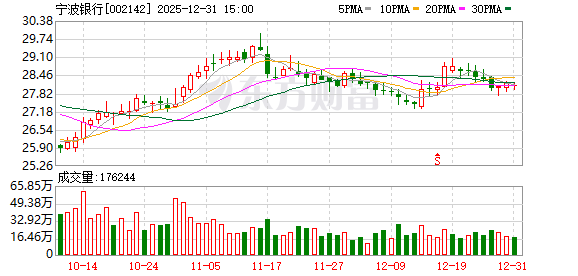
Core Insights - The report indicates that the current market sentiment is rated at 61, categorized as "relatively hot," suggesting a strong investor confidence in the market [2][10] - Key themes identified include robotics, banking, and brokerage sectors, with significant developments and investment opportunities highlighted in each area [6] Group 1: Robotics Sector - The establishment of a national standard organization for humanoid robots and embodied intelligence on December 26, 2025, marks a transition from "technical exploration" to "industrial collaboration" and "scale implementation," which is expected to accelerate technology deployment and ecosystem formation [6] - Related investment opportunities include companies such as Sanhua Intelligent Control (002050) and Wolong Electric Drive (600580) [6] Group 2: Banking Sector - Banking stocks are characterized by high dividend yields, with the China Securities Banking Index yielding 6.02%, significantly higher than the 10-year government bond yield, making them attractive for long-term investors like insurance and social security funds [6] - Notable banking stocks include Agricultural Bank of China (601288) and Ningbo Bank (002142) [6] Group 3: Brokerage Sector - The China Securities Regulatory Commission's chairman emphasized on December 6 the need for differentiated regulation, which aims to support high-quality institutions while limiting weaker ones, thus enhancing capital efficiency [6] - The focus is shifting from mere scale and growth to high-quality development, with recommendations for brokerage firms to differentiate their operations [6] - Relevant brokerage stocks include CITIC Securities (600030) and Guotai Junan Securities (601211) [6]






货币市场日报:1月4日
Xin Hua Cai Jing· 2026-01-04 12:36
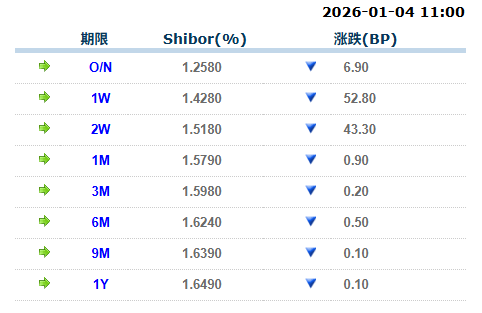
Group 1 - The People's Bank of China conducted a 365 billion yuan 7-day reverse repurchase operation, resulting in a net withdrawal of 433.6 billion yuan from the open market due to the maturity of 2,701 billion yuan in 7-day and 2,000 billion yuan in 14-day reverse repos [1] - The Shanghai Interbank Offered Rate (Shibor) saw significant declines, with the overnight Shibor dropping by 6.90 basis points to 1.2580%, the 7-day Shibor falling by 52.80 basis points to 1.4280%, and the 14-day Shibor decreasing by 43.30 basis points to 1.5180% [1][2] Group 2 - In the interbank pledged repo market, the R007 rate fell by over 70 basis points, with transaction volume dropping to 4%, while the R014 rate decreased by 40 basis points to below 1.45% [5] - The weighted average rates for DR001 and R001 decreased by 9.1 basis points and 19.7 basis points, respectively, while the transaction volumes increased significantly [5] - The overall funding environment on January 4 was characterized by a loose liquidity situation, with overnight rates for pledged deposits trading in the range of 1.25%-1.28% [7][10] Group 3 - The Ministry of Finance announced the issuance schedule for government bonds in the first quarter of 2026, including the launch of a 30-year bond on January 14 and subsequent issuances in February and March [12] - Ningbo Bank received approval from the Ningbo Financial Regulatory Bureau to amend its articles of association, which will eliminate the supervisory board starting December 31, 2025, transferring its responsibilities to the audit committee of the board [12]

宁波银行:不再设立监事会,监事会下设各专门委员会同步撤销
Jin Rong Jie· 2026-01-04 11:07
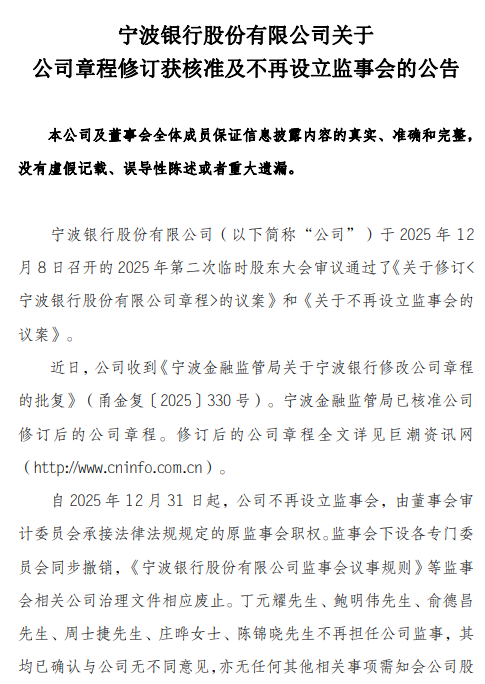
1月4日,宁波银行发布公告称,近日,公司收到《宁波金融监管局关于宁波银行修改公司章程的批复》 (甬金复〔2025〕330号)。宁波金融监管局已核准公司修订后的公司章程。 宁波银行表示,自2025年12月31日起,公司不再设立监事会,由董事会审计委员会承接法律法规规定的 原监事会职权。监事会下设各专门委员会同步撤销,《宁波银行股份有限公司监事会议事规则》等监事 会相关公司治理文件相应废止。丁元耀、鲍明伟、俞德昌、周士捷、庄晔、陈锦晓不再担任公司监事, 其均已确认与公司无不同意见,亦无任何其他相关事项需知会公司股东及债权人。公司对各位监事在任 职期间作出的贡献给予高度评价并致以衷心的感谢。 银行频道更多独家策划、专家专栏,免费查阅>> 责任编辑:小讯 ...
宁波银行:修订后的公司章程已获核准,同步撤销监事会
Bei Jing Shang Bao· 2026-01-04 09:37
(文章来源:北京商报) 北京商报讯1月4日,宁波银行发布公告称,该行于2025年12月8日召开的2025年第二次临时股东大会审 议通过了《关于修订的议案》和《关于不再设立监事会的议案》。近日,该行收到《宁波金融监管局关 于宁波银行修改公司章程的批复》。宁波金融监管局已核准宁波银行修订后的公司章程。 公告显示,自2025年12月31日起,宁波银行不再设立监事会,由董事会审计委员会承接法律法规规定的 原监事会职权。监事会下设各专门委员会同步撤销,《宁波银行股份有限公司监事会议事规则》等监事 会相关公司治理文件相应废止。丁元耀、鲍明伟、俞德昌、周士捷、庄晔、陈锦晓不再担任该行监事, 其均已确认与该行无不同意见,亦无任何其他相关事项需知会该行股东及债权人。 ...
宁波银行(002142) - 宁波银行股份有限公司章程(2025年12月)
2026-01-04 07:46
宁波银行股份有限公司章程 二〇二五年十二月 | | | | 第六节 董事会秘书 | | --- | | 第七章 高级管理人员 . | | 第八章 财务会计制度、利润分配和审计 | | 第一节 财务会计制度 . | | 第二节 内部审计 | | 第三节 会计师事务所的聘任 | | 第九章 通知和公告 53 | | 第一节 通知 53 | | 第二节 公告 54 | | 第十章 合并、分立、增资、减资、解散和清算 54 | | 第一节 合并、分立、增资和减资 . | | 第二节 解散和清算 | | 第十一章 修改章程. | | 第十二章 附则 . | 宁波银行股份有限公司章程 第一章 总则 第一条 为维护宁波银行股份有限公司(以下简称"本行")、股东、 职工和债权人的合法权益,规范本行的组织和行为,根据《中华人民共和 国公司法》(以下简称"《公司法》")、《中华人民共和国证券法》(以下简 称"《证券法》")、《中华人民共和国商业银行法》(以下简称"《商业银行 法》")和其他法律、行政法规及部门规章,制定本章程。 第二条 本行系依照《公司法》、《商业银行法》和其他法律、行政法 规及部门规章成立的股份有限公司。 本行 ...
宁波银行(002142) - 宁波银行股份有限公司关于公司章程修订获核准及不再设立监事会的公告
2026-01-04 07:46
证券代码:002142 证券简称:宁波银行 公告编号:2026-001 优先股代码:140001 优先股简称:宁行优01 宁波银行股份有限公司关于 公司章程修订获核准及不再设立监事会的公告 本公司及董事会全体成员保证信息披露内容的真实、准确和完整, 没有虚假记载、误导性陈述或者重大遗漏。 宁波银行股份有限公司(以下简称"公司")于 2025 年 12 月 8 日召开的 2025 年第二次临时股东大会审议通过了《关于修订< 宁波银行股份有限公司章程>的议案》和《关于不再设立监事会的 议案》。 近日,公司收到《宁波金融监管局关于宁波银行修改公司章程 的批复》(甬金复〔2025〕330 号)。宁波金融监管局已核准公司 修订后的公司章程。修订后的公司章程全文详见巨潮资讯网 (http://www.cninfo.com.cn)。 东及债权人。公司对各位监事在任职期间作出的贡献给予高度评价 并致以衷心的感谢。 特此公告。 宁波银行股份有限公司董事会 2026 年 1 月 5 日 2 自 2025 年 12 月 31 日起,公司不再设立监事会,由董事会审 计委员会承接法律法规规定的原监事会职权。监事会下设各专门委 员会同步 ...
多行业联合红利资产12月报:股息率年关盘点-20260104
Huachuang Securities· 2026-01-04 06:46
证 券 研 究 报 告 【策略月报】 股息率年关盘点 ——多行业联合红利资产 12 月报 策略研究 策略月报 2026 年 01 月 04 日 华创证券研究所 证券分析师:姚佩 邮箱:yaopei@hcyjs.com 执业编号:S0360522120004 证券分析师:吴一凡 邮箱:wuyifan@hcyjs.com 执业编号:S0360516090002 证券分析师:徐康 电话:021-20572556 邮箱:xukang@hcyjs.com 执业编号:S0360518060005 证券分析师:欧阳予 邮箱:ouyangyu@hcyjs.com 执业编号:S0360520070001 证券分析师:韩星雨 邮箱:hanxingyu@hcyjs.com 执业编号:S0360525050001 证券分析师:单戈 邮箱:shange@hcyjs.com 执业编号:S0360522110001 证券分析师:马野 邮箱:maye@hcyjs.com 执业编号:S0360523040003 相关研究报告 《【华创策略】杠杆&ETF 资金分化趋势逆转—— 流动性&交易拥挤度&投资者温度计周报》 2025-12-01 《【华 ...
优先股隐退永续债上位!银行业资本补充进入密集冲刺期,年利息至少省3%
Xin Lang Cai Jing· 2026-01-04 05:31
Core Viewpoint - The Chinese banking industry is undergoing a significant transformation, with banks redeeming high-cost preferred shares and issuing perpetual bonds as a more cost-effective financing alternative, driven by declining social financing costs and regulatory changes [2][4][11]. Group 1: Redemption of Preferred Shares - By the end of 2025, a total of 9 banks announced the redemption of preferred shares, amounting to 111.8 billion RMB in domestic preferred shares and 5.72 billion USD in foreign preferred shares [4]. - In December 2025 alone, five banks, including Changsha Bank and Beijing Bank, redeemed a total of 45.8 billion RMB in preferred shares [3]. - The redemption of preferred shares is facilitated by their lack of maturity dates but includes redemption clauses, allowing banks to manage capital flexibly [4]. Group 2: Issuance of Perpetual Bonds - As of December 31, 2025, Chinese commercial banks issued 69 perpetual bonds, raising a total of 821.8 billion RMB, marking a historical high in both issuance quantity and scale [5]. - The interest rates for newly issued perpetual bonds generally ranged from 2.0% to 2.9%, the lowest in nearly three years, with a significant issuance peak occurring in the second half of 2025 [5][6]. - The issuance of perpetual bonds is seen as a response to the urgent need for capital replenishment, especially among small and medium-sized banks facing declining capital adequacy ratios [2][6]. Group 3: Cost Savings and Financial Efficiency - By replacing preferred shares with perpetual bonds, banks can save at least 3% annually on interest expenses, significantly reducing their financing costs [8][10]. - For instance, the interest rate on newly issued perpetual bonds is substantially lower than that of previously issued preferred shares, with examples showing potential annual savings of 12.8 million RMB for banks like Industrial Bank [10]. - The transition from preferred shares to perpetual bonds is viewed as a strategic move to optimize capital structure and reduce interest payment burdens, aligning with regulatory requirements [8][10]. Group 4: Regulatory Environment and Market Dynamics - The shift towards perpetual bonds is influenced by regulatory changes that favor capital instruments with loss absorption capabilities, making traditional preferred shares less attractive [11]. - The approval process for issuing perpetual bonds is simpler and faster compared to preferred shares, which require dual regulatory approvals, thus enhancing their appeal to banks [11]. - The current low-interest-rate environment is expected to persist, allowing banks to lock in low financing costs for the next 5 to 10 years, effectively mitigating the pressure from narrowing net interest margins [10].






回望2025,盘点银行业十大关键词
Xin Lang Cai Jing· 2026-01-04 01:17
Core Viewpoint - In 2025, the Chinese banking industry is entering a transformative phase focused on high-quality development, with a clear strategic direction to accelerate the construction of a financial powerhouse and empower new productive forces [1] Policy Level Summary - The government has implemented targeted measures for risk resolution and transformation of local small and medium financial institutions, emphasizing market-oriented and legal approaches [1] - The Financial Regulatory Bureau has intensified efforts to address "involution" competition, guiding the industry to shift from "scale competition" to "value creation" [1] - The Central Economic Work Conference has set priorities for 2026, focusing on the "reduction and quality improvement" of small and medium financial institutions [1] Industry Practice Summary - State-owned banks are experiencing a new wave of capital replenishment supported by special government bonds, enhancing their risk resistance and credit issuance capabilities [2] - The adjustment of deposit interest rates has deepened, entering the "1 era," with high-interest long-term products gradually being phased out [2] - The governance structure of banks has undergone historic reforms, with many banks abolishing supervisory boards and transferring oversight functions to audit committees [2] - The banking sector has seen a significant revaluation of undervalued bank stocks, with a notable increase in stock prices across the board [2] Financial for the People Summary - Policies aimed at improving financial services for the public have been implemented, such as exempting large cash withdrawals from registration, enhancing service efficiency and safeguarding individual financial autonomy [2] - A personal credit repair policy has been introduced to assist individuals with credit damage due to non-malicious overdue situations, facilitating their reintegration into economic activities [2] Key Terms Summary - **Involution Competition Rectification**: The banking industry has reached a consensus on combating "involution," with associations issuing self-regulatory agreements to promote healthy development [3] - **Reduction and Quality Improvement of Small Financial Institutions**: Over 400 financial institutions have exited the market in 2025, with a focus on optimizing structure and enhancing service capabilities [4] - **Bank Stock Value Revaluation**: The banking sector has seen a significant increase in stock prices, with 35 out of 42 A-share listed banks reporting positive growth [5] - **Declining Deposit Rates**: The net interest margin for commercial banks has decreased to 1.42%, leading to a widespread reduction in deposit rates [6][7] - **Exit of Supervisory Boards**: A wave of governance reforms has led to the abolition of supervisory boards in favor of audit committees, enhancing governance efficiency [8][9] - **Core Capital Supplementation for Major Banks**: Major state-owned banks have initiated a new round of capital replenishment, with plans to raise significant funds through stock issuance [10] - **Expansion of AIC**: The issuance of AIC licenses has resumed, allowing more banks to establish financial asset investment companies [11][12] - **Exemption from Registration for Withdrawals Over 50,000**: New regulations will simplify the process for large withdrawals, balancing financial security and service convenience [13] - **Personal Credit Repair Policy Implementation**: A one-time credit repair policy has been introduced to support individuals with overdue credit issues [14][15] - **Deepening the "Five Major Articles"**: The financial sector has made significant progress in implementing the "Five Major Articles" strategy, with a notable increase in loans to key areas [16][17]
2025年深市公司分红总额超5000亿元
2 1 Shi Ji Jing Ji Bao Dao· 2026-01-03 08:42
Core Viewpoint - The article highlights the positive trend in cash dividends among companies listed in the Shenzhen Stock Exchange, indicating a stable and transparent dividend mechanism that enhances shareholder recognition and boosts the market image and long-term investment value of companies [1][2]. Group 1: Dividend Trends and Amounts - In 2025, companies in the Shenzhen market are expected to distribute over 500 billion yuan in dividends, with more than 18 companies anticipated to announce distributions exceeding 10 billion yuan at the beginning of 2026 [1]. - By the end of 2025, a total of 5,475.59 billion yuan in cash dividends will be distributed, contributing to a cumulative total of over 20 trillion yuan during the "14th Five-Year Plan" period [4]. - The number of companies disclosing mid-term dividend plans in 2025 reached 535, an increase of 7.24% year-on-year [3]. Group 2: Regulatory and Policy Support - Recent policies, including the new "National Nine Articles," have strengthened the regulation of cash dividends and increased incentives for companies with high-quality dividend practices [2]. - The China Securities Regulatory Commission (CSRC) has issued guidelines to encourage cash dividends, aiming to enhance the frequency and level of dividends among listed companies [2]. Group 3: Financial Performance and Governance - In the first three quarters of 2025, Shenzhen-listed companies achieved a total operating revenue of 15.72 trillion yuan, a year-on-year increase of 4.31%, and a net profit attributable to shareholders of 903.02 billion yuan, up 9.69% [2]. - The improvement in corporate governance has led to more standardized and predictable dividend distributions, enhancing transparency and investor confidence [3]. Group 4: Sector-Specific Dividend Highlights - Leading companies in the consumer and financial sectors have shown strong dividend distribution activity, with notable examples including Wuliangye and Gree Electric, which announced significant cash distributions in late 2025 [5][6]. - In the advanced manufacturing sector, companies like CITIC Special Steel and Weichai Power have also implemented substantial mid-term dividends, reflecting a robust return mechanism [5][6]. - The green and low-carbon sector is represented by companies like CATL, which distributed significant dividends, further demonstrating the trend of stable dividends across various industries [7].