
海尔智家

Search documents
哈萨克斯坦最大城市,满街中国品牌
21世纪经济报道· 2026-01-16 02:25
Core Viewpoint - Chinese brands have established a strong presence in Kazakhstan, becoming integral to the local economy and daily life, with significant growth in trade and investment between China and Central Asia [1][2]. Group 1: Market Growth and Chinese Brand Presence - China has become Central Asia's largest trading partner, with trade volume reaching $60.7 billion from 2017 to 2024, a 1.5 times increase [1]. - By 2024, China's direct investment and loans to Central Asia are expected to exceed $24 billion, with over 9,000 Chinese companies operating in the region [1]. - Kazakhstan is emerging as a key hub for Chinese enterprises' overseas growth, with a young population and high smartphone penetration (95%) [1]. Group 2: Integration of Chinese Brands - Chinese brands, including Haier, BYD, and Xiaomi, are increasingly integrated into the daily lives of Central Asian consumers, with visible presence in various sectors [2][7]. - The automotive sector has seen rapid growth, with Chinese manufacturers' market share in Kazakhstan rising from 2% in 2020 to 38% by 2024 [8]. - In the first nine months of this year, Chinese automotive brands captured 34.5% of the market share, with local production initiated by brands like Changan and Chery [8]. Group 3: Marketing and Consumer Behavior - The shift in perception of Chinese automobiles from low-cost to reliable technology reflects a broader acceptance among Central Asian consumers [9]. - The rapid technological advancements in China provide a competitive edge, as local consumers are open to new experiences and innovations [9]. - The e-commerce market in Central Asia is projected to reach $14.7 billion in 2024, with Kazakhstan's market alone estimated at $6 billion [12]. Group 4: Challenges and Localization - Companies entering the Central Asian market must navigate complex local languages and cultural differences, as each country has unique consumer habits [13]. - The regulatory environment varies significantly across Central Asian countries, necessitating thorough market research and local partnerships to mitigate risks [14][15]. - A dual approach of utilizing mainstream e-commerce platforms and developing direct-to-consumer channels is recommended for effective market penetration [12].


7个方面攻坚!青岛科创大走廊激活创新发展“新磁场”
Qi Lu Wan Bao· 2026-01-15 14:28
Core Viewpoint - The Qingdao Science and Technology Innovation Corridor aims to become a competitive innovation development hub both nationally and globally, focusing on integrating technology innovation with economic growth and enhancing the region's innovation ecosystem [1][4]. Group 1: Corridor Overview - The Qingdao Science and Technology Innovation Corridor officially started construction on November 7, 2025, stretching 53 kilometers along the coastal road and covering an area of approximately 190 square kilometers, connecting Laoshan District, Licang District, and Qingdao Blue Valley [1][2]. - The corridor is designed to highlight the natural features of mountains, seas, bays, rivers, islands, springs, and beaches, with a well-developed road network and metro connectivity [2]. Group 2: Innovation Resources - The corridor will leverage the Laoshan Laboratory as a leading entity, concentrating on marine science initiatives such as the "Transparent Ocean" project, and boasts the highest number of marine academicians in the country [2]. - It will gather eight universities, including Ocean University of China and Shandong University (Qingdao), along with eight national key laboratories, two national manufacturing innovation centers, 14 provincial-level research institutes, and 21 provincial-level new R&D institutions [2]. Group 3: Strategic Focus Areas - The construction plan includes seven focus areas and 24 specific tasks, such as establishing a global marine technology innovation source, building a high-level innovation platform system, and accelerating the integration of innovation chains and industrial chains [3]. - The corridor will also emphasize attracting high-level global innovation talent through the "Talent Strong Qingdao" initiative, enhancing the environment for talent development and entrepreneurship [3]. Group 4: Industry Development - The corridor will focus on four major industry directions: marine, digital intelligence, life sciences, and future technologies, creating an industry system referred to as "242N" [3]. - This includes high-end marine equipment, artificial intelligence, new generation information technology, and various advanced fields such as quantum information and satellite internet [3]. Group 5: Regional Cooperation and Environment - The initiative aims to foster regional innovation cooperation, engaging in international collaborations and integrating with advanced domestic innovation corridors [3]. - Efforts will be made to enhance the quality of the living and working environment, including smart city development and improving urban service facilities [3][4].
2026组织迭代,迈向共识型组织|2026杰出雇主认证榜单发布
Xin Lang Cai Jing· 2026-01-15 13:17
Core Insights - The article emphasizes the shift towards "consensus organizations" where collaboration, value, and clarity take precedence over speed and scale in response to economic uncertainty and technological change [3][4][11]. Group 1: Trends in Organizational Design - **Mission in Practice**: Organizations are moving beyond mere declarations of mission to integrate it into decision-making, leadership, and values [6][8]. - **Responsible AI Application**: The focus is shifting from the speed of AI adoption to its ethical and responsible integration, ensuring it supports human judgment and organizational values [7][9]. - **Structured Flexibility**: Flexibility is now a basic expectation, requiring organizations to design mechanisms that support collaboration and employee well-being while maintaining fairness and performance [9][10]. Group 2: Organizational Effectiveness - **Efficiency-Oriented Design**: Organizations must redirect resources towards activities that create the most value, as economic pressures and skill shortages persist [10][11]. - **Stability Paradox**: Organizations face the challenge of balancing employee safety and adaptability in a rapidly changing environment, with stability becoming a foundation for confidence and agility [11][12]. Group 3: Recognition of Outstanding Employers - A total of 168 companies in China have been certified as "Outstanding Employers 2026," reflecting their commitment to building consensus organizations that prioritize employee well-being and sustainable development [4][18].
中国智造引领下的卫浴毛巾架全球化跃迁,头豹词条报告系列:热能新边界
Tou Bao Yan Jiu Yuan· 2026-01-15 12:30
Investment Rating - The report does not explicitly state an investment rating for the bathroom towel rack industry. Core Insights - The bathroom towel rack industry is experiencing a transformation towards mechanization, automation, and intelligence, with a notable trend towards product smartization and an increasing emphasis on design aesthetics by consumers. The North American and European markets are identified as the core drivers of global market development due to their cold and humid climates, high economic development levels, and mature residential building systems. The industry is expected to grow as applications extend to hotels, gyms, pools, saunas, and yachts, supported by the optimization of e-commerce, engineering procurement, and cross-border channels. Chinese companies are leveraging manufacturing advantages, technological iterations, and brand expansion strategies to actively explore international markets, leading to a continuous increase in global market share [4]. Industry Definition - The bathroom towel rack is a heating home product, an upgraded version of the ordinary towel rack, capable of drying damp towels, bath towels, and clothing to prevent the growth of mold and bacteria due to moisture [5]. Industry Classification - The bathroom towel rack can be classified based on different heating sources into water-heated and electric-heated types, and by product style into plug-in, overlapping, and classical styles [6][10]. Industry Characteristics - The industry is characterized by a shift towards mechanization, automation, and smartization in production, a significant trend towards product smartization, and an increasing consumer focus on product design [18]. Development History - The bathroom towel rack industry originated in the late 19th century and has entered a rapid development phase. The industry has evolved from iron products to copper and steel products, with significant growth in the 21st century, particularly in the Chinese market [22][24][26]. Industry Chain Analysis - The industry chain consists of upstream raw material supply, midstream manufacturing and integration, and downstream sales channels. The overall industry chain is characterized by standardized upstream materials, competitive midstream manufacturing capabilities, and value differentiation driven by downstream channels and application scenarios [27][28]. Market Size - The market size of the bathroom towel rack industry grew from $792 million in 2019 to $952 million in 2024, with a compound annual growth rate (CAGR) of 3.75%. It is projected to reach $1.356 billion by 2029, with a CAGR of 7.48% from 2025 to 2029 [35]. Competitive Landscape - The competitive landscape of the bathroom towel rack industry features a tiered structure, with leading companies such as Kudox, Zehnder Group, IRSAP, and Jiangxi Aifenda in the first tier, while companies like Zhejiang Hongbeisi and Panasonic are in the second and third tiers, respectively. The industry remains fragmented with no dominant players globally [43][44]. Company Overview - Jiangxi Aifenda Warm Technology Co., Ltd. is a significant player in the industry, focusing on the research, design, production, and sales of heating home products, particularly electric towel racks. The company has a production capacity of over 2 million towel racks annually and is a major supplier in the European market [49][52]. - Zhejiang Hongbeisi Intelligent Technology Co., Ltd. specializes in smart heating solutions, including electric towel racks, and has established itself as a high-tech enterprise in the industry [53][54]. - Zhejiang Senlat Warm Equipment Co., Ltd. is also involved in the production of electric towel racks and other heating solutions, contributing to the industry's growth [55].
穿透消费分化迷雾:CBI品牌榜中的“真增长”挖掘
Ge Long Hui· 2026-01-15 11:25
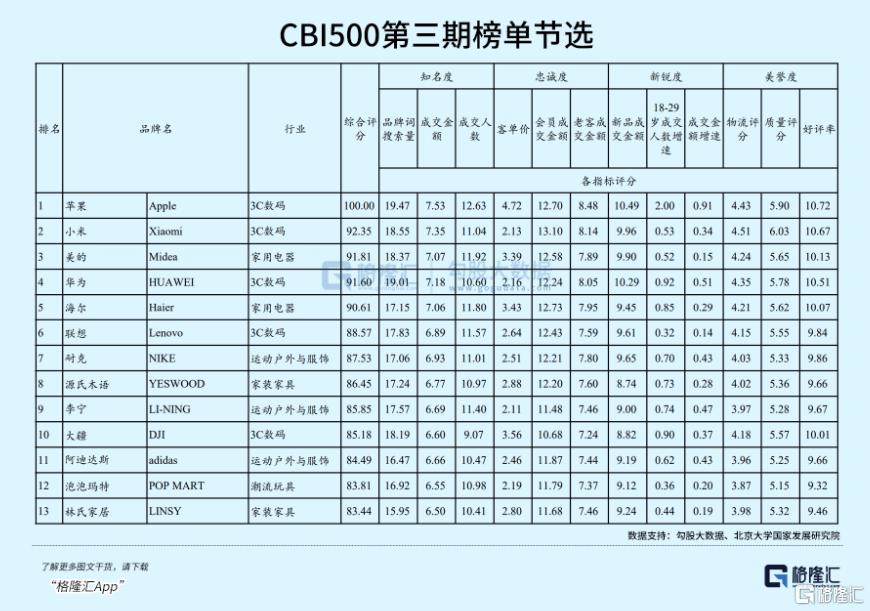
Group 1 - The Chinese consumer market has shown a steady recovery since 2025, with a year-on-year growth of 6.8% in retail sales of consumer goods in the first three quarters, contributing 53.5% to economic growth [1] - The recovery trend in the consumer sector is not uniform, with traditional brands struggling due to lack of innovation, while new brands are breaking through with technological advancements and innovative models [1] - The need for a quantitative evaluation tool to identify structural opportunities in the market has led to the development of the "China Online Consumption Brand Index (CBI)" and the "Global Brand China Online Top 500 List (CBI500)" by Peking University [2] Group 2 - The CBI500 list is based on real consumer data from Taobao and Tmall, utilizing a comprehensive brand quality indicator that includes new product capability, user reviews, and search popularity [2][5] - The top five brands in the CBI500 list—Apple, Xiaomi, Midea, Huawei, and Haier—demonstrate a "stronger gets stronger" logic, maintaining competitive advantages through balanced performance across various dimensions [6][8] - DJI has achieved significant growth, moving from a score of 78.53 to 85.18, entering the top ten for the first time, driven by continuous technological innovation and market expansion [9][12] Group 3 - Pop Mart has shown strong resilience in the collectible toy sector, climbing from 31st to 12th place in the CBI500 list, with leading scores in loyalty and customer spending [14][17] - The growth logic of Pop Mart is based on deep insights into emotional consumption needs, utilizing an IP matrix and a robust membership system to create a strong emotional connection with consumers [17] - The differentiation in the consumer market has created opportunities for brands that adapt to trends, as seen with Fenjiu's rise in rankings due to its "youthful" strategy targeting younger consumers [22][23] Group 4 - The CBI list serves as a data-driven tool for observing the consumer market, helping investors identify brands that capture product innovation opportunities and possess anti-cyclical potential [27][29] - The evaluation logic of the CBI list helps to avoid misleading short-term sales data, focusing instead on loyalty and reputation metrics to identify brands that achieve sustainable growth [27][29] - The current economic recovery phase presents a critical window for brand restructuring and value selection, emphasizing the importance of understanding consumer behavior changes [26][29]





穿透消费分化迷雾:CBI品牌榜中的“真增长”挖掘
格隆汇APP· 2026-01-15 11:15
Core Insights - The article highlights the steady recovery of China's consumer market since 2025, with a year-on-year growth of 6.8% in retail sales of consumer goods in the first three quarters, contributing 53.5% to economic growth [2] - However, the consumer sector faces challenges with increasing internal differentiation, where traditional brands struggle due to lack of innovation while new brands succeed through technological breakthroughs and innovative models [2][3] Group 1: Consumer Brand Landscape - The CBI500 ranking reflects a stable top tier of brands, emphasizing the "stronger get stronger" logic in the consumer market [7] - Leading brands like Apple, Xiaomi, Midea, Huawei, and Haier maintain competitive barriers through balanced performance across four dimensions: brand awareness, innovation, loyalty, and reputation [8][10] - DJI and Pop Mart have shown significant growth, with DJI entering the top ten for the first time, driven by continuous technological innovation and market expansion [11][16] Group 2: Brand Performance and Growth Strategies - DJI's growth is attributed to its focus on technology innovation and creating benchmark products, leading to a 66% market share in the global action camera market as of Q3 2025 [11][14] - Pop Mart's rise in the rankings is due to its strong loyalty metrics and effective IP matrix operation, which resonates with emotional consumer needs [19][20] - The brand's strategy includes a robust membership system that enhances customer loyalty through emotional engagement [19] Group 3: Market Differentiation and Opportunities - The differentiation in the consumer market presents challenges for traditional brands while creating opportunities for those that adapt to trends [21][22] - Brands like Fenjiu have successfully capitalized on changing consumer preferences, with a notable increase in their ranking due to a focus on younger consumers [26] - The article emphasizes the importance of aligning with policy support and consumer trends to identify quality brands that can thrive in a competitive landscape [27][28] Group 4: CBI Index and Its Value - The CBI index serves as a data-driven tool for observing the consumer market, helping investors identify brands that capture product innovation opportunities and possess resilience against economic cycles [30][31] - The index's multidimensional evaluation framework allows for a deeper understanding of consumer demand and brand performance, aiding in long-term investment decisions [32]

海尔智家(06690)1月15日斥资467.48万元回购18.1万股A股
智通财经网· 2026-01-15 10:21
Core Viewpoint - Haier Smart Home (06690) announced a share buyback plan, indicating confidence in its stock value and future prospects [1] Group 1: Buyback Details - The company will repurchase 181,000 A-shares at a total cost of 4.6748 million RMB [1] - The buyback price per share ranges from 25.78 to 25.87 RMB [1]
海尔智家1月15日斥资467.48万元回购18.1万股A股
Zhi Tong Cai Jing· 2026-01-15 10:18
Core Viewpoint - Haier Smart Home (600690)(06690) announced a share buyback plan, indicating confidence in its stock value and commitment to returning capital to shareholders [1] Group 1: Buyback Details - The company plans to repurchase 181,000 A-shares at a total cost of 4.6748 million RMB [1] - The buyback price per share is set between 25.78 and 25.87 RMB [1]
海尔智家(06690.HK)1月15日耗资467.5万元回购18.1万股A股
Ge Long Hui· 2026-01-15 10:16
Group 1 - The company Haier Smart Home (06690.HK) announced a share buyback on January 15, spending 4.675 million yuan to repurchase 181,000 A-shares [1]
海尔智家(06690) - 翌日披露报表
2026-01-15 10:12
如上市發行人的已發行股份或庫存股份出現變動而須根據《香港聯合交易所有限公司(「香港聯交所」)證券上市規則》(「《主板上市規則》」)第13.25A條 / 《香港聯合交易所有限公司GEM證券 上市規則》(「《GEM上市規則》」)第17.27A條作出披露,必須填妥第一章節 。 | 第一章節 | | | | | | | | --- | --- | --- | --- | --- | --- | --- | | 1. 股份分類 | 普通股 | 股份類別 A | | 於香港聯交所上市 | 否 | | | 證券代號 (如上市) | 600690 | 說明 | 每股面值人民幣1元之普通股(A股) (於上海證券交易所上市) | | | | | A. 已發行股份或庫存股份變動 | | | | | | | | | | 已發行股份(不包括庫存股份)變動 | | 庫存股份變動 | | | | 事件 | | 已發行股份(不包括庫存股份)數 目 | 佔有關事件前的現有已發 行股份(不包括庫存股 份)數目百分比 (註3) | 庫存股份數目 | 每股發行/出售價 (註4) | 已發行股份總數 | | 於下列日期開始時的結存(註1) | 202 ...