邮储银行

Search documents
撬动文旅发展“金杠杆”
Jin Rong Shi Bao· 2026-01-20 02:04
Core Viewpoint - The financial support from institutions like Postal Savings Bank has significantly boosted the development of small and micro cultural tourism enterprises in Anyang, allowing them to transition from small-scale operations to larger, more sustainable business models [1][2]. Group 1: Financial Innovation - The Anyang branch of the People's Bank of China has tailored financial products such as "Yuyou Minshu Loan" and "Yushang Hejiahao" to meet the unique needs of small and micro cultural tourism enterprises, addressing their challenges of being asset-light and having fluctuating operations [2]. - Industrial and Commercial Bank of China (ICBC) Anyang branch has developed a differentiated credit assessment model that reduces reliance on fixed assets, providing specialized loans for hotel upgrades, resulting in a 77% occupancy rate during off-peak seasons and annual revenue exceeding 12 million yuan [2]. Group 2: Key Project Leadership - The Anyang branch of the People's Bank of China has identified key projects with leading roles in the cultural tourism sector, providing tailored financing packages to enhance regional cultural tourism resources [3]. - A loan of 770 million yuan was allocated to key projects like the "Red Flag Canal Taihang Mountain" themed performance, which has achieved over 90% attendance per show, becoming a significant cultural tourism landmark [3]. Group 3: Comprehensive Financial Support - Financial institutions have collaborated with local cultural tourism departments to provide 350 million yuan in loans for the renovation of key tourist attractions, leading to over 20% growth in visitor numbers during peak seasons [4]. - The implementation of key projects has positively impacted related industries such as accommodation and dining, with retail sales in Linzhou's accommodation and dining sectors increasing by 25% year-on-year [4]. Group 4: Full Chain Empowerment - The Anyang branch of the People's Bank of China has extended financial services throughout the cultural tourism industry chain, including support for urban commercial areas and rural agricultural tourism [5]. - A loan of 20 million yuan was provided to enhance the Jingxin Shopping Plaza, which has seen significant increases in foot traffic and sales after the upgrade [5]. - The financial support has also facilitated the growth of local agricultural products, with annual sales reaching 80 million yuan for products like "Dahongpao" pepper and "Taihang Chrysanthemum" tea [5]. Group 5: Economic Impact - Anyang's cultural tourism revenue has consistently grown at an average annual rate of 13% over the past three years, demonstrating the transformative effect of financial support on the local economy [6]. - The cultural tourism sector has become a vital engine for regional economic activation and a crucial link between urban and rural development [6].
从经济数据看市场交易的宏观线索
2026-01-20 01:50
Summary of Key Points from Conference Call Records Industry Overview - The macroeconomic indicators for Q4 2026 show a GDP growth of 4.5%, which, despite a decline from the previous quarter, is considered robust given the high base of 5.4% in Q4 2025 [1][2] - The nominal GDP growth rate improved to 3.8% in Q4, up from 3.7% in the previous quarter, supported by significant improvements in PPI and CPI, with the deflator index reaching its best level of -0.7% for the year [3] Economic Data Insights - The birth rate in 2025 fell to 7.92 million, while deaths reached 11.31 million, resulting in a natural growth rate of -2.4‰. However, urbanization increased by 0.89 percentage points, adding 10 million urban residents, which supports rigid demand in the real estate sector [5] - Investment showed a cumulative negative growth of 3.8% for the year, with December alone estimated at -15.1%. The central government plans to increase investment support, potentially exceeding 1 trillion yuan during the upcoming Two Sessions [7] Sector Performance - High-tech manufacturing saw a year-on-year increase of 11%, with industrial value added growing by 5.2% in December. The service sector also performed well, with a production index growth of 5% [8] - Consumer spending growth was only 0.9% in December, the lowest for 2026, with an annual growth rate of 3.7%. The decline in policy subsidies contributed to this slowdown [6] Banking Sector Analysis - The banking sector is currently facing opportunities due to solid credit issuance foundations and easing margin pressures, although the pace of retail demand recovery remains uncertain [17] - The core logic of the banking sector includes a focus on corporate business, optimization of funding costs, and asset quality supported by debt resolution policies [18] - Expected credit growth in January 2026 is projected to be between 5.5 to 5.6 trillion yuan, with corporate loans being the main focus, particularly in technology and green finance sectors [19][20] Market Sentiment and Investment Opportunities - The A-share market is currently in an upward phase, with active investor sentiment and increasing margin financing. However, caution is advised regarding potential corrections in overvalued sectors [15] - Recommended sectors for investment include defensive large-cap stocks, growth stocks in technology, and sectors benefiting from new supply-side structural reforms such as chemicals and coal [16] Employment and Monetary Policy - The unemployment rate remained stable at 5.1% for three consecutive months, indicating a stable labor market, which supports a cautious approach to macroeconomic policy [9] - The central bank's monetary policy is focused on structural tools, with expectations for a 50 basis point reserve requirement ratio cut in Q1 2026, and possibly 1-2 additional cuts throughout the year [13][14] Conclusion - The overall economic outlook for 2026 indicates a mixed environment with growth opportunities in certain sectors, particularly in technology and infrastructure, while challenges remain in consumer spending and retail banking. The banking sector is expected to navigate these challenges with a focus on corporate lending and asset quality management.
银行“加码”信贷投放促消费
Jin Rong Shi Bao· 2026-01-20 01:39
Core Insights - The central economic work meeting in late 2025 emphasizes the importance of "domestic demand as the main driver, building a strong domestic market" for economic work in 2026 [1] - The People's Bank of China (PBOC) plans to enhance financial support for consumption through targeted monetary policies, particularly focusing on service consumption and elderly care loans [1][2] - Experts predict that the consumption market in China will continue to show stable growth and quality improvement in 2026, driven by macro policy support and internal development momentum [1][6] Group 1: Policy and Financial Support - In May 2025, the PBOC established a 500 billion yuan service consumption and elderly care re-loan program to boost service consumption supply and demand [2] - By the end of November 2025, consumer loans (excluding personal housing loans) reached 21.2 trillion yuan, indicating a significant increase in financial support for service consumption [2] - The re-loan policy aims to direct financial resources into key areas of livelihood and consumption upgrade, with a focus on long-term economic sustainability [2][4] Group 2: Growth Areas in Service Consumption - Health and elderly care are emerging as new growth points for service consumption credit, with banks actively providing loans for various projects in these sectors [3][4] - The service consumption market is expanding, with a notable increase in demand for health, education, and leisure services, although there are still structural deficiencies in supply [4][6] - Experts highlight the need for improved consumer confidence and infrastructure to further enhance service consumption, particularly in rural areas [4][6] Group 3: Banking Sector Strategies - Banks are encouraged to innovate credit products tailored to the characteristics of service consumption businesses, such as using intellectual property and future revenue rights as collateral [7] - There is a call for banks to collaborate with local governments and enterprises to create platforms that facilitate financial services for small and micro businesses in the service sector [7] - The integration of financial technology into consumption scenarios is seen as a way to provide comprehensive financial solutions, enhancing the overall service experience for consumers [7]

找准金融“支点” “撬动”科技创新
Jin Rong Shi Bao· 2026-01-20 01:39
Core Viewpoint - The Chinese financial sector is increasingly focusing on supporting technological innovation through various financial instruments and policies, particularly emphasizing low-cost credit and the development of a dedicated bond market for technology enterprises [1][2][3][6]. Group 1: Financial Support for Innovation - The People's Bank of China (PBOC) has prioritized enhancing financial services for high-quality development in the real economy, specifically targeting technological innovation [1]. - The PBOC has increased the quota for re-loans for technological innovation and technological transformation from 800 billion to 1.2 trillion yuan, expanding support to private small and medium-sized enterprises with high R&D investment [3][6]. - Banks are innovating products such as intellectual property pledge financing and specialized loans for equipment upgrades to better meet the financing needs of technology enterprises [4][5]. Group 2: Low-Cost Credit and Its Impact - Low-cost credit is crucial for technology companies, especially during R&D and capacity expansion phases, with structural monetary policy tools facilitating this support [2]. - As of the end of Q3 2025, 275,400 technology-oriented small and medium-sized enterprises received loans, with a loan balance of 3.56 trillion yuan, reflecting a year-on-year growth of 22.3% [2]. Group 3: Innovation in Credit Evaluation - Traditional credit assessment models struggle to meet the financing needs of technology enterprises, which often rely on intellectual assets rather than physical assets [4][5]. - Banks are adopting new evaluation systems that consider intellectual property, R&D investment, and core team capabilities to facilitate financing for technology firms [5]. Group 4: Development of Technology Bonds - The introduction of technology innovation bonds provides a new channel for direct financing, addressing the mismatch in financing terms for technology enterprises [6]. - Since the launch of the technology bond market, 1.8 trillion yuan in technology innovation bonds have been issued, with significant participation from various financial institutions [6][7].
中国邮政储蓄银行股份有限公司2026年第一次临时股东会决议公告
Shang Hai Zheng Quan Bao· 2026-01-19 19:38
Group 1 - The core point of the announcement is the resolution of the first extraordinary general meeting of China Postal Savings Bank held on January 19, 2026, with no rejected proposals [2][10] - The meeting was attended by 16 directors and was presided over by Chairman Zheng Guoyu, following legal and regulatory requirements [3][11] - The total number of shares eligible for voting at the meeting was 119,939,419,734 shares after accounting for shares that could not exercise voting rights [2][7] Group 2 - The meeting approved the election of Mr. Lu Wei as an executive director, with the proposal receiving more than half of the valid voting rights [6][7] - The meeting also approved the adjustment of the composition of the board's specialized committees, with Mr. Lu Wei appointed as the chairman of the Social Responsibility and Consumer Rights Protection Committee [12][13] - A proposal to revise the "Data Security Management Measures of China Postal Savings Bank" was also approved unanimously [14]

中国邮政储蓄银行完成执行董事选举,芦苇先生正式履职
Xin Lang Cai Jing· 2026-01-19 19:14
Core Viewpoint - The successful election of Mr. Lu Wei as the executive director of China Postal Savings Bank marks a significant step in enhancing the bank's corporate governance structure and strengthening the board's capabilities, which will inject new momentum into the bank's future strategic development and management decisions [1] Group 1: Meeting Details - The first extraordinary general meeting of 2026 was held on January 19, 2026, to elect a new executive director [1] - The meeting was attended by 2,476 shareholders and proxies, representing approximately 108.518 billion shares with voting rights, which accounts for 90.48% of the total voting shares [1] - The voting process combined both on-site and online participation, demonstrating high shareholder engagement in corporate governance matters [1] Group 2: Election Outcome - The proposal to elect Mr. Lu Wei as the executive director was formally approved during the meeting [1] - The legal opinion confirmed that the meeting's convening, procedures, attendance qualifications, and voting results were all lawful and valid [1] - The election of the executive director is seen as a crucial advancement for the bank's governance and strategic direction [1]
多地部署数字人民币年度重点工作 主攻跨境支付与普惠金融
Zheng Quan Shi Bao· 2026-01-19 18:08
Core Viewpoint - The digital renminbi, issued by the People's Bank of China, is gradually demonstrating its systemic value in promoting fintech innovation, enhancing payment efficiency, and fostering inclusive economic growth as its pilot scope expands and application scenarios deepen [1] Group 1: Recent Developments - In early 2026, various provincial branches of the central bank held annual meetings to outline key tasks for the development of digital renminbi, building on the achievements of 2025 [1] - Shanghai has established a digital renminbi international operation center and aims to enhance financial management and service capabilities in 2026 [2] - Yunnan's focus for 2026 includes accelerating the construction of digital renminbi border trade scenarios and promoting cross-border QR code payments with neighboring countries [2] - Chongqing has successfully implemented bilateral digital renminbi settlement trials and aims to continue developing digital renminbi in 2026 [2] Group 2: Application Scenarios - The central bank's work in 2026 emphasizes the expansion of digital renminbi acceptance environments and user groups, aiming to create a widely accessible and sustainable application ecosystem [3] - The digital renminbi's pilot promotion has entered a new phase of scale and deep integration, with acceptance scenarios rapidly expanding across various sectors [4] - As of November 2025, digital renminbi has processed 3.48 billion transactions totaling 16.7 trillion yuan, with 230 million personal wallets opened [4] Group 3: Functional Iteration - A new version of the digital renminbi app was launched on January 1, 2026, introducing interest payments on wallet balances based on current deposit rates [6] - The app has also introduced a "carbon benefit" program that quantifies users' carbon reduction efforts into "carbon points," which can be converted into digital renminbi [6] - This initiative aims to promote green consumption and sustainable development, making it easier for the public to engage in environmentally friendly practices [7]

银行消费贷优惠出新:增额度 长期限 低利率
Zheng Quan Ri Bao· 2026-01-19 16:10
Core Viewpoint - The domestic consumer loan market is experiencing a surge in various promotional measures driven by regulatory policies and proactive bank strategies, aimed at reducing financing costs and stimulating consumer demand [1][4]. Group 1: Promotional Measures - Multiple banks have updated their consumer loan policies focusing on lowering interest rates, extending repayment periods, increasing loan limits, and enhancing services to meet consumer needs in areas such as car purchases, home renovations, education, and travel [2][3]. - For instance, China Construction Bank's "Jianyi Loan" offers a maximum loan amount of 1 million yuan with a repayment period of up to 84 months and an annual interest rate ranging from 3.00% to 3.40% [2]. - Similarly, Guangfa Bank's promotional campaign features an annual interest rate starting at 3.0% and a maximum credit limit of 1 million yuan, with flexible repayment options [2]. Group 2: Market Dynamics - The recent wave of consumer loan promotions is a response to government policy guidance and banks' strategic initiatives, particularly in light of the State Council's meeting on January 9, which emphasized enhancing consumer capacity through optimized loan policies [4][5]. - The People's Bank of China announced a 0.25 percentage point reduction in relending and rediscount rates, significantly lowering banks' funding costs and supporting credit concessions [4]. - Analysts suggest that the combination of fiscal and financial policies is aimed at boosting domestic demand, with banks leveraging these measures to capture market share and address key consumer needs [4][5]. Group 3: Competitive Landscape - The introduction of these promotional measures has intensified competition among banks, particularly as they seek to establish consumer loans as a core growth area amid slowing mortgage loan growth [5][6]. - While this strategy lowers financing barriers for consumers, it may lead to increased homogenization in offerings, potentially compressing interest margins for smaller banks [5][6]. - Future policies are expected to expand the coverage of interest subsidies and enhance regulatory oversight on fund usage to ensure resources are directed towards genuine consumer spending [6].
邮储银行:2026年第一次临时股东会决议公告
Zheng Quan Ri Bao· 2026-01-19 14:19
Core Viewpoint - Postal Savings Bank of China announced the election of Mr. Lu Wei as an executive director during its first extraordinary shareholders' meeting of 2026 [1] Group 1 - The extraordinary shareholders' meeting took place on January 19, 2026 [1] - The proposal for Mr. Lu Wei's election was approved by the shareholders [1]
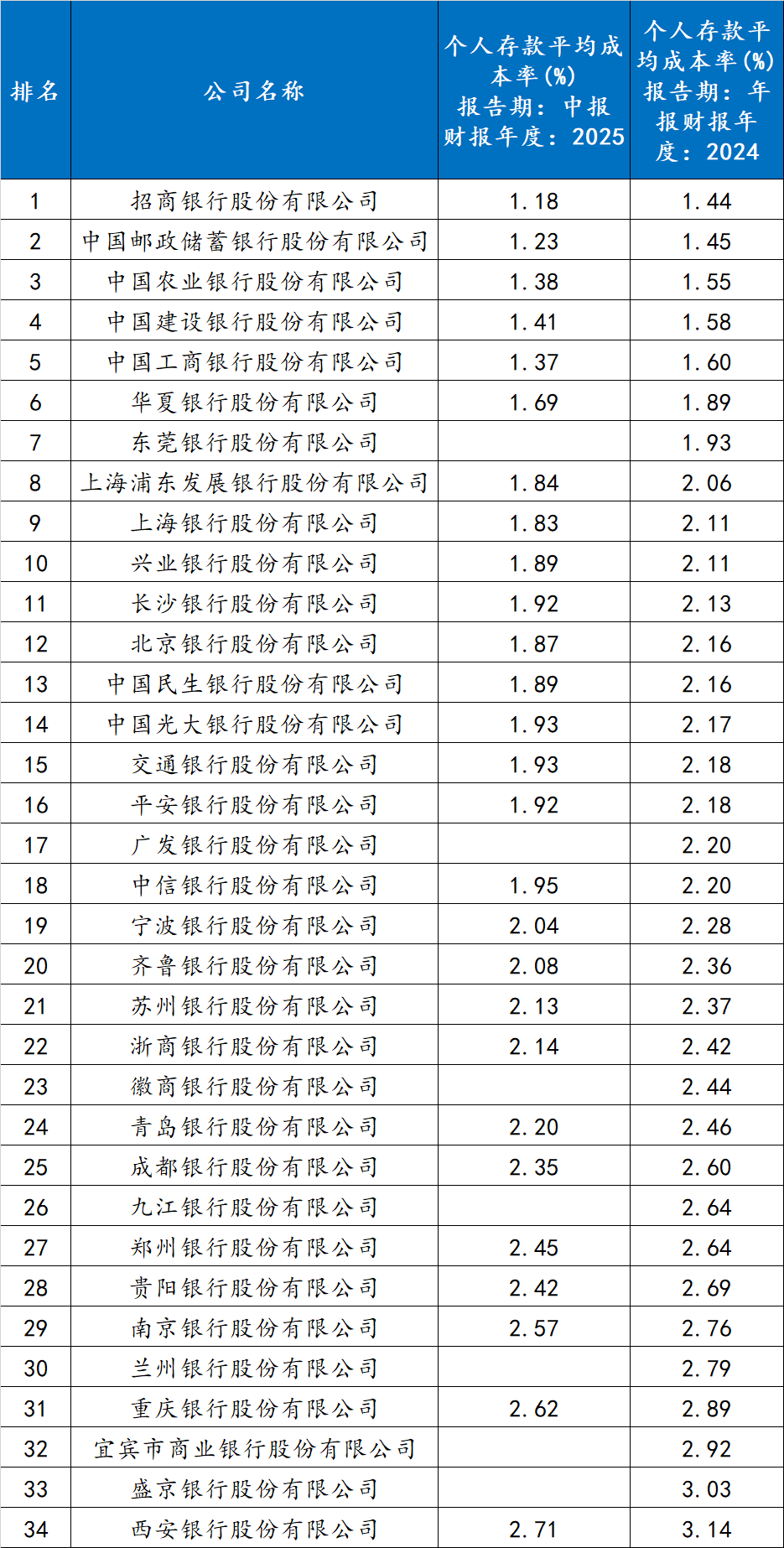
银行个人负债成本排名
Xin Lang Cai Jing· 2026-01-19 13:16
Core Insights - The average cost of personal deposits is a key indicator of banks' liability costs, with lower rates indicating stronger competitiveness in attracting deposits [1][7]. Group 1: Ranking of Banks by Deposit Cost - The banks with the lowest average cost of personal deposits are primarily state-owned large banks and some retail-focused joint-stock banks, with China Merchants Bank leading at 1.18% for the 2025 mid-year report [2][8]. - Following China Merchants Bank are China Postal Savings Bank at 1.23% and Agricultural Bank of China at 1.38%, benefiting from extensive branch networks and strong customer bases [2][8]. - The top six banks all have costs below 2%, indicating strong deposit cost control capabilities [2][8]. Group 2: Cost Trends and Observations - A notable trend is the general decline in average deposit costs across most banks when comparing 2024 annual reports to 2025 mid-year reports, with China Merchants Bank decreasing from 1.44% to 1.18% [6][12]. - This decline reflects a reduction in liability cost pressures for the banking industry, positively impacting net interest margins and profitability [6][12]. - However, lower deposit costs must align with asset yield and risk management capabilities, as a healthy bank seeks to balance these factors [12]. Group 3: Challenges for Joint-Stock and Regional Banks - Joint-stock banks and regional commercial banks generally face higher average deposit costs, often exceeding 2%, which can challenge their net interest margin management [5][11]. - National joint-stock banks like Industrial Bank and Minsheng Bank have costs ranging from 2.11% to 2.18%, while some regional banks experience even greater cost pressures [5][11].