OPPO

Search documents
From Global Awards to a Global Stage: OPPO Photography Awards 2025 Conclude with Finale Exhibition in Egypt
TMX Newsfile· 2025-12-19 07:11
Cairo, Egypt--(Newsfile Corp. - December 19, 2025) - OPPO today concluded the OPPO Photography Awards 2025 with its Finale Event in Cairo, Egypt, marking the conclusion of this year's global exhibition series. As one of the world's most inclusive mobile photography awards, the 2025 edition attracted nearly 2 million entries from 87 countries and regions, reflecting the growing role of mobile imaging in everyday visual storytelling.To view an enhanced version of this graphic, please visit:https://images.ne ...


OPPO Collaborates with UNESCO, Leveraging Tablets to Empower Educational Equity and Digital Inclusion in Asia and Africa
TMX Newsfile· 2025-12-19 07:09
Core Insights - OPPO has successfully completed its commitment to donate 1,000 tablets to five countries in Asia and Africa, collaborating with UNESCO and CODEMAO to promote educational equity and digital inclusion [1][4][5] Group 1: Donation Details - On December 15, OPPO donated 200 tablets to two pilot schools in Thailand, which will be used for programming practice by teachers and students [2][6] - The tablets will feature programming courses from the 'Youth Coding Initiative,' aimed at promoting safe technology use and equitable education [3] Group 2: Broader Impact - The initiative, announced in September 2024, includes donations to schools in Thailand, Congo Brazzaville, Kenya, Namibia, and Côte d'Ivoire, focusing on enhancing teaching capabilities in emerging technologies [4][5] - In regions like Kenya, Namibia, and Côte d'Ivoire, where hardware shortages exist, the collaboration aims to establish new digital classrooms, improving access to technology for young people [5] Group 3: Corporate Commitment - OPPO's collaboration with UNESCO reflects its commitment to youth empowerment and digital inclusion, emphasizing the use of technology for social good [7] - The company aims to continue leveraging technology to fulfill its long-term corporate social responsibility commitments [7][9]

联想要与字节合作AI手机?知情人士:一直紧密合作
Guan Cha Zhe Wang· 2025-12-19 06:51
Core Viewpoint - ByteDance is advancing collaborations with Lenovo and Transsion to integrate AI capabilities into smartphones, aiming to enhance user engagement and shift the current passive stance of AI in execution [1] Group 1: Collaboration and Product Development - ByteDance is working closely with Lenovo and other partners in the smart terminal sector, particularly with the "Doubao" mobile assistant application, which allows users to perform various tasks through voice commands [1] - The "Doubao" mobile assistant has sparked significant industry interest in the future of AI-enabled devices, although it faced initial user issues with popular applications like WeChat and banking apps [1][2] - Adjustments are being made to the AI mobile assistant's capabilities, including restrictions on certain applications to ensure compliance and user safety [2] Group 2: Strategic Intent and Market Position - ByteDance's strategy focuses on creating new monetization pathways rather than merely driving business growth, involving mobile manufacturers in revenue sharing from traffic distribution and subscription services [2] - Major smartphone manufacturers are cautious about relinquishing control over user access, with ByteDance emphasizing that it does not plan to develop its own smartphones [2] - Lenovo's Motorola brand, with a projected shipment of 16 million units by Q3 2025 and a 4.9% global market share, presents a significant opportunity for ByteDance to reach over 50 million users [3]

OPPO Reno15系列三周出货超200万 新品Reno15c今日开售
Zheng Quan Ri Bao Wang· 2025-12-19 04:49
Group 1 - The OPPO Reno15c was officially launched on December 19, with a starting price of 2899 yuan, targeting the student demographic as a "trendy entry-level choice" [1] - Since its launch on November 21, the OPPO Reno15 series has achieved over 2 million units in sales within three weeks, leading the market share in the 2500-4000 yuan price range, with over half of the users being young consumers from Generation Z [1] - OPPO ranked 13th in the "Top 50 Global Brands Favorite Among Generation Z" list released by Snapchat and Kantar [3] Group 2 - The OPPO Reno series, launched in 2019, has gained popularity among young consumers globally, with a cumulative activation of over 130 million units, indicating an average sales volume of over 10 million units per generation [3]

手机厂商“杀入”短剧市场:小米砸钱囤片,华为试水变现,图的是啥?
3 6 Ke· 2025-12-19 04:23
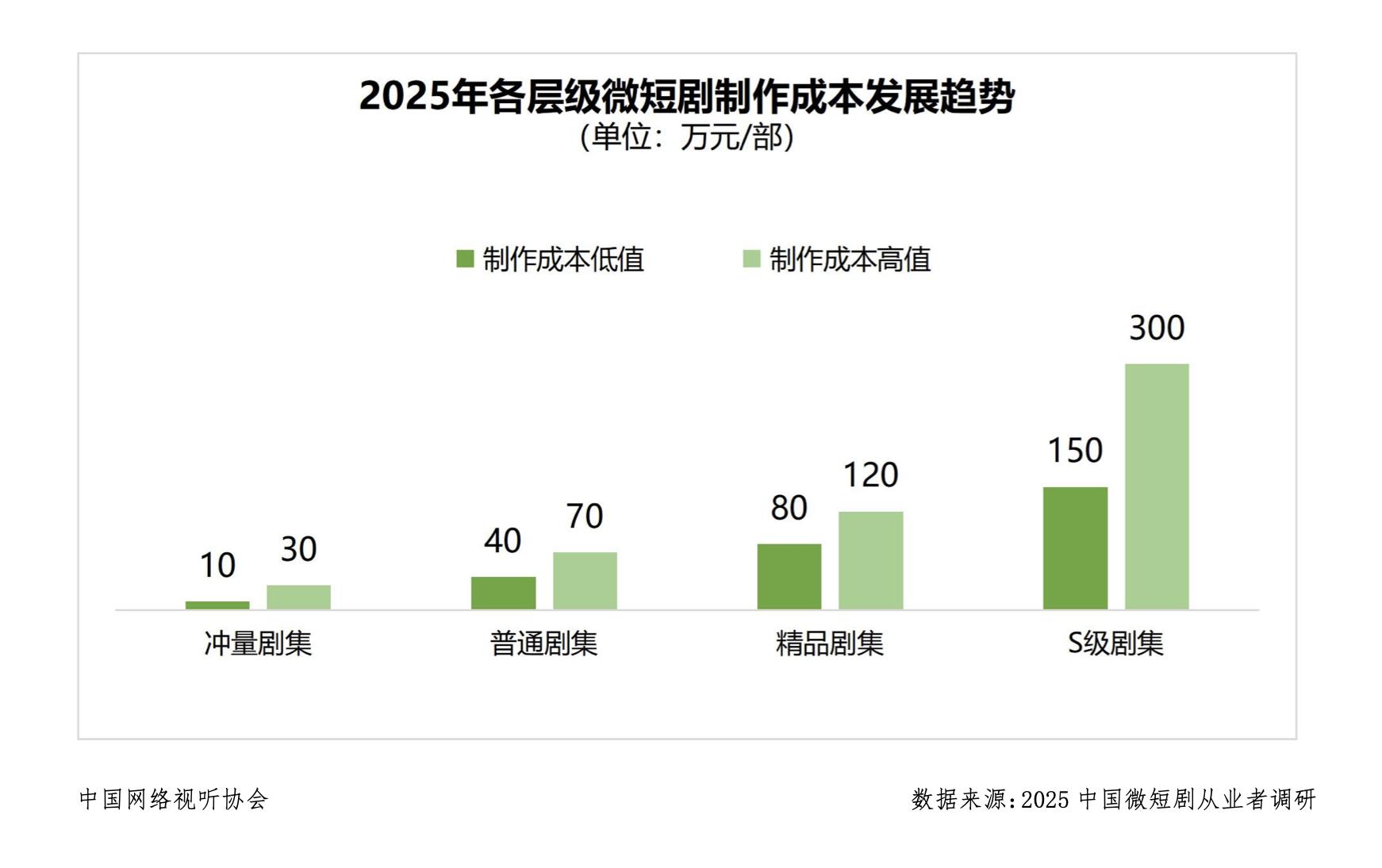
Market Growth - The short drama industry in China has rapidly expanded from a market size of 370 million yuan to over 50 billion yuan in just three years, with projections to exceed 68 billion yuan by 2025 and surpass 100 billion yuan by 2027 [1] - As of June this year, the user base for micro short dramas reached 626 million, accounting for 55.8% of the total internet users, with average daily usage time increasing to 120.5 minutes by August [1] Company Strategies - Xiaomi has developed 1,000 S-level short dramas, with an average consumption time of 70 minutes per user, indicating a significant investment in high-quality content [1][3] - The company has launched an independent short drama app called "Weiguan Short Drama," which is currently only available on the Xiaomi app store, emphasizing features like "ad-free" and "completely free" [4][9] Competitive Landscape - The leading apps in the short drama sector are Hongguo Short Drama and Hemat Theater, with Hongguo Short Drama holding a significant market lead [9] - Xiaomi's "Weiguan Short Drama" app has faced challenges in content variety, with fewer than 30 categories compared to competitors like Hemat Theater, which boasts over 10,000 short drama works across more than 100 categories [9] Industry Trends - The short drama industry is undergoing a trend towards premiumization, with major platforms focusing on S-level and high-quality productions [3] - The market for short dramas is seen as a new opportunity for smartphone manufacturers, as it offers lower production costs and better monetization potential compared to traditional video formats [26] Future Outlook - The short drama market is expected to continue its explosive growth, with significant potential for smartphone manufacturers to leverage this content for user engagement and brand promotion [29][30] - The integration of AI technology in short drama production is anticipated to enhance the creative process, making it a key area for future development [30][33]

苹果救得了小折叠吗?
创业邦· 2025-12-19 03:50
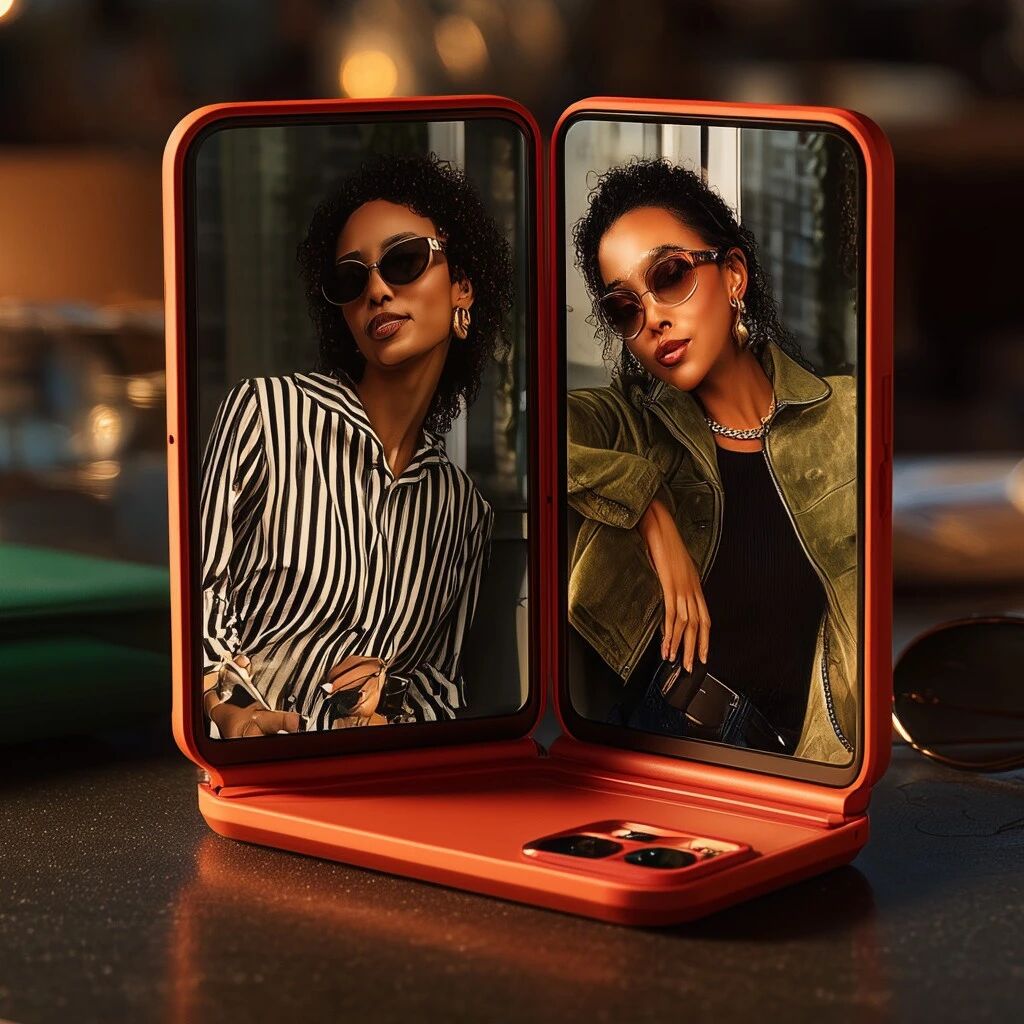
Core Viewpoint - The article discusses the anticipated entry of Apple into the foldable smartphone market, highlighting the challenges and market dynamics surrounding small foldable devices, particularly in comparison to traditional smartphones and larger foldable models [6][8][19]. Group 1: Apple's Foldable Smartphone Development - Apple has been working on foldable smartphone technology since at least 2011, focusing on addressing the issue of screen creases, which has been a significant barrier to market entry [9][11]. - Recent leaks suggest that Apple's first foldable iPhone will adopt a small flip design, similar to Huawei's Pura X, but with a more square aspect ratio [6][8]. - The company has developed various hinge designs to improve the folding mechanism, but achieving the desired results has proven difficult, leading to delays in product launch [13][14]. Group 2: Market Dynamics of Small Foldable Phones - Small foldable phones have struggled to gain traction in the market, with sales significantly lagging behind larger foldable models. In China, small foldable shipments are projected to be less than half of those for large foldables in 2024 [21][22]. - The lack of differentiation in functionality compared to traditional smartphones and the inability to command higher profit margins have hindered the success of small foldable devices [21][26]. - The additional costs associated with the unique components of small foldable phones, such as hinges and flexible screens, have led to lower profitability for manufacturers [29]. Group 3: Competitive Landscape and Manufacturer Strategies - Several manufacturers, including OPPO and vivo, have either paused or discontinued their small foldable phone development due to poor sales performance, while others like Xiaomi and Honor continue to explore this segment [31][32]. - Huawei has shifted its strategy by introducing the Pura X, which aims to enhance functionality through a larger display area, indicating a trend towards improving the utility of small foldable devices [38][40]. - Apple's brand strength may allow it to overcome pricing challenges in the small foldable market, but past experiences with products like the iPhone Air suggest that aesthetic appeal alone may not drive sales [40][41].

Counterpoint:成本上升影响终端需求 预计2026年全球智能手机出货量下跌2.1%
Zhi Tong Cai Jing· 2025-12-19 01:32
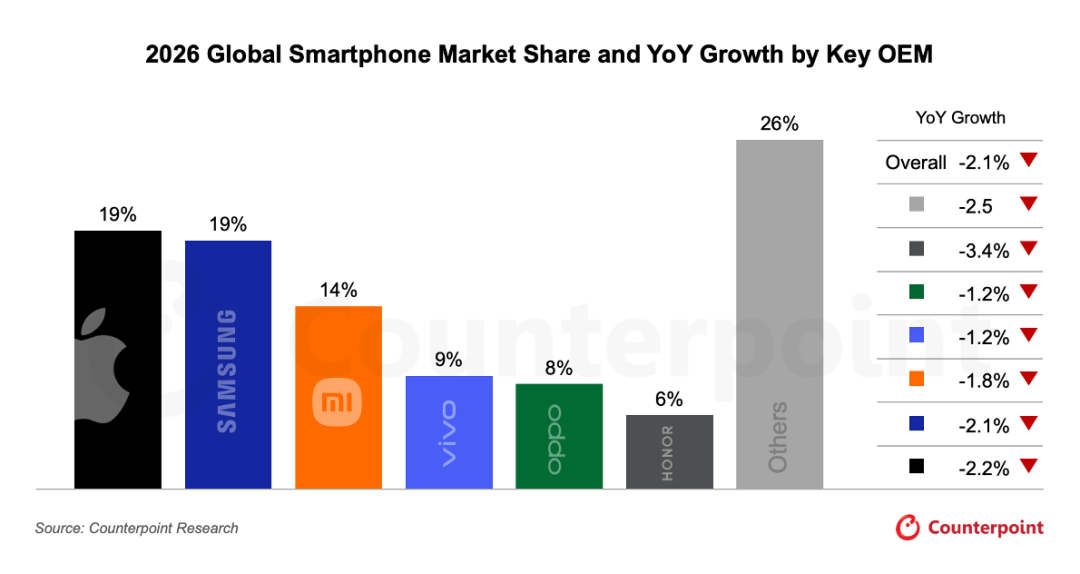
Core Insights - Counterpoint Research predicts a potential 2.1% decline in global smartphone shipments in 2026 due to rising component costs impacting end demand [1][4] - The forecast for 2026 has been revised down by 2.6 percentage points, with significant adjustments for Chinese OEMs like HONOR, OPPO, and vivo [4] Group 1: Market Trends - The low-end market (below $200) is expected to be significantly affected, with Bill of Materials (BoM) costs rising by 20%-30% since the beginning of the year [7] - Mid to high-end market segments are experiencing a cost increase of approximately 10%-15% [7] - Average smartphone selling prices are projected to increase by 6.9% in 2026, up from a previous forecast of 3.9% [7] Group 2: Competitive Landscape - Brands with scale advantages, comprehensive product lines (especially in high-end models), and vertical integration capabilities are expected to be more resilient to supply chain changes [8] - Market competition is anticipated to become more differentiated, with some brands facing challenges in balancing market share and profitability [8] - OEMs are adopting diverse strategies, including adjusting specifications of certain models and guiding consumers towards higher-spec versions to cope with cost and market changes [8]
存储成本走高,2026 年智能手机出货预期下滑
Counterpoint Research· 2025-12-19 01:10
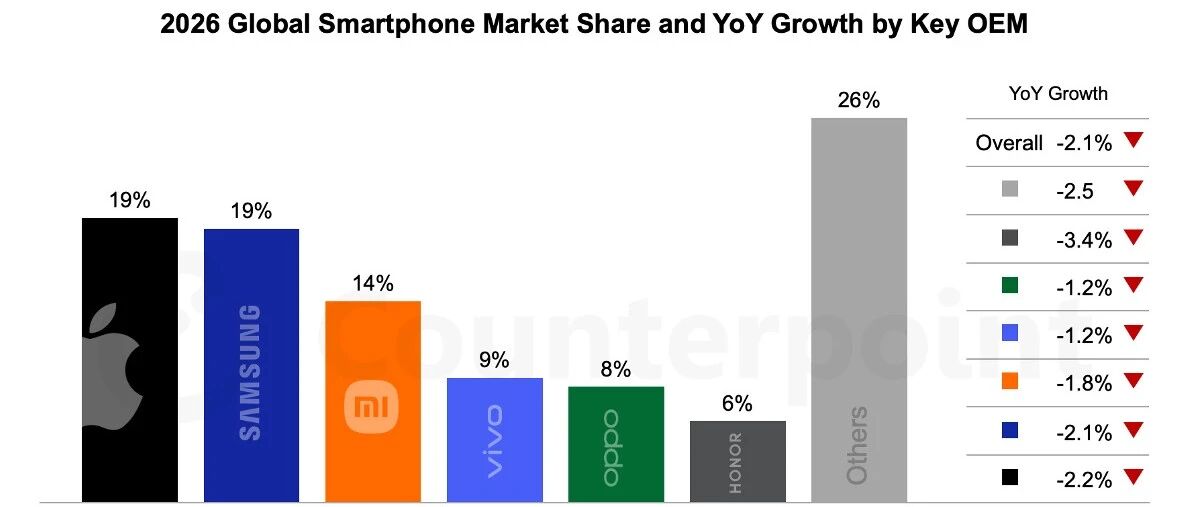
Core Insights - The global smartphone shipment volume is expected to decline by 2.1% in 2026 due to rising storage costs, marking a downward revision of 2.6 percentage points from previous forecasts [4][5][7]. Group 1: Market Trends - The increase in component costs is anticipated to impact end-user demand, particularly affecting Chinese OEMs like HONOR, OPPO, and vivo, which have seen significant adjustments in their forecasts [5][7]. - The average selling price of smartphones is projected to increase by 6.9% in 2026, up from a previous estimate of 3.6%, driven by rising Bill of Materials (BoM) costs [7][10]. Group 2: Cost Implications - DRAM prices have risen, leading to an increase in BoM costs by approximately 25% for low-end models, 15% for mid-range, and 10% for high-end models, with further increases expected in the second quarter of 2026 [7][9]. - The cost of storage is projected to rise by about 40% before the second quarter of 2026, further exacerbating BoM costs [9]. Group 3: Strategic Responses - OEMs are likely to adjust their product strategies in response to cost pressures, with some low-SKU models already experiencing reduced shipments [10]. - Companies are adopting various strategies, including adjusting specifications of camera modules, displays, and storage configurations, as well as streamlining product lines to cope with market changes [10].
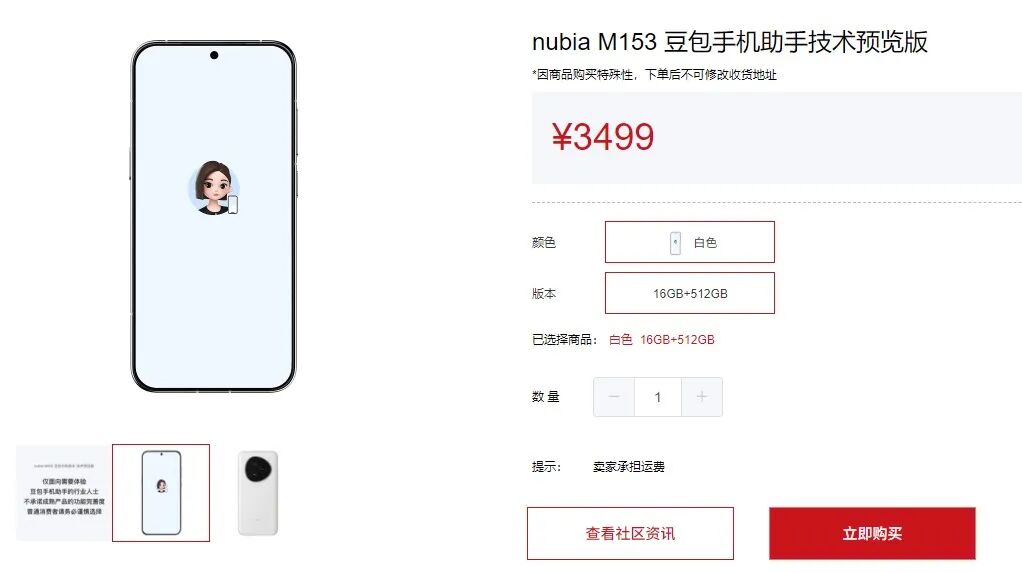
豆包手机恢复销售,华为、荣耀等多数手机厂商仍在调用无障碍权限
3 6 Ke· 2025-12-19 00:12
Core Viewpoint - The emergence of Doubao phone has sparked significant controversy due to its ability to access underlying system permissions, allowing it to simulate human interactions without relying on apps or manufacturers, raising concerns about privacy and compliance [1][14][24] Group 1: Doubao Phone Controversy - Doubao phone's assistant has resumed product purchase eligibility, indicating a return to the market amidst ongoing debates [1] - The phone's ability to bypass traditional app interactions has led to a clash with major platforms like WeChat and Alipay, which have implemented restrictions to prevent its use [17][19] - Doubao's approach challenges the dominance of super apps as traffic entry points, potentially disrupting existing business models [17][24] Group 2: AI Assistant Capabilities - AI assistants in new devices like Honor Magic 8 and Huawei Mate 80 have significantly improved, now capable of executing complex tasks such as price comparisons and product selections [5][6] - The use of "accessibility" permissions by various manufacturers allows AI assistants to enhance user experience by simulating clicks and reading screen content [6][7] - Doubao phone's assistant utilizes a deeper system-level permission (INJECT_EVENTS), enabling it to perform actions across multiple apps without relying on accessibility tools [16][14] Group 3: Industry Response and Compliance Issues - Major companies have expressed resistance to Doubao's operational model, citing security and risk management concerns [17][19] - The use of high-risk permissions by Doubao phone has raised alarms among app developers, particularly in social and content sectors, where user engagement is critical [21] - International competitors like Apple and Google are adopting a more cautious approach, focusing on user consent and privacy compliance rather than full automation [22][24] Group 4: Market Trends and Future Outlook - The demand for AI-enabled smartphones in China is projected to grow significantly, with an expected shipment of 147 million units by 2026, representing a 31.6% year-on-year increase [24] - The rapid development of AI capabilities in smartphones raises important questions about data security and the ethical use of AI, which the industry must address moving forward [24]
从“猎奇”到“信赖”:折叠屏手机用户发展洞察报告
艾瑞咨询· 2025-12-19 00:06
Core Insights - The global foldable smartphone market is experiencing continuous growth, particularly in China, driven by technological advancements and an improved supply chain, leading to product diversification [1] - China has emerged as a major growth engine for the global foldable smartphone market, with Huawei maintaining a significant market share and leading the industry [1][18] - User willingness to purchase foldable smartphones is increasing, with higher expectations for product functionality and experience [1] - The transition from niche to mainstream market for foldable smartphones is anticipated, with sustained demand growth and a focus on hardware optimization, software ecosystem development, and enhanced user interaction experiences [1] Market Overview - The global smartphone market has entered a phase of stock competition since 2017, with annual shipment volumes declining by approximately 2.52%, projected to reach 1.22 billion units by 2024 [2] - The flat smartphone market has become saturated, prompting manufacturers to innovate product forms to explore the high-end market [5] Competitive Landscape - The foldable smartphone industry chain includes upstream raw material supply, midstream design and manufacturing, and downstream sales [7] - Chinese foldable smartphone manufacturers, such as Huawei and Samsung, are leading the industry chain with strong technological capabilities and market influence [7][8] User Behavior and Preferences - The majority of foldable smartphone users are male and female, with a higher preference among first-tier and new first-tier city users [20] - Users with higher education levels, particularly those with a bachelor's degree or above, show a greater preference for foldable smartphones [20] - The price range for most users' foldable smartphones is between 5,000 to 9,000 yuan, with Huawei being the most used brand at 62.3% [22] Purchase Motivations - The key reason for purchasing foldable smartphones is the stronger sense of technology and futurism, accounting for 44.7% of users [24] - Users have a substantial budget for purchasing foldable smartphones, with 28.4% willing to spend between 8,000 to 10,000 yuan [24] Brand Recognition and Image - Huawei leads in brand recognition across various dimensions, including high-end perception, business style, technological innovation, and reputation [26][28] - Users express high satisfaction with Huawei products, indicating strong user recognition and loyalty [30] User Experience and Pain Points - Current user satisfaction is highest for Huawei, followed by Xiaomi and Samsung, with a notable willingness to recommend these brands [30][31] - Users report pain points related to hardware durability, such as screen wear and tear, and software issues like poor visual effects [39] Future Outlook - Over 90% of consumers are considering purchasing a foldable smartphone for their next device, focusing on reliability, battery life, and hardware specifications [41] - The foldable smartphone market is transitioning from a niche to a mainstream product, with 95.5% of consumers willing to switch to a foldable device in the future [47]