
大成基金

Search documents
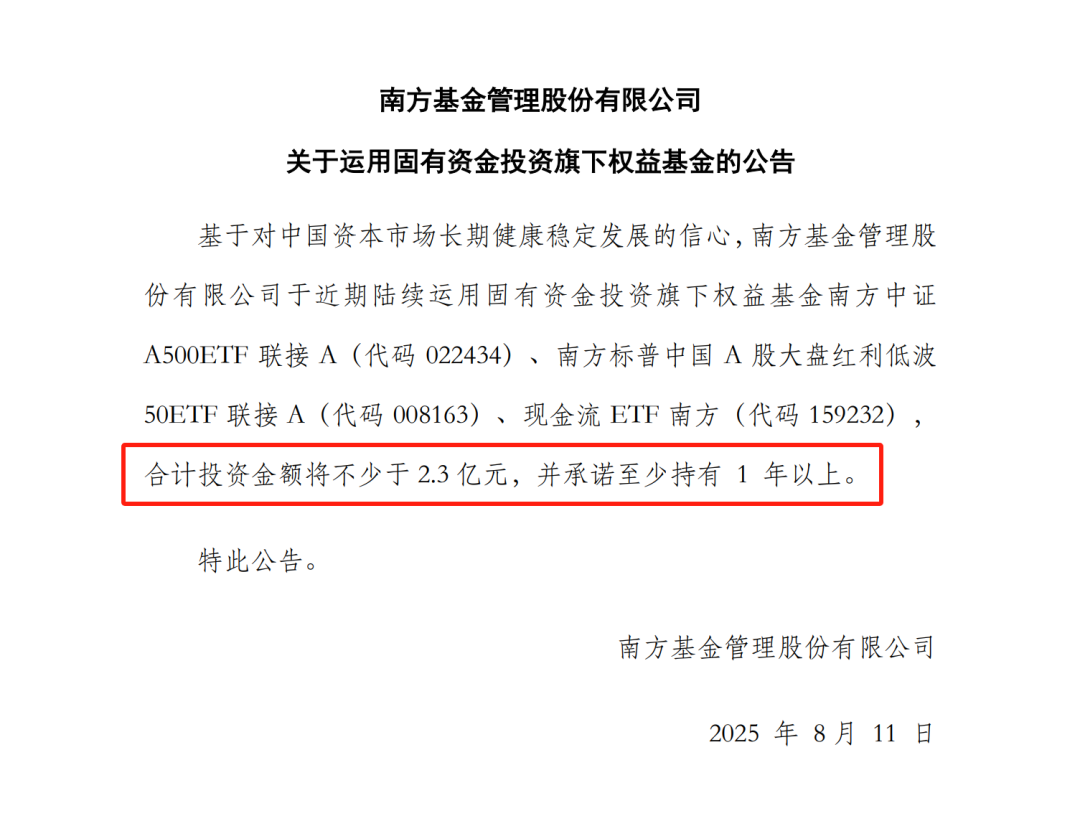
南方基金出手!2.3亿,自购!
券商中国· 2025-08-10 16:05
Core Viewpoint - Public funds in China are showing strong confidence in the equity market by significantly increasing their self-purchases, indicating a positive outlook for the second half of the year [2][3][5]. Group 1: Self-Purchase Activities - On August 10, Southern Fund announced a self-purchase of 230 million yuan in three equity ETFs, reflecting confidence in the long-term stability of the Chinese capital market [1][3]. - As of August 10, nearly 130 public funds have initiated self-purchases this year, totaling over 5 billion yuan, with equity fund products accounting for a substantial portion [2][3]. - Other funds, such as Dachen Fund and Industrial Bank of China Fund, have also committed significant amounts to self-purchases, further demonstrating institutional confidence [4]. Group 2: Market Outlook and Valuation - The self-purchase trend is driven by the perception of a valuation gap in the capital market, with a slow bull market expected rather than a rapid surge [6][7]. - As of August 6, the price-to-earnings ratios for the CSI 300 and Hang Seng indices were 13.93 and 11.83, respectively, both lower than major mature markets like the S&P 500 (26.89) and Nikkei 225 (18.88), highlighting the investment attractiveness of the Chinese market [7]. - The strong resilience of the Chinese economy, evidenced by a 5.3% GDP growth in the first half of the year, supports the positive outlook for the capital market [7][8]. Group 3: Investor Behavior and Trends - There is a notable shift of household savings towards the capital market, driven by declining deposit rates, which is expected to create more investment opportunities [8]. - The issuance of new equity funds has seen a significant increase, with many new funds surpassing 1 billion yuan in initial scale, indicating a rising willingness among investors to enter the market [8]. - Foreign capital inflows into A-shares and Hong Kong stocks have also been substantial, with over 10.1 billion USD entering in the first half of the year, suggesting a continued positive sentiment towards Chinese assets [8].

刚刚!巨头官宣大手笔自购:2.3亿元!
Zhong Guo Ji Jin Bao· 2025-08-10 15:30
Core Viewpoint - Fund companies are demonstrating confidence in the A-share market by investing their own funds into equity funds, with a total investment amount of no less than 230 million yuan from Southern Fund alone, indicating a strong belief in the long-term health of the Chinese economy and capital market [1][2][3]. Group 1: Fund Company Actions - Southern Fund announced the use of its own funds to invest in its equity funds, including Southern CSI A500 ETF and Southern S&P China A-Share Large Cap Dividend Low Volatility ETF, with a total investment of at least 230 million yuan and a commitment to hold for at least one year [3]. - Other fund companies such as ICBC Credit Suisse, Founder Fubon, and Great Wall Fund have also engaged in self-purchase actions, indicating a trend among asset management institutions to invest their own capital [1][6][10]. - The total net subscription amount for equity funds (stock and mixed types) by public institutions has reached 2.464 billion yuan this year, reflecting a sustained trend of self-purchase actions by fund companies [16]. Group 2: Market Confidence and Economic Outlook - Industry insiders believe that the participation of public funds using their own capital enhances investor trust and clearly conveys confidence in the Chinese capital market [6]. - The Chinese economy's strong vitality and resilience are seen as the foundation for the long-term positive development of the capital market, with a GDP growth of 5.3% in the first half of the year [18]. - The current valuation of the Chinese stock market is considered attractive, with the price-to-earnings ratios of the CSI 300 Index and Hang Seng Index being lower than those of major mature markets, presenting a good opportunity for long-term investors [18]. - The capital market's importance is increasingly recognized, with ongoing policy support enhancing investor protection mechanisms and improving the quality and structure of listed companies [18]. Group 3: Future Market Expectations - A fund company expressed a cautiously optimistic view on the A-share market for the second half of 2025, anticipating a three-phase upward cycle driven by policy support, technology, and globalization [19].
刚刚!巨头官宣大手笔自购:2.3亿元!
中国基金报· 2025-08-10 15:24
Core Viewpoint - The article emphasizes the confidence in the Chinese capital market, highlighted by Southern Fund's announcement of a self-purchase of its equity funds amounting to at least 230 million yuan, reflecting a strong belief in the long-term health and stability of the market [2][5]. Group 1: Fund Company Actions - Southern Fund has committed to investing at least 230 million yuan in its equity funds, including specific ETFs, and will hold these investments for a minimum of one year [5]. - Other fund companies, such as ICBC Credit Suisse, Founder Fubon, and Great Wall, have also engaged in self-purchases, indicating a broader trend among asset management institutions to invest their own funds [3][10][12]. - The total net subscription amount for equity funds (stock and mixed types) by public institutions has reached 2.464 billion yuan this year, showcasing a significant commitment to the market [17]. Group 2: Market Confidence and Economic Outlook - The article notes that the recent recovery in the market has led many institutions to recognize the medium to long-term investment value of A-shares, supported by China's strong economic vitality and resilience [19]. - Despite external complexities, China's GDP achieved a steady growth of 5.3% in the first half of the year, indicating a positive macroeconomic trend [19]. - The current valuation of the Chinese stock market is considered attractive, with the price-to-earnings ratios of major indices being lower than those of developed markets, presenting a good opportunity for long-term investors [19]. Group 3: Future Market Expectations - A cautious optimism is expressed regarding the A-share market for the second half of 2025, with expectations of a fluctuating upward trend driven by policy support, technological advancements, and financial reforms [20][21]. - The article outlines a three-phase upward cycle for A-shares, suggesting a positive outlook for sectors such as technology and domestic demand stimulation [21].

重回聚光灯下 主动权益类基金打响“正名之战”
Shang Hai Zheng Quan Bao· 2025-08-10 14:03
Group 1 - The core viewpoint is that actively managed equity funds are regaining attention and performance after years of underperformance, with significant returns observed in 2023 [2][3] - As of August 6, 2023, the Dongcai Ordinary Stock Fund Index and the Mixed Equity Fund Index both exceeded a 16% increase, outperforming passive index funds and fixed-income funds [3] - Nearly 10 actively managed equity funds have doubled their net value this year, with notable funds like Huazhang Medical Industry Selected Mixed Fund seeing a 130% increase in net value [3][4] Group 2 - Despite some actively managed funds experiencing significant inflows, the overall scale of these funds has declined, with a nearly 10 billion yuan drop in total scale in Q2 2023 [4] - The market's rapid changes and sector rotations have increased investment difficulty, with industry rotation cycles shortening to about two months [5][6] - Fund managers are facing higher demands for timely and precise adjustments to their portfolios due to frequent shifts in market sentiment and investment noise [5][6] Group 3 - The investment strategy has shifted from relying on broad market trends to focusing on individual stock selection, with a notable decline in the concentration of holdings in top sectors and stocks [8][9] - Fund managers are increasingly looking for opportunities in smaller, innovative companies, particularly in the pharmaceutical sector, which are on the verge of value reassessment [9][10] - The industry is emphasizing the importance of enhancing research capabilities and establishing a robust investment research framework to adapt to the evolving market landscape [10]

FOF产品缘何上演“冰与火之歌”?
Shang Hai Zheng Quan Bao· 2025-08-10 13:40
Core Viewpoint - The FOF (Fund of Funds) market is experiencing a dichotomy, with some products struggling to survive due to low scales while others are achieving remarkable success, indicating a profound transformation in the asset management industry [1][2]. Group 1: Market Phenomenon - Several FOFs have been liquidated due to their small scale, with over 10 FOFs facing liquidation this year alone [2]. - Conversely, there have been notable successes, such as the Morgan Stanley Yingyuan Stable Three-Month Holding Period FOF, which sold out in one day with a scale of 2.752 billion [2]. - Other successful FOFs include the Dongfanghong Yingfeng Stable Allocation Six-Month Holding Period FOF with a scale of 6.573 billion and the Fuguo Yinghe Zhenxuan Three-Month Holding Period FOF with a scale of 6.001 billion [2]. Group 2: Changing Investor Demands - The shift in FOF performance is attributed to changes in investment strategies, with a focus on multi-asset allocation aimed at stable returns and high drawdown control [3]. - The increasing availability of multi-asset allocation tools in the public fund market has provided more options for FOF investments [3]. - Investors are becoming more risk-averse, prioritizing stable asset appreciation, which is reflected in the sales channels of banks [3]. Group 3: Strategic Developments - Major banks are increasingly emphasizing FOF products, collaborating with fund companies to create FOF selection pools [4]. - The TREE Long-term Plan by China Merchants Bank exemplifies a one-stop asset allocation solution that adheres to multi-asset allocation strategies [4]. Group 4: Future Outlook - The FOF market is transitioning into a 2.0 multi-asset allocation era, with recent FOFs adopting strategies characterized by diverse asset allocation [6]. - Analysts highlight the advantage of FOFs in utilizing various sub-funds across stocks, bonds, and commodities to achieve long-term and value investments [6]. - New FOF products are increasingly incorporating "multi-asset" in their names, indicating a trend towards diversified asset allocation [6]. Group 5: Recommendations - Future FOF products should focus on returning to the essence of asset allocation by incorporating assets like gold, overseas markets, REITs, and commodities to meet the needs of retirement investment and absolute returns [7].
含“权”产品“受宠”机构提高权益仓位乐看后市
Shang Hai Zheng Quan Bao· 2025-08-10 13:40
Institutional Movements - The demand for "equity" products is increasing, with institutions raising their equity positions and optimistic about the market outlook [1] - "Fixed income +" products are experiencing a surge in popularity, with significant inflows and a notable increase in total scale from 13,807.34 billion to 14,815.72 billion [2][3] Fund Performance - The "fixed income +" fund's core strategy involves using fixed income assets as a base while enhancing returns through equity assets, leading to a shift in investor behavior towards seeking controlled-risk returns [3] - The median returns for short-term and medium-term pure bond funds were 0.85% and 0.77% respectively, indicating a compression in yield potential for traditional savings products [3] Equity Asset Focus - The issuance of equity funds remains robust, with over 10 equity funds exceeding 1 billion in issuance since July, reflecting a market recovery [4] - Insurance institutions are increasingly promoting equity funds, with several funds recently appointing insurance companies as distribution channels [4] Market Outlook - Multiple institutions are signaling intentions to increase equity asset allocations, with expectations of further strengthening in the A-share market [5] - The market is perceived to have significant upside potential due to economic resilience, policy support, and ongoing shifts in resident asset allocation [6]

帮主郑重:基金限购潮!三路真金急刹车,散户该慌还是抢?
Sou Hu Cai Jing· 2025-08-10 07:03
Core Viewpoint - The recent wave of fund subscription limits is a strategic move to protect existing investors and manage liquidity, rather than a lack of investment opportunities [3][4]. Group 1: Reasons Behind Subscription Limits - The primary reason for the subscription limits is to prevent dilution of returns for existing investors, especially in high-performing funds like China Europe Digital Economy, which has surged 60% this year [3]. - Subscription limits are also implemented to avoid strategy collapse in quantitative funds, where rapid inflows can overwhelm existing models and lead to poor performance [3]. - Limited foreign exchange quotas are another factor, as seen with Huatai-PineBridge Hong Kong Stock QDII, which has gained 144% this year but faces capacity constraints [3]. Group 2: Types of Subscription Limits - There are three categories of subscription limits: protective limits for high-performing funds, such as China Europe Digital Economy and Yongying Ruixin, which aim to secure profits and prevent speculative inflows [4]. - Risky limits include those on funds with low assets under management, which may indicate impending liquidation, and those that limit certain share classes to prevent arbitrage [5]. - Subscription limits can also signal potential pitfalls for investors, particularly in funds with high premiums or those that are heavily reliant on dividends [5]. Group 3: Investment Strategies for Retail Investors - Retail investors are advised to target funds with strong order backlogs and limited capacity, such as China Europe Digital Economy and Yongying Ruixin, which have significant growth potential [6]. - Investors should avoid funds with low asset bases, as they have a high probability of liquidation, and those with low institutional ownership, which may be subject to speculative trading [7]. - Monitoring subscription limits and market conditions is crucial; for instance, if a fund's scale increases by more than 20% weekly, it may be wise to reduce exposure [8].

社保必须交,到手工资会变少吗?
Sou Hu Cai Jing· 2025-08-09 12:20
Group 1 - The financing and securities lending balance in the A-share market has surpassed 2 trillion yuan for the first time in ten years, indicating a significant increase in retail investor activity [2][5] - Financing is the dominant component of the total balance, reflecting retail investor sentiment, as institutional investors typically do not use leverage [5][10] - Although the absolute value of financing has exceeded the peak seen in September last year, the proportion of financing balance to the A-share circulating market value has not yet reached the same level as last September [6][8] Group 2 - A new judicial interpretation from the Supreme People's Court states that any agreement to waive social insurance is invalid, which will impact companies that previously offered cash in lieu of social insurance [15][16] - The stricter regulations are aimed at addressing pension pressures and ensuring that more of the 230 million flexible workers participate in pension insurance [17][18] - Companies that fail to comply with the new regulations will face increased labor costs and potential penalties, which may lead them to prefer hiring part-time or outsourced workers [22][20] Group 3 - The rise of AI-generated content has led to an increase in information supply without a corresponding increase in value, prompting the need for effective content filtering methods [26][27] - Two key standards for identifying valuable information include the "shelf life" of the information and the "value" of the content created, emphasizing the importance of enduring insights and thoughtful analysis [28][30] - Investors are encouraged to focus on timeless topics and classic works that provide a solid foundation for understanding investment principles [31][32]
百亿基金经理收益回暖!张坤规模领衔,王明旭7产品年内亏损
Nan Fang Du Shi Bao· 2025-08-08 07:51
Group 1 - The core viewpoint of the articles indicates a strong recovery in the performance of actively managed equity funds in 2025, with 95% of these funds achieving positive returns and an average return exceeding 15% as of August 7 [2][3] - The pharmaceutical sector has emerged as the biggest winner, with four actively managed equity funds achieving returns that have doubled this year, all focusing on the pharmaceutical industry [4][5] - As of mid-2025, there are 90 fund managers managing over 10 billion yuan, with Zhang Kun from E Fund leading with over 50 billion yuan under management [8][9] Group 2 - The average return of actively managed equity funds has outperformed major stock indices, such as the CSI 300 and the CSI 500, which recorded returns of 4.6% and 10.6% respectively [3] - The average return of the entire market of over 4,500 actively managed equity funds is 15.03%, compared to 11.8% for over 2,500 stock index funds [3] - Despite the overall positive performance, there are still 228 actively managed equity funds with negative returns, with the worst performer, Qianhai Kaiyuan AI A, showing a return of -18.5% [4][6] Group 3 - The top-performing funds in the pharmaceutical sector include Changcheng Pharmaceutical Industry Selection, Bank of China Hong Kong Stock Connect Pharmaceutical, Yongying Pharmaceutical Innovation Selection, and Huashan Pharmaceutical Biotechnology, all achieving significant returns [4][5] - The performance of fund managers varies significantly, with some, like Zhang Wei and Zhang Lu, achieving returns of 65.8% and 53.4% respectively, while others, such as Wang Mingxu, have negative returns [12][13] - The total scale of actively managed equity funds reached 3.39 trillion yuan by mid-2025, although the total number of shares decreased by 198.24 billion compared to the end of the previous year [6][7]
市场活跃机会增多 公募指增产品超额收益“加速跑”
Zhong Guo Zheng Quan Bao· 2025-08-08 07:18
Core Insights - The A-share market has seen high activity this year, with nearly 80% of public quantitative index-enhanced funds outperforming their benchmarks, particularly those tracking small-cap indices like CSI 1000 and CSI 2000 [1][2] Group 1: Performance of Quantitative Funds - Nearly 80% of public index-enhanced funds have achieved excess returns this year, with significant outperformance noted in funds tracking small-cap indices [2] - For instance, the performance of the Zhaoshang CSI 2000 Enhanced Strategy ETF reached a return of 20.80%, while its benchmark only increased by 9.74%, resulting in an excess return of 11 percentage points [2] - Funds tracking larger indices like CSI 300 and CSI 500 have shown less impressive excess returns, with some achieving over 5 percentage points above their benchmarks [2] Group 2: Market Conditions and Strategy - The high activity level in the A-share market this year has been favorable for quantitative strategies, with growth factors and trading behavior factors contributing significantly to excess returns [4] - The competitive landscape for excess returns has intensified due to the rapid growth of public and private quantitative products, leading to a normalization of excess returns expected in 2024 [4][6] - The introduction of the "Action Plan for Promoting High-Quality Development of Public Funds" has reinforced the constraints of performance benchmarks, prompting a focus on stable excess returns [6] Group 3: Future Outlook and Risk Management - Future index-enhanced products are expected to diversify sources of excess returns and control risk exposure to maintain performance across varying market conditions [7] - The performance of new products like the CSI A500 index-enhanced funds has shown significant variation, influenced by factors such as establishment and investment timing [3][5] - The need for a more disciplined approach to risk management and the use of multi-factor systems for stock selection is emphasized to enhance long-term performance [6][7]