OPPO

Search documents
昀冢科技:公司消费电子产品终端应用于华为、小米等主流品牌智能手机
Zheng Quan Shi Bao Wang· 2025-12-04 09:00
Core Viewpoint - Yunzong Technology (688260) announced on December 4 that its stock experienced abnormal trading fluctuations, with a cumulative decline of 30% over three consecutive trading days [1] Company Overview - Yunzong Technology primarily engages in the research, design, production, and sales of products in the fields of consumer electronics, electronic ceramics, and automotive electronics [1] - The company's main business is focused on consumer electronics, specifically audio coil motors (VCM) and camera modules (CCM) used in smartphone cameras [1] - The end applications of the company's consumer electronic products include major smartphone brands such as Huawei, Xiaomi, OPPO, VIVO, and Honor [1] - There has been no change in the company's main business operations [1]

昀冢科技(688260.SH):消费电子产品主要应用在智能手机摄像头中的音圈马达VCM和摄像头模组CCM中
Ge Long Hui A P P· 2025-12-04 08:56
Core Viewpoint - Yunzhu Technology (688260.SH) focuses on the research, design, manufacturing, and sales of products in the consumer electronics and electronic ceramics, as well as automotive electronics sectors [1] Group 1: Business Overview - The company primarily engages in the consumer electronics business, which is its main revenue source [1] - Yunzhu Technology's consumer electronic products are mainly used in the voice coil motors (VCM) and camera modules (CCM) of smartphone cameras [1] Group 2: Clientele - The end applications of the company's products include major smartphone brands such as Huawei, Xiaomi, OPPO, VIVO, and Honor [1]
2025年第三季度全球智能手机产量达3.28亿支
WitsView睿智显示· 2025-12-04 08:28
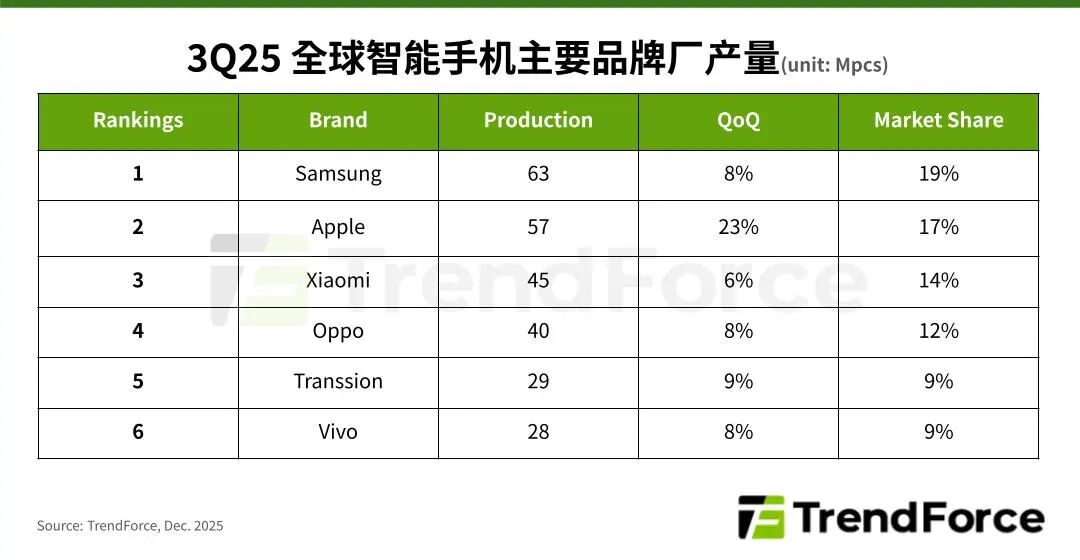
Core Viewpoint - The smartphone market is expected to see a seasonal increase in production in the second half of 2025, with a projected quarterly growth of 9% and an annual growth of 7%, reaching 328 million units. However, supply constraints in memory components may impact lower-tier smartphone profitability, potentially offsetting some growth momentum [2]. Group 1: Market Performance - The Chinese market is projected to see a slight annual sales increase of 2%, maintaining a 23% market share as the largest consumer market due to subsidy policies in the first quarter [3]. - India is expected to grow by 2% in annual sales, holding a 13% market share, benefiting from recovering demand [3]. - North America is forecasted to experience a 1% annual sales decline, with an 11% market share, as demand has slowed down in the second half of the year [3]. Group 2: Brand Production Rankings - Samsung leads the market with a production of approximately 63 million units, a quarterly increase of 8%, and a market share of 19% [4][6]. - Apple follows with a production of about 57 million units, achieving its highest third-quarter output ever, and holds a 17% market share [4][7]. - Xiaomi ranks third with nearly 45 million units produced, a quarterly increase of 6%, and a market share of 14% [4][8]. - OPPO produced around 40 million units, with an 8% quarterly increase, benefiting from sales recovery in India and Southeast Asia [4][9]. - Transsion reached a production of over 29 million units, a quarterly increase of 9%, primarily driven by emerging markets in Africa and Asia [4][10]. - Vivo produced approximately 28 million units, with a quarterly increase of over 8%, and its market share is closely trailing Transsion [4][11].





非洲手机之王净利大跌45%,盯上储能、电动车
2 1 Shi Ji Jing Ji Bao Dao· 2025-12-04 07:59
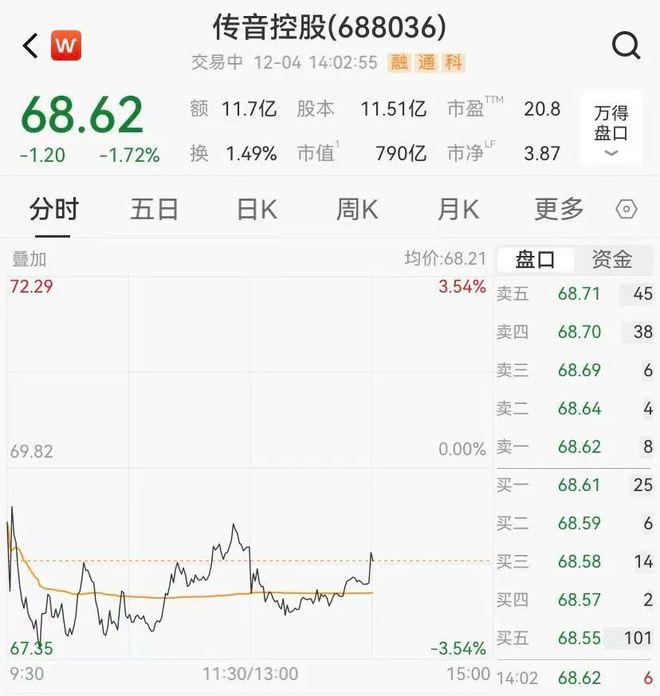
Core Viewpoint - Transsion Holdings, known as the "King of Mobile Phones in Africa," is seeking to shed this label by diversifying its business and pursuing a Hong Kong IPO to enhance its growth prospects [2][12]. Group 1: Company Overview - Transsion Holdings has submitted an application for H-share issuance and listing on the Hong Kong Stock Exchange [2]. - The company has established a strong market presence in Africa, leveraging hardware designs suited for local conditions and camera algorithms optimized for darker skin tones [2][7]. - In Q3, Transsion's global smartphone shipments reached 28.6 million units, ranking fourth globally with a year-on-year growth of 12% [2]. Group 2: Financial Performance - Despite its market success, Transsion faces increasing pressure on its financial performance, with a 3.33% year-on-year decline in revenue to CNY 49.54 billion in the first three quarters of the year [6]. - The company's net profit and net profit excluding non-recurring items fell by 44.97% and 46.71% respectively, indicating significant profitability challenges [6]. - The stock price has dropped 30% since reaching a peak of CNY 104.9 in September, closing at CNY 68.62 on December 3 [2][3]. Group 3: Market Challenges - Rising storage product prices and increased competition from domestic manufacturers targeting emerging markets are significant challenges for Transsion [2][6]. - Competitors like Xiaomi, Honor, and OPPO are rapidly expanding in the African market, with Xiaomi's shipments growing by 34% year-on-year [7][8]. - The global storage chip price surge is expected to continue until 2026, further squeezing Transsion's profit margins, as storage components account for 15%-25% of costs in mid-range smartphones [6][8]. Group 4: New Growth Areas - Transsion is actively exploring new growth avenues, including energy storage and electric two-wheeled vehicles, with IoT products and other revenues reaching CNY 2.568 billion, accounting for 8.8% of total revenue [4][10]. - The company has launched energy storage products under the DYQUE Energy brand, targeting both high-end and budget markets [10][12]. - The REVOO brand for electric two-wheeled vehicles was established in 2022, with plans for expansion into South Asia and Latin America [13].
太抢手了!3499元“豆包助手”手机一天就卖光,闲鱼最高溢价超过6500元【附智能手机行业市场分析】
Qian Zhan Wang· 2025-12-04 06:40
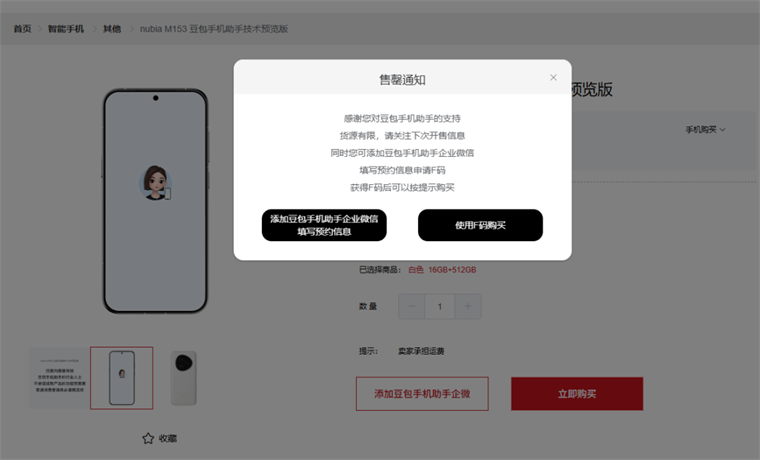
Core Insights - The "Doubao Assistant" engineering prototype, developed by ByteDance and ZTE, sold out within a day of its release, indicating strong market demand for AI-integrated smartphones [1][6] - The device is not a mass-market product but an engineering sample aimed at developers and tech enthusiasts, featuring high-end specifications and a unique AI assistant [1][2] - The smartphone market in China is highly concentrated, with major players like Vivo and Huawei holding significant market shares [3][5] Group 1: Product Overview - The "Doubao Assistant" is priced at 3499 yuan and features flagship specifications, including a 6.78-inch screen and Qualcomm Snapdragon 8 Gen 2 platform, making it attractive to developers [1][2] - The AI assistant can perform tasks across applications, breaking down data barriers and enhancing user experience [2][6] Group 2: Market Dynamics - The Chinese smartphone market is dominated by a few key players, with Vivo holding a 17.2% market share and Huawei over 16% in 2024 [3] - The top five manufacturers (Vivo, Huawei, Honor, OPPO, Xiaomi) account for approximately 80.8% of the market share, indicating high market concentration [5] Group 3: Industry Implications - The success of the "Doubao Assistant" prototype highlights the potential for system-level AI integration in smartphones, which could reshape the industry [6][7] - Traditional smartphone manufacturers may need to adapt to this new model of AI-defined hardware, which could disrupt existing brand-user relationships [6][7]

2399元起!一加发布新机型Ace 6T
Guo Ji Jin Rong Bao· 2025-12-04 06:32
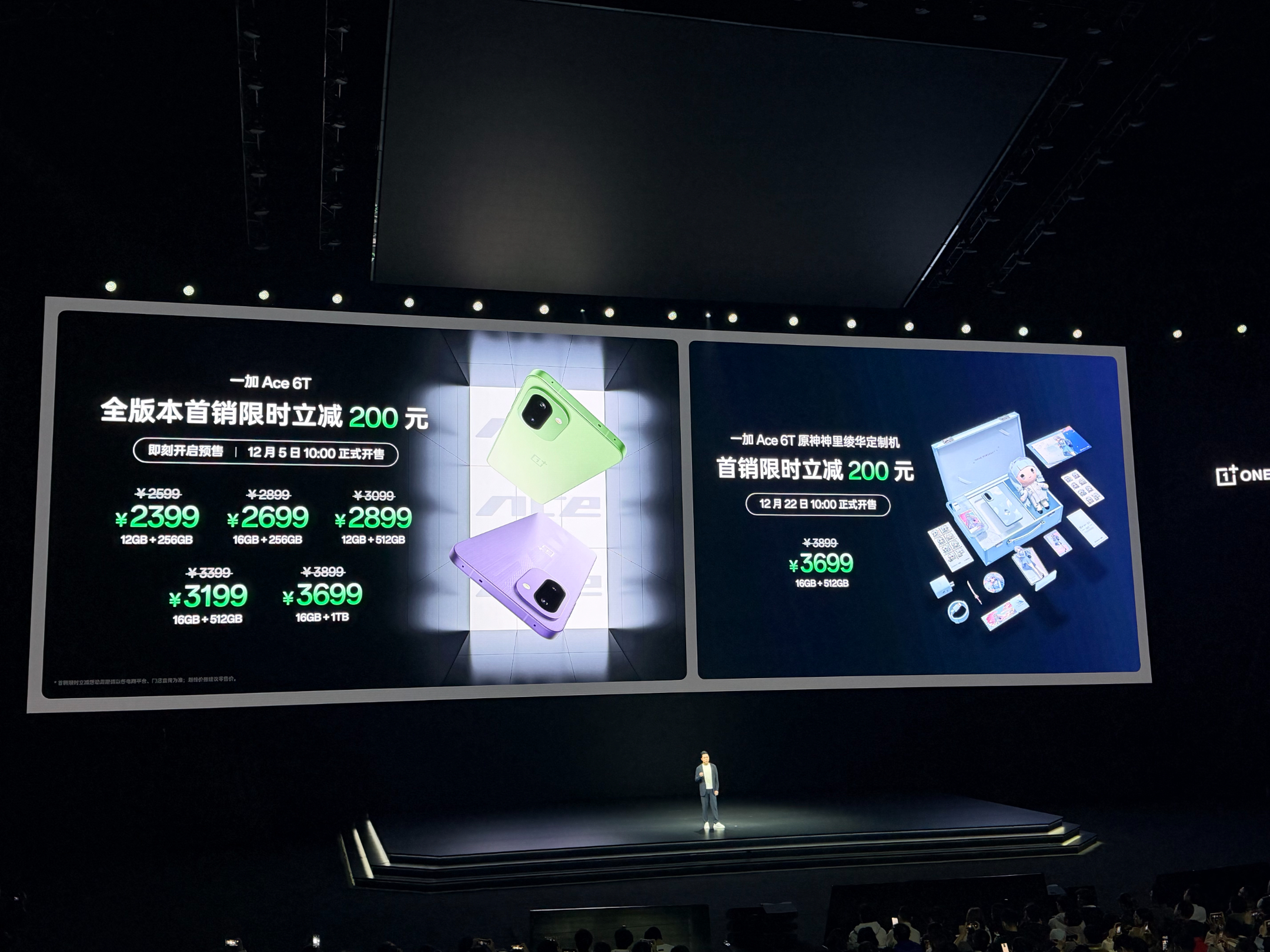
Core Insights - OnePlus has launched the OnePlus Ace 6T, a new member of its performance flagship series, with a starting price of 2399 yuan, lower than the Ace 6's starting price of 2599 yuan, and it will officially go on sale on December 5 [1][3] - The OnePlus Ace 6T features the Snapdragon 8 Gen 5 chip, which is the result of a 24-month collaboration with Qualcomm, offering a 36% increase in CPU performance and an 11% increase in GPU performance compared to the previous generation [1][3] Product Features - The OnePlus Ace 6T is positioned as a "new choice for performance flagships," highlighting its Snapdragon 8 Gen 5 chip, an 8300mAh battery, and a 165Hz high refresh rate screen [3] - The device supports native 165Hz high refresh rate mode for the game "Peacekeeper Elite," aiming to promote the widespread adoption of 165Hz gaming [3] - The Ace 6T is fully compatible with popular games like "Delta Force" and "Call of Duty Mobile," providing a native 165Hz experience for various gaming genres [3] Strategic Focus - OnePlus has partnered with miHoYo to launch a special edition of "Genshin Impact," priced at 3699 yuan, available from December 22 [4] - The company targets young users with a strong preference for gaming, optimizing all aspects of product design and software to meet their needs [4] - OnePlus has evolved from a latecomer in the Chinese smartphone industry to a brand with a clear user strategy, supported by significant investment from OPPO [4][5] Product Matrix - OnePlus's product lineup includes three main series: the digital flagship series (e.g., OnePlus 13, OnePlus 15) targeting high-end all-rounders, the Ace series (e.g., OnePlus Ace 6 / Ace 6T) focusing on high performance and cost-effectiveness for gaming, and an IoT and ecosystem product line including tablets, watches, and headphones [5]
TrendForce:第三季全球智能手机生产数按季增9% 达3.28亿支
智通财经网· 2025-12-04 06:03
Core Viewpoint - The global smartphone production is expected to increase by 9% quarter-on-quarter and 7% year-on-year in Q3 2025, reaching 328 million units, driven by seasonal demand and new product launches from brands [1]. Group 1: Market Trends - The fourth quarter will see flagship brands launching new models, supported by global e-commerce promotions, although tight memory supply and rising prices may compress profit margins for low-end smartphones [1]. - The overall smartphone production forecast for 2025 is projected to grow by 1.6% year-on-year, with potential downward adjustments due to memory supply issues [1]. Group 2: Regional Performance - In China, subsidy policies significantly boosted consumption in Q1, with an expected slight year-on-year sales increase of 2%, maintaining a 23% market share as the largest consumer market [1]. - India ranks second with a 13% market share, benefiting from recovering demand, with a projected 2% year-on-year sales growth [1]. - North America, the third-largest market, is expected to see a 1% year-on-year sales decline, with a market share of 11% due to slowed demand in the second half of the year [1]. Group 3: Brand Production Performance - Samsung produced approximately 63 million units in Q3, an 8% increase, maintaining a 19% market share as the leading brand [3]. - Apple achieved a production of about 57 million units in Q3, the highest for that quarter historically, securing the second position with a 17% market share [4]. - Xiaomi's production reached nearly 45 million units in Q3, a 6% increase, placing it third in the market [5]. - OPPO produced around 40 million units in Q3, an 8% increase, benefiting from sales recovery in India, Southeast Asia, and Latin America [6]. - Transsion's production exceeded 29 million units in Q3, a 9% increase, driven by growth in emerging markets in Africa and Asia [7]. - Vivo's production totaled approximately 28 million units in Q3, with an increase of over 8%, closely competing with Transsion [8].
研报 | 传统旺季与新品带动,2025年第三季度全球智能手机产量季增9%
TrendForce集邦· 2025-12-04 05:50
Core Insights - The global smartphone production is expected to increase by 9% quarter-over-quarter and 7% year-over-year in Q3 2025, reaching 328 million units, driven by seasonal demand and new product launches [2] - Despite the growth, the tightening supply and rising prices of memory components may compress profit margins for low-end smartphones, potentially offsetting some growth momentum [2] - The overall smartphone production forecast for 2025 is projected to grow by 1.6% year-over-year, with a possibility of downward revision due to memory supply issues [2] Regional Market Performance - In China, the subsidy policy significantly boosted consumption in Q1, with an estimated annual sales growth of 2%, maintaining a 23% market share as the largest consumer market [2] - India ranks second with a 13% market share, benefiting from recovering demand, with an expected annual sales growth of 2% [2] - North America, the third-largest consumer market, is projected to see a 1% decline in annual sales due to a slowdown in demand after preemptive stocking by brands in the first half of the year, holding an 11% market share [2] Brand Production Rankings - Samsung leads with a production of approximately 63 million units, an 8% increase quarter-over-quarter, maintaining a 19% market share [3][5] - Apple follows with a production of about 57 million units, marking the highest production for Q3 in its history, benefiting from successful pricing and capacity upgrades of the iPhone 17 [3][6] - Xiaomi ranks third with nearly 45 million units produced, a 6% quarter-over-quarter increase, driven by new product launches and festive season stocking [3][7] - OPPO, in fourth place, produced around 40 million units, an 8% increase, supported by sales recovery in India, Southeast Asia, and Latin America [3][8] - Transsion ranks fifth with over 29 million units produced, a 9% increase, primarily driven by emerging markets in Africa and Asia [3][9] - Vivo, in sixth place, produced approximately 28 million units, with a growth of over 8%, aided by demand for mid-to-high-end models [3][10]
千寻位置:时空服务月调用量破万亿次,每秒处理超38万次请求
Xin Lang Cai Jing· 2025-12-04 02:52
Core Insights - The company, Qianxun Location, has announced that its monthly spatiotemporal intelligent service call volume has exceeded 1 trillion times for two consecutive months, making it the first platform globally to reach this milestone [1][2] - The monthly call volume has increased tenfold from 100 billion times in March 2022 to over 1 trillion times in just three and a half years, equating to approximately 380,000 service requests processed per second [1][2] Smart Driving Sector - Qianxun Location has provided services to over 3.5 million smart connected vehicles, with a reliability risk as low as 10⁻⁷ per hour, supporting advanced driving functions such as high-speed NOA [1][2] - The company currently facilitates over 10 billion kilometers of driving mileage for intelligent vehicles each month, covering major brands like XPeng, Aion, Li Auto, and others [1][2] Low-altitude Economy - In the low-altitude economy sector, Qianxun Location has assisted over 200,000 drones and other low-altitude aircraft in completing various professional tasks, accumulating nearly 4 billion kilometers of service mileage [3] - This service mileage is equivalent to these aircraft flying around the Earth nearly 100,000 times [3] Consumer Market - The number of smartphones supporting Qianxun Location's high-precision positioning capabilities has surpassed 50 million units, covering major brands such as Huawei, Honor, OPPO, and VIVO [3]
豆包“撞墙”微信:所有AI手机厂商都将面临的生态战争正式引燃
3 6 Ke· 2025-12-04 02:21
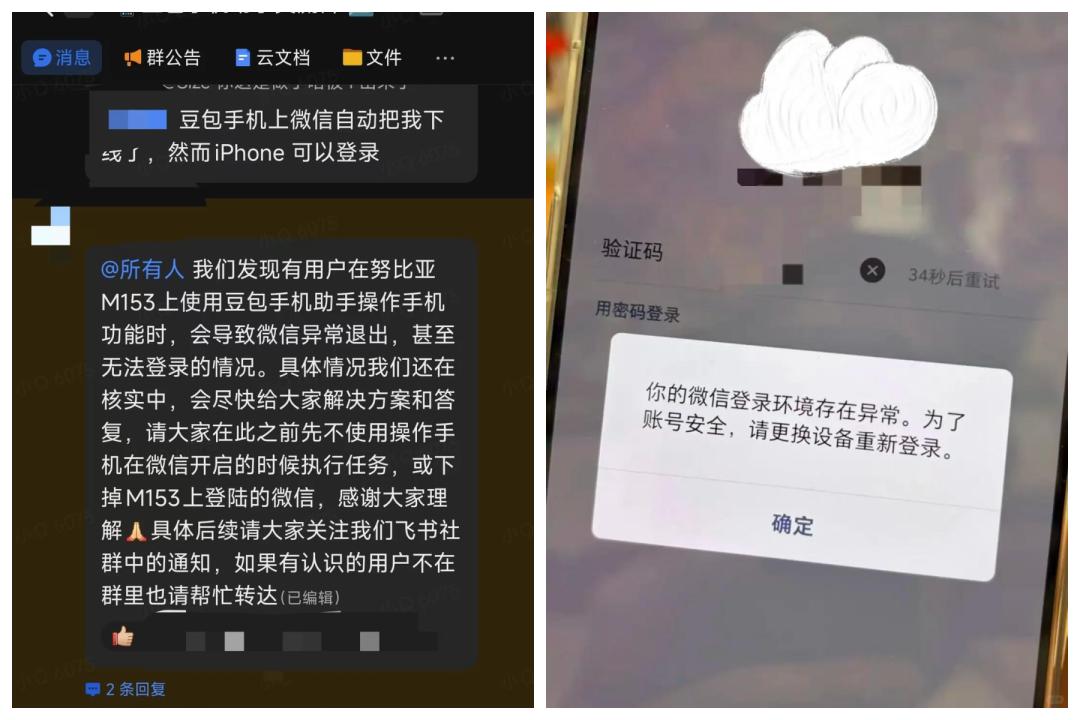
豆包助手在微信上的短暂尝试如闪电般照亮了行业深水区的暗礁。这部售价3499元却溢价千元的手机,成为了一个时代的测试机,测试技术的 边界,也测试商业的容忍度。 3日多位努比亚M153用户发现,当他们使用豆包手机助手操作涉及微信的任务时,微信会异常退出甚至无法登录。 微信方面回应称"可能是触发了安全风控",而豆包则宣布其操作手机功能"目前不再支持操作微信"。 这场短暂而激烈的交锋,表面上是一场技术兼容性问题,实则揭开了AI手机时代生态控制权的边界之争。 Part.1 权限的诱惑与代价 豆包手机助手之所以能够实现"全网比价并下单"的炫酷演示,核心在于它获得了INJECT_EVENTS这一系统级权限。 这一权限允许应用模拟用户的点击、滑动等操作,在多应用间自动跳转,但在安卓生态中历来被视为"高危操作"。它打破了应用之间的沙盒隔离原则,使 得一个应用可以操纵其他应用。 虽然小米小爱、荣耀Yoyo等手机厂商的原生助手也拥有类似权限,但它们的使用范围通常被严格限制在自家生态内。 豆包的不同之处在于,它试图用这一权限调度整个移动互联网生态,包括微信这样的国民级应用。 冲突由此爆发,即豆包凭什么有权限重新划定边界? Part. ...