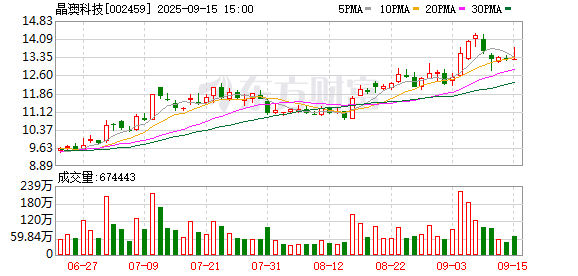
晶澳科技

Search documents
硅业分会:市场情绪高涨 单晶硅片价格继续上行
智通财经网· 2025-09-18 08:11
Core Insights - The price of silicon wafers continues to rise this week, driven by an increase in polysilicon prices and positive market sentiment [1][2] - The average transaction prices for various types of N-type silicon wafers have shown significant increases compared to the previous week [1][3] Price Trends - N-type G10L silicon wafer (182*183.75mm/130μm) average price is 1.32 CNY per piece, up 3.13% week-on-week - N-type G12R silicon wafer (182*210mm/130μm) average price is 1.40 CNY per piece, up 1.45% week-on-week - N-type G12 silicon wafer (210*210mm/130μm) average price is 1.68 CNY per piece, up 5.00% week-on-week [1][3] Supply and Demand Dynamics - On the supply side, the price of polysilicon continues to rise, leading silicon wafer manufacturers to be optimistic about future market conditions - On the demand side, overseas demand remains strong due to the impact of U.S. anti-dumping measures and expected domestic export tax rebate policies, resulting in a high volume of orders for battery cells [1][2] Production Capacity - The overall operating rate in the industry remains stable, with two leading companies operating at 52% and 50% capacity, while integrated companies operate between 54% and 80%, and other companies operate between 50% and 80% [1] Future Outlook - In the short term, the increase in polysilicon prices is expected to support current silicon wafer prices due to rising production costs and sustained overseas demand - In the medium term, the price trend of silicon wafers will depend on terminal demand and the acceptance of price increases by component manufacturers [2]

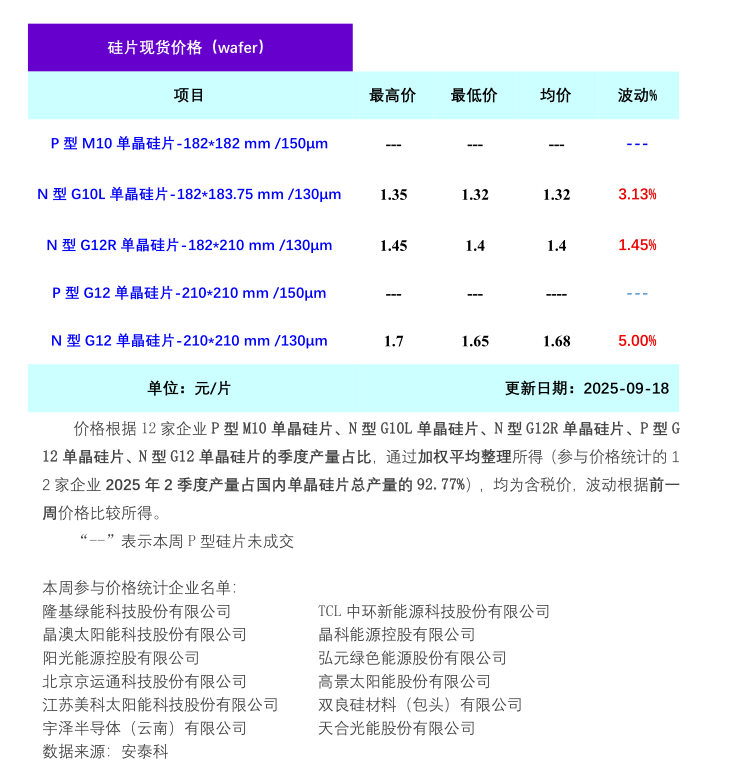
【安泰科】单晶硅片周评-市场情绪高涨 硅片价格继续上行(2025年9月18日)
中国有色金属工业协会硅业分会· 2025-09-18 07:55
Core Viewpoint - The price of silicon wafers continues to rise, driven by increasing polysilicon prices and strong demand from overseas markets, particularly in light of favorable policies and stable production rates in the industry [1][2]. Group 1: Silicon Wafer Prices - The average transaction price for N-type G10L monocrystalline silicon wafers (182*183.75mm/130μm) is 1.32 yuan per piece, up 3.13% week-on-week [1]. - The average transaction price for N-type G12R monocrystalline silicon wafers (182*210mm/130μm) is 1.40 yuan per piece, up 1.45% week-on-week [1]. - The average transaction price for N-type G12 monocrystalline silicon wafers (210*210mm/130μm) is 1.68 yuan per piece, up 5.00% week-on-week [1]. Group 2: Market Dynamics - The increase in silicon wafer prices is attributed to rising polysilicon prices, which have boosted market sentiment [1]. - On the supply side, the continuous rise in polysilicon prices has led silicon wafer manufacturers to be optimistic about future market conditions [1]. - On the demand side, the impact of U.S. anti-dumping measures and corresponding tariffs, along with expectations of domestic export tax rebate policies, has resulted in strong overseas demand and increased orders for battery cells [1]. Group 3: Production Rates - The overall operating rate in the industry remains stable, with two leading companies operating at rates of 52% and 50%, while integrated companies operate between 54% and 80% [1]. - Other companies have operating rates ranging from 50% to 80% [1]. Group 4: Battery and Module Prices - The mainstream price for battery cells is 0.29-0.30 yuan/W, reflecting a week-on-week increase of 0.01 yuan/W [2]. - The mainstream price for modules remains stable at 0.66-0.68 yuan/W, unchanged from the previous week [2]. - In the short term, the increase in polysilicon prices is expected to raise silicon wafer production costs, while sustained overseas demand supports current silicon wafer prices [2].



晶澳科技股价跌5.03%,国泰基金旗下1只基金重仓,持有83.8万股浮亏损失57.82万元
Xin Lang Cai Jing· 2025-09-18 06:28
Company Overview - JA Solar Technology Co., Ltd. is located in Beijing and was established on October 20, 2000. It was listed on August 10, 2010. The company specializes in the research, production, and sales of silicon wafers, solar cells, and solar modules, as well as the development, construction, and operation of solar photovoltaic power plants [1]. Financial Performance - As of September 18, JA Solar's stock price decreased by 5.03%, trading at 13.03 CNY per share, with a total transaction volume of 999.3 million CNY and a turnover rate of 2.27%. The company's total market capitalization is 43.125 billion CNY [1]. - The main revenue composition of JA Solar includes photovoltaic modules at 91.10%, other sources at 5.85%, and photovoltaic power plant operations at 3.05% [1]. Fund Holdings - According to data from the top ten holdings of funds, one fund under Guotai Fund has a significant position in JA Solar. The Guotai CSI Photovoltaic Industry ETF (159864) increased its holdings by 17,700 shares in the second quarter, bringing the total to 838,000 shares, which represents 2.31% of the fund's net value, ranking it as the ninth largest holding [2]. - The Guotai CSI Photovoltaic Industry ETF (159864) was established on July 28, 2021, with a current scale of 363 million CNY. Year-to-date returns are at 21.51%, ranking 2496 out of 4222 in its category, while the one-year return is 44.38%, ranking 2558 out of 3804. Since its inception, the fund has experienced a loss of 41.02% [2]. Fund Management - The fund manager of the Guotai CSI Photovoltaic Industry ETF (159864) is Huang Yue, who has been in the position for 4 years and 227 days. The total asset scale of the fund is 29.614 billion CNY, with the best return during his tenure being 57.72% and the worst return being -54.34% [3].
晶澳科技(002459) - 东方金诚国际信用评估有限公司关于晶澳太阳能科技股份有限公司2025年半年度业绩亏损的关注公告
2025-09-17 13:02
东方金诚国际信用评估有限公司关于晶澳太阳能科技股份有限 公司 2025 年半年度业绩亏损的关注公告 1 东方金诚公告【2025】0373 号 东方金诚国际信用评估有限公司(以下简称"东方金诚")受托对晶澳太阳能科技股份有限公 司(以下简称"晶澳科技"或"公司")及其发行的"晶澳太阳能科技股份有限公司向不特定对象 发行可转换公司债券"(以下简称"晶澳转债")进行了信用评级。2025 年 6 月 20 日,东方金诚 对晶澳科技主体及"晶澳转债"进行了定期跟踪评级,维持晶澳科技主体信用等级为 AA+,评级展 望稳定,维持"晶澳转债"信用等级为 AA+,评级结果自评级报告日起至到期兑付日有效。 东方金诚将持续关注上述事项后续进展情况,关注晶澳科技的经营和财务状况的变化,并及时 披露相关事项对晶澳科技主体信用等级、评级展望以及对"晶澳转债"债项信用等级可能产生的影 响。 特此公告。 东方金诚国际信用评估有限公司 2025 年 9 月 16 日 1 特别声明: 本公告的著作权等相关知识产权均归东方金诚所有。除委托评级合同约定外,委托方、受评对象等任何使用者未经东方金诚书面授权,不 得用于发行债务融资工具等证券业务活动或其 ...
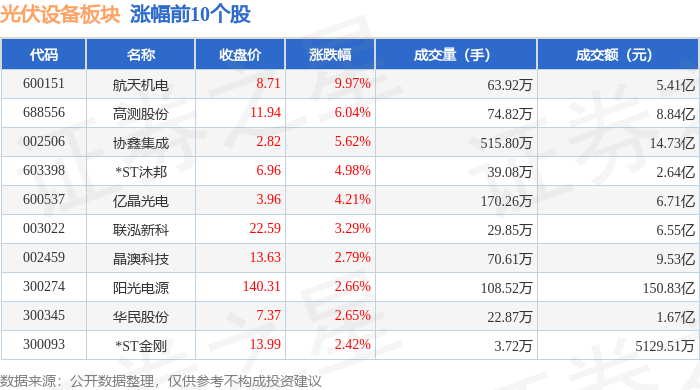
光伏设备板块9月16日涨0.76%,航天机电领涨,主力资金净流出11.31亿元
Zheng Xing Xing Ye Ri Bao· 2025-09-16 08:53
Market Overview - On September 16, the photovoltaic equipment sector rose by 0.76%, with Aerospace Electromechanical leading the gains [1] - The Shanghai Composite Index closed at 3861.87, up 0.04%, while the Shenzhen Component Index closed at 13063.97, up 0.45% [1] Stock Performance - Notable gainers in the photovoltaic equipment sector included: - Aerospace Electromechanical (600151) with a closing price of 8.71, up 9.97% on a trading volume of 639,200 shares and a turnover of 541 million yuan [1] - High Measurement Co. (688556) closed at 11.94, up 6.04% with a trading volume of 748,200 shares and a turnover of 884 million yuan [1] - GCL-Poly Energy (002506) closed at 2.82, up 5.62% with a trading volume of 5,158,000 shares and a turnover of 1.473 billion yuan [1] Fund Flow Analysis - The photovoltaic equipment sector experienced a net outflow of 1.131 billion yuan from institutional investors, while retail investors saw a net inflow of 1.076 billion yuan [2] - The main fund flows for selected stocks included: - Sunshine Power (300274) with a net inflow of 558 million yuan from institutional investors [3] - GCL-Poly Energy (002506) had a net inflow of 232 million yuan from institutional investors [3] - Aerospace Electromechanical (600151) saw a net inflow of 176 million yuan from institutional investors [3]




并购股权到手就质押贷款,这家“光伏银浆龙头”资金压力不一般地大
3 6 Ke· 2025-09-16 02:50
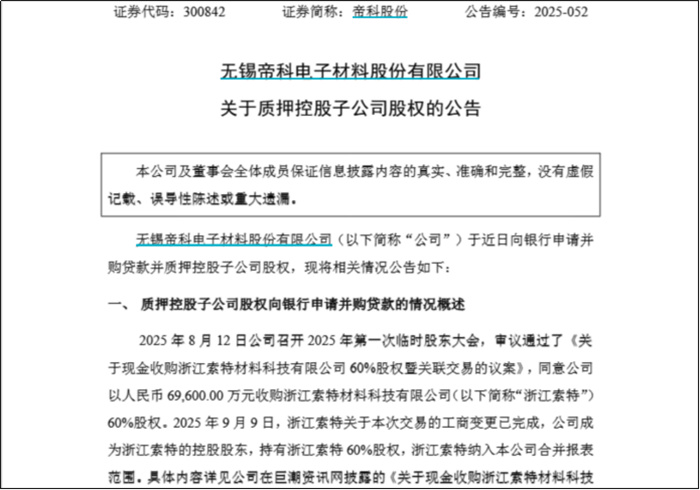
Core Viewpoint - Dike Co., Ltd. has pledged its newly acquired 60% stake in Zhejiang Sote Materials Technology Co., Ltd. to secure a loan of up to 400 million RMB, highlighting ongoing cash flow issues despite high sales volumes in the photovoltaic silver paste market [1][2]. Group 1: Acquisition Details - Dike Co., Ltd. announced two significant acquisitions: a 60% stake in Zhejiang Sote for 696 million RMB and an 80% stake in Zhejiang Jinko New Materials for 8 million RMB [2]. - The valuation for Zhejiang Sote was set at 1.16 billion RMB, representing a 74% premium over its net assets of 667 million RMB, while the valuation for Jinko New Materials reached 100 million RMB, indicating a staggering 299.08% premium over its net assets of 25.06 million RMB [2]. Group 2: Financial Performance - Dike Co., Ltd. has faced negative operating cash flow each quarter since 2019, raising concerns about its financial health [1]. - The company reported a net profit of 360 million RMB in 2024, a decline of 6.66% year-on-year, and a significant drop of 70.03% in net profit to 69.81 million RMB in the first half of 2025 [7][8]. Group 3: Market Position and Challenges - Dike Co., Ltd. is a leading player in the photovoltaic silver paste market, achieving a global market share of 26.9% in 2024, ranking first [7]. - The company faces intense competition in the silver paste market, with supply exceeding demand, particularly for front-side silver paste [9]. - Rising silver prices have increased production costs, while demand from downstream battery manufacturers has decreased due to inventory pressures [9]. Group 4: Debt and Cash Flow Management - Dike Co., Ltd.'s debt has surged from 784 million RMB in 2020 to 7.438 billion RMB in mid-2025, with a debt ratio of 80.42% [12][15]. - The company has implemented various measures to manage cash flow, including focusing on high-quality customers and improving accounts receivable management [13]. - Legal actions have been initiated against clients with outstanding debts, amounting to approximately 214 million RMB, which is 12.76% of the company's latest audited net assets [15].
光伏:反内卷扎实推进,Q4价格有望上涨
2025-09-15 14:57
Summary of the Solar Industry Conference Call Industry Overview - The solar industry is experiencing initial success in combating internal competition, with the Ministry of Industry and Information Technology (MIIT) emphasizing the need to address low-price competition [1][2] - The price of rod silicon has slightly increased to 55,000 RMB, improving the profitability of leading companies, while downstream prices for silicon wafers and battery components are also rising [1][4] Key Points and Arguments - The cancellation of export tax rebates is expected to lead to adjustments in overseas component prices, with discussions on futures contracts aiding price transmission [1][5] - The industry is focusing on capacity governance, production and sales restrictions, and price management, with potential mergers and acquisitions expected to be finalized in October [1][6] - A reduction in production plans has been implemented by silicon material companies, with an expected decrease in total industry capacity from 3.5 million tons to over 2 million tons by 2026, aligning with a demand of over 600 GW [1][8] Price Trends and Market Dynamics - The solar industry chain has seen a slight price increase, with significant price hikes in component procurement bids from major companies like China Resources and Huadian [1][4] - The industry anticipates further price increases in Q4 due to policy support and a gradual recovery in domestic demand driven by the implementation of detailed regulations [1][9] Future Development Directions - The future development of the solar industry will focus on capacity governance, production and sales restrictions, and price management, with legal measures being considered if market-based approaches do not yield expected results [1][6][7] - The industry is expected to see positive changes by the end of the year, similar to supply-side reforms in the steel industry [7] Production and Sales Outlook - Current production is estimated between 125,000 to 130,000 tons, with total production potentially reaching 500,000 tons if this level is maintained from September to December [1][8] - Sales are expected to be constrained, but effective monthly demand anchoring and strict planning will support supply-demand balance [1][8] Investment Opportunities - The solar sector's stock prices are currently low, with a more favorable fundamental outlook compared to the same period last year [1][12] - Investment opportunities are seen in leading silicon material companies and new technology representatives, as well as integrated component leaders [1][12][13]



反内卷vs市场化出清:光伏行业反内卷进入关键观察节点
2025-09-15 14:57
Summary of Key Points from the Conference Call on the Photovoltaic Industry Industry Overview - The photovoltaic industry is currently experiencing a significant improvement in cash flow, with operational cash flow turning positive in Q2 2025. However, capital expenditures have slowed down, with only a few companies like Tongwei, Trina, and Jinko showing some capital spending [1][4] - The industry is facing challenges related to low-price sales and overcapacity, prompting regulatory measures from six ministries to control the market and prevent price wars [1][5] Core Insights and Arguments - **Cash Flow and Capital Expenditure**: The operational cash flow of photovoltaic companies improved significantly in Q2, but capital expenditures have decreased. Leading companies had positive net cash inflows in Q1, while second-tier companies continued to weaken [1][4] - **Silicon Material Pricing**: The price of silicon material needs to reach approximately 70,000 yuan/ton for the industry to achieve a profit of around 19 billion yuan, with only about 5 billion yuan remaining after debt repayment [1][7] - **Battery Component Pricing**: To achieve a reasonable return on equity (ROE) of 10%, the price of battery components must increase to 0.94 yuan/watt, while the current price is about 0.74 yuan/watt [1][9] - **Market Dynamics**: The photovoltaic market is currently characterized by a focus on high-power products, which are expected to command a premium in the coming years. High-power components are projected to account for over 50% of the market share by 2026 [2][11] Additional Important Content - **Industry Consolidation**: The industry may need to rely on mergers and acquisitions to stabilize and exit non-competitive companies and capacities. However, the specifics of such plans are still under development [1][4][11] - **Glass and Film Market**: The photovoltaic glass market is currently tight, with prices rising to 13 yuan/square meter. The overall capacity utilization in the glass industry is around 68%, with leading companies performing better than the average [14][17] - **Future Trends**: The photovoltaic industry is expected to continue growing, supported by government policies and the increasing importance of high-power products. The anticipated market dynamics suggest a potential for significant profit margins for companies that can adapt effectively [6][13] Conclusion - The photovoltaic industry is at a critical juncture, with improving cash flows and regulatory measures aimed at stabilizing prices. The focus on high-power components and potential consolidation through mergers and acquisitions could shape the future landscape of the industry.
硅料能耗标准或收紧,顶层定调储能专项行动
2025-09-15 14:57
Summary of Key Points from Conference Call Records Industry Overview - **Industry Focus**: The records primarily discuss the photovoltaic (PV) and energy storage industries, with specific emphasis on silicon materials, lithium batteries, and solid-state batteries. Key Insights and Arguments - **Photovoltaic Industry**: - The photovoltaic industry is driven by policy changes, with tightening standards for polysilicon and energy consumption expected to accelerate capacity clearance. This, combined with strong demand during peak seasons, leads to strong price increase expectations in Q4. Component companies are likely to pass on costs, making companies like Foster and Flirte worth monitoring [1][2][5]. - The current price of polysilicon has risen to approximately 50,000 yuan, with component prices needing further transmission. The cost increase in auxiliary materials, glass, and films provides component companies with a strong cost transmission capability [5][6]. - There is a significant expectation difference in the PV component industry, with integrated battery components becoming a focal point. Key companies include GCL, Tongwei, Aiko, Longi, JA Solar, and JinkoSolar [9]. - **Energy Storage Sector**: - The energy storage sector benefits from policy support and growing demand, with a new action plan outlining mid-term support directions. The Ningxia region has introduced capacity pricing policies, and optimistic order guidance from lithium material companies suggests a significant increase in energy storage installation demand [1][8][11]. - The expected installed capacity for energy storage is projected to exceed 180 GW by 2027, with annual installation demand around 140 GWh. This is a substantial increase from last year's 110 GWh [11][14]. - Recommended companies in the energy storage sector include Sungrow, Haibo Shichuang, and Canadian Solar, with a focus on system integration and PCS [13]. - **Lithium Battery Market**: - Leading manufacturers in the lithium battery market are optimistic about orders, projecting growth of over 30% next year. However, there are concerns about potential bubble orders due to supply shortages in the supply chain [12][15]. - The lithium battery supply chain is experiencing shortages, particularly in battery cells, hexafluorophosphate, and separators. If demand growth exceeds 30%, supply constraints may persist into mid-2026 [15]. - **Solid-State Battery Development**: - The outlook for solid-state batteries is optimistic, with accelerated industrialization and significant market potential in low-altitude robotics and high-end passenger vehicles. Companies like Xiba and Xiayu, along with equipment manufacturers like Lianying and Nako, are recommended for monitoring [3][16]. Additional Important Insights - **Regulatory Changes**: Recent regulatory changes in the PV industry, including improved pricing mechanisms and the promotion of green electricity connections, are expected to facilitate the development of new energy systems and support energy storage and wind-solar construction [10]. - **Market Sentiment**: The sentiment in the lithium battery sector is positive, driven by major companies' spending and product launches, which are expected to catalyze market performance [4][17]. - **Investment Recommendations**: The recommendation includes focusing on companies with stable valuations and growth potential in the lithium battery and solid-state sectors, as well as those involved in energy storage system integration [17].
连亏三季!上半年亏损扩大 晶澳的储能业务能扛起扭亏大旗吗?
Xin Jing Bao· 2025-09-15 12:54
Core Viewpoint - The focus on energy storage has intensified for JA Solar Technology (002459.SZ) following Longi Green Energy's (601012.SH) recent entry into the energy storage sector, prompting investors to reassess the strategies of various renewable energy companies [2][5]. Group 1: Company Overview - JA Solar began its energy storage business in 2022 and restructured its main product line to include both photovoltaic and energy storage solutions in 2023 [3]. - The company has established several energy storage subsidiaries, including a joint venture with Haibos Technology in 2022 [3]. Group 2: Financial Performance - In the first half of the year, JA Solar reported a revenue of 23.905 billion yuan, a year-on-year decrease of 36%, and a net loss of 2.58 billion yuan, which is an increase in losses compared to the same period last year [5]. - The company attributed its financial struggles to an oversupply in the photovoltaic industry, leading to intensified competition and declining prices [5]. - Despite the net loss, the company reported a significant improvement in cash flow, with net cash flow from operating activities turning positive [5]. Group 3: Market Position and Strategy - JA Solar's revenue is heavily reliant on photovoltaic modules, with over 95% of its income derived from this segment, making it vulnerable to price fluctuations [7]. - The company has set a goal to return to profitability by 2026, with an employee stock ownership plan linked to achieving specific net profit targets [10]. - JA Solar has secured new orders in the energy storage sector, including a project in Egypt to build a new factory with a capacity of 2GW for batteries and components [4][5].