
南京银行

Search documents
私人银行客户数两位数增长
Di Yi Cai Jing Zi Xun· 2025-11-10 00:07
Core Insights - The private banking sector in China continues to experience robust growth, with several banks reporting double-digit increases in the number of private banking clients and assets under management (AUM) [2][3][4] Group 1: Client Growth and Market Dynamics - As of the end of Q3 2025, the number of private banking clients at Ping An Bank surpassed 100,000 for the first time, joining six other banks in the "100,000 club" [2][3] - China now has seven banks with over 100,000 private banking clients, an increase of one from the end of last year, reflecting a growing high-net-worth population and evolving wealth management needs [2][4] - The number of private banking clients at China Merchants Bank reached 191,418, a 13.20% increase from the previous year, maintaining its leading position among joint-stock banks [3][4] Group 2: Asset Management and Performance - Ping An Bank's AUM reached 1.974659 trillion yuan, with a year-on-year growth rate of nearly 20%, indicating strong performance in asset management [3][5] - Other banks, such as Minsheng Bank and Industrial Bank, also reported significant growth in private banking clients and AUM, with increases of 18.21% and 11.39%, respectively [3][4] Group 3: High-Net-Worth Population and Wealth Management Trends - The number of high-net-worth individuals in mainland China, defined as those with a net worth exceeding $10 million, has reached 470,000, accounting for 20% of the global total [4][5] - New economic groups, including entrepreneurs and mid-level managers from technology, manufacturing, and pharmaceuticals, are increasingly becoming private banking clients, driven by stock incentives and wealth repatriation [5][6] Group 4: Technological Advancements and Service Transformation - Banks are leveraging technology to enhance service delivery, with initiatives like AI wealth management tools and digital banking apps improving client engagement and transaction efficiency [6][7] - The shift from a product-centric sales model to a client-centric advisory model is evident, with banks focusing on comprehensive wealth planning and asset allocation strategies [7][8] Group 5: Competitive Landscape and Future Outlook - The competition among private banks is intensifying, with a focus shifting from the number of clients to average AUM and long-term client value [8] - Industry experts predict that banks may start to prioritize high-potential clients while reducing focus on lower-contribution clients, reflecting a strategic shift in client management [8]




私人银行客户数两位数增长,“10万户俱乐部”扩容至7家
Di Yi Cai Jing· 2025-11-09 12:37
Core Insights - The domestic private banking sector continues to experience robust growth, with major banks reporting double-digit increases in private banking client numbers and assets under management (AUM) [1][2][3] Group 1: Client Growth and Market Dynamics - As of the end of Q3 2025, several banks, including Ping An Bank and China Merchants Bank, have seen their private banking client numbers grow significantly, with Ping An Bank surpassing 100,000 clients for the first time [1][2] - China Merchants Bank reported a 13.20% increase in private banking clients, reaching 191,418, while Ping An Bank's client base grew by 6.7% to 103,300 [2] - The total number of private banking clients exceeding 100,000 in China has reached seven, indicating a growing trend in the high-net-worth individual (HNWI) segment [1][3] Group 2: High-Net-Worth Individual Trends - The increase in private banking clients is attributed to the expanding base of high-net-worth individuals in China, which has reached 470,000, accounting for 20% of the global total [3] - New economic groups, particularly entrepreneurs and mid-level managers in technology, manufacturing, and pharmaceuticals, are contributing to the growth of private banking clients [3] Group 3: Service Evolution and Technology Integration - The private banking sector is shifting from a product-centric approach to a client-centric model, focusing on comprehensive wealth management and long-term client relationships [6][7] - Banks are enhancing their digital capabilities, with initiatives like AI-driven wealth management tools and 24/7 intelligent advisory services, which are increasing online transaction rates [5][6] Group 4: Competitive Landscape and Future Outlook - The competition among private banks is intensifying, with a shift in focus from the number of clients to the average AUM per client and overall client lifetime value [7] - Some banks are expected to streamline their client bases, concentrating on high-potential clients while reducing low-contribution clients [7]
青岛银行股权结构重塑 国信系成第一大股东
Jing Ji Guan Cha Wang· 2025-11-09 06:38
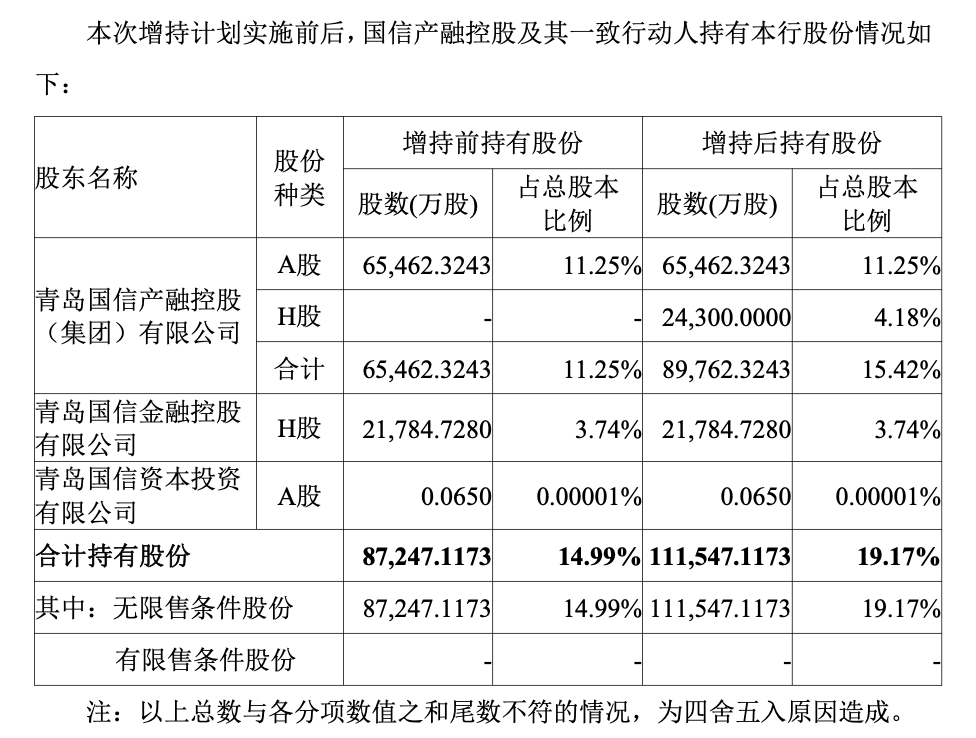
Core Viewpoint - The recent shareholding increase by Qingdao Bank's major shareholder, Guoxin Chanin Holdings, marks a significant shift in the bank's equity structure and reflects a broader trend of capital reallocation within the banking sector in 2025 [1][6]. Group 1: Shareholding Increase Details - Guoxin Chanin Holdings and its concerted actions have raised their combined shareholding in Qingdao Bank to 19.17% within a few months, showcasing a well-structured and strategic approach to capital investment [1][4]. - The shareholding increase was executed through a series of transactions from September 15 to November 5, with the shareholding rising from 11.26% to 15.42% during this period [2][3]. - The increase was completed without triggering a mandatory tender offer and did not alter the bank's governance status, which maintains no controlling shareholder [1][2]. Group 2: Financial Performance and Shareholder Confidence - Qingdao Bank's third-quarter report for 2025 indicated a total asset growth of 10.96% year-on-year, with a net profit increase of 15.54% for the first three quarters [4]. - The bank's non-performing loan ratio decreased to 1.10%, and the provision coverage ratio improved to 269.97%, providing a solid foundation for the shareholder's confidence in the bank's long-term value [4][9]. - The commitment from Guoxin Chanin Holdings to hold the shares for at least five years reflects a long-term investment perspective rather than a short-term financial strategy [4]. Group 3: Broader Industry Trends - The shareholding increase at Qingdao Bank is part of a larger trend in the banking sector, where several banks have seen significant capital inflows from major shareholders throughout 2025 [6][8]. - Regional banks, particularly in economically vibrant areas, have experienced notable increases in shareholding, indicating strong local capital support for financial institutions [6][8]. - The current environment of improved bank profitability expectations and a stabilizing macroeconomic backdrop has led to a redefinition of bank stocks as core assets with safety margins and dividend appeal [8][9].
年内上百只可转债成功摘牌
Shen Zhen Shang Bao· 2025-11-07 16:52
Group 1 - The issuance of convertible bonds has seen a recovery this year, with 36 companies completing issuances totaling 57.828 billion yuan, a year-on-year increase of 65.6% [1] - The China Convertible Bond Index has risen by 18% this year, indicating strong performance in the secondary market [1][3] - In the fourth quarter, there has been an acceleration in the issuance of convertible bonds, with 11 companies launching plans since October [1] Group 2 - Several companies are using convertible bonds for mergers and acquisitions, such as Xinbang Intelligent and Sunshine Nuohe [1] - Over 100 convertible bonds have been delisted this year due to price surges triggering forced redemptions and approaching maturities [2] - The market for convertible bonds is experiencing a reduction in outstanding bonds, with significant issuances like Daqin and Citic bonds being delisted [2] Group 3 - The market for convertible bonds is characterized by its "attack and defense" advantages, attracting investor interest [3] - The highest price for a convertible bond this year reached 2593.987 yuan, indicating strong demand and market activity [3] - Analysts suggest that the convertible bond market may enter a wide fluctuation range in the fourth quarter, with a focus on low-priced bonds with conversion demands [3]
江苏前三季度2556户科技型企业首贷破冰
Zhong Guo Jing Ji Wang· 2025-11-07 14:53
Core Insights - Jiangsu Financial Regulatory Bureau, in collaboration with the provincial Science and Technology Department and Finance Department, has initiated a special action to expand the first loan support for technology-based enterprises, resulting in 2,556 companies receiving first loans totaling 14.14 billion yuan by the end of September [1][3] Group 1: Special Action Implementation - Jiangsu financial institutions have developed specific implementation plans to achieve the goals of the special action, with banks like Jiangsu Bank, Nanjing Bank, and Agricultural Bank of Jiangsu quickly establishing their action plans [2] - Nanjing Bank has set up reward policies focusing on customer visits, marketing implementation, and comprehensive services [2] - Bank of China Jiangsu Branch has created a "Digital Inclusive" service platform for automatic customer assignment to nearby branches [2] Group 2: Product and Service Optimization - Jiangsu financial institutions are continuously optimizing products and services to ensure that technology-based enterprises with reasonable financing needs can access loans [3] - Industrial and Commercial Bank of China Jiangsu Branch has introduced a "Value Evaluation System" for technology enterprises, facilitating the transition from "no loan" to "first loan" [3] - Nanjing Bank has launched a product for the transformation of scientific and technological achievements, and upgraded its online standardized product "Xin e Technology Enterprise" [3] Group 3: Loan Growth Metrics - By the end of September, the loan balance for technology-based enterprises in Jiangsu reached 27.7 trillion yuan, reflecting a growth of 16.17% since the beginning of the year, which is 7.33 percentage points higher than the overall loan growth rate [3]


亿元级资产包频“上新”,年底银行加速出清不良资产
Hua Xia Shi Bao· 2025-11-07 12:16
Core Viewpoint - The acceleration of bad asset transfers by banks is aimed at improving financial statements and capital utilization, providing more support for future business expansion and strategic planning [2][4]. Group 1: Bad Asset Transfer Trends - In the fourth quarter, banks are increasingly announcing the transfer of bad loans, with several major banks, including state-owned and joint-stock banks, participating in this trend [3][5]. - In October, Bohai Bank and Guangzhou Rural Commercial Bank initiated significant asset transfers, with Bohai Bank offering nearly 700 billion yuan in debt assets and Guangzhou Rural Commercial Bank proposing over 189 billion yuan [3][4]. - By early November, nine banks had listed 23 bad asset packages totaling over 37 billion yuan, indicating a growing trend in bad asset transfers [3][4]. Group 2: Impact on Financial Metrics - The transfer of bad assets allows banks to clear long-term capital-occupying and poorly performing assets, effectively reducing the non-performing loan (NPL) ratio and improving asset quality [4][7]. - Data from the financial regulatory authority shows that banks disposed of 1.5 trillion yuan in bad assets in the first half of the year, a year-on-year increase of 123.6 billion yuan, leading to a decrease in both the balance of bad assets and the NPL ratio [4][6]. Group 3: Individual Loan Bad Asset Market - The demand for transferring individual loan bad assets is increasing, with the scale of batch transfers reaching 37.04 billion yuan by the end of the first quarter, a year-on-year surge of 761.4% [6][7]. - In November, 17 out of 23 bad asset packages transferred were individual loans, highlighting the growing focus on this segment [6][7]. - Analysts suggest that the transfer of individual bad loans is a normal part of banking operations, initiated in response to regulatory changes and market conditions [6][7].

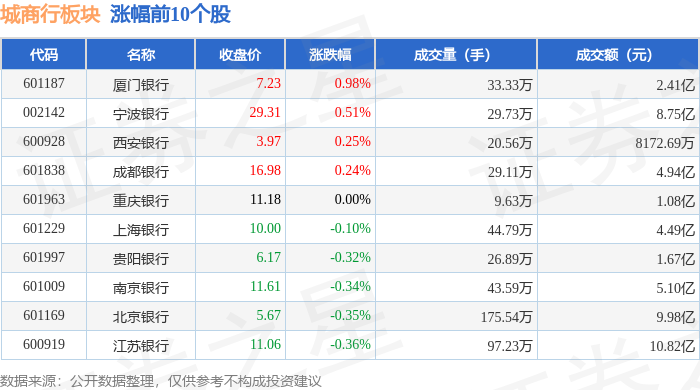
城商行板块11月7日跌0.21%,齐鲁银行领跌,主力资金净流出1.48亿元
Zheng Xing Xing Ye Ri Bao· 2025-11-07 08:37
Market Overview - The city commercial bank sector experienced a decline of 0.21% on November 7, with Qilu Bank leading the drop [1] - The Shanghai Composite Index closed at 3997.56, down 0.25%, while the Shenzhen Component Index closed at 13404.06, down 0.36% [1] Individual Bank Performance - Xiamen Bank closed at 7.23, up 0.98% with a trading volume of 333,300 shares and a transaction value of 241 million [1] - Ningbo Bank closed at 29.31, up 0.51% with a trading volume of 297,300 shares and a transaction value of 875 million [1] - Qilu Bank closed at 6.08, down 1.46% with a trading volume of 648,100 shares and a transaction value of 39.86 million [2] - Suzhou Bank closed at 8.33, down 1.07% with a trading volume of 373,400 shares and a transaction value of 314 million [2] Capital Flow Analysis - The city commercial bank sector saw a net outflow of 148 million from institutional investors, while retail investors had a net inflow of 163 million [2] - Jiangsu Bank had a net inflow of 63.24 million from institutional investors, but a net outflow of 39.08 million from speculative funds [3] - Nanjing Bank experienced a net inflow of 24.45 million from institutional investors, with a net outflow of 30.58 million from speculative funds [3]

私行业务成银行“香饽饽”?七家客户数破10万大关
Xin Lang Cai Jing· 2025-11-07 00:20
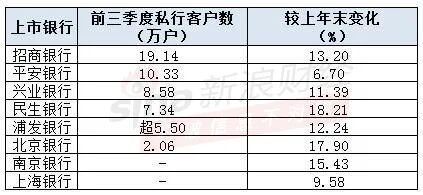
Core Insights - The private banking sector in China is experiencing significant growth, with several listed banks reporting an increase in private banking clients exceeding 10% [1][2][3] - Notably, Minsheng Bank, Beijing Bank, and Nanjing Bank have all reported client growth rates above 15% [1][2][3] - As of the end of September, the total number of private banking clients at Minsheng Bank reached 73,409, marking an 18.21% increase from the previous year [3][5] Private Banking Client Growth - Multiple banks have shown robust growth in private banking clients, with Minsheng Bank, Beijing Bank, and Nanjing Bank leading with growth rates over 15% [1][2][3] - As of September 30, 2023, the number of private banking clients at major banks is as follows: - China Merchants Bank: 191,418 clients, up 13.2% - Ping An Bank: 103,300 clients, up 6.7% - Minsheng Bank: 73,409 clients, up 18.21% - Beijing Bank: 20,586 clients, up 17.9% - Nanjing Bank: growth of 15.43% [3][5][6] Wealth Management Market Expansion - The wealth management market in China continues to expand, with listed banks reporting steady growth in wealth clients [8][9] - As of September 30, 2023, Ping An Bank reported 1.4911 million wealth clients, a 2.4% increase from the previous year [9] - Nanjing Bank's wealth clients grew by 16.31%, while Guiyang Bank's wealth clients increased by 7.77% [9] Asset Under Management (AUM) Growth - The total assets under management (AUM) for private banking clients at Minsheng Bank reached 1,014.72 billion yuan, an increase of 148.75 billion yuan, or 17.18% [3][5] - Beijing Bank's private banking AUM was 224 billion yuan, up 14.39% from the beginning of the year [4] Revenue from Wealth Management Services - Several banks reported positive growth in wealth management fee income, with many exceeding 15% growth [10][12] - For instance, China Merchants Bank's wealth management fee income reached 20.67 billion yuan, an 18.76% year-on-year increase [10] - Ping An Bank's wealth management fee income was 3.979 billion yuan, up 16.1% [10] Distribution and Sales Growth - The distribution of financial products has become a significant revenue source for banks, with many reporting substantial increases in sales [11][12] - For example, Ping An Bank's income from personal insurance sales grew by 48.7%, while its income from personal fund sales increased by 6.7% [12] - China Merchants Bank's income from fund sales rose by 38.76%, driven by increased sales and improved product structure [12]


抖音:将进一步规范金融账号经营行为;现货黄金重回4000美元/盎司上方 | 金融早参
Mei Ri Jing Ji Xin Wen· 2025-11-06 23:29
Group 1: Gold Jewelry Industry - The Shanghai Gold Jewelry Industry Association emphasizes the importance of implementing the new tax policies announced by the Ministry of Finance and the State Administration of Taxation, requiring member units to ensure compliance and enhance internal management [1] - The association encourages companies to improve product quality, service levels, and brand influence to ensure stable market development [1] Group 2: Payment Industry - The China Payment and Clearing Association advocates for enhanced security management of "no-password payment" services, ensuring users' choice and informed consent during the activation process [2] - The initiative aims to improve payment security and user experience by standardizing authorization management and increasing transaction monitoring [2] Group 3: Financial Services on Douyin - Douyin announces measures to further regulate financial account operations, including merchant qualification standards and compliance checks for financial content [3] - The platform's actions reflect a commitment to preventing financial fraud and protecting user rights, thereby enhancing its credibility [3] Group 4: Gold Market - On November 6, spot gold prices rose above $4000 per ounce, indicating strong market demand and heightened risk aversion among investors [4] - The increase in gold prices is influenced by global economic uncertainties, geopolitical risks, and inflation pressures [4] Group 5: Stock Buyback Financing - The stock buyback financing program is expected to expand to city commercial banks, increasing participation beyond the previously limited national financial institutions [5] - This expansion will provide new business opportunities for city commercial banks and support liquidity for listed companies' stock buybacks, contributing to market stability [5][6]
债市波动拖累投资收益 银行非息收入增长现分化
Zhong Guo Zheng Quan Bao· 2025-11-06 22:34
Core Viewpoint - In a low interest rate environment, banks are increasingly relying on non-interest income as a key driver for revenue growth, with significant disparities emerging among different banks in terms of non-interest income performance [1] Non-Interest Income Overview - In the first three quarters of this year, 42 listed banks achieved a total non-interest income of 1.22 trillion yuan, an increase of over 300 billion yuan compared to the first half of the year and an increase of 583 billion yuan year-on-year [1] - Among these banks, only 18 reported positive year-on-year growth in non-interest income, while 8 banks experienced a decline in investment income due to bond market fluctuations, and 31 banks reported negative fair value changes [1] Fee and Commission Income - A breakdown of non-interest income shows that net fee and commission income, investment income, and fair value changes significantly impact overall non-interest income [2] - In the first three quarters, 27 banks reported positive year-on-year growth in net fee and commission income, with 12 banks achieving growth rates exceeding 10% [2] - Notable performers include Changshu Bank and Ruifeng Bank, with increases of 364.75% and 162.66% respectively, while major state-owned banks like Agricultural Bank, Postal Savings Bank, and Bank of China also reported steady growth [2] Impact of Bond Market Fluctuations - The bond market's volatility has negatively affected investment income and fair value changes for several banks, leading to declines in non-interest income and overall revenue growth [3] - For instance, China Merchants Bank reported a 4.23% year-on-year decline in non-interest net income, primarily due to reduced returns from bond and fund investments [3] - Other banks, such as Ping An Bank and Huaxia Bank, also reported significant declines in revenue attributed to market fluctuations affecting their non-interest income [3] Regional Bank Performance - Regional banks like Qingdao Bank faced similar challenges, with a year-on-year decrease in investment income and fair value changes due to weaker bond market performance [4] - Conversely, some banks, such as China Construction Bank and Changsha Bank, reported over 100% year-on-year growth in investment income [4] Future Market Outlook - Analysts suggest that the bond market is likely to remain volatile in the short term, with fluctuations in fair value changes being more pronounced for joint-stock and regional banks due to their higher proportion of FVTPL assets [5] - Experts recommend that banks focus on differentiated operations and niche markets to support non-interest income growth, while also balancing short-term gains with long-term risks [6] - The outlook for the bond market indicates a gradual return to fundamentals and liquidity, but uncertainties remain regarding the growth of other non-interest income sources [6]