中国移动

Search documents
洛阳钼业近一个月首次上榜港股通成交活跃榜
Zheng Quan Shi Bao Wang· 2026-01-20 15:50
1月20日上榜港股通成交活跃榜个股中,洛阳钼业为近一个月首次上榜。 (文章来源:证券时报网) 洛阳钼业为近一个月首次上榜,当日港股通成交额为5.27亿港元,成交净卖出0.98亿港元,该股当日收 盘下跌1.01%。(数据宝) 1月20日港股通成交活跃股榜单 证券时报·数据宝统计显示,1月20日港股通(包括沪市港股通及深市港股通)成交活跃股合计成交 318.29亿港元,占当日港股通成交金额的32.72%,净买入金额8.08亿港元。 上榜的成交活跃股中,腾讯控股成交额为63.88亿港元,成交金额居首;其次是阿里巴巴-W、小米集团- W,成交金额分别为48.94亿港元、46.53亿港元。 以上榜次数统计,1月20日上榜个股中,近一个月上榜次数最多的是阿里巴巴-W、腾讯控股等,近一个 月均上榜18次,最受港股通资金关注。 | 证券 | 证券简称 | 成交金额(亿 | 净买入金额(亿 | 近一个月上榜 | 最新收盘价 | 日涨跌幅 | | --- | --- | --- | --- | --- | --- | --- | | 代码 | | 港元) | 港元) | 次数 | (港元) | (%) | | 00700 | 腾 ...
南向资金今日净买入36.63亿港元,腾讯控股净买入6.63亿港元
Zheng Quan Shi Bao Wang· 2026-01-20 15:44
Core Viewpoint - The Hang Seng Index fell by 0.29% on January 20, with southbound capital transactions totaling HKD 97.283 billion, resulting in a net inflow of HKD 36.63 billion [1] Group 1: Southbound Capital Transactions - Total southbound capital transactions amounted to HKD 97.283 billion, with buy transactions at HKD 50.473 billion and sell transactions at HKD 46.810 billion, leading to a net buy of HKD 36.63 billion [1] - The Hong Kong Stock Connect (Shenzhen) recorded a total transaction amount of HKD 37.804 billion, with net buying of HKD 2.18 billion, while the Hong Kong Stock Connect (Shanghai) had a total transaction amount of HKD 59.479 billion, with net buying of HKD 34.44 billion [1] Group 2: Active Stocks - Tencent Holdings had the highest transaction amount among active stocks, totaling HKD 63.88 billion, with a net buy of HKD 6.63 billion, despite a closing price drop of 1.48% [1][2] - Other notable stocks included Alibaba-W and Xiaomi Group-W, with transaction amounts of HKD 48.94 billion and HKD 46.53 billion, respectively [1] - The most significant net sell was recorded for SMIC, with a net sell of HKD 7.18 billion and a closing price drop of 3.25% [1][2] Group 3: Continuous Net Buying - Five stocks experienced continuous net buying for more than three days, with Tencent Holdings leading at 10 days, followed by Alibaba-W at 7 days and Huahong Semiconductor at 4 days [2] - The total net buying amounts during this period were HKD 106.21 billion for Tencent Holdings, HKD 47.56 billion for Alibaba-W, and HKD 14.29 billion for Xiaomi Group-W [2]






港股通(深)净买入2.18亿港元
Zheng Quan Shi Bao Wang· 2026-01-20 15:44
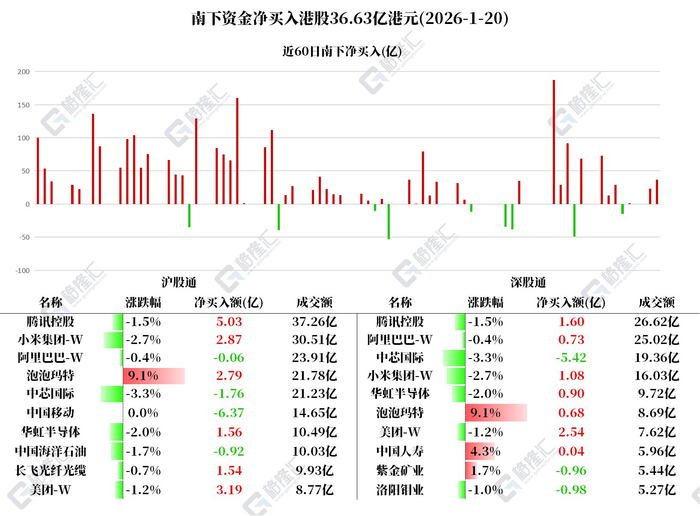
Core Viewpoint - On January 20, the Hang Seng Index fell by 0.29%, closing at 26,487.51 points, while southbound funds through the Stock Connect recorded a net buy of HKD 36.63 billion [1]. Group 1: Market Activity - The total trading volume for the Stock Connect on January 20 was HKD 972.83 billion, with a net buy of HKD 36.63 billion [1]. - The Shanghai Stock Connect accounted for HKD 594.79 billion in trading volume with a net buy of HKD 34.44 billion, while the Shenzhen Stock Connect had a trading volume of HKD 378.04 billion and a net buy of HKD 2.18 billion [1]. Group 2: Active Stocks - In the Shanghai Stock Connect, Tencent Holdings was the most actively traded stock with a transaction amount of HKD 37.26 billion, followed by Xiaomi Group-W and Alibaba-W with transaction amounts of HKD 30.51 billion and HKD 23.91 billion, respectively [1]. - Tencent Holdings had a net buy of HKD 5.03 billion, despite its closing price dropping by 1.48% [1]. - China Mobile recorded the highest net sell amount of HKD 6.37 billion, closing flat [1]. Group 3: Shenzhen Stock Connect Activity - In the Shenzhen Stock Connect, Tencent Holdings also led with a transaction amount of HKD 26.62 billion, followed by Alibaba-W and SMIC with transaction amounts of HKD 25.02 billion and HKD 19.36 billion, respectively [2]. - Meituan-W had the highest net buy amount of HKD 2.54 billion, although it closed down by 1.17% [2]. - SMIC experienced the largest net sell amount of HKD 5.42 billion, closing down by 3.25% [2].


中国星网换帅增资 冲刺星座部署关键期
经济观察报· 2026-01-20 14:01
Core Viewpoint - The market's expectations for China Star Network have shifted from technological breakthroughs to commercial implementation, with a focus on the upcoming three years for increased satellite launches [1][3]. Management Changes - China Star Network has undergone significant management changes, with new appointments including Gou Ping as chairman and Liang Baojun as general manager, signaling a strengthened focus on satellite technology development and integration with traditional telecom operators [2][5]. Satellite Deployment Timeline - The urgency of deploying the planned 13,000 low-orbit satellites is driven by international regulations requiring the first satellite to be launched within seven years and 10% of the planned satellites deployed within nine years, making 2029 a critical deadline [2][6]. Capital Investment - China Star Network's subsidiary, Star Network Digital Technology, has increased its registered capital from 120 million to 700 million RMB, a 483% increase, to support ground-based infrastructure and application ecosystems for satellite internet [3][9]. Ground Infrastructure Development - The company plans to build a large-scale ground station network in Xiong'an, which is essential for connecting satellite signals to ground networks, thereby enhancing service capabilities [10][11]. Commercialization Challenges - The satellite internet industry faces dual challenges: competition for frequency resources with international rivals and uncertainties in market acceptance and technology stability [13][14]. Policy Environment - While satellite internet has been included in the "new infrastructure" category, uncertainties remain regarding policy implementation and regulatory frameworks, which could impact project timelines and operational costs [14]. Strategic Collaborations - China Star Network is exploring partnerships, such as its joint venture with China Mobile to establish a satellite-ground integrated network, which may serve as a breakthrough for commercialization [14]. Technological Advancements - Recent technological milestones include the successful trial of a satellite broadband video call based on 5G NTN standards, laying the groundwork for consumer applications in satellite internet [14]. Industry Outlook - With technological breakthroughs, policy support, and increasing market demand, the satellite industry is rapidly evolving, and the management changes and capital investments at China Star Network are pivotal in this competitive landscape [15].
三大运营商定调2026:继续战略收缩 聚焦AI转型
Zhong Guo Jing Ying Bao· 2026-01-20 13:24
Core Insights - The three major telecom operators in China are shifting their strategies towards "strategic contraction and focused transformation," moving away from a "large and comprehensive" approach to concentrate resources on core business areas such as computing power, AI applications, and enterprise markets [1][4] Financial Performance - In 2024, the total revenue of the three operators approached 2 trillion yuan, with a year-on-year growth rate slowing to approximately 3%, a significant decline compared to previous years. The combined net profit was about 192 billion yuan, reflecting a year-on-year increase of approximately 6.1%. The combined EBITDA was around 574 billion yuan, showing a slight decline of about 0.7%, indicating a fatigue in profitability [2] Strategic Focus - China Telecom is upgrading its strategy from "cloud transformation" to "intelligent and beneficial cloud transformation," emphasizing AI empowerment and security in enterprise construction. In 2024, the revenue from digitalization in its industry is expected to increase, with a 22% year-on-year growth in capital expenditure for computing power [3] - China Unicom is focusing on four core areas: connectivity, computing power, services, and security, moving away from a comprehensive coverage model. Its investment in computing power is expected to rise by 19% in 2024, with plans to build a multi-layered computing supply system [3] - China Mobile aims to strengthen its three main businesses: communication services, computing services, and intelligent services, with a focus on technology leadership and scale synergy. The planned investment in computing power for 2025 is 37.3 billion yuan, maintaining the same level as 2024 but increasing its share in capital expenditure to 25% [4] Embracing AI - All three operators are sending a clear signal of "fully embracing AI." China Unicom is focusing on the synergy between AI and its core areas, while China Telecom is integrating AI throughout its operations. China Mobile is also prioritizing intelligent services and plans to develop 15 million AI terminals by 2026 [5][6] Capital Expenditure Trends - The capital expenditure of the three operators is showing a trend of "overall contraction with localized increases," with a total planned capital expenditure for 2025 reduced by 9.1% to 289.8 billion yuan. The focus is shifting towards "intelligent computing centers" and "massive card clusters" [7]



智慧连接千行百业 浙江移动5G-A覆盖感知升级
Ren Min Wang· 2026-01-20 12:58
Core Viewpoint - The deployment of "5G-A" technology by China Mobile Zhejiang is enhancing network speed and coverage, contributing to the economic and social development of Zhejiang province while improving the quality of life for its residents [1] Group 1: 5G-A Technology Implementation - The establishment of the first 5G-A×AI uplink demonstration zone in West Xixi Wetland allows for a maximum uplink speed of 1 Gbps, facilitating various intelligent applications [1][3] - The deployment of 5G-A three-carrier aggregation at the recent New Year's concert in Chuzhou significantly improved network capacity and speed, supporting high-bandwidth applications like live streaming [3][5] Group 2: Smart Applications and User Experience - The AI-guided robot "Xiao Tian" utilizes 5G-A technology for real-time interaction and navigation, enhancing the visitor experience at tourist sites [3] - The introduction of the "UE LOGO display" feature by China Mobile in Wenzhou allows mobile signals to provide location-specific information, enriching the cultural tourism experience [5][7] Group 3: Infrastructure and Economic Impact - The deployment of over 1,600 5G-A base stations in Wenzhou has improved network performance, achieving peak speeds of up to 2.8 Gbps in key areas [7] - The integration of 5G technology in rural areas, such as in Anji County, is enhancing the quality of services in homestays and reducing operational costs, thus supporting rural revitalization [8] - At Jiaxing Nanhu Airport, the implementation of 5G-A technology is creating a smart communication network that improves operational efficiency and passenger experience [9][11]

资金动向 | 北水连续12日出逃中移动,加仓腾讯超6.6亿港元
Ge Long Hui· 2026-01-20 12:12
Group 1 - Southbound funds net bought Hong Kong stocks worth HKD 36.63 billion on January 20, with notable purchases including Tencent Holdings (HKD 6.63 billion), Meituan-W (HKD 5.73 billion), and Xiaomi Group-W (HKD 3.95 billion) [1] - Tencent Holdings has seen continuous net buying for 10 days, totaling HKD 106.21 billion, while Alibaba has been net bought for 7 consecutive days, amounting to HKD 47.57 billion [3] - Meituan's travel platform reported a significant increase in flight bookings, with a year-on-year growth of approximately 35% since January [5] Group 2 - Xiaomi Group repurchased 5.5 million B shares for approximately HKD 196 million, with a repurchase price ranging from HKD 35.46 to HKD 35.86 per share [5] - Pop Mart announced a share buyback of 1.4 million shares for HKD 251 million, with expectations of attracting more investor attention due to strong growth and clear driving factors [5] - Semiconductor company SMIC experienced a net sell-off of HKD 7.17 billion, while China Mobile faced a net sell-off of HKD 6.37 billion [1][4] Group 3 - TSMC raised its capital expenditure guidance for 2026 to USD 52-56 billion, indicating strong long-term demand driven by AI [6] - The DRAM market is experiencing price increases, with certain DDR4 models seeing weekly price rises exceeding 12%, driven by AI demand [6] - The humanoid robot market is projected to see an annual installation of approximately 16,000 units by 2025, driven by sectors such as data collection, logistics, and manufacturing [6]
湖北启动组建6G创新发展联盟
Zhong Guo Xin Wen Wang· 2026-01-20 11:01
Group 1 - Hubei is accelerating the research and development of 6G technology, focusing on building and nurturing an industrial ecosystem for 6G applications [1] - The Hubei 6G Innovation Development Alliance has been established to concentrate on breakthroughs in core 6G technologies, standard system construction, application scenario exploration, industrial ecosystem cultivation, and talent training [1] - Wuhan has a national-level strategic emerging industry cluster for next-generation information networks, with over 16,000 optoelectronic information companies, forming a complete industrial ecosystem from basic research to product manufacturing and application services [1] Group 2 - Hubei has achieved several landmark results in standard formulation, integrated communication, wireless technology, and device research and development related to 6G technology [1] - Major telecom operators in Hubei, including China Mobile, China Telecom, and China Unicom, are building 6G technology testing platforms through 5G-A network construction in various fields such as Yangtze River shipping, low-altitude economy, intelligent manufacturing, and smart tourism [1] - Hubei will focus on tackling key core technologies of 6G and promote deep integration of scientific research, technology, and talent resources to accelerate the transformation and application of innovative achievements [1] Group 3 - Hubei Mobile and Zhongxing Telecommunication Equipment Corporation have established a joint innovation center for 6G technology and industrial applications, focusing on core technology breakthroughs and standard formulation [2] - A signing ceremony for the establishment of the Zhongxing Telecommunication—Wuhan University 6G Joint Laboratory was held, aiming for collaborative innovation in frontier 6G technologies and high-end talent cultivation [2]
智通港股通活跃成交|1月20日
智通财经网· 2026-01-20 11:01
Core Insights - On January 20, 2026, Tencent Holdings (00700), Xiaomi Group-W (01810), and Alibaba-W (09988) were the top three companies by trading volume in the Southbound Stock Connect, with trading amounts of 3.726 billion, 3.051 billion, and 2.391 billion respectively [1] - In the Shenzhen-Hong Kong Stock Connect, Tencent Holdings (00700), Alibaba-W (09988), and SMIC (00981) led the trading volume, with amounts of 2.662 billion, 2.502 billion, and 1.936 billion respectively [1] Southbound Stock Connect Trading Activity - The top active companies in the Southbound Stock Connect included: - Tencent Holdings (00700) with a trading amount of 3.726 billion and a net buying amount of +0.503 billion [2] - Xiaomi Group-W (01810) with a trading amount of 3.051 billion and a net buying amount of +0.287 billion [2] - Alibaba-W (09988) with a trading amount of 2.391 billion and a net selling amount of -5.778 million [2] - Other notable companies included Pop Mart (09992) and SMIC (00981) with trading amounts of 2.178 billion and 2.123 billion respectively [2] Shenzhen-Hong Kong Stock Connect Trading Activity - The top active companies in the Shenzhen-Hong Kong Stock Connect included: - Tencent Holdings (00700) with a trading amount of 2.662 billion and a net buying amount of +0.160 billion [2] - Alibaba-W (09988) with a trading amount of 2.502 billion and a net buying amount of +7.257 million [2] - SMIC (00981) with a trading amount of 1.936 billion and a net selling amount of -5.420 billion [2] - Other notable companies included Xiaomi Group-W (01810) with a trading amount of 1.603 billion and a net buying amount of +0.108 billion [2]

图解丨南下资金连续10日净买入腾讯,连续12日净卖出中国移动
Ge Long Hui A P P· 2026-01-20 10:07
Group 1 - Southbound funds net bought Hong Kong stocks worth HKD 3.663 billion today [1] - The top net purchases included Tencent Holdings at HKD 663 million, Meituan-W at HKD 573 million, and Xiaomi Group-W at HKD 395 million [1] - Continuous net buying trends were observed for Tencent over 10 days totaling HKD 10.62116 billion and Alibaba over 7 days totaling HKD 4.75655 billion [1] Group 2 - Southbound funds net sold shares of SMIC at HKD 717 million and China Mobile at HKD 637 million [1] - China Mobile has seen continuous net selling for 12 days, amounting to HKD 9.29936 billion [1] - Hua Hong Semiconductor and Xiaomi also experienced net buying trends over multiple days, with Hua Hong totaling HKD 1.33901 billion over 4 days and Xiaomi HKD 1.42914 billion over 3 days [1]