
方正证券

Search documents
增量资金入市 交易热度攀升
Jin Rong Shi Bao· 2025-08-15 01:11
Market Performance - A-shares have shown a strong upward trend since August, with the Shanghai Composite Index reaching a new high of 3683.46 points on August 13, surpassing the previous peak after the "9·24" market event [1] - On August 14, the index briefly exceeded 3700 points, with a peak of 3704.77 points, and the total market turnover exceeded 2 trillion yuan for two consecutive days, reaching a record high of 2.31 trillion yuan on August 14 [1] - Analysts attribute the strong performance to improved policy expectations, increased liquidity, and a decrease in external risks [1] Fund Inflow - The recent market rally is significantly driven by accelerated inflow of incremental funds from various sources, including insurance, pension funds, public and private equity funds, as well as individual investors [2] - Since the "9·24" market event, the M1-M2 growth rate gap has been narrowing, indicating enhanced liquidity and a marginal recovery in consumer and investment sentiment [2] - The average monthly new account openings on the Shanghai Stock Exchange have increased by 80% compared to the first nine months of 2024, reflecting a rising risk appetite among individual investors [2] Margin Trading - As of August 5, the margin trading balance in the A-share market exceeded 2 trillion yuan for the first time in 10 years, indicating increased investor engagement [4] - By August 13, the margin trading balance reached 20,462.51 billion yuan, with the margin trading balance accounting for 2.08% of the A-share market's circulating market value [4] - The current margin trading levels are significantly lower than the peak levels seen in 2015, suggesting a more stable market environment [4][5] Sector Focus - Analysts recommend focusing on sectors with high growth potential and strong performance, such as AI, computing power, innovative pharmaceuticals, military, and non-ferrous metals [5] - The report highlights the importance of sectors that are expected to benefit from increased retail investment, including brokerage and insurance industries [5] - The market is anticipated to continue experiencing volatility, but the overall trend remains positive due to loose liquidity and earnings recovery [5]
券商狂撒“红包雨”:华林证券暴增10倍 有头部券商每手派40元
2 1 Shi Ji Jing Ji Bao Dao· 2025-08-14 23:04
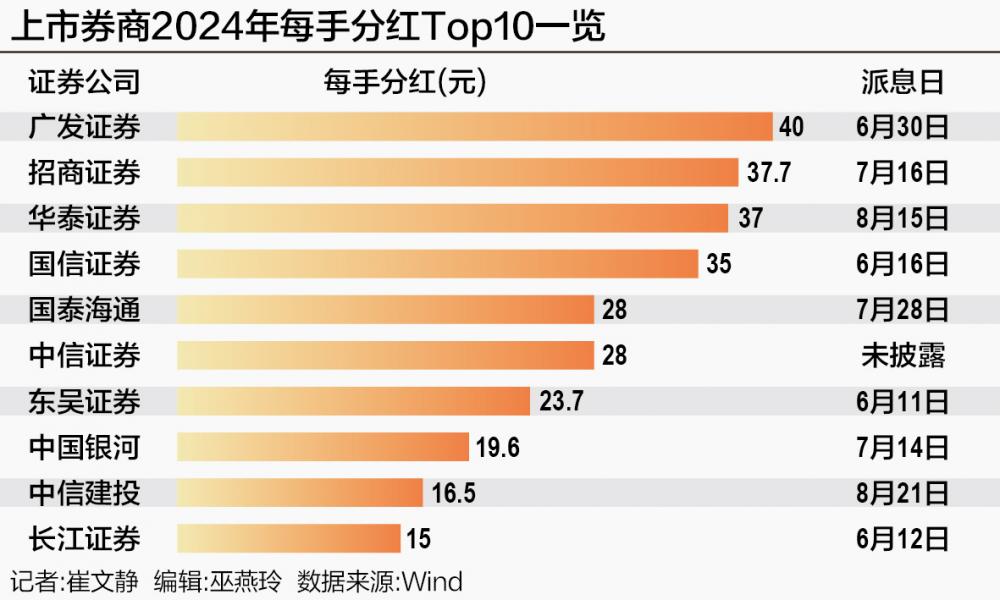
Core Viewpoint - The A-share market has seen a significant increase, surpassing 3700 points, leading to enhanced returns for investors, particularly through rising dividends from listed companies [1] Group 1: Dividend Trends in the Securities Industry - Many securities firms are increasing both the scale and intensity of their dividends, with several firms planning to double their 2024 dividends compared to 2023 [2][3] - Notable firms like Huayin Securities are projected to have a dividend scale for 2024 that is ten times that of 2023, indicating a strong trend towards higher shareholder returns [3] - As of August 13, over ten companies have proposed mid-term dividend plans for 2025, a significant increase from previous years [3] Group 2: Mid-term Dividends and Regulatory Influence - The number of securities firms planning mid-term dividends has surged to 26 in 2024, with expectations for further increases in 2025 [4] - Historically, mid-term dividends were rare, but regulatory encouragement has led to a notable rise in firms adopting this practice [15] Group 3: Specific Dividend Figures and Comparisons - Leading firms such as GF Securities and China Merchants Securities are offering substantial dividends per share, with GF Securities leading at 40 yuan per hand [5][16] - Huayin Securities has reported a total dividend scale of 1.08 billion yuan for 2024, a significant increase from 108 million yuan in 2023 [11] - Other firms like Fangzheng Securities and Hongta Securities have also shown remarkable growth in their dividend scales, with Fangzheng's total reaching 883 million yuan, four times that of 2023 [12][13] Group 4: Dividend Payment Ratios and Company Strategies - Smaller securities firms are showing higher dividend payment ratios, with Guolian Minsheng leading at 80.04%, while larger firms like China Merchants Securities maintain lower ratios around 30% [17] - The analysis suggests that high dividend payouts do not necessarily correlate with high investment value, as companies must balance dividends with their growth and capital needs [18][19]







A股重磅,参与两融交易投资者数量创年内新高
Zheng Quan Shi Bao· 2025-08-14 22:32
截至8月13日,融资融券个人投资者数量为755.68万名,机构投资者数量为50004家,有融资融券负债的 投资者数量为172.18万名。 根据中国结算数据,截至2024年底,开立了两融证券账户的投资者数量为720.38万,其中个人投资者 715.2万。2024年当年,新开立个人两融证券账户数为47.52万,机构投资者数为0.75万。 公开数据显示,8月13日参与融资融券交易的投资者数量为52.34万名,创年内新高,超过了今年2月21 日的52.14万名。与上一交易日相比,投资者数量增加了4.61万名,环比增长9.67%。 华西证券研报认为,A股市场两融余额重返2万亿元高位,背后动力主要在于政策预期改善与市场风险 偏好回升的共振。监管层密集释放稳定资本市场的政策信号,增量改革与制度优化预期不断增强,提振 了投资者对后市发展的信心。从资金流向来看,年内融资资金主要流向信息技术、工业、材料等行业, 这彰显出资金对产业结构优化升级的看好,也折射出市场对经济高质量发展的坚定信心。 "总体来看,与十年前相比,此次两融余额重返2万亿元所处的市场生态已发生深刻变革,政策更加完 善,资金更加稳健,投向更加精准,呈现出明显的价值 ...
券商“瘦身”不影响股价飙涨
Shen Zhen Shang Bao· 2025-08-14 17:07
深圳某证券营业部工作人员告诉记者:"我们营业部成立于1992年,前几年这条街上各大券商快速扩 张,一年之内好几家营业部同时开业。但是客户是有限的,再加上数字化渠道的冲击,导致营业部客流 量早已大不如前。" 记者了解到,券商行业正经历从"跑马圈地"到"练内功"的快速转变。2025年一季度,头部券商普遍实现 盈利修复。例如,国泰君安与海通证券合并后,国泰海通一季度净利润达122.42亿元,位列行业第一, 同比增长391.78%。 在股价屡创新高的情况下,券商行业却悄然掀起了一场"瘦身"行动。据不完全统计,今年以来,已有20 余家券商在全国范围内公告撤销营业部和分公司,合计裁撤网点超100家。其中,方正证券大规模优化 布局引发关注,从5月到7月,裁撤营业部11家、分公司2家。 值得注意的是,在裁撤名单中,既有二三线城市,也有北京、上海等一线城市。其中,方正证券、华福 证券、光大证券、中国银河证券等裁撤了多家位于北京的营业部。而中国银河证券裁撤了3家位于上海 的营业部。 【深圳商报讯】(记者 周良成)8月14日,有"牛市旗手"之称的券商股延续强势,截至收盘,长城证券 涨停,华泰证券涨超3%,中银证券、国盛金控涨超2% ...
券商“瘦身”不影响股价飙涨 今年以来20余家券商共裁撤网点超100家
Shen Zhen Shang Bao· 2025-08-14 16:40
【深圳商报讯】(记者周良成)8月14日,有"牛市旗手"之称的券商股延续强势,截至收盘,长城证券 涨停,华泰证券涨超3%,中银证券、国盛金控涨超2%,东方证券、光大证券、浙商证券等跟涨。今年 以来,湘财股份、国盛金控、中银证券等股价涨幅超五成;长城证券、东吴证券、广发证券等涨超三 成;国信证券、华西证券、华泰证券等涨超两成。 深圳某证券营业部工作人员告诉记者:"我们营业部成立于1992年,前几年这条街上各大券商快速扩 张,一年之内好几家营业部同时开业。但是客户是有限的,再加上数字化渠道的冲击,导致营业部客流 量早已大不如前。" 记者了解到,券商行业正经历从"跑马圈地"到"练内功"的快速转变。2025年一季度,头部券商普遍实现 盈利修复。例如,国泰君安与海通证券合并后,国泰海通一季度净利润达122.42亿元,位列行业第一, 同比增长391.78%。 (文章来源:深圳商报) 在股价屡创新高的情况下,券商行业却悄然掀起了一场"瘦身"行动。据不完全统计,今年以来,已有20 余家券商在全国范围内公告撤销营业部和分公司,合计裁撤网点超100家。其中,方正证券大规模优化 布局引发关注,从5月到7月,裁撤营业部11家、分公司2 ...
A股重磅!参与两融交易投资者数量,创年内新高!
券商中国· 2025-08-14 15:05
Core Viewpoint - The article highlights the significant increase in margin trading activity in the A-share market, indicating improved investor sentiment and a more stable financial environment compared to previous years [2][3]. Summary by Sections Investor Participation - As of August 13, the number of investors participating in margin trading reached 523,400, marking a new high for the year and an increase of 46,100 from the previous trading day, representing a 9.67% growth [1]. Margin Trading Statistics - By August 13, the total number of individual margin trading investors was 7,556,800, while institutional investors numbered 50,004. The number of investors with margin trading liabilities stood at 1,721,800 [2]. - The total margin balance was 2,032.045 billion yuan, remaining above 2 trillion yuan. This current level of margin financing is characterized by lower leverage compared to 2015, with a minimum margin requirement of 80% and a maximum leverage of 1.25 times [2]. Market Dynamics - Analysts from Huaxi Securities attribute the resurgence of margin trading to improved policy expectations and a rebound in market risk appetite, supported by regulatory signals aimed at stabilizing the capital market [2]. - The flow of financing has primarily targeted sectors such as information technology, industrials, and materials, reflecting investor confidence in structural economic upgrades and high-quality development [2]. Historical Context and Market Sentiment - Compared to ten years ago, the current market environment for margin trading has undergone profound changes, with more robust policies and a shift towards value investing [3]. - The margin trading balance has risen above 2 trillion yuan for the first time since July 2015, although it remains below the peak levels seen in 2015 in terms of its proportion to A-share market capitalization [3]. - The continuous increase in margin trading reflects a rise in market risk appetite and a generally loose liquidity environment in the A-share market [3].

“瘦身”进行时!多家券商分公司、营业网点组团告别市场
Bei Jing Shang Bao· 2025-08-14 14:16
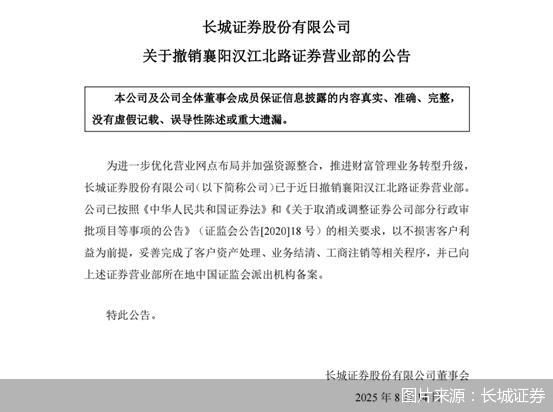
Group 1 - The trend of securities firms closing or merging their branches is increasing, driven by cost reduction and resource optimization [1][3][6] - Changcheng Securities announced the closure of its Xiangyang Hanjiang North Road branch to enhance resource integration and promote wealth management transformation [3][4] - Guosen Securities has also announced the closure of 12 branches, with plans to further optimize its network [4][5] Group 2 - Several securities firms, including Fangzheng Securities and Debang Securities, have also announced branch closures to improve operational efficiency and support high-quality business development [5][6] - The closures are part of a broader industry trend towards digital transformation and a focus on online services, reflecting changing investor habits [6][7] - The number of branches among securities firms varies significantly, with some firms having over 100 branches while others have fewer than 5 [7][8]


广东鸿图: 方正证券承销保荐有限责任公司关于广东鸿图继续使用暂时闲置募集资金进行现金管理之核查意见
Zheng Quan Zhi Xing· 2025-08-14 12:16
Core Viewpoint - The company intends to continue using temporarily idle raised funds for cash management to enhance the efficiency and returns of these funds, ensuring that it does not affect the normal progress of investment projects or the company's main business [1][5][8] Fundraising Basic Situation - The company has issued 133,333,333 A shares at a price of 16.50 RMB per share, raising a total of approximately 2.20 billion RMB, after deducting issuance costs [1][2] - As of June 30, 2025, the company has used approximately 1.10 billion RMB of the raised funds, with an unexpired balance of 900 million RMB in time deposits [2] Fund Usage and Idle Reasons - The raised funds are allocated to several projects, including a large integrated lightweight automotive parts intelligent manufacturing project, with a total investment of approximately 2.55 billion RMB [2] - The company has temporarily idle funds due to the phased investment approach based on project progress [2] Previous Cash Management Situation - The company previously approved the use of idle funds for cash management, with a maximum limit set by the board of directors [3][4] Current Cash Management Plan - The company plans to use up to 1.10 billion RMB of idle funds for cash management, including time deposits and structured deposits, with a maximum duration of 12 months for each transaction [4][5] - The decision-making authority for cash management is delegated to the chairman or authorized agents [4][5] Impact on the Company - The continued use of idle funds for cash management is expected to improve fund efficiency and safeguard shareholder interests without affecting the investment plans or main business operations [5][7] Decision-Making Process - The board of directors and the supervisory board have approved the cash management plan, ensuring compliance with relevant regulations and company policies [6][7][8]


创年内新高!A股单日成交额突破2.3万亿元
Jin Rong Shi Bao· 2025-08-14 11:17
Group 1 - The A-share market has seen a significant increase in trading volume, with total turnover exceeding 2 trillion yuan for two consecutive days, reaching a new high of 2.31 trillion yuan on August 14, 2023, up 130 billion yuan from the previous day [1] - The decline in deposit interest rates has led to an expansion in bank wealth management and "fixed income+" fund scales, with resident funds indirectly entering the equity market through these channels, becoming a major source of incremental capital for future market trends [1] - The three major A-share indices experienced a collective pullback on August 14, with the Shanghai Composite Index reaching a peak of 3704.77 points before closing at 3666.44 points, down 0.46% [1] Group 2 - The Shanghai Composite Index has surpassed last year's high, indicating three new dimensions of outperformance: historical cost-effectiveness, consistent outperformance against economic growth, and potential outperformance against US stocks [2] - Despite external shocks and internal challenges, various industries in China have maintained steady growth, with GDP increasing by 5.3% year-on-year in the first half of the year, reflecting a resilient macroeconomic foundation [2] - Analysts suggest that while there may be increased volatility in the index due to valuation rises and new capital inflows, the current market trend since last year's "924" remains intact, supported by loose liquidity and improving corporate earnings [2]
年内裁撤网点超百家!券商加速“瘦身”
Guo Ji Jin Rong Bao· 2025-08-14 11:06
Group 1 - The core viewpoint of the article is that the wave of brokerage branch closures signifies a shift in the industry from "extensive expansion" to "refined operations" [2][4][7] - Changcheng Securities announced the closure of its Xiangyang Hanjiang North Road branch as part of its strategy to optimize branch layout and enhance resource integration [1][3] - Over 20 brokerage firms have announced branch closures this year, with a total of more than 100 branches shut down, led by Guosen Securities, which closed 21 branches [1][3] Group 2 - The trend of branch closures is seen as a natural market correction, driven by the rise of internet finance and declining trading commissions, making traditional high-cost, low-efficiency models unsustainable [4][5] - The closures are not just about reducing numbers but represent a revolutionary change in business models, shifting from a transaction-centered approach to a client asset allocation-centered approach [4][6] - The increasing focus on digital transformation and cost pressures is forcing brokerages to upgrade their services, as traditional branches struggle to meet evolving client needs [4][5] Group 3 - The "Matthew effect" is expected to intensify, with leading brokerages like CITIC and Huatai expanding their advantages, while smaller firms face increased operational pressures [6][7] - The closure of branches may weaken the offline service connection for traditional client groups, but brokerages can mitigate client loss by implementing "digital twin branch" solutions [6][7] - The future may see a continued reduction in branch numbers as brokerages shift focus to digital capabilities and wealth management services, creating a new multi-faceted service model [7]