
陕西煤业

Search documents
“黑色能源”的绿色革命
Ke Ji Ri Bao· 2025-10-11 00:14
Group 1: Event Overview - The 19th Yulin International Coal and High-end Energy Chemical Industry Expo and the 3rd Western Hydrogen Energy Expo showcased advancements in the coal and energy sectors, highlighting Yulin's energy transformation and global business connections [1] - Hydrogen fuel cell vehicles were introduced, capable of traveling 400 kilometers on a single hydrogen fill, with a total of 15,000 kilometers safely operated, resulting in a carbon reduction of nearly 10 tons [1] Group 2: Technological Advancements - The coal industry is undergoing a shift from mechanization to automation, with intelligent robots capable of distinguishing coal from gangue, performing up to 6,000 grabs per hour [2] - The Shaanxi Coal and Chemical Industry's Caijiatang Mine has implemented a smart mining system, reducing underground inspection personnel from 15 to 5 and significantly enhancing safety and efficiency [2][4] Group 3: Policy Support - The establishment of the Yulin Energy Revolution Innovation Demonstration Zone by the National Development and Reform Commission and the National Energy Administration provides strong support for intelligent construction in the coal industry [3] - Yulin has built 31 intelligent mines and 85 intelligent coal mining faces, with 78.7% of production capacity being intelligent and 99% of coal mines achieving comprehensive mechanization [4] Group 4: Green Transition - The expo highlighted green low-carbon technologies, particularly CCUS (Carbon Capture, Utilization, and Storage), which has been implemented in Yulin with a large-scale demonstration project capturing and storing CO2 from power plant emissions [5][6] - Yulin is actively exploring pathways for carbon reduction and has a clear top-level design and policy support for its green transition, including the development of coal-based special fuels and biodegradable materials [6][7] Group 5: Hydrogen Energy Development - The hydrogen energy industry is a key component of Yulin's green transition, with a complete hydrogen energy industrial chain being showcased at the expo [7][8] - Yulin plans to invest 300 million yuan annually to support hydrogen energy development, aiming to establish itself as the "Hydrogen Energy Capital of the West" by 2030, with plans for 10,000 hydrogen heavy trucks and 5,000 public transport vehicles [8]

煤炭行业:国内动力煤价上涨,三大港口煤炭库存环比同比均下降明显
Dongxing Securities· 2025-10-10 08:53
Investment Rating - The coal industry is rated as "Positive" for the next 3-6 months [4] Core Insights - Domestic thermal coal prices have increased month-on-month, while international prices from Australia, South Africa, and Europe have decreased [3] - The monthly production of coal from key state-owned mines in Shaanxi, Shanxi, and Inner Mongolia has shown a mixed trend, with increases in Shaanxi and Shanxi, but a decrease in Inner Mongolia [2] - Coal inventories at three major ports have decreased significantly both month-on-month and year-on-year, alongside a decline in daily coal consumption by major power generation groups [2][3] - Domestic shipping costs have decreased, while international shipping rates have shown mixed trends [3] Summary by Sections 1. Thermal Coal 1.1 Prices - As of September 30, the price of Shanxi mixed thermal coal at Qinhuangdao is 701.00 CNY/ton, up 9 CNY/ton, a rise of 1.30% month-on-month [8][11] - Prices in Inner Mongolia and Shanxi have also increased month-on-month [8] 1.2 Production - In August, coal production from key state-owned mines in Shaanxi was 21.12 million tons, up 0.67% year-on-year and 2.26% month-on-month [21] - Shanxi produced 46.33 million tons, down 13.25% year-on-year but up 2.17% month-on-month [21] - Inner Mongolia's production was 18.21 million tons, down 0.18% year-on-year but up 2.12% month-on-month [21] 1.3 Imports - In August, coal and lignite imports reached 42.74 million tons, up 20.02% month-on-month but down 6.76% year-on-year [23] - Thermal coal imports were 10.24 million tons, up 19.36% month-on-month but down 17.41% year-on-year [25] 1.4 Inventory - Total coal inventory at the three ports was 12.19 million tons as of September 29, down 17.32% month-on-month and 18.84% year-on-year [31] - The number of coal vessels at anchor has also decreased significantly [31] 1.5 Downstream Demand - Daily coal consumption by major power generation groups was 839,800 tons, down 11.15% month-on-month and 2.87% year-on-year [40] - National electricity generation increased by 3.18% year-on-year in August, with thermal power generation rising by 2.04% [40] 1.6 Shipping Costs - Domestic shipping costs have decreased, with the Qinhuangdao to Shanghai route at 23.10 CNY/ton, down 10.12% month-on-month [3] - International shipping rates have varied, with some routes increasing while others decreased [3]
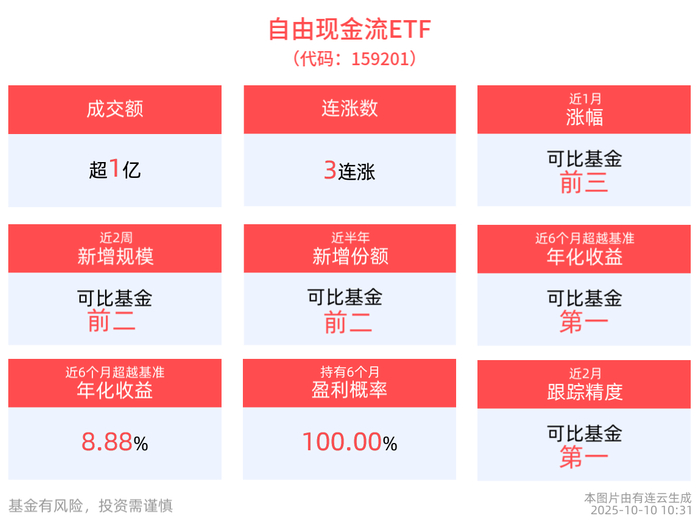
成交额超1亿元,自由现金流ETF(159201)逆势上行,冲击3连涨
Xin Lang Cai Jing· 2025-10-10 03:04
Core Insights - The Guozheng Free Cash Flow Index has increased by 0.7% as of October 10, 2025, with significant gains in constituent stocks such as Lianfa Co. and Baiyin Nonferrous Metals [1] - The Free Cash Flow ETF (159201) has risen by 0.78%, marking its third consecutive increase, with a trading volume of 1.4 billion yuan [1] - Over the past six months, the Free Cash Flow ETF has achieved a net value increase of 25.65%, ranking first among comparable funds [1][3] Performance Metrics - The Free Cash Flow ETF has a maximum drawdown of 3.65% over the past six months, the smallest among comparable funds, with a recovery time of 35 days [3] - The management fee for the Free Cash Flow ETF is 0.15%, and the custody fee is 0.05%, both the lowest in its category [3] - The tracking error for the Free Cash Flow ETF over the past two months is 0.054%, indicating the highest tracking precision among comparable funds [3] Top Holdings - As of September 30, 2025, the top ten weighted stocks in the Guozheng Free Cash Flow Index include China National Offshore Oil Corporation, SAIC Motor, Wuliangye, Gree Electric Appliances, and others, collectively accounting for 54.91% of the index [3]

长城上证科创板100指数增强A基金经理变动:增聘向晨为基金经理
Sou Hu Cai Jing· 2025-10-10 01:39
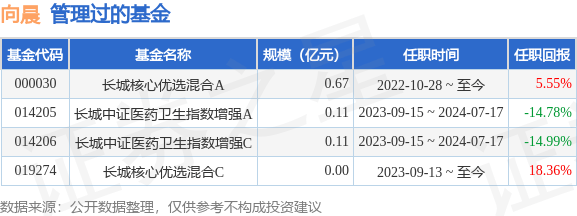
Core Insights - The announcement on October 10, 2025, states that Xiang Chen has been appointed as the fund manager for the Great Wall SSE Sci-Tech Innovation Board 100 Index Enhanced Fund (023446) effective from the same date [1] - As of October 9, 2025, the net value of the fund was 1.3956, reflecting an increase of 0.88% from the previous day [1] Fund Manager Background - Xiang Chen, a Chinese national with a master's degree, joined Great Wall Fund Management Co., Ltd. in August 2019, serving as a quantitative researcher and investment manager assistant [1] - He has been the fund manager for the Great Wall Core Preferred Flexible Allocation Mixed Securities Investment Fund since October 28, 2022, and for the Great Wall CSI Pharmaceutical Health Index Enhanced Securities Investment Fund since September 15, 2023 [1] Fund Performance - The following are the funds managed by Xiang Chen along with their respective sizes and performance: - Great Wall Core Preferred Mixed A (Code: 000030) with a size of 0.67 billion, has a return of 5.55% since October 28, 2022 [1] - Great Wall CSI Pharmaceutical Health Index Enhanced A (Code: 014205) with a size of 0.11 billion, has a return of -14.78% from September 15, 2023, to July 17, 2024 [1] - Great Wall CSI Pharmaceutical P Index Enhanced C (Code: 014206) with a size of 0.11 billion, has a return of -14.99% from September 15, 2023, to July 17, 2024 [1] - Great Wall Core Preferred Mixed C (Code: 019274) with a size of 0.00 billion, has a return of 18.36% since September 13, 2023 [1] Stock Performance Review - In the third quarter of 2023, the Great Wall Core Preferred Mixed A fund added Shaanxi Coal and Chemical Industries, with an average entry price of 22.73. After holding for one year and one quarter, it exited in the fourth quarter of 2024 at an average exit price of 31.49, resulting in an estimated return of 38.54% [1]
安全生产考核巡查将开启,助力煤价反弹 | 投研报告
Zhong Guo Neng Yuan Wang· 2025-10-10 01:17
Core Viewpoint - The coal supply is expected to contract due to the upcoming safety production inspections, which may lead to an increase in coal prices as demand rises in November [2][3]. Group 1: Safety Inspections and Supply Impact - In November, 22 safety inspection teams will enter 31 provinces and regions to conduct annual assessments, focusing on major safety issues and illegal activities in production [2]. - The inspections may lead to rectifications of safety hazards related to overproduction in the coal sector, further tightening coal supply [2][3]. - Since July 2025, the monthly coal output has seen a year-on-year decline of over 3%, with expectations of further reductions due to the inspections [2]. Group 2: Demand and Price Outlook - The coal price has rebounded during the off-season, stabilizing above 700 yuan/ton by the end of September, primarily due to supply contraction [3]. - As the heating season begins in mid-November, the demand for coal is expected to increase, particularly from non-electric sectors like coal chemical industries, which may support coal prices [3]. - The anticipated supply reduction is expected to end the seasonal price decline early, with projections suggesting coal prices could exceed 900 yuan/ton by year-end [3]. Group 3: Investment Recommendations - The sector is expected to benefit from improved supply-demand dynamics and rising coal prices, with a focus on companies with high spot market exposure [3]. - Recommended investment targets include: 1. Companies with high spot market elasticity, such as Lu'an Environmental Energy [3]. 2. Stable and growth-oriented companies like Jincheng Anthracite Mining and Huayang Co., Ltd. [3]. 3. Companies with recovery in production, such as Shanxi Coal International [3]. 4. Industry leaders with stable performance, including China Shenhua, China Coal Energy, and Shaanxi Coal and Chemical Industry [3].



煤炭行业事件点评:安全生产考核巡查将开启,助力煤价反弹
Minsheng Securities· 2025-10-09 12:27
Investment Rating - The report maintains a "Buy" rating for the coal sector, with specific recommendations for several companies based on their performance and market conditions [4]. Core Insights - The upcoming safety production assessments are expected to lead to a contraction in coal supply, which may support a rebound in coal prices. Since July 2025, the monthly coal output has seen a year-on-year decline of over 3%, and the anticipated inspections may further tighten supply [1][2]. - The coal price has shown signs of recovery, stabilizing above 700 RMB/ton by the end of September 2025. The report predicts that by the end of the year, coal prices could exceed 900 RMB/ton due to supply constraints and increased demand from the coal chemical sector [2]. - The report highlights several investment opportunities within the sector, particularly focusing on companies with high spot market exposure and those expected to benefit from supply-demand dynamics [2]. Summary by Sections Supply and Demand Dynamics - The safety inspections scheduled for November 2025 are likely to impact coal supply negatively, reinforcing expectations of reduced output. This is particularly relevant as the country transitions into the heating season, which typically sees increased demand [1][2]. - The report notes that the coal chemical sector is poised to benefit from the seasonal demand increase, providing additional support for coal prices [2]. Company Recommendations - The report recommends specific companies based on their market positioning and expected performance: 1. **High Spot Market Exposure**: Lu'an Huanneng (潞安环能) is highlighted for its significant elasticity in response to price changes. 2. **Stable Growth Companies**: Jin控煤业 (晋控煤业) and Huayang Co., Ltd. (华阳股份) are recommended for their robust performance. 3. **Recovery in Production**: Shanmei International (山煤国际) is noted for its potential production recovery. 4. **Industry Leaders**: China Shenhua (中国神华), Zhongmei Energy (中煤能源), and Shaanxi Coal (陕西煤业) are recognized for their stable earnings [2][4].

煤炭行业今日净流入资金3.01亿元 永泰能源等12股净流入资金超千万元
Zheng Quan Shi Bao Wang· 2025-10-09 09:33
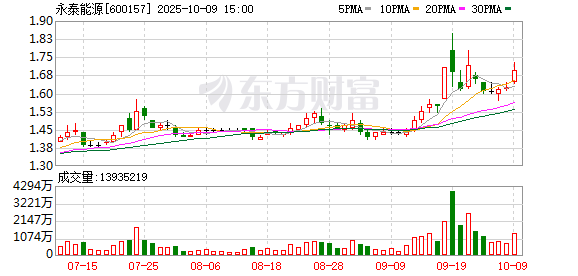
Market Overview - The Shanghai Composite Index rose by 1.32% on October 9, with 23 out of 28 sectors experiencing gains. The top-performing sectors were non-ferrous metals and steel, with increases of 7.60% and 3.38% respectively. The coal industry ranked third in terms of gains, rising by 3.00% [2][3]. Fund Flow Analysis - The main funds in the two markets experienced a net outflow of 19.966 billion yuan. However, 12 sectors saw net inflows, with the non-ferrous metals sector leading with a net inflow of 5.361 billion yuan. The construction and decoration sector followed with a 2.17% increase and a net inflow of 1.868 billion yuan [2]. - The sectors with the largest net outflows included non-bank financials, which saw a net outflow of 6.725 billion yuan, and the automotive sector, which had a net outflow of 4.325 billion yuan. Other sectors with significant outflows included media, electronics, and banking [2]. Coal Industry Performance - The coal industry saw a 3.00% increase with a net inflow of 301 million yuan. Out of 37 stocks in this sector, 36 rose, and one hit the daily limit. The top stock in terms of net inflow was Yongtai Energy, with an inflow of 111 million yuan, followed by China Shenhua and New Dazhou A, with inflows of 56.399 million yuan and 27.092 million yuan respectively [3][4]. - The coal industry had several stocks with significant net outflows, including Shaanxi Coal, New集 Energy, and Panjiang Coal, with outflows of 61.551 million yuan, 13.266 million yuan, and 9.8342 million yuan respectively [3][4].


煤炭行业今日净流入资金3.01亿元,永泰能源等12股净流入资金超千万元
Zheng Quan Shi Bao Wang· 2025-10-09 09:30
Market Overview - The Shanghai Composite Index rose by 1.32% on October 9, with 23 out of 28 sectors experiencing gains. The top-performing sectors were non-ferrous metals and steel, with increases of 7.60% and 3.38% respectively. The coal industry ranked third in terms of gains, rising by 3.00% [1]. Coal Industry Performance - The coal sector saw a net inflow of 301 million yuan, with 36 out of 37 stocks in the sector rising, including one hitting the daily limit. Only one stock declined [1]. - Among the coal stocks, the top net inflow was from Yongtai Energy, with 111 million yuan, followed by China Shenhua and New Dazhou A, with net inflows of approximately 56.4 million yuan and 27.1 million yuan respectively [1]. Key Stocks in Coal Sector - The following table summarizes the performance of key coal stocks: - Yongtai Energy: +4.29%, turnover rate 6.39%, net inflow 110.54 million yuan - China Shenhua: +2.44%, turnover rate 0.26%, net inflow 56.39 million yuan - New Dazhou A: +10.04%, turnover rate 5.91%, net inflow 27.09 million yuan - Shanxi Coking Coal: +3.45%, turnover rate 1.72%, net inflow 26.17 million yuan - Jiangxi Tungsten: +6.61%, turnover rate 3.92%, net inflow 23.90 million yuan [1]. Fund Flow Analysis - In the coal sector, 26 stocks experienced net inflows, with 12 stocks seeing inflows exceeding 10 million yuan. Conversely, the stocks with the highest net outflows included Shaanxi Coal, New集 Energy, and Panjiang Coal, with outflows of approximately 61.6 million yuan, 13.3 million yuan, and 9.8 million yuan respectively [1].
东方财富证券:25Q2或为全年业绩低点 看好煤炭板块震荡向上机会
Zhi Tong Cai Jing· 2025-10-09 07:37
Core Viewpoint - The coal industry in the first half of 2025 (25H1) experienced a significant decline in profits, with total profits amounting to 149.2 billion yuan, a year-on-year decrease of 52.9% [1][3] Group 1: Profit and Revenue Trends - In 25H1, the coal industry's total profit was 149.2 billion yuan, down 52.9% year-on-year, with profits for Q1 and Q2 at 80.4 billion yuan and 68.8 billion yuan respectively, reflecting declines of 47.4% and 58.1% [1][3] - The average net profit per ton of coal in 25H1 decreased by 30%, with Q2 net profit for the sector declining by 14% quarter-on-quarter, indicating that Q2 may represent the lowest point for the year [3][4] - The number and proportion of loss-making companies in the coal industry continued to rise, reaching a loss ratio of 56% by June 2025, an increase of 13.6 percentage points compared to the end of 2024 [1] Group 2: Capital Expenditure and Debt Levels - Capital expenditure in the coal industry slowed down in 25H1, but listed companies still saw a 47% year-on-year increase, with total capital expenditure reaching 84 billion yuan [2] - The industry's total debt reached a record high of 4.8 trillion yuan, while the asset-liability ratio remained stable at around 60% [2] Group 3: Cost and Expense Management - The average cost per ton of coal decreased, with a reduction of 19.5% and 4.2% in average costs for 25H1, leading to a significant drop in net profit per ton [3][4] - The average return on equity (ROE) for sample companies in 25H1 was only 1.9%, down from 5.4% in 24H1, indicating increased profitability pressure [4] Group 4: Market Outlook and Recommendations - The coal market has shown signs of recovery since July 2025, with significant price increases for major coal companies, suggesting potential for improved performance in the second half of the year [3][4] - Investment recommendations include focusing on companies that are expected to benefit from the stabilization of coal prices and those with strong performance resilience, such as China Shenhua and China Coal Energy [5]



陕西煤业涨2.00%,成交额7.81亿元,主力资金净流出4608.94万元
Xin Lang Cai Jing· 2025-10-09 05:52
Core Viewpoint - Shaanxi Coal's stock price has experienced fluctuations, with a recent increase of 2.00% on October 9, 2023, but a year-to-date decline of 7.20% [1][2] Company Overview - Shaanxi Coal Industry Co., Ltd. is located in Xi'an, Shaanxi Province, established on December 23, 2008, and listed on January 28, 2014 [2] - The company's main business includes coal mining, washing, transportation, sales, and production services [2] - Revenue composition: self-produced coal 55.83% (including raw selected coal 39.02% and trade coal 31.85%), washing coal 16.81%, electricity 8.69%, others 3.26%, and transportation 0.37% [2] Financial Performance - For the first half of 2025, Shaanxi Coal reported operating revenue of 77.983 billion yuan, a year-on-year decrease of 7.97%, and a net profit attributable to shareholders of 7.638 billion yuan, down 27.64% year-on-year [2] - Cumulative cash dividends since the A-share listing amount to 81.645 billion yuan, with 47.331 billion yuan distributed in the last three years [3] Shareholder Information - As of June 30, 2025, the number of shareholders increased by 11.26% to 102,900, with an average of 94,219 circulating shares per person, a decrease of 10.12% [2] - Major shareholders include Hong Kong Central Clearing Limited, holding 240 million shares (a decrease of 17.8098 million shares), and various ETFs with increased holdings [3]