
Ally Financial

Search documents
COF vs. SYF: Which Credit Card Lender Offers More Upside?
ZACKS· 2026-02-12 18:20
Core Insights - Capital One (COF) and Synchrony Financial (SYF) are significant players in the consumer finance sector, heavily influenced by consumer credit trends and interest rate environments [1][2] - COF operates as a diversified financial institution, while SYF focuses on private-label and co-branded cards through retailer partnerships [2][3] Capital One (COF) - COF's strength lies in its data-driven, digital-first business model, enhancing customer acquisition and scalable growth [4] - The acquisition of Discover Financial Services for $35.3 billion in May 2025 made COF the largest U.S. credit card issuer by balances [4][5] - COF's inorganic growth strategy includes notable acquisitions like Brex for $5.15 billion, transforming it into a diversified financial services firm [6] - Despite a marginal revenue decline in 2020, COF experienced a five-year CAGR of 13.4% from 2020 to 2025, with positive revenue prospects [7] - COF's net interest income (NII) grew at a CAGR of 13.4% over five years, with NIM expanding to 7.84% in 2025 from 6.63% in 2023 [10] - As of December 31, 2025, COF had total debt of $51 billion and cash equivalents of $57.4 billion, indicating a solid balance sheet [11] - COF restored its quarterly dividend to 80 cents per share in November 2025, following a 75% cut in 2020 [12] - A share repurchase plan of up to $16 billion was authorized in October 2025, reflecting strong earnings and liquidity [13] Synchrony Financial (SYF) - SYF leverages a strong distribution channel to offer a range of products, including private-label credit cards and dual cards [14] - The company has pursued growth through acquisitions and partnerships, including the acquisition of Ally Financial's point-of-sale financing business in 2024 [15][16] - SYF's revenues experienced a five-year CAGR of 5.1% through 2025, driven by strategic partnerships [17] - As of December 31, 2025, SYF had $15 billion in cash and cash equivalents, with total borrowings of $15.2 billion [20] - In Q4 2025, SYF returned $952 million through share buybacks and paid $106 million in dividends [21] Revenue and Earnings Estimates - The Zacks Consensus Estimate for COF's revenues implies year-over-year growth of 18.3% for 2026 and 4.6% for 2027, with upward revisions in earnings estimates [22] - SYF's revenue estimates indicate year-over-year growth of 4.2% for 2026 and 4.8% for 2027, with a projected earnings decline of 1.4% for 2026 [24] - COF shares gained 8.7% over the past year, while SYF shares increased by 13.8%, both underperforming the S&P 500 Index [27] Valuation - COF is trading at a forward P/E of 10.33X, higher than its five-year median of 9.06X, while SYF trades at 7.76X, slightly above its five-year median of 7.45X [29] - COF's premium valuation is justified by its superior growth trajectory compared to SYF [32] Strategic Outlook - SYF's robust liquidity and strong distribution channel contribute to its operational efficiency, though elevated expenses may impact profitability [33] - COF's strategic partnerships and higher credit card demand are expected to support growth, despite potential challenges in profitability margins [34] - Both companies are navigating a volatile macroeconomic environment, with potential caps on credit card interest rates posing risks to interest income [35]




OneMain (OMF) - 2025 Q4 - Earnings Call Transcript
2026-02-05 15:02
Financial Data and Key Metrics Changes - Full-year earnings per share increased by 36% year-over-year to $6.66, with capital generation rising by 33% to $913 million [5][18] - Fourth quarter GAAP net income was $204 million, or $1.72 per diluted share, up 64% from the previous year [18] - Managed receivables grew by 6% year-over-year to $26.3 billion, with revenue increasing by 8% in the fourth quarter [18][20] Business Line Data and Key Metrics Changes - Personal loans saw significant growth driven by targeted initiatives, with debt consolidation products reducing customer payments by about 25% [6][7] - Auto finance receivables grew to $2.8 billion, with a scalable platform established and partnerships expanded [9][14] - Credit card receivables increased to $936 million, with accounts rising to nearly 1.1 million customers [10][14] Market Data and Key Metrics Changes - The company maintained a conservative underwriting posture despite a slightly weaker labor market and persistent inflation [16][32] - The 30-plus delinquency rate for consumer loans was 5.65%, in line with expectations and better than pre-pandemic trends [14][23] - C&I net charge-offs were 7.9% in the fourth quarter, with consumer loan net charge-offs at 7.6%, showing significant improvement [14][25] Company Strategy and Development Direction - The company is focused on product innovation, enhancing customer experience, and expanding its auto finance and credit card businesses [34] - Plans to maintain a conservative underwriting posture while targeting a minimum 20% return on tangible equity [19][32] - The introduction of new products and the expansion of existing services are expected to drive growth in managed receivables by 6%-9% in 2026 [31][32] Management's Comments on Operating Environment and Future Outlook - Management expressed confidence in the resilience of OneMain's customers and the strength of its portfolio, anticipating continued capital generation growth in 2026 [16][34] - The company expects to see some seasonal patterns in losses, with a potential improvement in the second half of 2026 [32] - Management highlighted the importance of maintaining a strong balance sheet and the ability to issue capital opportunistically [30][31] Other Important Information - The company was recognized as one of America's most loved workplaces for the fourth consecutive year, reflecting a strong corporate culture [13] - A $1 billion share repurchase program was approved through 2028, with a commitment to maintaining dividends [15][18] Q&A Session Questions and Answers Question: Outlook for credit performance - Management indicated that while credit should continue to improve, there are pressures from the backbook contributing to delinquency and losses, with expectations for a range of C&I net charge-offs in 2026 [37][39] Question: ILC application status and implications - The company is progressing through the ILC application process, which could enhance its ability to serve customers and diversify its balance sheet, but any positive effects are expected to materialize around 2027 [41][42] Question: Loan growth expectations - The company expects loan growth to be driven by innovation in personal loan products and improved team member effectiveness, with a target of 6%-9% growth in managed receivables for 2026 [53][54] Question: Impact of tax refunds on performance - Tax refunds are a significant focus, as they typically improve delinquencies and drive loan demand, but the company does not have specific expectations for the current tax season [60][62] Question: Interest yield trends - The consumer loan yield is currently at 22.5%, with expectations for stability in yields moving forward, influenced by product mix and pricing actions [63][64] Question: Whole loan sales strategy - The whole loan sale program is viewed as a funding diversification strategy, providing flexibility and attractive pricing, while also generating additional revenue streams [70][72]

OneMain (OMF) - 2025 Q4 - Earnings Call Transcript
2026-02-05 15:02
Financial Data and Key Metrics Changes - Full-year earnings per share increased by 36% year-over-year to $6.66, with capital generation rising by 33% to $913 million [5][18] - Fourth quarter GAAP net income was $204 million, or $1.72 per diluted share, up 64% from $1.05 per diluted share in the fourth quarter of 2024 [18] - Total revenue for the fourth quarter was $1.6 billion, an 8% increase compared to the fourth quarter of 2024, with full-year revenue growth at 9% [20][21] Business Line Data and Key Metrics Changes - Receivables grew 6% year-over-year to $26.3 billion, with personal loans driving growth through targeted initiatives [5][18] - Auto finance receivables increased to $2.8 billion, with significant progress in building a scalable platform [9][14] - Credit card receivables grew to $936 million, with accounts increasing to nearly 1.1 million customers [10][14] Market Data and Key Metrics Changes - The company maintained a conservative underwriting posture despite a slightly weaker labor market in 2025, with net charge-offs improving significantly [16][24] - The 30-plus delinquency rate for consumer loans was 5.65%, in line with expectations and better than pre-pandemic trends [14][23] Company Strategy and Development Direction - The company is focused on product innovation, enhancing customer experience, and expanding its auto finance and credit card businesses [34] - A new secured lending product for homeowners is being introduced, which is expected to drive originations without loosening underwriting standards [7][9] - The company is committed to a share repurchase program, with a $1 billion authorization through 2028, reflecting confidence in capital generation [15][17] Management's Comments on Operating Environment and Future Outlook - Management expressed confidence in the resilience of OneMain's customers and the portfolio, anticipating continued capital generation growth in 2026 [16][33] - The outlook for 2026 includes managed receivables growth of 6%-9%, with expectations for C&I net charge-offs in the range of 7.4%-7.9% [32][33] Other Important Information - The company was recognized as one of America's most loved workplaces for the fourth consecutive year, highlighting its strong workplace culture [13] - The financial wellness platform on the mobile app saw a 36% increase in customer adoption, indicating a commitment to customer financial education [11][12] Q&A Session Summary Question: Outlook for credit performance - Management indicated that while credit should continue to improve, there are pressures from the backbook contributing to delinquency and losses, with expectations for seasonal patterns in 2026 [37][39] Question: ILC application status and implications - The company is progressing through the ILC application process, which could enhance its ability to serve customers and diversify its balance sheet, but any positive effects are expected to materialize around 2027 [41][42] Question: New product rollout and pilot periods - New products, including the home merchandise-backed product, will undergo pilot testing to assess performance before full rollout [47] Question: Loan growth expectations - The company expects loan growth to be driven by innovation in personal loan products and improved team member effectiveness, with a target of 6%-9% growth in 2026 [53][54] Question: Impact of tax refunds on performance - Tax refunds are a significant focus, with expectations that higher refunds could improve delinquencies and drive loan demand, although no specific expectations were set for the current tax season [60][62] Question: Interest yield trends - The consumer loan yield is currently at 22.5%, with expectations for yields to remain stable, influenced by product mix and pricing actions taken in previous years [63][64] Question: Whole loan sales strategy - The whole loan sale program is viewed as a funding diversification strategy, providing flexibility and attractive pricing, while also contributing to revenue through gains on sale and servicing income [70][72]
OneMain (OMF) - 2025 Q4 - Earnings Call Transcript
2026-02-05 15:00
Financial Data and Key Metrics Changes - Full-year earnings per share increased by 36% year-over-year to $6.66, with capital generation rising by 33% to $913 million [5][19] - Fourth quarter GAAP net income was $204 million, or $1.72 per diluted share, up 64% from the previous year [19] - Managed receivables grew by 6% year-over-year to $26.3 billion, with revenue increasing by 8% in the fourth quarter [19][22] Business Line Data and Key Metrics Changes - Personal loans saw significant growth, driven by targeted initiatives, with consumer loan originations for the full year up by 8% [6][19] - Auto finance receivables increased to $2.8 billion, with a scalable platform being built [10][15] - Credit card receivables grew to $936 million, with accounts increasing to nearly 1.1 million customers [11][19] Market Data and Key Metrics Changes - The company maintained a conservative underwriting posture despite a slightly weaker labor market and persistent inflation [17][33] - The 30-plus delinquency rate for consumer loans was 5.65%, in line with expectations and better than pre-pandemic trends [14][25] Company Strategy and Development Direction - The company is focused on product innovation, enhancing customer experience, and expanding its auto finance and credit card businesses [35] - A new secured lending product for homeowners is being introduced, which is expected to drive originations without loosening underwriting standards [8][10] - The company is committed to a share repurchase program, with a $1 billion authorization through 2028 [16][35] Management's Comments on Operating Environment and Future Outlook - Management expressed confidence in the resilience of OneMain's customers and the portfolio, anticipating continued capital generation growth in 2026 [17][34] - The outlook for 2026 includes managed receivables growth of 6%-9% and C&I net charge-offs expected in the range of 7.4%-7.9% [33][34] Other Important Information - The company was recognized as one of America's most loved workplaces for the fourth consecutive year, reflecting a strong workplace culture [13] - The financial wellness platform on the mobile app saw a 36% increase in users, indicating a commitment to customer financial education [12] Q&A Session Questions and Answers Question: Can you tie together the outlook for credit and the expected losses for 2026? - Management noted that 2025 was a remarkable year with significant loss benefits, and while the front book is performing well, the backbook remains a headwind [38][40] Question: What are the implications of the ILC application? - The company believes that obtaining an ILC license would allow for a more standardized rate structure and operational structure, enhancing customer service [42][43] Question: How do you view the rollout of new products like the home merchandise-backed products? - New products will be piloted to assess performance before full rollout, ensuring they meet risk-adjusted return criteria [47][48] Question: What drives demand for personal loans? - Demand remains stable, with debt consolidation being a primary use case, alongside emergency needs and discretionary spending [49][50] Question: What is the expectation for loan growth in 2026? - The company expects loan growth to be driven by innovation in personal loan products and improved team member effectiveness [53][54] Question: How will share repurchase pace change in 2026? - The company plans to bias incremental capital returns towards share repurchases unless more attractive uses of capital arise [56][57] Question: How do you expect tax refunds to impact your customer base? - Tax refunds typically improve delinquencies and drive seasonal low losses, but the company does not have specific expectations for the upcoming tax season [59][60]
I Predicted This Former Buffett Stock Would Outperform Every Other Buffett Stock in 2025. I Was Right.
The Motley Fool· 2026-01-31 07:42
Core Viewpoint - Berkshire Hathaway remains a compelling investment despite Warren Buffett stepping down as CEO, with quarterly data still reflecting his influence until the first-quarter results of 2026 are released [1] Group 1: Company Performance - Berkshire Hathaway missed significant gains by selling its position in Nu Holdings at the end of 2024, which has since outperformed other stocks in its portfolio [2][3] - Nu Holdings has shown remarkable stock performance, surpassing the top 10 stocks in Berkshire Hathaway's portfolio in 2025 [3] Group 2: Market Position and Growth - Nu Holdings is an all-digital bank operating in Brazil, Mexico, and Colombia, becoming the largest financial institution in Brazil by customer count, with 61% of the adult population on its platform [6] - The company has a growing presence in Mexico and Colombia, with 14% and 10% of the populations, respectively, using its services [6] - Nu is actively monetizing its Brazilian user base and plans to expand into new markets, including the U.S., with new offices opening in Miami, Palo Alto, and Washington, D.C. [8] Group 3: Stock Information - Nu Holdings has a current market capitalization of $85 billion, with a stock price of $17.75, reflecting a recent change of -5.38% [7]


Stock Market Today, Jan. 20: Nu Holdings Rises as Brazilian Banks Attract Spotlight
Yahoo Finance· 2026-01-20 23:09
Company Overview - Nu Holdings (NYSE:NU) is a digital banking services provider in Latin America, closing at $16.97, up 2.23% on a day marked by optimism about its growth prospects and expansion plans [1] - The company has experienced a growth of 50.84% since its IPO in 2021 [1] Market Performance - Trading volume for Nu Holdings reached 74.1 million shares, which is approximately 102% above its three-month average of 36.6 million shares [1] - The S&P 500 fell 2.06% and the Nasdaq Composite declined 2.39%, indicating a broader market downturn, while Nu Holdings showed a slight recovery [2][3] Institutional Interest - Triasima Portfolio Management reduced its stake in Nu Holdings by almost 40% during Q3, indicating a shift in institutional interest [3] - Conversely, firms like Dynasty Wealth Management and Americana Partners have recently increased their positions in Nu Holdings [3] Sector Developments - There were no major drivers behind the gains for Nu Holdings, but the planned IPO of PicPay, another Brazilian digital bank, may have increased interest in the digital banking sector [4] - Nu Holdings is rapidly expanding its digital banking services across Brazil, Mexico, Colombia, and the Cayman Islands, and has applied for a U.S. national bank charter [4] - The company's Q4 earnings report is scheduled for February 25 [4]
大摩展望美国消费金融财报季:防御仍是主线,特朗普信用卡限息提议增添不确定性
智通财经网· 2026-01-13 09:33
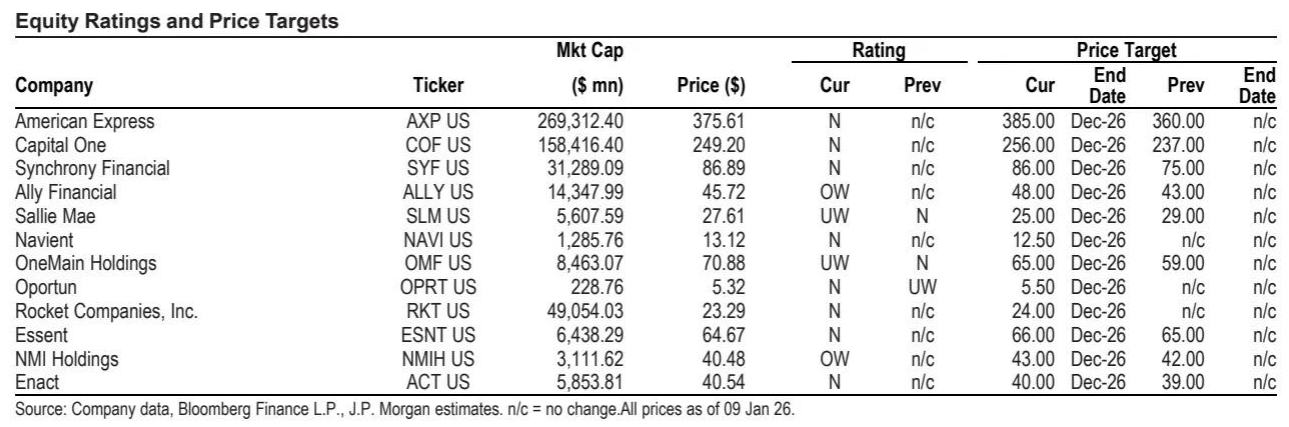
Group 1 - The core viewpoint of the reports indicates that the financial sector is advised to maintain a defensive posture due to anticipated impacts from inflation and labor market dynamics on credit performance and consumer confidence [1] - Morgan Stanley acknowledges that while target stock prices have been steadily raised since the beginning of the year, earnings expectations have largely remained unchanged, reflecting a conservative outlook [1] - The report highlights a significant proposal from Trump to limit credit card interest rates to 10% for one year, which could fundamentally reshape the credit card industry and significantly reduce profitability for issuers [1] Group 2 - In December, U.S. consumer spending growth showed signs of slowing, with a year-over-year increase of 2.4%, down from 3.7% in November, indicating a divergence in spending patterns between high-income and low-income households [2] - The labor market is characterized by low hiring and low layoffs, with non-farm payrolls increasing by only 50,000 in December, which is below expectations, while the unemployment rate decreased from 4.6% to 4.4% [2] - Despite geopolitical news, the direct impact on consumer finance remains limited, with Morgan Stanley expecting inflation and labor market conditions to continue being focal points for investors and operators [3] Group 3 - Morgan Stanley maintains a selective and rigorous approach in evaluating the financial sector, considering factors such as adequate valuations, uneven credit trends, and execution risks within the rating spectrum [3] - The report includes specific ratings and target price adjustments for various financial stocks, reflecting a balanced and differentiated outlook based on current market dynamics [3]
高盛推出“2026年最重要交易”:AI生产力受益组合
美股IPO· 2025-11-26 04:45
Core Viewpoint - Goldman Sachs has launched a new investment portfolio, GSXUPROD, consisting of non-tech companies that have integrated AI into their workflows to reduce costs and improve profit margins. The firm believes that this portfolio has the potential for higher earnings per share changes compared to the Russell 1000 and S&P 500 indices due to AI adoption and productivity enhancements [1][3][7]. Group 1: AI Adoption in Various Industries - The adoption rate of AI in enterprises has reached 37%, with large companies showing a 13% adoption rate based on stricter definitions [5]. - Financial institutions are deploying AI to enhance operational efficiency across various applications, including fraud detection and customer interaction [8]. - Retailers and warehouse operators are utilizing AI for optimizing customer experiences, supply chain logistics, and internal operations, leading to significant productivity improvements [14][15]. Group 2: Specific Company Initiatives - JPMorgan Chase emphasizes its pre-existing AI expertise and uses AI to control workforce growth while maintaining cost discipline [9]. - Bank of America views AI as "augmented intelligence," with its Erica platform handling 2 million customer interactions daily [11]. - Amazon is heavily investing in AI across multiple domains, including AWS AI services and custom chips [14]. - HCA Healthcare is implementing AI to improve revenue cycle management and enhance clinical documentation [25]. - Yum Brands has deployed AI in over 28,000 restaurants to provide operational guidance and improve efficiency [27]. Group 3: Performance and Market Outlook - The GSXUPROD portfolio has underperformed the market this year, even when excluding the seven tech giants, but still shows potential for higher earnings per share changes due to AI integration [7]. - Goldman Sachs believes that the long-term investment opportunity lies in AI productivity beneficiaries, which will be crucial in 2026 [3].

Popular Bank exits mortgage lending
American Banker· 2025-10-24 21:12
Core Viewpoint - Popular Bank is exiting the U.S. residential mortgage origination business due to competitive pressures and a desire to focus on more profitable areas [2][3] Company Summary - Popular Bank, based in Puerto Rico, is the second institution to exit home lending in a little over a month, following Oceanfirst Bank's similar decision [1][7] - The bank reported a net income of $211 million in the most recent quarter, with a $129 million increase in mortgage activity in its Puerto Rico business [3] - The exit from the mortgage segment will impact an unspecified number of employees and is accompanied by the closure of four branches in the New York metropolitan area [2][3] Industry Summary - The mortgage industry is undergoing significant changes due to current market conditions, leading to a wave of mergers and exits as companies reassess their strategies [4] - Rising interest rates and housing affordability challenges have resulted in many nonbank lenders struggling with profitability, prompting them to merge or exit the mortgage business [5][6] - Other institutions, such as Ally Financial and WaFd Bank, have also announced exits from the mortgage segment, indicating a broader trend in the industry [6]


招银国际每日投资策略-20251020
Zhao Yin Guo Ji· 2025-10-20 01:49
Market Overview - The global stock markets experienced mixed performance, with the Hang Seng Index closing at 25,247, down 2.48% for the day but up 25.86% year-to-date [1] - The US markets showed slight gains, with the Dow Jones up 0.52% and the S&P 500 up 0.53% [1] - The Chinese stock market saw significant declines, particularly in healthcare, consumer discretionary, and industrial sectors, while defensive sectors like telecommunications and utilities outperformed [3] Sector Performance - In the Hong Kong market, the Hang Seng Financial Index fell by 1.72% while the Hang Seng Industrial Index dropped by 3.04% [2] - The healthcare sector in Hong Kong led the declines, indicating a potential shift in investor sentiment towards defensive stocks [3] Investment Opportunities - The software and IT services industry is highlighted for its potential investment opportunities, particularly in companies that are enhancing their strategic collaborations and commercializing AI applications [4] - Specific companies to watch include Alibaba (BABA US), Baidu (BIDU US), Tencent (700 HK), and Kuaishou (1024 HK) for their strong growth in cloud services and AI-related revenues [4] - In the engineering machinery sector, a recovery in non-earthmoving machinery sales in September suggests the beginning of an upward cycle, with companies like Zoomlion (1157 HK), Sany Heavy Industry (600031 CH), and Hengli Hydraulic (601100 CH) recommended for investment [4] Economic Indicators - The Chinese ETF market has seen a net inflow of nearly 90 billion yuan since the National Day holiday, indicating a trend of investors buying on dips, particularly in technology and high-dividend sectors [3] - The Chinese central bank is expected to maintain a loose monetary policy, with potential rate cuts anticipated in November or December [3]