跨境型ETF

Search documents
每日市场观察-20260115
Caida Securities· 2026-01-15 03:22
Market Overview - On January 14, the market experienced fluctuations, with the Shanghai Composite Index closing down by 0.31% while the Shenzhen Component and ChiNext Index rose by 0.56% and 0.82%, respectively[3] - The total trading volume reached 3.99 trillion yuan, an increase of approximately 290 billion yuan compared to the previous trading day[1] Sector Performance - Over half of the sectors saw gains, with notable increases in computer, communication, media, and electronics sectors, while banking, real estate, non-bank financials, and transportation sectors faced declines[1] - The commercial aerospace sector remains strong, supported by significant capital inflows and a robust mid-term outlook[1] Regulatory Changes - The minimum margin requirement for financing purchases of securities was raised from 80% to 100% by the Shanghai and Shenzhen Stock Exchanges, aimed at reducing leverage and ensuring market stability[5] - This adjustment is expected to help protect investors' rights and promote long-term market health[5] Trade and Economic Data - In 2025, China's total import and export value reached 45.47 trillion yuan, a year-on-year increase of 3.8%, marking nine consecutive years of growth[7] - The automotive industry saw record production and sales in 2025, with 34.53 million vehicles produced and 34.40 million sold, reflecting year-on-year growth of 10.4% and 9.4%, respectively[8] Fund Flows - As of January 13, the scale of cross-border ETFs surpassed 1 trillion yuan, reaching 1,002.15 billion yuan, with a significant inflow of 69.74 billion yuan since the beginning of 2026[14] - The technology sector ETFs have seen substantial growth, driven by strong performance in Chinese tech stocks across A-shares, Hong Kong, and U.S. markets[15]
万亿“里程碑”!跨境型ETF一年规模翻倍,“限购”和“溢价”成为关键词
Xin Lang Cai Jing· 2026-01-14 02:21
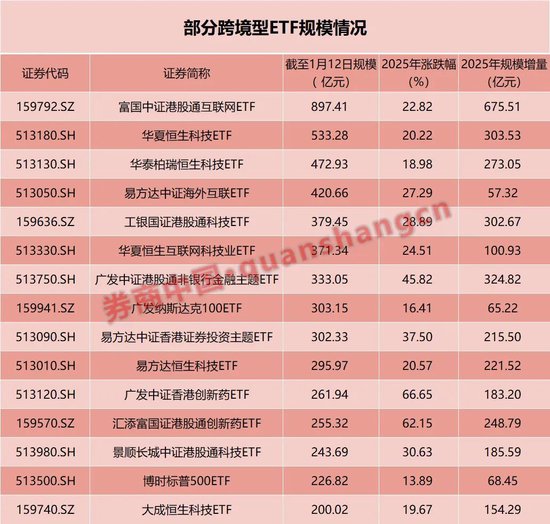
Core Viewpoint - The total scale of cross-border ETFs has surpassed 1 trillion RMB for the first time, reaching 1.0008 trillion RMB as of January 13, driven by global capital market enthusiasm and significant growth in the past year [1][10]. Group 1: Cross-Border ETF Growth - The scale of cross-border ETFs increased by 136% from 424.2 billion RMB at the beginning of 2025 to over 1 trillion RMB in just over a year [1][12]. - As of January 12, the leading cross-border ETF is the Invesco China Internet ETF with a scale of 897.41 billion RMB, followed by the Huaxia Hang Seng Technology ETF at approximately 533.28 billion RMB [2][11]. - There are 25 cross-border ETFs with scales exceeding 10 billion RMB, indicating a robust market presence [2][11]. Group 2: Performance and Market Dynamics - In 2025, 95.2% of the 650 comparable QDII funds saw net value increases, benefiting from the global rise in sectors like artificial intelligence and innovative pharmaceuticals [5][12]. - The surge in ETF scale is attributed to both investor purchases and strong performance in the QDII market, with multiple markets reaching historical highs [4][12]. Group 3: Premiums and Market Conditions - As of January 13, 2026, the Invesco Nasdaq Technology ETF had a premium rate of 20.42%, indicating a supply-demand imbalance in the secondary market [6][13]. - The limited QDII quota has led to frequent premiums in the secondary market, with several funds experiencing significant price increases above their net asset values [6][13]. Group 4: Investment Outlook - Fund managers express optimism for QDII investment opportunities in Hong Kong stocks, viewing them as a bridge for foreign capital into Chinese assets [7][14]. - The technology sector in Hong Kong is highlighted as a key area for investment, driven by domestic AI developments and potential capital expenditure from major internet companies [7][14].

万亿“里程碑”!一年规模翻倍,“限购”和“溢价”成为关键词
券商中国· 2026-01-14 02:20
Core Viewpoint - The cross-border ETF market has reached a historic milestone, surpassing 1 trillion RMB in total scale, driven by global capital market trends and investor enthusiasm for overseas markets [1][5]. Group 1: Market Growth - As of January 13, the total scale of cross-border ETFs reached 1.0008 trillion RMB, marking the first time it has exceeded the trillion RMB threshold [1]. - The scale of cross-border ETFs was only 424.2 billion RMB at the beginning of 2025, indicating a remarkable growth rate of 136% over just over a year [5]. - By early 2026, the overall scale of cross-border ETFs was approximately 932.4 billion RMB, with a rapid increase of over 60 billion RMB in less than half a month [5]. Group 2: Leading Products - The top cross-border ETF by scale is the Invesco Hong Kong Internet ETF, with a size of 89.741 billion RMB as of January 12 [2]. - Other significant ETFs include the Huaxia Hang Seng Technology ETF at approximately 53.328 billion RMB and the Haitong Baichuan Hang Seng Technology ETF at 47.293 billion RMB [2][4]. - A total of 25 cross-border ETFs have surpassed 10 billion RMB in scale, reflecting strong investor interest [2]. Group 3: Performance and Premiums - As of January 13, 2026, the Invesco Nasdaq Technology ETF had a premium rate of 20.42%, indicating high demand in the secondary market [6]. - The overall performance of QDII funds has been strong, with 95.2% of comparable QDII funds showing net value increases in 2025, benefiting from global trends in AI and innovative pharmaceuticals [5][6]. - The limited QDII quota has led to frequent premiums in the secondary market, with several funds experiencing significant price increases above their net asset values [6]. Group 4: Investment Outlook - Fund managers express optimism about investment opportunities in Hong Kong stocks for 2026, viewing them as a bridge for foreign capital into Chinese assets [7]. - The technology sector in Hong Kong is highlighted as a key area for investment, particularly with the rise of AI and related applications [7][8]. - There is a focus on dividend assets in the short term and a shift towards growth investments driven by demand-side changes in the medium term, particularly in technology and consumer sectors [8].

6万亿ETF大盘点,谁是细分赛道隐形冠军?
Sou Hu Cai Jing· 2026-01-08 09:42
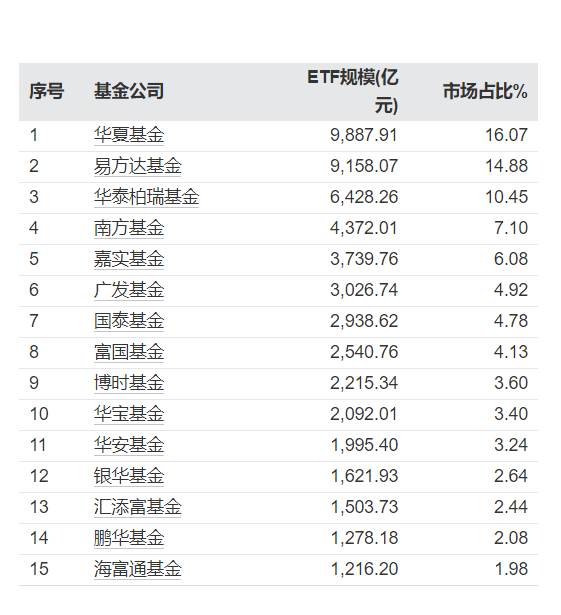
Core Insights - The total scale of ETFs has surpassed 6 trillion, specifically reaching 6.15 trillion [8] - Leading companies in the ETF market include Huaxia and E Fund, both exceeding 900 billion, followed by Haitai Baichuan, which has emerged as a significant player due to its performance in the CSI 300 ETF [9][10] - The ETF market is characterized by a mix of established leaders and emerging champions across various segments, indicating a competitive landscape [10] ETF Market Overview - The top three ETF companies by scale are Huaxia Fund (7,896.61 billion), E Fund (6,981.13 billion), and Haitai Baichuan Fund (5,671.73 billion) [2] - Other notable companies include Southern Fund, Huarun Fund, and GF Fund, which are also recognized as leading public funds in the industry [10] Segment Analysis - In the bond ETF segment, Haifutong Fund leads with a market share of 15.07%, being the only bond ETF to exceed 100 billion [12] - The money market ETF segment is led by Huabao Fund, followed closely by Yinhua Fund, both around 80 billion [13] - The commodity ETF segment is dominated by Huarun Fund with 980 billion, primarily benefiting from the rise in precious metals [13] Emerging Champions - In the cross-border ETF segment, major public funds dominate, with Morgan Fund emerging as a notable player due to its global investment capabilities [14] - The industry index ETF segment is led by Guotai Fund, which, despite being outside the top ten in total scale, excels in this specific category [14] - The thematic index ETF market is primarily held by established public funds, with Huaxia Fund leading at over 1,300 billion [14] Future Outlook - The ETF market is expected to continue growing, with projections suggesting it could reach 10 trillion in the next two years, indicating significant potential for expansion [15]
上周单周增超2000亿元,ETF总规模首次突破6万亿元
Xin Lang Cai Jing· 2025-12-28 18:23
Core Viewpoint - The A-share market is experiencing a significant upward trend, with major indices showing substantial weekly gains, particularly in the ETF market, which has reached a new milestone of over 60 trillion yuan in total scale [1][3]. Group 1: Market Performance - From December 15 to December 19, the CSI 300 index rose by 1.95%, and the CSI A500 index surged by 2.75%, while the ChiNext index increased by 3.90% [1]. - The total scale of domestic ETFs increased by 200.4 billion yuan in one week, marking the first time it surpassed 60 trillion yuan [3]. - The stock-type ETFs accounted for a significant portion of this growth, attracting 133 billion yuan, with broad-based indices contributing 85% of the inflow [3]. Group 2: ETF Growth - The CSI A500 index-linked ETF saw a remarkable increase of 1.066 billion yuan in December, entering the 300 billion yuan club [1][5]. - The total number of listed ETFs reached 1,381, with a total scale of 6.03 trillion yuan as of December 27 [3]. - Year-to-date, the total scale of ETFs has grown by 22.947 billion yuan, with stock-type ETFs nearing a growth of 10 trillion yuan [4]. Group 3: Fund Management - The top seven fund management institutions have significantly increased their ETF scales, with six of them surpassing 10 billion yuan in weekly growth [2][7]. - Southern Fund led the charge with a weekly increase of 34.3 billion yuan, accumulating over 50 billion yuan in three weeks [2][7]. - The competition between major fund houses, such as Huaxia Fund and E Fund, continues to intensify, with both showing substantial year-to-date growth [8].
ETF市场总规模突破6万亿元
Xin Lang Cai Jing· 2025-12-28 13:32
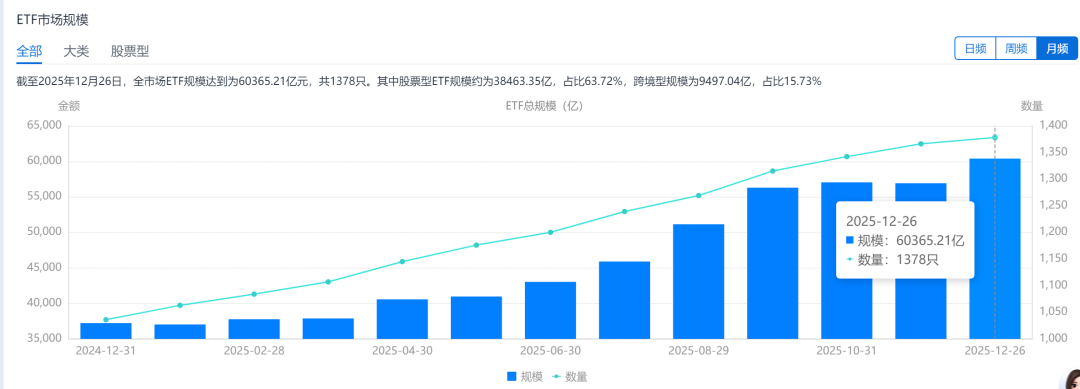
Market Performance - The A-share market experienced a collective rise, with the Shanghai Composite Index achieving an 8-day consecutive increase. The weekly growth rates were 1.88% for the Shanghai Composite Index, 3.53% for the Shenzhen Component Index, and 3.9% for the ChiNext Index [1][4]. ETF Market Trends - The ETF market continued to show significant net inflows, with a total net inflow of 914.29 billion yuan this week. The broad-based ETFs and bond ETFs saw net inflows of 489.96 billion yuan and 599.61 billion yuan, respectively, while industry ETFs experienced an outflow of 139.03 billion yuan [5]. - As of December 26, the total scale of the ETF market grew from 3.72 trillion yuan at the beginning of the year to 6.04 trillion yuan, marking an increase of over 60%. The number of ETFs rose from 1,036 to 1,378 [5]. ETF Issuance and Listings - Two new ETFs are set to be issued in the last three trading days of 2025, specifically the Huabao Sci-Tech Chip ETF and the GF Sci-Tech Chip ETF [6]. - Next week, two ETFs will be listed: the Industrial Bank Sci-Tech Entrepreneurship Artificial Intelligence ETF and the Huabao Hong Kong Stock Connect Automotive ETF [7][8].
见证历史,刚刚,突破6万亿元大关
3 6 Ke· 2025-12-27 08:59
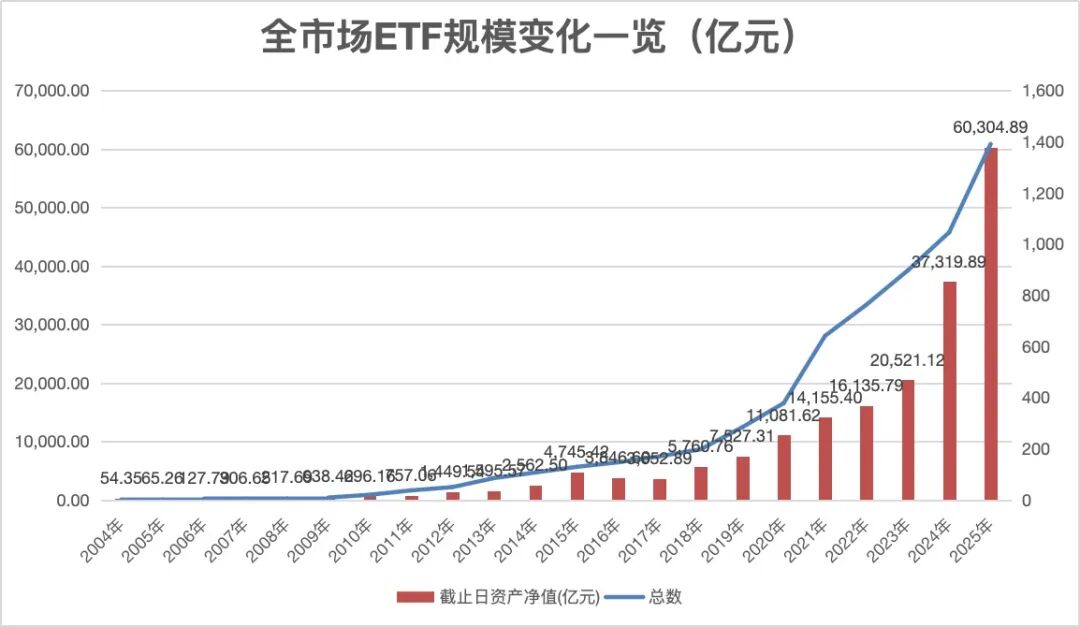
Core Insights - The ETF market in China has reached a significant milestone, with total assets surpassing 6 trillion yuan as of December 26, marking a growth of nearly 2.3 trillion yuan in 2023 alone, the first time the annual increase has exceeded 2 trillion yuan since the inception of ETFs in 2004 [1][4][2] Market Growth - The total number of ETFs in the market has reached 1,391, with a total scale of 6.03 trillion yuan, reflecting a daily increase of 354.52 billion yuan [2] - The growth rate of the ETF market has accelerated, with the time taken to surpass each trillion yuan milestone decreasing significantly: 4 months for 5 trillion yuan and just over 4 months for 6 trillion yuan [4] ETF Types and Performance - Stock ETFs remain the largest segment, totaling 3.85 trillion yuan, but their market share has decreased from 77.38% to 63.78% [4] - Bond ETFs and cross-border ETFs have seen remarkable growth, with their scales reaching 804.56 billion yuan and 938.91 billion yuan respectively, reflecting year-on-year increases of 362.46% and 239.42% [4] - The total net inflow into the ETF market this year has reached 1.33 trillion yuan, with bond ETFs, cross-border ETFs, and stock ETFs leading the inflows [5] Leading Products - The top five stock ETFs by net inflow include products from Guotai Junan, Huaxia, and Haitong, with each exceeding 200 billion yuan in inflows [5] - In the cross-border ETF segment, the top inflow product is the Fuguo Hong Kong Internet ETF, which has attracted over 57 billion yuan [8] - The leading bond ETFs include products focused on credit bonds, indicating a shift in investor preference [9] Industry Dynamics - The number of ETF management firms with over 100 billion yuan in assets has increased to 16, highlighting a growing concentration in the industry [16] - The top three firms—Huaxia, E Fund, and Huatai-PB—control approximately 41% of the total ETF market, with their combined management scale reaching 2.48 trillion yuan [18] - The competitive landscape is shifting towards a focus on comprehensive service capabilities rather than just the number of products offered [20]
见证历史!刚刚,突破6万亿元大关!
中国基金报· 2025-12-27 08:33
Core Viewpoint - The ETF market in China has achieved significant growth, surpassing 6 trillion yuan in total scale, marking a milestone in its development [2][4][6]. Market Growth - As of December 26, the total scale of the ETF market reached 6.03 trillion yuan, an increase of 354.52 billion yuan from the previous trading day [4]. - The ETF market has seen a year-to-date growth of approximately 2.3 trillion yuan, the first time since 2004 that the annual increase has exceeded 2 trillion yuan [2][6]. - The market has consecutively broken through the 4 trillion, 5 trillion, and 6 trillion yuan thresholds within a short span, with the latest milestone achieved in just over four months [6]. Market Structure - Stock ETFs account for the largest segment of the market, with a total scale of 3.85 trillion yuan, but their market share has decreased from 77.38% at the end of last year to 63.78% [7]. - Bond ETFs and cross-border ETFs have experienced substantial growth, with current scales of 804.56 billion yuan and 938.91 billion yuan, respectively, reflecting year-on-year increases of 362.46% and 239.42% [7]. Fund Inflows - The total net inflow into the ETF market this year reached 1.33 trillion yuan, with bond ETFs, cross-border ETFs, and stock ETFs leading the inflows at 528.57 billion yuan, 429.63 billion yuan, and 239.79 billion yuan, respectively [9]. - Commodity ETFs also saw significant inflows, exceeding 100 billion yuan, with gold ETFs leading the category [13]. Competitive Landscape - The number of ETF management firms with over 100 billion yuan in assets has expanded to 16, highlighting a growing concentration of assets among leading firms [18][19]. - The top three firms—Hua Xia Fund, E Fund, and Huatai-PB—hold a combined ETF management scale of 2.48 trillion yuan, representing about 41% of the total market [21]. Product Development - The total number of ETFs in the market has surpassed 1,391, with 358 new products launched this year, indicating a strong trend towards passive investment strategies [22][23]. - Regulatory changes, such as the rapid registration mechanism for stock ETFs, have significantly improved product supply efficiency [23].

股票型ETF月内净申购超400亿份 宽基ETF受资金青睐
Zheng Quan Ri Bao· 2025-12-22 16:17
Group 1 - Since December, there has been a significant inflow of funds into equity markets through stock ETFs, with net subscriptions exceeding 40 billion shares by December 22 [1][2] - The number of ETFs in the market reached 1,386, an increase of over 300 since the beginning of the year, with total ETF shares at 33.5 trillion, reflecting a 26.25% growth, and total ETF assets at 5.83 trillion yuan, a 56.24% increase [2] - Stock ETFs have seen the highest net subscriptions, with 40.096 billion shares in December, followed by cross-border ETFs with 32.789 billion shares [2] Group 2 - Wide-base ETFs are particularly favored by investors, with net inflows exceeding 11.137 billion yuan in December [4] - Key wide-base indices such as the CSI A500 and CSI 500 have attracted significant investment, with major fund houses leading in net inflows [4] - The appeal of wide-base ETFs is attributed to their valuation advantages and the expectation of policy support, which is expected to attract long-term capital [4][3] Group 3 - The development of ETFs has been supported by government policies aimed at enhancing market quality and promoting index-based investment [3] - The establishment of a fast-track approval process for ETFs is part of the broader regulatory framework to support the growth of the ETF market [3] - The anticipated rollout of personal pension systems in December 2024, which will include index funds, is expected to provide stable incremental capital to the market [4]
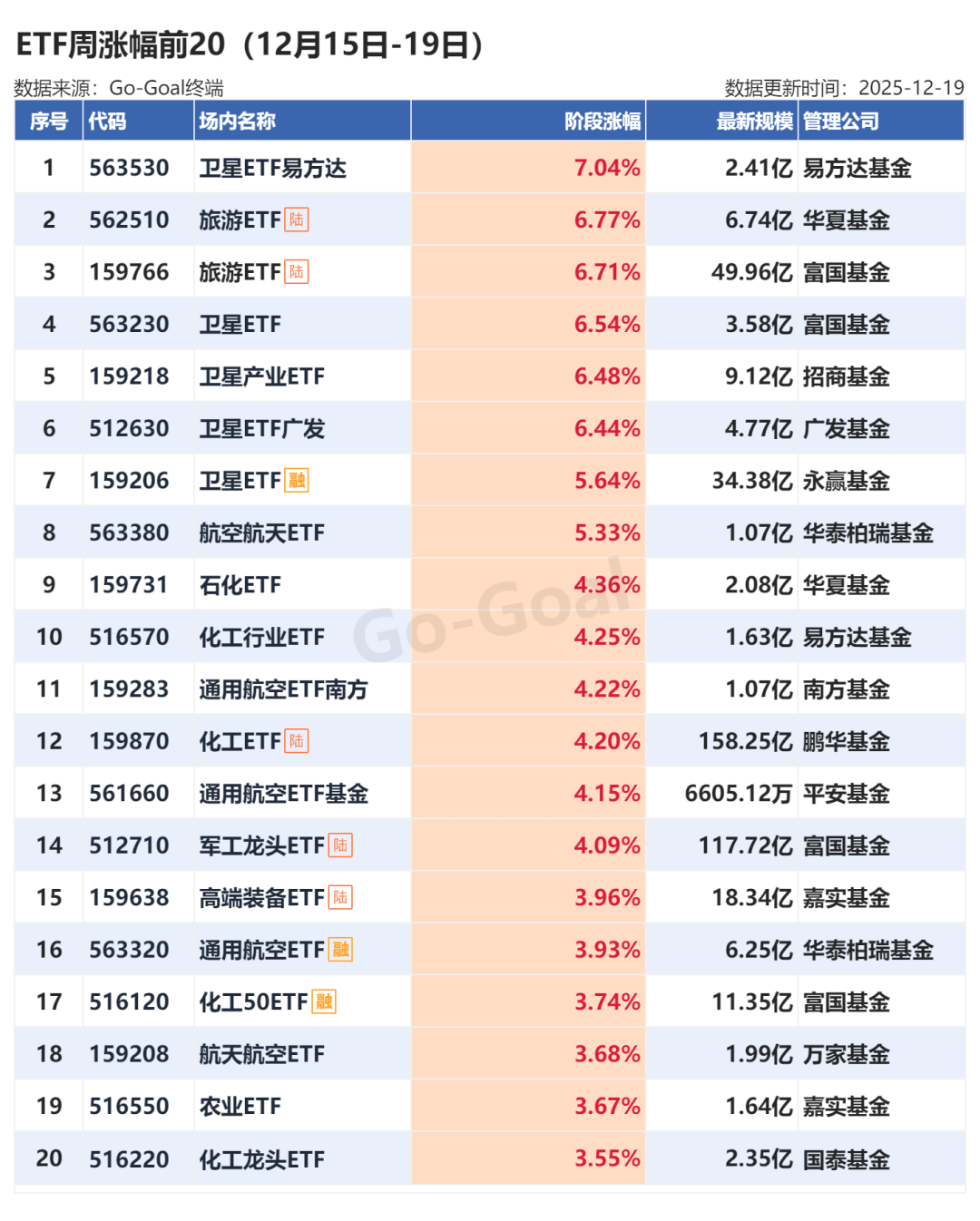
本周ETF市场大额净流入870.91亿元 宽基ETF成资金“避风港”
Sou Hu Cai Jing· 2025-12-21 11:02
Core Viewpoint - Despite market fluctuations, broad-based ETFs have become a "safe haven" for funds and a tool for positioning [1][3] Fund Flows - This week, the ETF market saw a significant net inflow of 87.09 billion yuan, with broad-based ETFs receiving a net inflow of 47.45 billion yuan, cross-border ETFs gaining 13.55 billion yuan, and bond ETFs attracting 19.98 billion yuan [1][3] Market Performance - The three major A-share indices showed mixed performance, with the Shanghai Composite Index rising by 0.03%, while the Shenzhen Component Index fell by 0.89% and the ChiNext Index dropped by 2.26% [1] ETF Performance - Satellite, general aviation, and aerospace-related ETFs performed strongly this week, with the E Fund Satellite ETF leading with a 7.04% increase. Other notable performers included tourism and chemical ETFs, while chip and semiconductor ETFs experienced the largest declines [1][2] Upcoming ETFs - Four new ETFs are set to be issued next week, including a shipbuilding ETF and a photovoltaic ETF, with subscription periods starting from January 5 and January 12, 2026 [4][5]