Enosemi

Search documents
Arm、AMD相继官宣收购 AI芯片大厂开启密集整合
2 1 Shi Ji Jing Ji Bao Dao· 2025-11-12 22:28
Core Insights - The article discusses the recent acquisition activities among major international chip manufacturers, driven by the rapid evolution of AI large model technology, highlighting their efforts to enhance ecosystem capabilities [1][2]. Group 1: Acquisition Activities - Arm and AMD have announced acquisition plans, with Arm set to acquire DreamBig Semiconductor for approximately $265 million, aimed at enhancing data transmission capabilities in data centers [3][5]. - AMD completed the acquisition of MK1, which specializes in high-speed AI inference, marking a significant milestone in AMD's strategy to improve AI performance and efficiency [2][3]. - Qualcomm is also pursuing acquisitions, including a deal with Alphawave IP Group valued at around $2.4 billion, to bolster its data center capabilities and enhance data transmission efficiency [5][6]. Group 2: Market Opportunities - The current AI market presents diverse opportunities, spanning from cloud data centers to edge AI inference, necessitating improvements in data transmission and development efficiency [2][4]. - The acquisitions reflect a strategic shift for companies traditionally focused on mobile or PC markets, as they aim to expand into broader AI-related markets [1][2]. Group 3: Ecosystem Development - Companies are not only focusing on enhancing AI chip capabilities but are also aiming to build comprehensive ecosystem capabilities, integrating hardware, software, and cloud services [6][7]. - Qualcomm's acquisitions in various sectors, including automotive and IoT, indicate its transition from a mobile-centric focus to a broader strategy encompassing data centers and intelligent devices [6][7]. - The competitive landscape is evolving from individual chip performance to a holistic approach that includes system-level integration and ecosystem development [7].



Arm、AMD相继官宣收购,AI芯片大厂开启密集整合
2 1 Shi Ji Jing Ji Bao Dao· 2025-11-12 13:20
Core Insights - The article discusses the recent acquisition activities among major international chip manufacturers, driven by the rapid evolution of AI large model technology, highlighting their efforts to enhance ecosystem capabilities [1][4]. Group 1: Acquisition Activities - AMD announced the completion of its acquisition of MK1, which specializes in high-speed AI inference, marking a significant milestone in enhancing AI performance and efficiency [3][4]. - Arm plans to acquire DreamBig Semiconductor for approximately $265 million, aiming to improve data transmission capabilities within data centers [4][5]. - Qualcomm is set to acquire Alphawave IP Group for an implied enterprise value of about $2.4 billion, focusing on enhancing data transmission efficiency for AI training and inference [5][6]. Group 2: Strategic Focus - The acquisitions reflect a broader strategy among AI chip manufacturers to strengthen their capabilities in various dimensions, including data transmission efficiency and AI inference [1][4]. - Companies are not only enhancing their chip capabilities but are also expanding their ecosystem to include software and system-level integration, moving from selling individual chips to offering comprehensive solutions [9]. Group 3: Market Trends - The competitive landscape is shifting towards a race to build integrated systems that encompass computing, transmission, memory, and inference capabilities, indicating a transition from discrete technology to a cohesive ecosystem [9]. - The article emphasizes the importance of improving data transmission efficiency, which is critical for AI chip manufacturers as they navigate the complexities of the AI market [5][6].

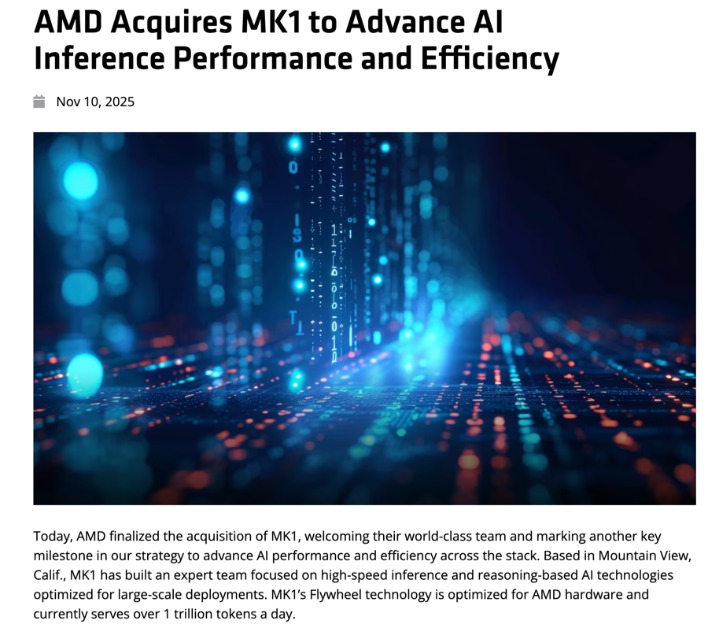
半年4起,AMD又收购一家AI公司!
美股研究社· 2025-11-11 10:09
Core Viewpoint - AMD has completed the acquisition of AI inference startup MK1, which will enhance its capabilities in AI software and high-speed inference, contributing to its broader AI strategy [4][9]. Group 1: Acquisition Details - MK1, led by Paul Merolla, focuses on high-speed inference and AI technologies optimized for large-scale deployment, with a team comprising former engineers from Neuralink, Meta, Tesla, and Apple [4][9]. - The acquisition is part of AMD's strategy to strengthen its AI software ecosystem and improve its offerings in enterprise-level AI solutions [9]. Group 2: Financial Performance - AMD reported a record revenue of $9.25 billion for Q3, a 36% year-over-year increase, with a net profit of $1.2 billion, up 61% [11]. - The company forecasts Q4 revenue midpoint at $9.6 billion, exceeding market expectations [11]. Group 3: Strategic Moves - AMD has made several acquisitions this year, including Enosemi and Untether AI, investing a total of $36 million in these efforts [11]. - The company is also collaborating with OpenAI, with plans to deploy 1 GW of AMD Instinct MI450 GPUs by the second half of 2026 [11]. Group 4: Market Performance - AMD's stock price has doubled this year, reaching $243.98 per share, with a total market capitalization of $397.2 billion [12].

苏姿丰又收购一家AI公司!马斯克朋友创办
Sou Hu Cai Jing· 2025-11-11 08:23
Core Insights - AMD has completed the acquisition of AI inference startup MK1, which will enhance its AI software capabilities and accelerate its enterprise-level AI initiatives [2][6] - MK1, led by Paul Merolla, focuses on high-speed inference technologies optimized for large-scale deployment, with a team comprising former engineers from Neuralink, Meta, Tesla, and Apple [2][6] - This acquisition is part of AMD's broader strategy to strengthen its position in the AI sector, following several other acquisitions aimed at enhancing its software capabilities [6][7] Company Developments - AMD's recent acquisitions include ZT Systems for $4.9 billion, Enosemi, and Untether AI, among others, indicating a strong push into the AI market [6][7] - The company reported a record revenue of $9.25 billion for Q3, a 36% year-over-year increase, and a net profit of $1.2 billion, up 61% [7] - AMD's stock price has doubled this year, reaching $243.98 per share, with a total market capitalization of $397.2 billion [7] Strategic Partnerships - AMD is collaborating with OpenAI, with plans to deploy 1 gigawatt of AMD Instinct MI450 GPUs by the second half of 2026, indicating a significant partnership in AI computing [7] - The company anticipates substantial growth in its AI business, projecting revenues to reach hundreds of billions by 2027 [7]

苏姿丰又收购一家AI公司,马斯克朋友创办
3 6 Ke· 2025-11-11 08:15
Core Insights - AMD has completed the acquisition of AI inference startup MK1, which will enhance its AI software stack and capabilities in high-speed inference and enterprise-level AI solutions [1][6] - MK1, led by Paul Merolla, focuses on high-speed inference technologies optimized for large-scale deployment, with a team comprising former engineers from Neuralink, Meta, Tesla, and Apple [1][6] - The acquisition is part of AMD's broader AI strategy, which includes multiple acquisitions aimed at strengthening its software capabilities [6][7] Company Developments - The MK1 team will integrate its software innovations with AMD's computing power, contributing to the development of a robust AI software ecosystem [1][2] - AMD's recent acquisitions include ZT Systems for $4.9 billion, Enosemi, and Untether AI, indicating a strong push into the AI sector [6][7] - AMD reported a record revenue of $9.25 billion for Q3, a 36% year-over-year increase, and a net profit of $1.2 billion, up 61% [7] Financial Performance - AMD's Q4 revenue guidance is projected at $9.6 billion, exceeding market expectations [7] - The company anticipates its AI business revenue to reach hundreds of billions by 2027 [7] - AMD's stock price has doubled this year, currently at $243.98 per share, with a market capitalization of $397.2 billion [7]
三年买下九家AI公司,AMD拼了
半导体行业观察· 2025-06-08 01:16
Core Viewpoint - AMD is heavily investing in acquisitions to enhance its AI capabilities and compete with Nvidia in the data center GPU market, particularly through its Instinct product line [1][2]. Group 1: AMD's AI Strategy and Acquisitions - AMD is focusing on providing "end-to-end AI solutions" and has made several acquisitions over the past three years to bolster its AI strategy, including companies like Mipsology, Nod.ai, Silo AI, and ZT Systems [1][2][3]. - The company plans to unveil its next-generation Instinct GPU, MI400, at the upcoming Advancing AI 2025 event, with positive early customer feedback indicating a significant expansion of its AI accelerator market [1][2]. - AMD's CEO Lisa Su highlighted the importance of these acquisitions in enhancing the company's AI capabilities and addressing the growing demand for AI infrastructure [1][2]. Group 2: Specific Acquisitions and Their Impact - The acquisition of Untether AI aims to improve AMD's AI hardware and software engineering capabilities, focusing on energy-efficient AI inference chips [5][6]. - AMD's purchase of Brium is expected to enhance its AI software capabilities, particularly in optimizing AI solutions for its hardware [8]. - The acquisition of Enosemi will support the development of next-generation AI systems through advanced photonic solutions, improving data transmission efficiency [9][11]. - ZT Systems was acquired for $4.9 billion to integrate its expertise in data center solutions with AMD's chip offerings, aiming to accelerate the deployment of AI systems [10][12]. - The acquisition of Silo AI for $665 million positions AMD to leverage Europe's largest private AI lab for developing open-standard AI solutions [14][15]. - Nod.ai's acquisition is intended to enhance AMD's open software capabilities, facilitating easier deployment of AI solutions optimized for AMD hardware [16][17]. - Mipsology's acquisition will accelerate collaboration with customers and expand AMD's AI software development capabilities [18][19]. - The acquisition of Xilinx for $49 billion is expected to significantly enhance AMD's opportunities in data centers and embedded computing, further driving its AI strategy [22][23].


马斯克脑机接口公司Neuralink融资6亿美元,估值90亿美元;Hugging Face推出两款新型人形机器人丨全球科技早参
Mei Ri Jing Ji Xin Wen· 2025-05-30 00:03
Group 1: Google and AI Innovations - Google has launched the Gemini model, allowing users to analyze video content stored in Google Drive, generating summaries or answering questions without watching the videos, significantly enhancing information retrieval efficiency [2] - This innovation may strengthen Google's competitive position in the AI sector, attracting more users and developers, and putting pressure on competitors like OpenAI [2] Group 2: Neuralink Financing - Neuralink, Elon Musk's brain-computer interface company, has raised $600 million in its latest funding round, bringing its valuation to $9 billion, up from $5 billion in the previous round [3] - This financing solidifies Neuralink's leading position in the brain-computer interface field and may stimulate interest in related sectors such as medical technology and artificial intelligence [3] Group 3: Robotics Development - Hugging Face has introduced two new open-source robots: HopeJR, a full-sized humanoid robot with 66 degrees of freedom, and Reachy Mini, a desktop robot capable of head movement and speech [4] - This initiative may attract more developers and promote the proliferation of robotics technology, increasing attention in the sector [4] Group 4: AMD Acquisition - AMD has acquired the silicon photonics startup Enosemi, although specific terms of the deal have not been disclosed [5] - This acquisition signifies AMD's strategic expansion in AI and high-performance computing, addressing the growing demand for faster and more efficient data transmission [5] Group 5: Supercomputer Collaboration - The U.S. Department of Energy announced that the upcoming "Doudna" supercomputer, set to launch in 2026, will utilize technology from NVIDIA and Dell, named after Nobel laureate Jennifer Doudna [6] - This collaboration reinforces NVIDIA and Dell's leadership in AI and high-performance computing, potentially accelerating advancements in AI model training, autonomous driving, and scientific computing [6]

AMD收购硅光子企业Enosemi!
国芯网· 2025-05-29 13:49
Core Viewpoint - AMD has acquired Enosemi, a company focused on photonic circuit development, to strengthen its competitive position against NVIDIA and Intel in the semiconductor industry [2]. Group 1: Acquisition and Technology - AMD's acquisition of Enosemi is aimed at enhancing its capabilities in integrating silicon photonic technologies into next-generation AI systems [2]. - Silicon photonics technology utilizes photons instead of traditional electrons for information transmission, offering faster speeds, higher bandwidth, and better energy efficiency compared to conventional electronic circuits [2]. - Enosemi will assist AMD in rapidly advancing its support and development of silicon photonic technologies and optical packaging solutions [2]. Group 2: Competitive Landscape - NVIDIA has already launched a silicon photonics-based network switch platform with a bandwidth of 400TB/s and plans to integrate more related technologies into its AI solutions [3]. - To compete with NVIDIA, AMD has previously acquired companies like ZT Systems, Mipsology, and Silo AI to bolster its technical strength and partnerships in enterprise solutions [3]. - Observers note that China has significantly increased its research investment in silicon photonics, surpassing the U.S. by more than double in the past five years, potentially allowing it to leapfrog Western technologies in next-generation computing [3].

硅光子芯片,AMD不想缺席
3 6 Ke· 2025-05-29 12:25
Core Viewpoint - AMD's acquisition of Enosemi marks a strategic move to enhance its capabilities in silicon photonics technology, which is crucial for meeting the increasing computational demands of AI systems [1][2]. Group 1: Acquisition Details - AMD announced the acquisition of Enosemi, a startup focused on silicon photonics design and IP, led by an experienced management team [1]. - Enosemi, founded in 2023, has developed production capabilities for photonic integrated circuits, which are already applied in data center optical interconnects [2]. - The acquisition will allow AMD to quickly integrate Enosemi's team into its internal silicon design efforts, shortening the technology integration cycle [2]. Group 2: Technology and Market Context - Silicon photonics technology is seen as a strategic breakthrough to overcome bandwidth limitations in data centers, with the potential to reduce energy consumption by over 20% [1]. - The demand for data transmission speeds is increasing exponentially, especially as AI models grow in complexity [3]. - Industry predictions suggest that by 2027, the penetration rate of chip-on-photonics (CPO) technology in large-scale data centers will reach 35%, positioning it as a mainstream solution [3]. Group 3: Competitive Landscape - Intel and NVIDIA have been early adopters of silicon photonics, with Intel shipping over 8 million photonic integrated circuits and NVIDIA integrating the technology into their data platforms [4]. - AMD's comprehensive technology ecosystem, including x86 CPUs and RDNA architecture GPUs, supports the integration of new technologies like silicon photonics [5]. Group 4: Challenges Ahead - The large-scale commercialization of silicon photonics faces challenges such as technical integration, cost control, and competitive ecosystem dynamics [6]. - AMD must address the low light-emission efficiency of silicon-based materials and optimize production costs to compete effectively [6]. - The market for silicon photonics is expected to grow from $1.4 billion in 2023 to $6.1 billion by 2030, indicating significant future potential [6].
AMD收购硅光芯片公司
半导体行业观察· 2025-05-29 01:15
Core Viewpoint - AMD's acquisition of Enosemi aims to accelerate the development of co-packaged optical devices for AI systems, enhancing its position as a full-stack AI provider [1][2][3]. Group 1: Acquisition Details - AMD announced the acquisition of Enosemi, a startup focused on photonic integrated circuits, to boost its capabilities in optical device development for AI [1]. - The financial terms of the acquisition have not been disclosed, and Enosemi was founded in 2023 with 16 employees and 11 investors [1]. - Enosemi's products include integrated photodetectors and custom silicon chips, indicating a strong product portfolio that complements AMD's existing technologies [1]. Group 2: Technological Implications - Photonic integrated circuits utilize photons for data transmission, offering high speed and low power consumption, which is crucial for applications in healthcare, automotive, and communications [1]. - The demand for faster data transmission is increasing with the complexity of AI models, making co-packaged optical devices essential for next-generation AI systems [2][4]. - AMD's strategy includes integrating its leading CPU, GPU, and SoC technologies with enhanced networking, software, and system integration expertise to support advanced AI workloads [2][4]. Group 3: Future Outlook - The acquisition is expected to enhance AMD's capabilities in supporting various photonic and co-packaged optical solutions for AI systems [3][4]. - AMD aims to provide a comprehensive innovation stack that encompasses computing, networking, system architecture, and software, positioning itself uniquely in the AI market [4].