Helion

Search documents
可控核聚变行业观点更新
2026-02-03 02:05
Summary of Controlled Nuclear Fusion Industry Conference Call Industry Overview - The controlled nuclear fusion industry is recognized as a potential ultimate energy source due to its high energy release, easy access to reactants, and low radioactive waste, making it a focal point of technological competition among major countries [1][3][7]. Key Points and Arguments - **Q Value as a Key Indicator**: The current critical indicator for the development of controlled nuclear fusion technology is the Q value, which measures the ratio of energy produced by the fusion reaction to the energy input required to sustain the reaction. Achieving a Q value greater than 1 is essential for energy balance, while a Q value greater than 10 is necessary for commercialization [1][5]. - **Global Investments and Plans**: Major countries, including China, the EU, the US, Japan, Russia, and India, are increasing their policy support and financial investments in the controlled nuclear fusion sector. For instance, the US company Helion plans to build the world's first fusion power plant by 2028, and China has included controlled nuclear fusion in its "15th Five-Year Plan" [1][6]. - **Domestic Development Transition**: The domestic controlled nuclear fusion sector is transitioning from scientific feasibility verification to engineering feasibility verification. From 2025 to 2027, approximately 60 billion RMB will be invested in experimental reactors, while from 2027 to 2035, commercial demonstration reactors will be the focus, with each project expected to require an investment of 80 to 100 billion RMB [1][8]. - **Recent Capital Expenditure Trends**: There has been a significant acceleration in capital expenditures, particularly for key projects such as BEST, Chengdu, and Nanchang. The bidding activities for these projects are increasing, indicating a ramp-up in development [1][9]. Important but Overlooked Content - **Investment Focus Areas**: Investors are advised to focus on high-value segments of the nuclear fusion supply chain, including superconducting materials, core equipment and components (like magnets and vacuum chambers), and power and heating systems. The successful advancement of experimental reactor construction and order confirmations are critical for investment decisions [1][4][12]. - **Industry Chain Development**: The nuclear fusion industry chain includes upstream raw materials, midstream core components, and downstream applications. Government capital expenditures are primarily concentrated in the upstream and midstream segments, which are now entering the order fulfillment phase [1][10]. - **Emerging Technologies**: The development of new technologies, such as high-temperature superconductors, is expected to significantly impact the industry. The supply-demand tension in high-temperature superconducting materials presents investment opportunities in leading companies [1][12]. - **Cost Breakdown**: In the Tokamak technology path, the cost distribution is approximately 28%-30% for magnets and superconducting materials, 15% for core components, and around 40% for heating systems and power supply [1][11]. This summary encapsulates the essential insights from the conference call regarding the controlled nuclear fusion industry, highlighting its potential, current developments, and investment opportunities.
技术突破与资本赋能助力核聚变产业化提速-聚焦中上游投资机会-可控核聚变深度报告
2026-01-08 16:02
Summary of Key Points from the Conference Call on Controlled Nuclear Fusion Industry Overview - The conference focuses on the **controlled nuclear fusion industry**, highlighting significant advancements in both the US and China, particularly with the **Energy Singularity Company** achieving a 120-second steady-state long-pulse plasma operation with its **Honghuang 170** device, exceeding market expectations [1][2]. Core Insights and Arguments - **Rapid Development**: The controlled nuclear fusion sector has seen substantial changes since 2025, driven by energy demand, US-China technological competition, advancements in high-temperature superconductors and AI, and a competitive investment landscape [1][4]. - **Investment Opportunities**: Current investment opportunities are primarily concentrated in the **midstream and upstream segments**, including high-temperature superconductors, plasma-facing materials, superconducting magnets, vacuum chambers, and auxiliary systems like cooling and heating systems [1][5][18]. - **Market Dynamics**: The controlled nuclear fusion sector experienced three phases of growth in 2025: driven by technological breakthroughs, downstream engineering installations, and significant tenders following the completion of the BEPCII device [6]. Important Developments and Catalysts - **2026 Catalysts**: Key factors expected to catalyze the controlled nuclear fusion sector in 2026 include national funding support, major device tenders, and project launches such as **Best Craft** and **Jiangxi Xinghuo No. 1** [3][7]. - **Global Progress**: The announcement of a potential merger between **Trump Media Group** and **TAE** to build the world's largest commercial fusion power plant by 2026 signifies rapid advancements in the US commercial fusion sector [2][19]. Challenges and Considerations - **Technical Challenges**: The industry faces significant challenges, including the need for extremely high temperatures and collision probabilities, as well as the efficient confinement and utilization of high-temperature plasma [12][16]. - **Investment Focus**: Investors are advised to focus on upstream raw material suppliers and midstream equipment manufacturers, particularly those producing superconducting materials and key components for fusion devices [20]. Additional Insights - **Government Support**: Governments worldwide are prioritizing controlled nuclear fusion as a strategic energy solution due to its potential to address energy shortages with clean, high-density energy sources [8][9]. - **Research Resurgence**: Renewed interest in controlled nuclear fusion research is attributed to breakthroughs in high-temperature superconductors and AI technologies, which enhance the feasibility and efficiency of fusion experiments [16][17]. Conclusion - The controlled nuclear fusion industry is poised for significant growth, driven by technological advancements, government support, and increasing investment opportunities, particularly in the midstream and upstream segments. Investors should remain vigilant for emerging trends and key players in this rapidly evolving sector [1][20].
观察 | 融资数亿!红杉高瓴抢投的核聚变,藏着你未来10年的财富密码
未可知人工智能研究院· 2026-01-08 10:03
Core Viewpoint - The article discusses the increasing investment in nuclear fusion technology, highlighting its potential as a solution to the energy demands of the AI era and the significant financial backing from top venture capital firms and government initiatives [2][8][20]. Group 1: Investment Trends - Dongsheng Fusion, a newly established nuclear fusion company, secured several hundred million yuan in its angel round funding [2]. - Major investors include Sequoia, IDG, Hillhouse, and Dinghui, indicating a strong interest from top-tier venture capital firms [3]. - The trend of investing large sums in early-stage, high-risk projects like nuclear fusion is unusual, as traditionally, venture capitalists avoid significant investments at the angel stage due to high risks [9][10]. Group 2: Energy Demand and AI - The demand for AI computing power is driving a shift in focus from acquiring more chips to securing sufficient electricity, as the operational costs of AI data centers are heavily influenced by electricity expenses [17][19]. - The capital expenditures of major tech companies like Microsoft, Google, and Amazon are projected to approach $400 billion, with a significant portion allocated to addressing energy shortages [19]. Group 3: Nuclear Fusion as a Solution - Nuclear fusion is being viewed as a "ultimate energy" solution due to the limitations of traditional energy sources and the safety concerns associated with nuclear fission [21][22]. - Notable investments in nuclear fusion include a $375 million investment by OpenAI's CEO in Helion and a power purchase agreement between Google and Commonwealth Fusion [24][25]. Group 4: Domestic Developments - In China, the establishment of the China Fusion Energy Company and significant funding rounds for various fusion startups indicate a strong governmental push towards fusion energy, with plans to invest over 300 billion yuan by 2030 [28][31]. - The timeline for fusion energy development includes milestones such as starting combustion experiments in 2027 and completing engineering experimental reactors by 2035 [35]. Group 5: Technological Advances - The article outlines three main approaches to nuclear fusion: Tokamak, FRC, and inertial confinement, each with its own advantages and challenges [41]. - Recent breakthroughs in high-temperature superconductors and AI technology are accelerating the development of nuclear fusion by making it more feasible and cost-effective [46][48]. Group 6: Opportunities for Individuals - The transition from laboratory to engineering in nuclear fusion presents numerous job and entrepreneurial opportunities across various fields, including engineering, materials science, and project management [57]. - Investment opportunities exist in the supply chain related to nuclear fusion, such as superconducting materials and precision manufacturing [58]. - Understanding the implications of nuclear fusion and energy transformation can provide individuals with a competitive edge in future investment opportunities [58]. Group 7: Dongsheng Fusion's Significance - Dongsheng Fusion is pursuing a unique "deuterium-helium-3" fusion route, which is considered safer and cleaner than traditional methods [61]. - The company is backed by a team from Fudan University and supported by significant funding from local government initiatives [62]. - The interest from top-tier VCs in Dongsheng Fusion is attributed to its differentiated technology, strong academic foundation, and robust policy support [63].

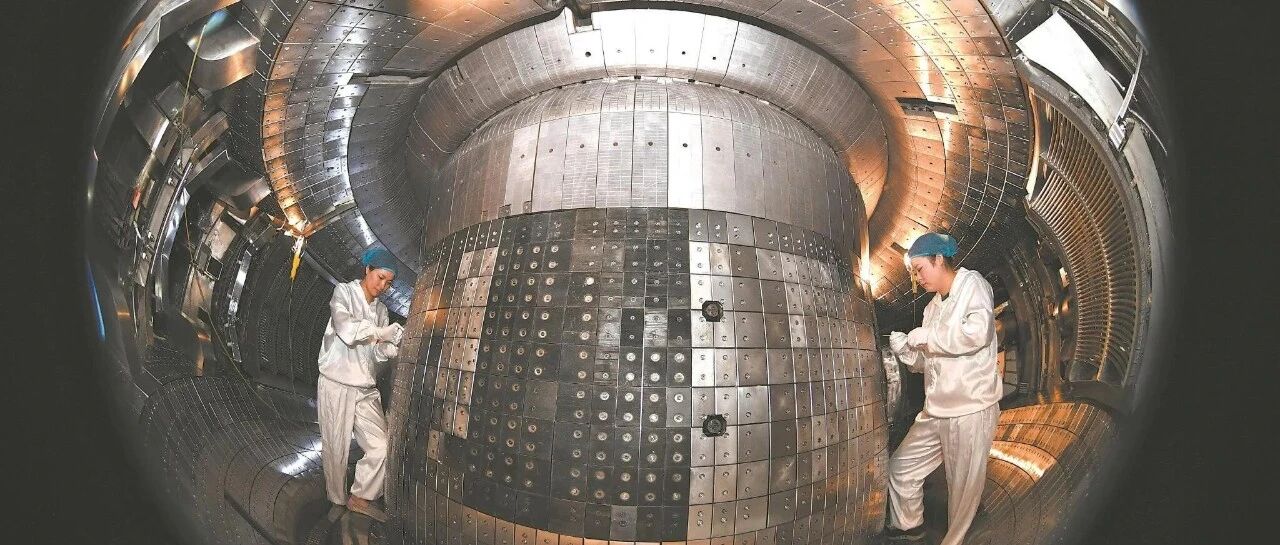
【大涨解读】可控核聚变:技术突破与产业催化共振,产业重磅大会召开在即,核心部件需求有望迎来集中释放
Xuan Gu Bao· 2026-01-08 02:33
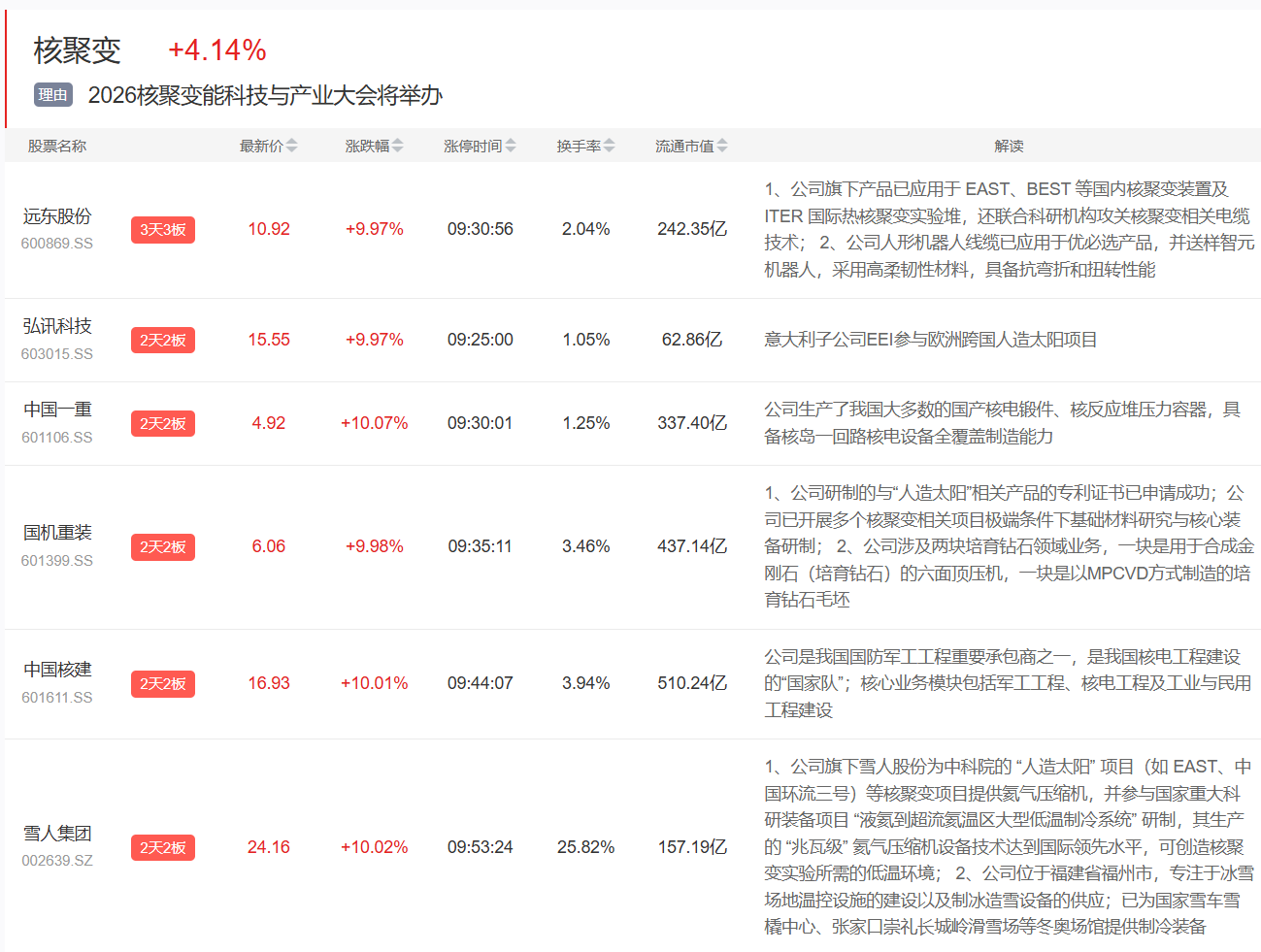
Market Performance - On January 8, the controllable nuclear fusion sector saw a collective surge, with companies like Far East Holdings achieving three consecutive daily limits, and others such as Hongxun Technology, China First Heavy Industries, and China Nuclear Engineering experiencing two consecutive daily limits [1] Events - The 2026 Nuclear Fusion Energy Technology and Industry Conference is scheduled to be held in Hefei, Anhui from January 16 to 17, 2026, with participation from top global research institutions, leading enterprises, and financial institutions to accelerate industry chain collaboration and results transformation [3] - On January 7, 2026, Energy Singularity announced the successful operation of the world's first full high-temperature superconducting Tokamak nuclear fusion experimental device, achieving 120 seconds of steady-state long-pulse plasma operation, marking a significant milestone for commercial companies [3] - TAE and Trump Media Technology Group announced a merger, creating the world's first publicly listed nuclear fusion company, with plans to start construction of a utility-scale fusion power plant in 2026 [3] - In late December 2025, the Hefei Institute of Plasma Physics and Fusion New Energy in Anhui collectively won projects worth 521 million yuan, including four projects exceeding 50 million yuan, with various companies winning orders for core components [3] Institutional Insights - In the context of major power competition, controllable nuclear fusion has become a strategic focus, with China's National Development and Reform Commission emphasizing the need for technological breakthroughs in nuclear fusion, indicating a shift from basic research to engineering and industrialization [4] - The industry has seen a significant acceleration in project wins, with the Hefei Institute and Fusion New Energy winning over 1 billion yuan in contracts, primarily for core components like magnets and power supplies [5] - The industry is entering a phase of engineering feasibility verification, with strong demand and supply driving order volumes. The global power demand is expected to grow exponentially due to AI capabilities, highlighting the importance of controllable nuclear fusion as a "ultimate energy" source [5] - The global nuclear fusion equipment market is projected to reach an average annual scale of 266 billion yuan by 2035, with domestic projects expected to invest 145.6 billion yuan, benefiting various segments of the supply chain [5]
120秒稳态运行!中国核聚变再突破
财联社· 2026-01-07 14:54
Core Viewpoint - The article highlights significant advancements in China's nuclear fusion sector, particularly the successful operation of the world's first full-temperature superconducting tokamak fusion experimental device, Honghuang 70, which achieved a stable long-pulse plasma operation for 120 seconds during its 5319th experiment [4]. Group 1: Breakthroughs in Nuclear Fusion - Energy Singularity announced that the Honghuang 70 device has demonstrated reliable long-pulse operation capabilities, validating the engineering reliability and operational stability of high-temperature superconducting tokamaks [4]. - This achievement marks the first time a commercially developed fusion device has successfully operated plasma currents at the hundred-second level [4]. Group 2: Future Plans and Developments - Energy Singularity plans to implement an AI-based real-time plasma control system in future experiments to enhance results [5]. - The company, established in 2021 and backed by investment from Mihayou, focuses on developing high-field, high-parameter, compact high-temperature superconducting tokamak devices and their operational control software [5]. Group 3: Domestic and International Progress - Recent advancements in China's nuclear fusion field include the EAST experiment confirming the existence of a density-free zone in tokamaks, providing crucial physical evidence for high-density operation in magnetic confinement fusion devices [5]. - The 2026 Nuclear Fusion Energy Technology and Industry Conference is scheduled for January 16-17 in Hefei, aiming to promote collaborative innovation and results transformation within the nuclear fusion industry [5]. Group 4: Global Industry Trends - Internationally, TAE and Trump Media Technology Group announced a merger, creating the first publicly listed fusion device company, with plans to start construction of a utility-scale fusion power plant by 2026 [6]. - Helion is expected to demonstrate net energy gain soon and has signed a power purchase agreement for 2028 [6]. - The nuclear fusion sector is entering a catalytic release phase, driven by significant events, with domestic orders primarily consisting of large scientific experimental devices and specialized domestic and overseas projects [6]. Group 5: Investment Opportunities - The acceleration of the commercial viability of controlled nuclear fusion presents investment opportunities in core companies with key component capabilities and traditional businesses with migration potential, including companies like Hezhong Intelligent, Lianchuang Optoelectronics, Guoguang Electric, Xuguang Electronics, Yingjie Electric, and Wangzi New Materials [7].

Every fusion startup that has raised over $100M
Yahoo Finance· 2025-12-31 15:05
Group 1: Company Developments - Commonwealth Fusion Systems (CFS) expects to have its Sparc reactor operational by late 2026 or early 2027 and plans to begin construction on its commercial power plant, Arc, which will produce 400 megawatts of electricity near Richmond, Virginia, with Google agreeing to purchase half of its output [1][3] - CFS has raised approximately $3 billion in total funding, with its latest round adding $863 million, representing about a third of all private capital invested in fusion companies to date [4][8] - TAE Technologies announced a merger with Trump Media & Technology Group, valuing the combined company at $6 billion, and TAE has raised a total of $1.79 billion prior to the merger [10][11] Group 2: Industry Trends - The fusion industry is experiencing a bullish wave driven by advances in powerful computer chips, sophisticated AI, and high-temperature superconducting magnets, which have improved reactor designs and control schemes [6] - Fusion power is transitioning from a long-term promise to a more tangible technology, attracting significant investment interest, with notable backers including Bill Gates and Breakthrough Energy Ventures [8] - The potential for fusion to generate nearly limitless energy could disrupt trillion-dollar markets if commercially viable power plants are completed [7] Group 3: Technological Innovations - CFS's Sparc reactor utilizes a tokamak design with high-temperature superconducting tape to generate a powerful magnetic field for plasma containment, developed in collaboration with MIT [2] - Helion plans to produce electricity from its reactor by 2028, with Microsoft as its first customer, and has raised $1.03 billion to date [13][15] - Zap Energy employs an electric current to compress plasma, generating its own magnetic field for ignition, and has raised $327 million from various investors [28][29]
开源证券:BEST订单持续释放,看好板块长期发展前景
Xin Lang Cai Jing· 2025-12-30 00:29
Core Viewpoint - The development and construction of controllable nuclear fusion devices are progressing steadily, with projects like BEST, Xinghuo No. 1, Xianjue Juyuan, and Huanliu No. 4 expected to commence sequentially, leading to a continuous release of core component orders [1] Group 1 - The merger of TMTG and TAE aims to create the world's first publicly listed commercial fusion company, which is anticipated to boost sentiment in the FRC sector [1] - Helion has announced plans to achieve power generation verification by 2025, and if the feasibility of the FRC technology route is validated, domestic startups in this field may accelerate their projects [1] - The 14th Five-Year Plan suggests a forward-looking layout in the nuclear fusion energy sector, indicating strong governmental support for the industry [1] Group 2 - The long-term development prospects of the nuclear fusion sector are viewed positively, with a recommendation to focus on core components such as magnets, main engines, and power supplies [1]
开源证券:BEST订单持续释放 看好板块长期发展前景
Di Yi Cai Jing· 2025-12-30 00:15
Core Insights - The development and construction of controllable nuclear fusion devices are progressing steadily, with projects such as BEST, Xinghuo No.1, Xianjue Juyuan, and Huanliu No.4 expected to commence sequentially [1] - The merger of TMTG and TAE aims to create the world's first publicly listed commercial fusion company, which is likely to boost sentiment in the FRC sector [1] - Helion has announced plans to achieve power generation verification by 2025, and if the feasibility of the FRC technology route is validated, domestic startups in this field may accelerate their projects [1] - The 14th Five-Year Plan suggests a proactive layout in the nuclear fusion energy sector, indicating long-term growth potential [1] - The industry outlook is positive, with a recommendation to focus on core components such as magnets, main engines, and power supplies [1]
Trump Media—TAE Merger: Fusion's Public Market Leap
Yahoo Finance· 2025-12-21 16:46
Core Insights - The fusion industry has seen unprecedented growth in 2023, driven by record private funding and political support, particularly through the new Department of Energy Office of Fusion [1] - The TMTG-TAE merger represents a significant shift in the fusion landscape, creating the first large-cap, pure-play fusion stock on a major U.S. exchange, which could enhance U.S. leadership in fusion energy [3][4] - The merger is viewed as a bold experiment to crowd-fund the next generation of baseload energy, with potential implications for global energy markets and the demand for energy to power AI [2] Funding Landscape - U.S. fusion companies have historically relied on private capital, with 91.9% of funding coming from this source, contrasting sharply with China's state-directed funding model [1] - The TMTG-TAE deal allows for direct public investment in fusion, providing a new avenue for capital that venture capital cannot match, potentially accelerating the commercialization of fusion technology [1][4] Market Dynamics - The TMTG-TAE merger signifies the end of "stealth mode" for fusion, pushing it into the public eye and capital markets, which will now track its progress through SEC filings and project finance structures [4] - Competitors in the fusion space, such as Helion and Commonwealth Fusion Systems, may feel pressured to pursue public listings to avoid missing out on the wave of public funding [4] Regulatory and Technical Challenges - The ambitious timeline for TMTG-TAE to begin construction of a utility-scale fusion plant by 2026 is contingent on overcoming various technical and regulatory hurdles [6] - The power sector must adapt to the new dynamics of fusion funding, prioritizing commercial projects for high-demand sites and requiring regulatory support for new grid connections and contract approaches [7] Public Perception and Investment Psychology - The merger reframes fusion as a critical component for meeting the energy demands of AI and data centers, positioning it as a reliable energy source free from geopolitical constraints [8] - The association with a high-profile public company like TMTG is expected to attract a diverse range of investors, from AI hyperscalers to clean energy advocates, thereby mainstreaming fusion in energy discussions [8]
Trump Media is merging with fusion power company TAE Technologies in $6B+ deal
TechCrunch· 2025-12-18 14:59
Company Overview - Trump Media and Technology Group (TMTG) is merging with TAE Technologies, a company focused on fusion power, in an all-stock transaction valued at over $6 billion [1] - TMTG is the parent company of Truth Social, a microblogging platform launched after former President Trump was banned from major social media platforms [2] - TMTG went public last year through a merger with a special-purpose acquisition company (SPAC) and reported a loss of $54.8 million on revenue of $972,900 for the quarter ended September 30, 2025 [2] Financial Position - TMTG has amassed $3.1 billion in assets, primarily through cryptocurrency investments and partnerships, despite low revenue generation from its platforms [3] Fusion Power Initiative - TMTG's acquisition of TAE Technologies aims to establish America's global energy dominance, with plans to construct the world's first utility-scale fusion power plant (50 MWe) next year and additional plants expected to be 350-500 MWe [4] - TAE Technologies has raised nearly $2 billion since its inception, with a recent funding round of $150 million from investors including Google and Chevron [8] - TAE has faced challenges in making its fusion designs work but is also developing a division focused on life sciences, selling a particle accelerator for cancer treatment [9] Industry Context - The fusion power sector is competitive, with other companies like Commonwealth Fusion Systems and Helion also pursuing the goal of integrating fusion power into the grid by the early 2030s [6] - Successful fusion startups could provide gigawatts of clean energy using hydrogen isotopes from seawater, with the process involving heating and compressing these isotopes to create plasma [7]