VMware

Search documents
1 Brilliant AI Stock That You Should Buy Hand Over Fist in 2026
Yahoo Finance· 2026-02-12 20:49
Broadcom's (NASDAQ: AVGO) stock rallied nearly 600% over the past five years. Most of that growth was driven by its aggressive acquisitions and its brisk sales of AI chips. Let's see why it could still be one of the best stocks to buy in 2026 as the AI market continues to expand. Why is Broadcom growing so rapidly? From fiscal 2020 to fiscal 2025 (which ended last November), Broadcom's revenue grew at a 22% CAGR from $23.9 billion to $63.9 billion. Its adjusted earnings before interest, taxes, depreciatio ...

Zadara Empowers Kocho with Streamlined VMware Alternative to Eliminate Complexity and Multi-Tenant AI Clouds Powered by NVIDIA GPUs to Enable Efficient Sovereign AI Clouds
Globenewswire· 2026-02-03 13:04
Core Insights - Kocho has partnered with Zadara to enhance its cloud infrastructure, focusing on cybersecurity, identity, and cloud transformation services to meet increasing client demands and adapt to market changes [1][4] Group 1: Strategic Shift and Infrastructure - Kocho is transitioning from traditional infrastructure to a consumption-based, OPEX-driven cloud model with Zadara, reducing upfront capital investments and allowing for scalable resource management [2] - The collaboration with Zadara addresses challenges such as rising licensing costs and infrastructure complexity, providing a viable alternative to VMware [2] Group 2: Benefits of Partnership - Zadara's distributed edge cloud offers performance, data sovereignty, and real-time AI processing without data egress fees, enabling Kocho to focus on application development [3] - Clients of Kocho benefit from improved agility, faster service delivery, and secure data residency, supported by Zadara's advanced architecture and multi-tenancy capabilities [3] Group 3: Zadara's Capabilities - Zadara operates over 500 edge cloud locations globally, providing a cloud infrastructure that supports various use cases, including sovereign cloud and AI inference [5] - The platform features consumption-based pricing with zero data egress fees, designed to accommodate workloads across on-premises, hybrid, multi-cloud, or edge environments [5] Group 4: Company Background - Kocho specializes in Microsoft cloud technology, cybersecurity, and managed services, serving a diverse range of clients from mid-market organizations to large enterprises across various sectors [7][8] - Zadara is headquartered in Irvine, California, and offers 24/7 support with a skilled global team [6]



The Hidden Risks In Broadcom Stock's Bull Run
Forbes· 2026-01-29 15:13
Core Viewpoint - Broadcom (AVGO) has faced significant stock declines in the past, with drops exceeding 30% on multiple occasions, indicating vulnerability to abrupt market corrections [1][5]. Risk Factors - **Risk 1: VMware Customer Loss and Legal Action** There is a potential loss of VMware customers due to compulsory subscriptions and price increases, with evidence of price hikes ranging from 800% to 1,500% expected by May 2025. Additionally, legal actions are anticipated, such as Tesco's £100 million lawsuit regarding alleged contract violations [3][10]. - **Risk 2: Geopolitical Retaliation Risks in China** Broadcom may face a significant revenue exposure loss of 17% from China due to new U.S. tariffs on AI chip exports and directives to eliminate foreign software from state-owned enterprises by mid-2026. This geopolitical tension could lead to immediate margin pressures [4][10]. Financial Performance - **Revenue Growth** Broadcom has reported a revenue growth of 23.9% over the last twelve months and a 25.2% average growth over the last three years [11]. - **Cash Generation** The company has demonstrated strong cash generation capabilities, with a free cash flow margin of nearly 42.1% and an operating margin of 40.8% for the last twelve months [11]. - **Valuation** Broadcom's stock is currently trading at a price-to-earnings (P/E) multiple of 68.2, indicating a high valuation relative to earnings [11].

UPDATE - Rackspace Technology Secures VMware Sovereign Cloud Partner Status
Globenewswire· 2026-01-16 17:33
Core Insights - Rackspace Technology has achieved VMware Sovereign Cloud Partner Status, enhancing its capability to manage sensitive data for UK organisations [1][5] - The company's Sovereign Services provide a fully managed private cloud platform tailored for organisations needing strict data control [2][3] - Rackspace's digital Sovereign Cloud aims to optimize private cloud architecture for mission-critical applications, ensuring performance and security [3] Company Overview - Rackspace Technology specializes in end-to-end hybrid cloud and AI solutions, supporting customers throughout their cloud journey [6] - The company collaborates with UK public sector organisations, financial services, and healthcare providers to deliver comprehensive cloud solutions [4] Service Features - The Sovereign Services are built on VMware technologies and operated from UK data centres, ensuring high availability and integrated security [2] - The VMware Sovereign Cloud Partner Status signifies compliance with local data sovereignty and privacy regulations [5]


Nutanix (NasdaqGS:NTNX) FY Conference Transcript
2026-01-16 17:02
Nutanix Conference Call Summary Company Overview - **Company**: Nutanix - **Industry**: Infrastructure Software - **Revenue**: Approximately $2.5 billion to $3 billion annually [8] Key Points and Arguments Company Background - Nutanix is an infrastructure software company that provides a hyper-converged infrastructure (HCI) solution, which simplifies IT management by converging compute, networking, and storage into a single architecture [4][5] - The company has maintained a customer net promoter score (NPS) of over 90 for more than a decade, indicating high customer satisfaction [8] Market Dynamics - The HCI market is still growing, with opportunities to modernize legacy three-tier architectures [6] - Nutanix has expanded its portfolio to support applications running on public cloud, bare metal, and edge locations, as well as both virtual machine-based and containerized applications [7] Customer Adoption Challenges - Customer inertia and existing hardware depreciation cycles are significant barriers to adopting HCI solutions [11][13] - Some customers may delay adoption due to recent hardware investments, leading to timing issues in transitioning to Nutanix's solutions [13] External Storage Support - Nutanix has recently begun supporting external storage solutions, such as Dell PowerFlex and Pure Storage, to address customer needs and facilitate quicker migrations from legacy systems [14][18] - This decision was influenced by market changes, particularly Broadcom's acquisition of VMware, which forced customers to consider alternatives [19][20] Financial Performance and Guidance - In the most recent quarter, bookings exceeded expectations, but revenue was impacted by an increase in orders with future start dates, which delays revenue recognition [37][40] - The company has adjusted its full-year guidance to account for ongoing future start date dynamics and potential supply chain issues [41][42] AI and Product Development - Nutanix is in the early stages of deploying its AI solutions, including "GPT-in-a-Box," which allows customers to build and run AI applications efficiently [31][34] - The company believes it is well-positioned to support customers transitioning to cloud-native applications as they explore AI opportunities [34] Capital Allocation Strategy - Nutanix has initiated an accelerated share repurchase (ASR) program to take advantage of its strong balance sheet and current stock price dislocation [59][60] - The company is also open to acquisitions that align with its strategic goals, having previously acquired D2IQ to enhance its cloud-native capabilities [63] Renewal and New Logo Strategy - Nutanix has a dedicated renewals team to focus on maintaining existing customer relationships while also pursuing new logo acquisitions [55][56] - The company incentivizes sales teams to convert new logos, recognizing the additional effort required compared to expanding existing accounts [57][58] Additional Important Insights - The company is monitoring supply chain dynamics closely, particularly around memory and server prices, which could impact future operations [42][44] - Nutanix's approach to customer engagement emphasizes flexibility and responsiveness to customer needs, particularly in the context of transitioning from legacy systems to modern architectures [22][23]

美国半导体-2026 年行业及个股十大速览表-U.S. Semiconductors & Semicap Equipment - Ten cheat sheets for our sector & stocks in 2026
2026-01-13 02:11
Summary of U.S. Semiconductors and Semiconductor Capital Equipment Conference Call Industry Overview - The focus is on the U.S. semiconductor and semiconductor capital equipment sector, with a particular emphasis on AI-related technologies and companies [1][2][3]. Key Companies Discussed - **NVIDIA (NVDA)**: Rated Outperform with a target price of $275. The datacenter opportunity is significant, with expected growth driven by AI infrastructure [12][22][25]. - **Broadcom (AVGO)**: Rated Outperform with a target price of $475. Strong AI revenue growth is anticipated, with projections of over $50 billion in AI revenues for FY26 [10][32][34]. - **Qualcomm (QCOM)**: Rated Outperform with a target price of $215. The company is expected to benefit from a strong product portfolio despite headwinds from Apple [12][39][46]. - **Texas Instruments (TXN)**: Rated Market Perform with a target price of $160. The company is experiencing double-digit growth but faces valuation concerns [7][73]. - **Analog Devices (ADI)**: Rated Market Perform with a target price of $270. The company is high quality but shares are considered expensive [7][78]. - **Advanced Micro Devices (AMD)**: Rated Market Perform with a target price of $200. The company is expected to see significant growth from AI partnerships, but skepticism remains regarding its competitive position [7][61][64]. - **Intel (INTC)**: Rated Market Perform with a target price of $35. The company faces fundamental challenges and competition from AMD and ARM [7][53][56]. Core Insights and Arguments - **AI Spending**: Continued strong spending in AI is expected to drive growth for NVDA and AVGO, with no signs of slowing down [4][10][32]. - **Semicap Valuations**: Despite high valuations, semicap companies like AMAT and LRCX are expected to benefit from positive WFE (Wafer Fabrication Equipment) revisions and growth in DRAM and NAND capex [4][98][100]. - **Market Performance**: The semiconductor sector (SOX) outperformed the S&P 500 by 2600 basis points in 2025, with a 42% increase compared to the S&P's 16% [3][16][21]. - **Recovery in Analog**: There are signs of recovery in the analog segment, but the pace is uncertain, and companies like TXN and ADI may already be in mid-cycle recovery [5][70][78]. Additional Important Points - **Valuation Concerns**: Many companies, particularly in the analog space, are facing high valuations despite strong growth, leading to cautious outlooks [5][70][78]. - **Market Dynamics**: The competitive landscape is shifting, with AMD and Intel losing market share to newer entrants and facing challenges in core markets [53][54][61]. - **Future Projections**: Companies like AMD and QCOM are expected to see significant revenue growth in the coming years, driven by AI and adjacent markets, but there is skepticism about the sustainability of these projections [61][63][45]. Conclusion - The semiconductor sector is poised for growth driven by AI and related technologies, but companies must navigate high valuations and competitive pressures. Key players like NVDA, AVGO, and QCOM are positioned favorably, while others like INTC and AMD face significant challenges.


华为:2025年全域互联一键贯通-企业级骨干网云化演进趋势解析报告
Sou Hu Cai Jing· 2026-01-12 13:44
Group 1 - The core viewpoint of the report emphasizes the evolution of enterprise-level backbone networks towards cloud integration, driven by global digital transformation and the need for agile, reliable, and efficient digital infrastructure [1][9] - The report outlines the development background of cloud network integration, highlighting the supportive policies and increasing market demand for digital infrastructure upgrades [10][13] - The evolution of enterprise-level cloud networks is categorized into four stages: traditional networks, internet and mobile office, cloud computing and SDN integration, and the current phase of intelligence and 5G integration [27][30] Group 2 - The report identifies four core dimensions of cloud network integration: interconnectivity, scheduling, control, and reliability, focusing on the need for seamless connectivity and intelligent management [2][9] - Various enterprises have successfully upgraded their operations through cloud backbone networks, achieving significant improvements in latency, reliability, and operational efficiency [2][9] - Future trends in enterprise-level cloud networks include AI-driven standardization, enhanced network capabilities, and a shift from "network adapting to business" to "network sensing business" [2][9] Group 3 - The report discusses the challenges faced by existing cloud network solutions, including rigid architecture, insufficient performance guarantees, and low operational efficiency [36][38] - A new cloud network integration system is proposed, emphasizing capabilities such as one-click creation, multi-plane isolation, and intelligent control to overcome current limitations [44][49] - The design philosophy for future enterprise-level networks focuses on breaking boundaries and creating an integrated network that encompasses cloud, edge, and office environments [53][54]

The Best AI Semiconductor Stock to Buy for 2026, According to Certain Wall Street Analysts (Hint: Not Nvidia or Broadcom)
The Motley Fool· 2026-01-01 08:15
Group 1: Micron Technology - Morgan Stanley analysts have selected Micron Technology as their top semiconductor pick for 2026, highlighting its potential in the ongoing AI buildout and the current DRAM and NAND shortage [1][17] - Micron develops memory and storage solutions, including DRAM and NAND products, which are crucial for AI workloads [14][15] - Although Micron is not the market leader in DRAM or NAND, it is gaining market share, particularly with a 10 percentage point increase in HBM market share over the past year [16][17] - Wall Street expects Micron's earnings to grow at 48% annually over the next three years, making its current valuation of 28 times earnings appear attractive [17] Group 2: Nvidia - Nvidia is recognized for its leading graphics processing units (GPUs) and a full-stack strategy that includes hardware and software development tools [4][6] - The company dominates the AI accelerator space with over 80% market share and is expected to maintain this dominance due to its low total cost of ownership (TCO) [8][7] - Nvidia's earnings are projected to grow at 37% annually over the next three years, with a median target price of $250 per share, indicating a 33% upside from its current price of $187 [9][8] Group 3: Broadcom - Broadcom plays a significant role in the AI supply chain, holding 80% market share in high-speed Ethernet switching and routing chips, with a projected market growth of 20% to 30% annually [10] - The company is also a leading supplier of custom AI accelerators, with a market share of 70% to 80%, and has major customers including Google and OpenAI [11] - Wall Street estimates Broadcom's adjusted earnings will grow at 36% annually over the next three years, making its current valuation of 51 times earnings look appealing [13]

博通CEO:硅光是必经之路,但还要时间
半导体行业观察· 2025-12-15 01:33
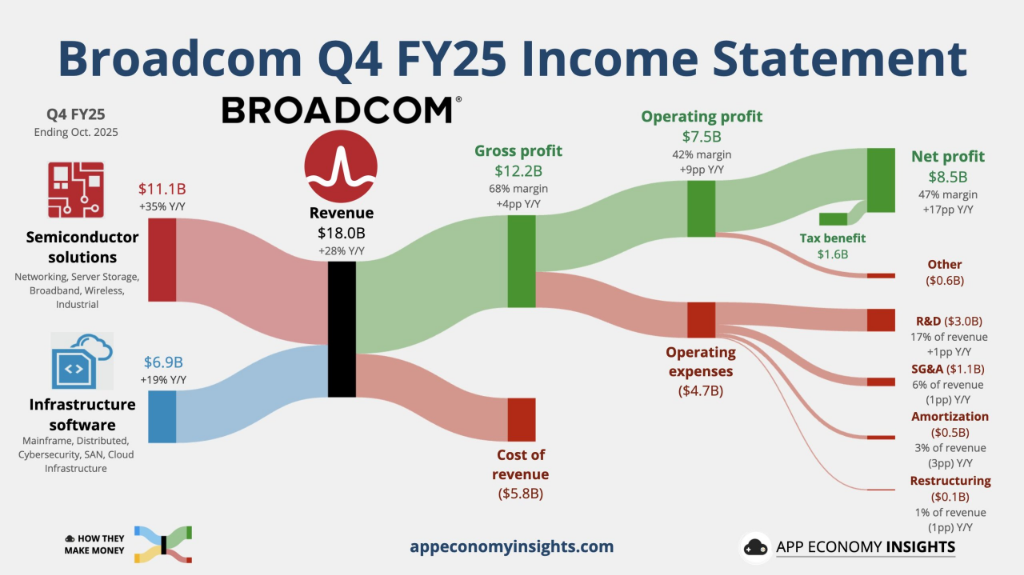
Core Viewpoint - Broadcom's CEO Hock Tan indicated that silicon photonics technology will not have an immediate impact on data centers, suggesting that the transition to this technology will take time and require two waves of innovation before it becomes essential [2]. Group 1: Silicon Photonics Technology - The CEO believes that the adoption of silicon photonics technology will occur in the future, but it is not imminent. The first wave involves expanding copper interconnect technology for rack-level systems, followed by a second wave of pluggable optical devices that combine electronic and photonic components [2]. - Tan emphasized that the transition to silicon photonics is inevitable but will require time, stating that Broadcom is preparing for this shift through necessary R&D efforts [2]. Group 2: AI Hardware Demand - Broadcom is currently focused on producing AI hardware to fulfill a backlog of orders valued at $73 billion, with over $50 billion coming from large-scale customers ordering custom AI accelerators, referred to as "XPUs" [3]. - The CEO expressed confidence in the sustained demand for AI hardware, countering claims of a cooling market, and highlighted a recent $1 billion XPU order from a new customer and an additional $11 billion order from Anthropic [3]. Group 3: Financial Performance - In the fourth quarter, Broadcom's semiconductor business revenue reached $11 billion, a 35% year-over-year increase, with $6.7 billion attributed to AI products, marking a tenfold growth in AI hardware revenue in less than three years [4]. - The company's infrastructure software business generated $6.9 billion in revenue, up 19% year-over-year, primarily driven by VMware software sales, which are expected to maintain low double-digit growth until 2026 [4]. - The CEO projected that the semiconductor business will continue to drive rapid growth, with first-quarter revenue expectations for fiscal year 2026 set at $19.1 billion, reflecting a 28% increase [4]. Group 4: Stock Market Reaction - Following the earnings announcement, Broadcom's stock price initially rose by approximately 3% but quickly fell by 5% [5].

“未上调2026财年指引”不是大问题,高盛:越来越相信博通的AI业务
Hua Er Jie Jian Wen· 2025-12-12 05:56
Core Viewpoint - Despite not raising the full-year guidance for fiscal year 2026 as some investors expected, Goldman Sachs reaffirmed a "Buy" rating for Broadcom, citing the company's strengthening dominance in the custom chip sector and robust fundamentals in its AI business [1][2]. Financial Performance - Broadcom reported a strong fourth-quarter revenue of $18 billion, exceeding market expectations of $17.5 billion. The guidance for the first quarter of fiscal year 2026 is set at $19.1 billion, significantly above the analyst forecast of $18.3 billion. This growth is primarily driven by a 74% year-over-year increase in AI semiconductor revenue [1][5]. - The AI semiconductor revenue reached $6.5 billion, surpassing the expected $6.2 billion, while total semiconductor solutions revenue was $11.1 billion, above the anticipated $10.7 billion. Infrastructure software revenue was $6.9 billion, slightly exceeding expectations [5]. Market Reaction and Guidance - The market's reaction to the earnings report may be mixed, as there is disappointment over the lack of an updated full-year guidance for fiscal year 2026. Analysts noted that the absence of an upward revision could lead to short-term stock price pressure [1][3]. - Goldman Sachs' analysts predict that Broadcom's AI revenue growth for fiscal year 2026 will actually exceed 100%, despite management's conservative stance not reflecting the actual business momentum [3]. Customer Expansion and Orders - Broadcom has made significant progress in customer expansion, maintaining strong momentum with its largest client, Google, and announcing a new major customer. The company has secured a fifth XPU customer and received an additional $11 billion order from Anthropic for fiscal year 2026 [4]. - The backlog of AI orders has reached $73 billion for the next 18 months, indicating strong demand, with additional orders expected to increase this figure [4]. Profitability Trends - Broadcom's gross margin for the fourth quarter was 77.9%, slightly above market expectations. The adjusted EBITDA margin guidance for the first quarter of fiscal year 2026 is set at 67% [5]. - Goldman Sachs noted that as Broadcom begins delivering full-rack solutions to Anthropic and potentially OpenAI in the second half of fiscal year 2026, there may be some dilution in gross and operating margins due to a higher proportion of direct components in these solutions [5]. Valuation Logic - Goldman Sachs raised Broadcom's 12-month price target from $435 to $450, based on an increase in AI revenue expectations and improved visibility into industry cycles. The estimated EPS was adjusted from $11.50 to $12.00, maintaining a 38x P/E multiple [2][7].