
产学研用协同

Search documents
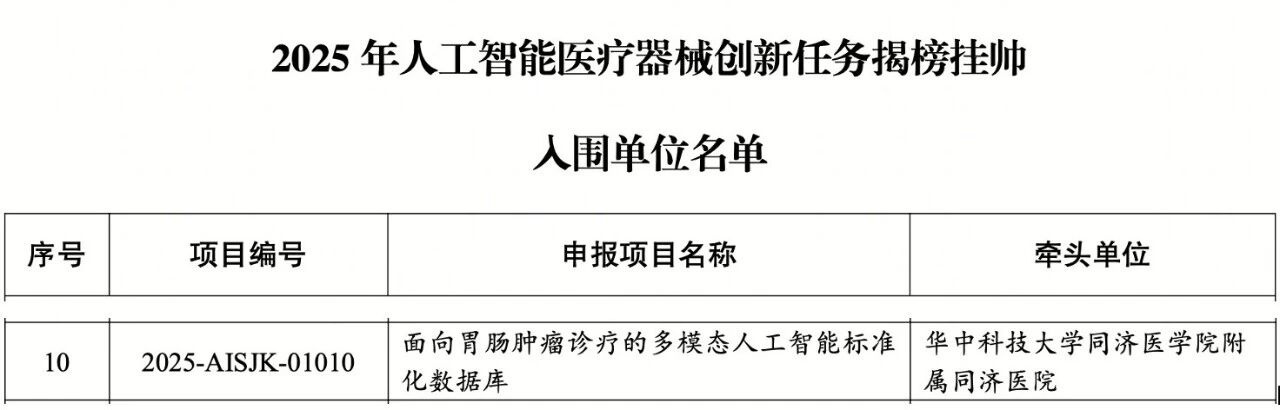
成功“揭榜”国家级任务!医渡科技携手同济医院攻关胃肠肿瘤AI诊疗
Zhi Tong Cai Jing· 2026-02-10 03:13
Core Insights - The project aims to establish a high-quality, standardized multimodal database for gastrointestinal tumors, focusing on enhancing early detection rates and treatment precision in China [2][3][4] Group 1: Project Overview - The initiative is led by Professor Liao Jiazhi from Tongji Hospital, with a core team comprising experts from various medical and data science fields [3] - The project will integrate diverse data types, including endoscopic images, pathology slides, genetic sequencing, and clinical follow-ups, to create a comprehensive data asset for gastrointestinal tumors [4] Group 2: Technological Framework - The core technology of the project revolves around "multimodal" and "standardization," aiming to improve the efficiency of AI product and technology development in gastrointestinal oncology [4] - The collaboration plans to gather and manage tens of thousands of high-quality case data during the project period, developing AI algorithms for early screening, precise classification, efficacy prediction, and recurrence risk assessment [4] Group 3: Industry Impact - The partnership between Yidu Technology and Tongji Hospital represents a practical application of the "clinical demand-driven, AI-powered research, and industry-academia collaboration" model, which is expected to enhance the overall diagnostic and treatment levels for gastrointestinal tumors in China [5] - Yidu Technology has extensive experience in data governance and multimodal analysis, having processed nearly 7 billion authorized medical records across over 10,000 hospital partnerships by September 30, 2025 [5]

5.4%增速之外,上海新质生产力藏着怎样的破局密码
Ren Min Ri Bao· 2026-02-02 04:21
增长并非简单的规模扩张,而是质效并重的结构性跃升:工业战略性新兴产业占规上工业总产值比重已 达45%,较2024年提升1.4个百分点,标志着上海工业经济已从"规模主导"转向"创新主导"。 产业质变的深层逻辑,是上海对"硬科技"赛道的长期坚守与制度创新。三大先导产业的爆发式增长,源 于"十五五"规划建议中对集成电路全产业链突破、人工智能全栈创新的系统布局,更得益于"产学研 用"协同机制的持续优化。 新质生产力的生命力,在于与城市发展全局的深度融合,既筑牢产业根基,又激活民生温度。 上周,2025年上海经济运行数据重磅发布:全市地区生产总值突破5.67万亿元,同比增长5.4%,第三产 业增加值增长6.0%,工业战略性新兴产业产值增长6.5%,三大先导产业制造业产值更是以9.6%的增速 领跑。 这组亮眼数据的背后,是新质生产力作为核心引擎的强劲驱动——从集成电路、人工智能的技术突破到 长三角协同创新的范式升级,从数字基建的广泛铺展到民生场景的深度赋能,上海正以新质生产力重塑 城市发展肌理,书写中国式现代化龙头城市的高质量答卷。 科技创新是发展新质生产力的核心要素,是产业质变的源动力,这在上海2025年的经济数据中得 ...
代表委员通道|罗晓东委员:为“云药”腾飞插上科技翅膀
Xin Lang Cai Jing· 2026-01-31 06:05
Core Insights - Yunnan has a rich biodiversity and ranks among the top in China for traditional Chinese medicine cultivation area and variety, providing a solid foundation for the biopharmaceutical industry [1] - The biopharmaceutical industry in Yunnan has shown significant development, with companies like Yunnan Baiyao and Beitaini leading the market with their unique products [1] - Despite the potential, the industry faces challenges such as low levels of deep processing, insufficient core technological support, and a lack of integration between research and industry [1][2] Group 1: Industry Development - Yunnan's biopharmaceutical industry has made notable progress, with leading companies capitalizing on unique product offerings [1] - The industry is characterized by a strong foundation in traditional medicine, but it requires advancements in technology and processing capabilities [1] Group 2: Challenges and Recommendations - Key challenges include insufficient core technology, gaps in the translation of laboratory results to industry applications, and low levels of automation [1][2] - Recommendations include transitioning from resource-dependent to innovation-driven models, emphasizing technological empowerment in deep processing [1][2] - Establishing interdisciplinary innovation teams and enhancing collaboration between universities, research institutions, and enterprises is crucial for overcoming existing barriers [2] Group 3: Technological Advancements - The focus should be on modernizing traditional drugs and enhancing smart manufacturing through digital quality management systems and intelligent production lines [2] - The adoption of AI technology is recommended to optimize production parameters, reduce R&D cycles, and lower production costs [2] - Strengthening brand development and upgrading standards to promote the internationalization of natural drug products is essential for increasing the visibility of Yunnan's biopharmaceutical offerings [2]
好牌就要打好
Liao Ning Ri Bao· 2026-01-08 01:02
Core Viewpoint - The focus of the recent research and visits by the Liaoning Provincial Party Secretary, Xu Kunlin, emphasizes the importance of technological innovation as a key driver for revitalizing the old industrial base in Liaoning [1][2]. Group 1: Technological Innovation and Industry Integration - The research activities are aimed at addressing "bottleneck" challenges and achieving dual outputs of scientific research results and technological talent [2]. - There is a strong emphasis on combining basic research with applied research to help Liaoning build a competitive advanced manufacturing cluster [2]. - The strategy includes promoting the transformation of research results into products and industries, highlighting the deep integration of technological and industrial innovation [2]. Group 2: Strategic Planning and Continuous Learning - The provincial government has established a coherent and forward-looking strategic line regarding technological innovation over the past three months [2]. - High-level thematic learning sessions have been held, focusing on future topics such as atomic-level manufacturing and quantum information technology, inviting top experts to provide insights [2][3]. - The emphasis is on moving away from outdated industrial maps to navigate new production capabilities, indicating a shift in regional competition towards technological innovation [3]. Group 3: Talent Development and Support - The strategy includes providing quality services for scientific personnel and creating a supportive environment, which is crucial for retaining talent [3]. - Initiatives such as "attracting, nurturing, utilizing, and retaining talent" and granting greater autonomy to scientific personnel are part of the strategic deployment [3]. - The underlying logic is that talent is key to technological innovation, and effective support will enable innovation to flourish [3].
“创新飞轮”转出发展动能
Xin Hua Ri Bao· 2025-12-30 23:07
Core Insights - The Suzhou Industrial Park's educational and technological innovation zone is focusing on the integration of education, technology, and talent development, showcasing cutting-edge projects in AI, biomedicine, and new energy [1][12] - The "Innovation Flywheel" concept is introduced to enhance collaboration between government, universities, and enterprises, driving efficient flow of innovation elements [1][6] - The region has successfully organized 20 industry-university matchmaking events, collecting 351 industrialization projects, with 19 projects successfully landing [6][7] Group 1: Educational and Technological Integration - The educational model in the Dushu Lake Innovation Zone is redefining boundaries, with practical training often occurring in corporate R&D centers, addressing real industry challenges [2][4] - Universities in the region, such as Xi'an Jiaotong-Liverpool University, emphasize "fusion education," collaborating with leading enterprises to develop projects that solve real-world problems [2][3] - The integration of education and industry is becoming standard, with specialized industry practice modules established in local universities [2][5] Group 2: Talent Development and Collaboration - The Suzhou Institute of Advanced Research is exploring a dual-track system for research personnel, enhancing the integration of disciplines and industry [3][10] - The region has gathered 33 renowned universities and 15 national research institutes, serving as a hub for high-level talent cultivation and efficient technology transfer [5][11] - The "Huihu Small Leaders" project aims to support entrepreneurial initiatives among faculty and recent graduates, enhancing the commercialization of research outcomes [7][8] Group 3: Innovation and Market Transition - The transition from research outcomes to market-ready products is a critical challenge, with the Dushu Lake Innovation Zone focusing on scaling innovations for commercial success [6][9] - The zone's achievements in technology transfer include 116 projects presented at roadshows, with significant interest from industry partners [6][7] - The establishment of a supportive ecosystem for innovation is evident, with policies designed to facilitate the transformation of academic research into practical applications [8][12]
苏州纳微捐赠3000余万,国产仪器公司的“战略奇招”
仪器信息网· 2025-12-15 10:12
Core Viewpoint - Suzhou Nano Micro Technology Co., Ltd. (referred to as "Nano Micro Technology") has made two significant donations of shares worth over 30 million yuan to universities, aiming to create a new paradigm for domestic instrument development through industry-academia collaboration [3][4]. Group 1: Donations Overview - Within one month, Nano Micro Technology donated 800,000 shares (approximately 20 million yuan) to Peking University Education Foundation to support research and talent development [4]. - The company also announced a donation of 400,000 shares (approximately 10 million yuan) to Dalian Maritime University Education Development Foundation, representing 0.10% of the company's total share capital [4][5]. - The donations are made by the controlling shareholder, reflecting a commitment to higher education and technological innovation [4][6]. Group 2: Strategic Alignment - The donations align with the research needs of the recipient universities, which are top-tier institutions in China, focusing on fields such as biomedicine and maritime technology [8]. - Peking University is a leader in life sciences and materials science, providing research outcomes that can directly enhance Nano Micro Technology's product development [8]. - Dalian Maritime University specializes in maritime technology, offering research that supports the application of Nano Micro Technology's products in maritime sensors and environmental monitoring [8]. Group 3: Strategic Benefits - The donations serve multiple strategic purposes: they fulfill social responsibility while enhancing technology, brand, and market opportunities for the company [9]. - Collaborating with universities allows Nano Micro Technology to access cutting-edge research needs, facilitating a more efficient "demand-driven R&D" model compared to traditional methods [9]. - The donations improve the company's brand image by demonstrating a commitment to social responsibility, which is crucial in an industry facing trust issues [9]. - The collaboration with universities also opens pathways for market expansion through the direct application of products in university research projects [9]. Group 4: Conclusion - The dual donations exemplify a new model of "industry-academia-research-application" collaboration, fulfilling strategic objectives across technology, branding, and market development [10]. - This approach provides a replicable strategic model for the development of domestic instrument companies, holding significant value for industry promotion [11].


通途贯东西 发展“跑”起来——沈卢高速为中原发展注入新动能
He Nan Ri Bao· 2025-12-05 23:34
Core Insights - The Shenlu Expressway segment from Shenqiu to Suiping is set to officially open by the end of December, enhancing regional development in Central China [1] - The expressway, spanning 105.96 kilometers with a total investment of 13.629 billion yuan, connects key transportation networks and facilitates faster logistics and passenger flow [1] Group 1: Project Overview - The Shenlu Expressway segment is a crucial link between Zhoukou and Zhumadian, featuring a dual four-lane design with 46.12 kilometers in Zhoukou and 59.84 kilometers in Zhumadian [1] - The project connects to the Shanggu Expressway and the Beijing-Hong Kong-Macau Expressway, forming a significant transportation network that integrates the Yangtze River Delta and the Belt and Road Initiative [1] Group 2: Quality and Safety Measures - The project team emphasizes quality as the lifeline of the engineering, implementing a "11356" management system to achieve long-term quality goals [2] - Special measures for winter construction include using insulation techniques for concrete pouring and strict control of moisture content in roadbed filling to ensure stability [2] - The project has achieved zero accidents since its inception and has been recognized as a provincial-level "Safety Production Demonstration Unit" [2] Group 3: Innovation and Efficiency - The project promotes collaboration between academia and industry, working with institutions like Zhengzhou University to enhance construction techniques and materials [2] - A total of 198 innovative results have been generated through ongoing improvement activities, with 68 outstanding results being implemented across the project [2] - The project has also secured 12 provincial-level construction methods and 26 authorized patents, showcasing its commitment to innovation [2] Group 4: Environmental Considerations - The project adopts a sustainable approach to land use, implementing a "river dredging + reservoir silt removal + land transformation" model to protect basic farmland [3] - Through these efforts, 730 acres of land have been created while saving 20,000 acres of farmland, achieving a "zero take, zero occupy" policy for basic farmland [3] - The project has successfully integrated ecological considerations, ensuring clean waterways and connected farmland alongside the expressway [3]
武汉激光产业,何以闪耀世界?
Chang Jiang Ri Bao· 2025-12-04 09:01
Core Viewpoint - The Wuhan laser industry, represented by companies like Huagong Technology and Raycus Laser, has made significant advancements, transitioning from reliance on imports to becoming a global player in high-end laser equipment manufacturing [2][5][18]. Industry Development - The 2025 Guanggu Marathon in Wuhan highlighted the city's growing reputation in the laser industry, with Huagong Technology being a key player and sponsor [1]. - Over the past fifty years, the Wuhan laser industry has evolved from importing core components to exporting high-end laser equipment globally [2]. - Major projects, such as the Raycus Laser's new light source research and production base with an investment of 489 million yuan, are set to enhance the industry's capabilities significantly [3]. Company Innovations - Huagong Technology has established itself as "China's first laser stock," leading in setting international standards and achieving numerous national awards [1][7]. - The company has reported a 35% annual growth rate in core products over the past decade, indicating strong market demand and innovation [7]. - New products, such as the AI smart laser weeder, demonstrate the company's commitment to diversifying applications into areas like agriculture [8][10]. Collaborative Ecosystem - The establishment of the Wuhan Semiconductor Laser Equipment Industry Innovation Joint Laboratory aims to enhance collaboration between academia and industry, facilitating the transition from research to practical applications [11][12]. - The "135" strategy aims for the laser industry's output value to reach 300 billion yuan by 2035, supported by a 10 billion yuan fund [15]. Global Expansion - Huagong Technology has expanded its international presence, with over ten manufacturing and service centers worldwide, achieving a 16% increase in export revenue in the first half of the year [16]. - Companies like Jinyun Laser have reported that over 60% of their revenue comes from overseas markets, reflecting a collective shift towards international markets [16][17]. - Raycus Laser has seen a 78.2% increase in overseas shipments, indicating a robust international demand for its products [17].



四大证券报头版头条内容精华摘要_2025年12月3日_财经新闻
Xin Lang Cai Jing· 2025-12-02 23:27
Group 1 - The National Development and Reform Commission and other departments aim to strengthen the construction of data element disciplines and digital talent teams to promote the integration of education, talent, industry, and innovation in the data field [1] - The China Interbank Market Dealers Association has optimized the merger note mechanism to enhance the efficiency of fund utilization and support corporate mergers and acquisitions [2] - Fujian Province has issued measures to promote the orderly development of computing power infrastructure, encouraging the planning of urban computing networks and upgrading submarine cables [3][21] Group 2 - The brain-computer interface sector is experiencing accelerated commercialization driven by policy and technology, with current valuations aligning with emerging growth characteristics [4][22] - Leading lithium iron phosphate companies are raising prices, with one company announcing a processing fee increase of 3000 yuan per ton starting January 1, 2026 [5][23] - New regulations on credit repair have been introduced to facilitate the revival of business entities, expanding the scope of credit repair and shortening processing times [6][24] Group 3 - Shanghai is moving towards regulating the development of offshore bond business in the free trade zone, with new draft regulations under review [7][26] - Fujian Province plans to build a collaborative computing network with a target of exceeding 12 EFLOPS in public computing power by the end of 2027, leading to significant market activity in related stocks [9][27] - Institutions are optimistic about the cross-year market, with 197 stocks included in the December "golden stock" list by brokerages [10][28] Group 4 - The brain-computer interface industry is set to accelerate with multiple conferences scheduled, including a large-scale competition and investment cooperation forum [11][29] - The charging infrastructure sector is witnessing rapid development, with a total of 18.645 million charging facilities in China as of October, marking a 54% year-on-year increase [12][30] - The new national standard for electric bicycles has been implemented, prohibiting the sale of vehicles that do not meet the updated requirements, creating new growth opportunities in the industry [13][31] Group 5 - Public fund institutions have increased their research activities, focusing on hard technology and advanced manufacturing sectors, with over 4200 company visits in November [14][32] - Offshore wind power is transitioning from demonstration to large-scale development, supported by increasing policy backing [15][33] - The scope of real estate investment trusts (REITs) has expanded to include urban renewal facilities, marking a significant milestone in the infrastructure sector [16][34][35] Group 6 - Eight real estate companies reported total sales exceeding 100 billion yuan in the first eleven months, with a notable increase in new housing supply and a positive market outlook [17][36][18]
五部门:加强人才队伍建设 促进数据领域产学研用协同
Zhong Guo Zheng Quan Bao· 2025-12-02 20:29
Group 1 - The core viewpoint of the news is the issuance of an opinion by multiple government departments aimed at strengthening the construction of data element disciplines and digital talent teams, promoting the integration of education, talent, industry, and innovation in the data field [1][2][3] Group 2 - The opinion emphasizes optimizing the setting of disciplines and majors related to data elements, encouraging universities and data enterprises to participate in the construction of relevant disciplines such as data science and engineering, and digital economy and management [1] - It proposes the establishment of a talent training mechanism that connects undergraduate, master's, and doctoral programs in data-related fields, and supports vocational schools in adjusting data-related majors based on industry needs [1] Group 3 - The opinion calls for accelerated research on major issues related to the market-oriented allocation of data elements, focusing on key topics such as data ownership, pricing, and trading, while also keeping pace with advancements in technologies like artificial intelligence and blockchain [2] - It highlights the importance of building typical application scenarios to promote deep integration of technological and industrial innovation in the data field, with a focus on cultivating composite, innovative, and practical digital talents [2] Group 4 - The opinion outlines the creation of a data element industry-education integration innovation platform, encouraging the establishment of interdisciplinary research teams to accelerate the development of key common technologies and cutting-edge technologies in the data field [3] - It emphasizes the need for collaboration among government departments to strengthen the organization and promotion of data element discipline construction and digital talent team building, fostering a conducive environment for the collaborative training of digital talents [3]