全功能GPU

Search documents
预计增速超230%!摩尔线程2025年营收有望突破15亿元,国产全功能GPU迈入规模商用阶段
Mei Ri Jing Ji Xin Wen· 2026-01-22 09:44
Core Viewpoint - The domestic GPU sector is experiencing significant growth, with Moores Threads projecting a revenue increase of 230.70% to 246.67% in 2025, reaching between 1.45 billion to 1.52 billion yuan, marking a pivotal moment for the commercialization of domestic GPUs [1][2] Group 1: Revenue Growth and Market Demand - Moores Threads' revenue is expected to surge from 438 million yuan in 2024 to over 1.45 billion yuan in 2025, driven by external market demand and internal technological breakthroughs [2] - The year 2025 is identified as the "year of large-scale deployment of AI models," with a significant increase in demand for high-performance computing across various sectors, particularly under the ongoing domestic substitution policies [2][7] - The flagship product, MTT S5000, based on the fourth-generation GPU architecture, is set to achieve mass production in 2025, serving as the core engine for revenue growth [2][3] Group 2: Product Performance and Technological Advancements - The MTT S5000 supports large-scale model training and has demonstrated high efficiency and performance, achieving a linear expansion efficiency of 95% and effective training time exceeding 90% [2][3] - The S5000 has established new benchmarks for domestic inference performance, with throughput exceeding 4000 tokens/s for Prefill and 1000 tokens/s for Decode [3] - Moores Threads has successfully transitioned from technology development to large-scale commercialization, with the S5000 operating stably in complex scenarios [3][8] Group 3: Strategic Investment and R&D Commitment - The GPU industry is characterized by high capital and talent intensity, and Moores Threads has chosen a challenging path by focusing on full-function GPUs, which require breakthroughs in various computing capabilities [4][6] - The company has invested over 4.3 billion yuan in R&D from 2022 to mid-2025, with funds primarily directed towards developing new AI training and inference chips [6] - Moores Threads aims to build a comprehensive competitive strategy through sustained high-intensity R&D investments, reflecting its long-term vision [6][8] Group 4: Market Position and Future Outlook - The demand for domestic AI computing is projected to grow at an annual rate exceeding 50%, creating a substantial market for domestic GPUs [7] - Moores Threads is one of the few companies in China pursuing a full-function GPU technology route, which enhances user stickiness and ecosystem expansion [7] - The core team, with extensive experience from international GPU giants, is driving the company towards achieving competitive product performance and market presence [7][8]
摩尔线程:五年“长考”,筑起全功能算力的硬核长城
半导体行业观察· 2025-12-26 01:57
Core Viewpoint - The semiconductor industry recognizes that while developing a chip may take three years, it often takes a decade for developers to write code for that chip. The success of NVIDIA's CUDA is fundamentally a victory of software stack and developer ecosystem. For domestic GPUs, merely matching computational power is insufficient for long-term competitiveness; the real challenge lies in establishing a deeply integrated hardware-software architecture that allows global developers to transition seamlessly [1][3]. Group 1: MUSA Ecosystem and Achievements - The MUSA developer conference showcased a strong consensus on the need for an ecosystem breakthrough, emphasizing that it was not just a technical release but a large-scale event with around 1,000 participants [1]. - Over the past five years, the company has made significant strides, including the development of five chips, an investment exceeding 4.3 billion yuan in R&D, a 77% R&D personnel ratio, and over 200,000 active developers, highlighting its unique position in the domestic GPU sector [3]. Group 2: MUSA Architecture - MUSA (Meta-computing Unified System Architecture) is not merely a software package; it encompasses a full-stack technology system that integrates chip architecture, instruction sets, programming models, and software libraries, enabling developers to efficiently write, migrate, and optimize code on the company's GPUs [6][8]. - The MUSA architecture defines unified technical standards from chip design to software ecosystem, similar to how Android and Windows function as platforms rather than just software installers [8]. Group 3: Full-Function GPU - The concept of a "full-function GPU" is rooted in its ability to handle multiple tasks, including graphics rendering, AI tensor computation, physical simulation, and ultra-high-definition video encoding, making it versatile for various applications [12][15]. - The evolution of GPU capabilities has been pivotal in the computing revolution, transitioning from graphics acceleration to general computing and now to AI-driven applications [10][14]. Group 4: New Architectures and Innovations - The latest "Huagang" architecture has been introduced, featuring a 50% increase in computational density and a tenfold improvement in computational efficiency, along with new asynchronous programming models and AI-driven rendering capabilities [19][21]. - The company has filed over 1,000 patents, with more than 500 granted, establishing a leading position in the domestic GPU industry [21]. Group 5: Key Products - The "Huashan" chip is designed for AI training and inference, featuring advanced load balancing and a new generation of Tensor Cores optimized for AI applications, significantly enhancing computational efficiency [24][25]. - The "Lushan" chip, aimed at high-performance graphics rendering, boasts a 15-fold increase in 3A game performance and a 64-fold increase in AI computing performance compared to previous models [28][30]. Group 6: AI Factory and Large-Scale Systems - The company is advancing towards building AI factories capable of supporting over 100,000 GPUs, addressing challenges such as connectivity, fault tolerance, and energy efficiency in large-scale systems [34]. - The new MTLink 4.0 technology enhances data transmission efficiency, while the ACE 2.0 engine optimizes GPU collaboration, ensuring high stability and availability in large clusters [34]. Group 7: MUSA 5.0 Software Stack - The MUSA 5.0 upgrade represents a significant milestone, providing seamless support for various applications, including AI training and scientific computing, while ensuring compatibility with both international and domestic CPU operating systems [36][37]. - The upgrade includes enhancements in performance optimization, open-source tools, and programming languages tailored for 3D graphics and AI applications, improving developer efficiency [40]. Group 8: Embodied Intelligence and AI SoC - The company is venturing into embodied intelligence with the launch of the "Changjiang" AI SoC, integrating multiple computational cores to support advanced AI applications in robotics and next-generation devices [39]. - The MT Lambda simulation platform aims to enhance the efficiency of transitioning from simulation to real-world applications, providing a comprehensive solution for embodied intelligence [42]. Group 9: Developer Ecosystem - The success of the domestic GPU ecosystem hinges on attracting developers, addressing high migration costs, and improving toolchains and documentation [46]. - The MUSA software stack is designed to enhance developer experience, facilitating a smooth transition to domestic GPUs while ensuring compatibility with mainstream ecosystems [47].

摩尔线程张建中和他的伙伴们
YOUNG财经 漾财经· 2025-12-23 11:19
Core Viewpoint - Moore Threads is a comprehensive GPU chip developer and AI computing solution provider that aims to become the domestic alternative to NVIDIA, achieving a strong market presence with a significant valuation and rapid growth in revenue [4][18]. Group 1: Company Overview - Moore Threads was listed on the Shanghai Stock Exchange's Sci-Tech Innovation Board on December 5, achieving a remarkable closing increase of 425.46%, with a total market capitalization of 282.25 billion [4]. - The company aims to capitalize on the booming AI sector, with a projected compound annual growth rate (CAGR) of 208.44% in revenue from 2022 to 2024 [4]. - As of 2025, Moore Threads is ranked 212th on the Hurun Global Unicorn List with a valuation of 31 billion yuan [4]. Group 2: Leadership and Founders - Zhang Jianzhong, the founder and chairman, holds 11.06% of the company's shares and controls 36.36% through various holding platforms, with his stake valued at over 4.3 billion USD (approximately 304 billion yuan) [6][7]. - Zhang has a strong background in the GPU industry, having previously served as NVIDIA's Vice President and General Manager for Greater China, where he significantly increased NVIDIA's market share in China from under 50% to nearly 80% [7][10]. - The founding team includes several key figures from NVIDIA and other tech companies, contributing to the rapid growth and success of Moore Threads [13][14]. Group 3: Product and Market Strategy - Moore Threads aims to develop a "fully functional GPU" that supports graphics rendering, scientific computing (including AI), and multimedia encoding, distinguishing itself from other domestic chip companies [17][18]. - The company has successfully produced five GPU chips and has maintained a rhythm of releasing one new GPU architecture annually from 2021 to 2024, with significant milestones in product development [19]. - The Chinese GPU market is projected to exceed 120 billion yuan by 2025, indicating a substantial growth opportunity for Moore Threads [18]. Group 4: Financial Performance and Challenges - In 2024, Moore Threads reported a revenue of 438 million yuan, a year-on-year increase of approximately 253%, despite a high R&D expense ratio of 310% [20]. - The company is currently in discussions for orders exceeding 2 billion yuan, covering various sectors including AI computing and professional graphics acceleration [20]. - Moore Threads is positioned to achieve significant performance growth by 2027, with a potential for profitability in the same year [20].
MDC2025:全功能GPU路线清晰,MUSA生态进入规模化验证阶段
海通国际· 2025-12-23 05:14
Investment Rating - The report does not explicitly state an investment rating for the industry or specific companies involved. Core Insights - The MUSA 5.0 has established a comprehensive full-stack system that includes instruction sets, programming models, compilers, and communication libraries, achieving engineering performance close to international mainstream standards across key metrics [2][10] - The Huagang architecture, introduced at the MDC 2025, represents a significant upgrade in compute density, energy efficiency, precision coverage, and interconnect capabilities, supporting full-precision computing from FP4 to FP64 and introducing mixed low precision [2][10] - Moore Threads is one of the few domestic GPU vendors committed to a "full-function GPU" strategy rather than focusing solely on AI accelerators, indicating a long-term vision for broader ecosystem development [2][10] Summary by Sections Event Overview - The inaugural MUSA Developer Conference (MDC 2025) was held on December 20-21, 2025, in Beijing, focusing on sovereign computing and the developer ecosystem, unveiling the next-generation full-function GPU architecture Huagang and the Ku'e ten-thousand-card AI compute cluster [1][9] Technical Developments - The Huagang architecture emphasizes asynchronous programming and ultra-large-scale interconnect (MTLink), laying the groundwork for scaling to ten-thousand-card and hundred-thousand-card clusters [2][10] - The Ku'e ten-thousand-card AI compute cluster achieved approximately 60% MFU on dense models and 40% on MoE models, with a linear scaling efficiency of about 95% and effective training time exceeding 90% [3][11] Ecosystem and Strategy - The report outlines a clear roadmap for progressively open-sourcing core components, including compute libraries and communication libraries, to enhance the ecosystem [2][14] - The MT Lambda platform was launched, integrating physics engines, graphics rendering engines, and AI compute engines to create a full-stack framework for development, simulation, and training [3][12] Future Directions - The company has articulated a clear product segmentation path with a focus on unified AI training and inference, positioning itself as a foundation for next-generation AI factories [2][14] - The Huashan and Lushan architectures are designed to cater to AI training and high-performance graphics rendering, respectively, with significant improvements in various performance metrics [3][14]
上市后的摩尔线程,重心从造芯变成建生态
Xin Lang Cai Jing· 2025-12-22 11:02
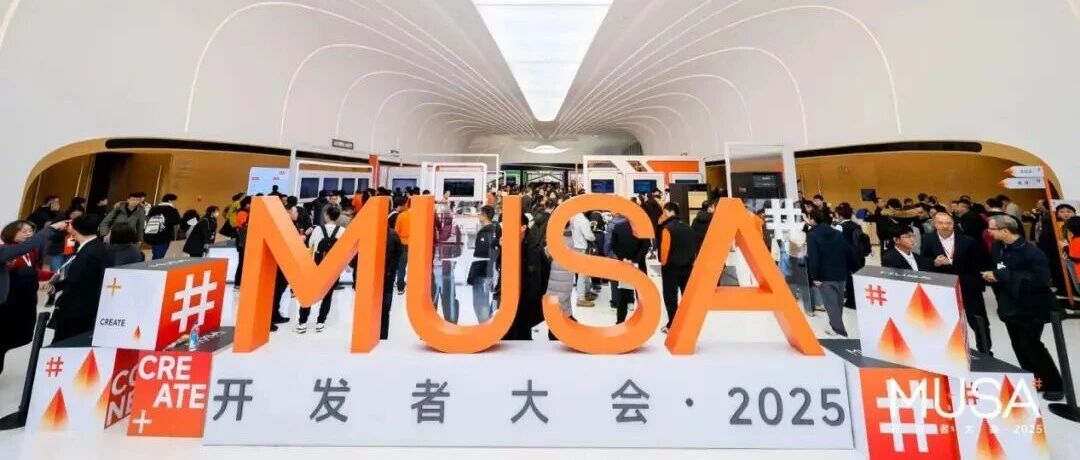
Core Viewpoint - The Moer Thread's first MUSA Developer Conference (MDC 2025) showcased significant advancements in GPU technology and emphasized the importance of ecosystem development in the GPU industry, positioning itself as a key player in the market with a valuation of 300 billion [1][26]. Group 1: Ecosystem and Developer Focus - The ecosystem is identified as the core moat and value in the GPU industry, with a strong emphasis on developer engagement as a critical component of ecosystem construction [2][27]. - The MUSA architecture has undergone comprehensive upgrades centered around developers, aiming to reduce development and migration costs while enhancing usability [2][27]. - Moer Thread's strategy appears to challenge NVIDIA's CUDA ecosystem, highlighting the necessity for domestic GPU manufacturers to build robust ecosystems beyond mere technological competition [2][28]. Group 2: MUSA Architecture and Full-Stack Technology - MUSA (Meta-computing Unified System Architecture) is the first domestic architecture to support AI computing, graphics acceleration, scientific computing, and more on a single chip, representing a full-stack technology system [8][32]. - The full-function GPU is designed to handle various tasks, supporting multiple precision levels, which enhances efficiency and compatibility for emerging applications [9][33]. - MUSA has evolved to its fifth generation since its launch in 2022, with significant performance improvements across various GPU engines [11][35]. Group 3: Upcoming Products and Innovations - The new full-function GPU architecture "Huagang" was introduced, featuring substantial upgrades in computing density, energy efficiency, and precision support [16][40]. - Two upcoming chips, "Huashan" and "Lushan," are set to focus on AI training and high-performance graphics rendering, respectively, indicating a strategic dual focus on AI and graphics [20][44][48]. - "Huashan" will support a wide range of precision calculations and enhance AI training capabilities, while "Lushan" aims to significantly improve graphics performance metrics [23][48].
摩尔线程的野心,不藏了
量子位· 2025-12-21 14:13
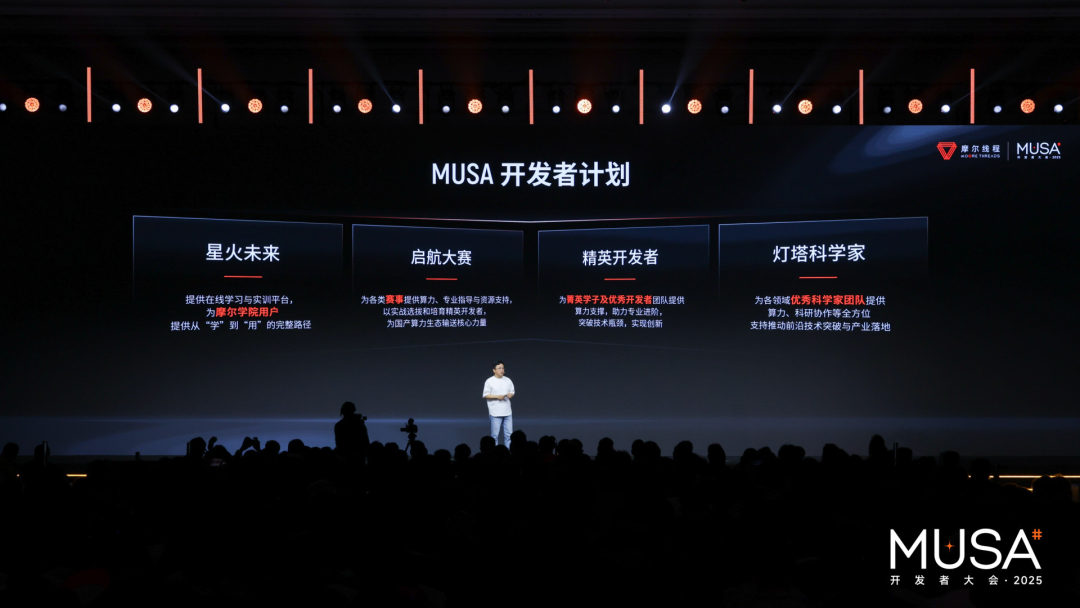
Core Viewpoint - The article highlights the significant advancements made by Moore Threads in the GPU sector, particularly through the launch of the MUSA architecture and its associated products, which aim to enhance the developer ecosystem and position domestic GPUs at a competitive level in the global market [1][4][19]. Group 1: MUSA Architecture and Innovations - MUSA stands for Meta-computing Unified System Architecture, representing a comprehensive framework that encompasses chip architecture, instruction sets, programming models, and software libraries [6][7]. - The latest GPU architecture, Huagang, boasts a 50% increase in density and a 10-fold improvement in efficiency, with three new chips focusing on AI training, graphics rendering, and intelligent SoC [8][10]. - The MUSA architecture has been iteratively developed over five years, culminating in the latest iteration that optimizes low-precision computing for AI applications [11][13]. Group 2: New Product Launches - Moore Threads introduced three new chips: Huashan, Lushan, and Yangtze, along with two hardware products, AIBOOK and AICube, and the KUAE 2.0 AI Foundry cluster [20][21]. - The Huashan chip targets AI training and high-performance computing, supporting full precision from FP4 to FP64 and significantly enhancing Transformer throughput [22][25][27]. - The Lushan chip focuses on graphics computing, achieving a 64-fold increase in AI performance and a 15-fold improvement in 3A game rendering performance [28][30][31]. - The Yangtze chip is designed for edge computing, providing 50 TOPS of heterogeneous AI computing power for various applications [32][34]. Group 3: Software Ecosystem and Developer Engagement - The MUSA software stack 5.0 was launched, offering a complete toolchain from compilers to AI frameworks, with plans to open-source key components to foster community engagement [15][16]. - Moore Threads aims to build a robust developer ecosystem through the establishment of the Moore Academy, targeting a community of 1 million developers by 2025 [59][61]. - The company emphasizes the importance of a comprehensive ecosystem that integrates software, hardware, and developer trust to create a sustainable competitive advantage in the GPU market [56][58].
全新架构、万卡集群、智算平台,摩尔线程(688795.SH)开发者大会还有哪些亮点?
智通财经网· 2025-12-20 23:23
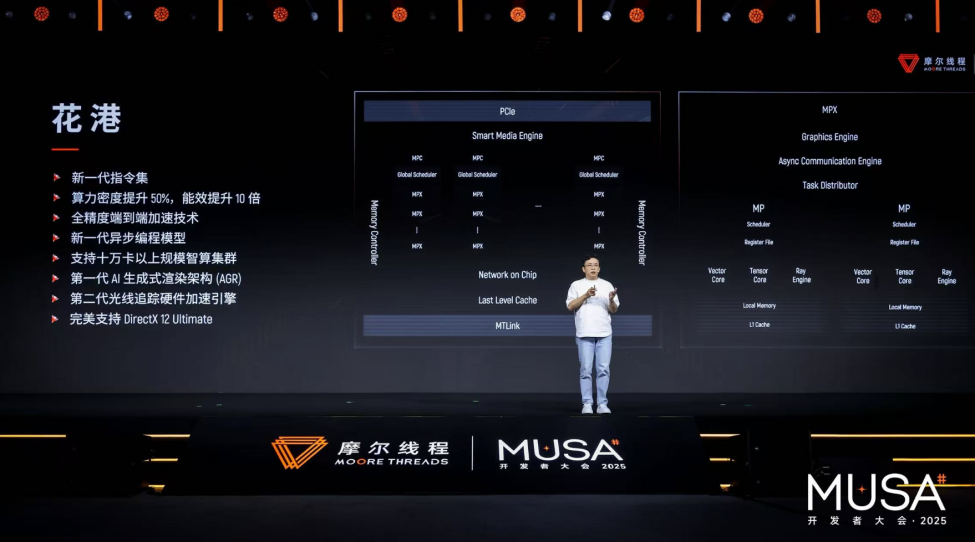
Core Insights - The core focus of the article is the rapid expansion of the domestic GPU leader, Moore Threads, highlighted by the launch of their new GPU architecture "Huagang" at the first MUSA Developer Conference [1][2]. Group 1: Product Development - Moore Threads introduced the "Huagang" architecture, which boasts a 50% increase in computing density and a 10-fold improvement in energy efficiency compared to the previous generation, set for mass production next year [1]. - The "Huagang" architecture supports full precision from FP4 to FP64 and integrates the first-generation AI generative rendering architecture (AGR) and second-generation ray tracing hardware acceleration engine [1]. - Two core chips based on the "Huagang" architecture were announced: "Huashan," designed for AI training and inference, and "Lushan," focused on high-performance graphics rendering, with AI computing performance improved by 64 times and geometric processing performance increased by 16 times [2]. Group 2: Infrastructure and Performance - The "Kua'e" supercomputing cluster was launched, achieving a floating-point computing capability of 10 Exa-Flops, with a training efficiency of 60% on Dense models and 40% on MOE models [4]. - The MTT S5000 single card achieved a Prefill throughput of over 4000 tokens/s and a Decode throughput of over 1000 tokens/s on the DeepSeek R1 671B model, indicating significant breakthroughs in system-level engineering optimization for large-scale parameter models [5]. Group 3: Software Ecosystem - The MUSA architecture received a full-stack software upgrade, with the core computing library muDNN achieving over 98% efficiency in GEMM/FlashAttention and 97% in communication efficiency [6]. - The company plans to open-source key components of its computing acceleration library, communication library, and system management framework to the developer community [6]. - A new intermediate language, MTX, compatible with cross-generation GPU instruction architectures, and a programming language, muLang, aimed at rendering and AI integration, will be introduced to lower adaptation barriers for developers [6]. Group 4: Market Position and Strategy - Moore Threads officially entered the personal intelligent computing terminal hardware market with the launch of the MTT AIBOOK, priced at 9999 yuan, expected to be available on January 10, 2026 [7][8]. - The MTT AIBOOK features the self-developed intelligent SoC chip "Changjiang," integrating a high-performance CPU and full-function GPU, with heterogeneous AI computing power reaching 50 TOPS [8]. - The company aims to transition from a single hardware supplier to a platform-level computing infrastructure provider, as reflected in the showcased "Huagang" architecture and the "chip-edge-end-cloud" full-stack system [9]. Group 5: Financial Performance - The company's stock price closed at 664.10 yuan per share on December 19, down 5.9%, with a cumulative decline of 29.4% from the peak on December 11, although it remains up over 481% from the issue price, maintaining a market capitalization of 312.146 billion yuan [9].
摩尔线程亮出全栈技术底牌:“花港”新架构与万卡集群冲击高端GPU市场格局
Huan Qiu Wang· 2025-12-20 07:00
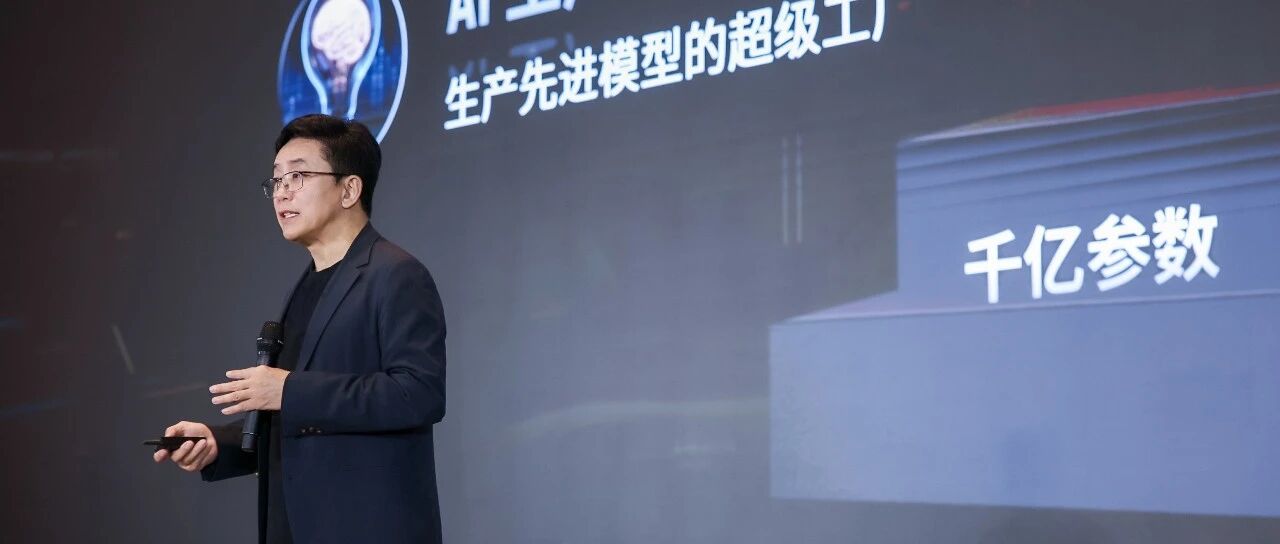
Core Insights - The article highlights the significant advancements made by Moore Threads in the GPU sector, particularly through the introduction of the new "Huagang" architecture and the "Kua'e" ten-thousand card intelligent computing cluster, which supports trillion-parameter model training [2][3]. Architecture Innovations - The "Huagang" architecture showcases a 50% increase in computing density and up to 10 times improvement in efficiency, fully supporting precision calculations from FP4 to FP64. It integrates the self-developed MTLink high-speed interconnect technology, facilitating cluster expansion beyond 100,000 cards [3][5]. - Two chips have been planned based on the "Huagang" architecture: "Huashan" for AI training and inference integration, and "Lushan" aimed at high-performance graphics rendering, with performance improvements of 64 times for AI computation, 16 times for geometric processing, and 50 times for ray tracing [5]. Cluster Capabilities - The "Kua'e" ten-thousand card intelligent computing cluster has publicly disclosed key engineering efficiency metrics, achieving a model compute utilization (MFU) of 60% for dense models and 40% for mixture of experts (MOE) models, with a linear scaling efficiency of 95% and effective training time exceeding 90% [6]. Ecosystem Development - Moore Threads announced the iteration of its unified software architecture MUSA to version 5.0, with plans to gradually open-source core components, including computation acceleration libraries and system management frameworks [8]. - The "Moore Academy" platform has attracted nearly 200,000 learners and collaborates with over 200 universities nationwide, reflecting a comprehensive approach to ecosystem building through technology open-sourcing, developer tool provision, and early talent cultivation [9]. Technological Integration and Exploration - The release indicates a trend towards the deep integration of graphics, AI, and high-performance computing, with hardware-level ray tracing acceleration and the introduction of the AI generative rendering technology MTAGR 1.0 [10]. - The company is also exploring cutting-edge fields such as embodied intelligence and AI for science, showcasing its ambition to redefine the value of GPUs as a general computing platform [10]. Industry Context - The comprehensive technology showcase reflects the current stage of domestic high-end computing power development, transitioning from single-chip innovations to tackling large-scale system engineering and building a thriving application ecosystem [11]. - The efficiency disclosure of the ten-thousand card cluster signifies that domestic computing infrastructure is beginning to undergo rigorous testing in large-scale, high-load scenarios, while the architecture iteration and integration of graphics and AI demonstrate the company's intent to define the next generation of computing architecture [11].
摩尔线程股价5天涨7倍居A股第三 押注全功能GPU前九月投8.6亿研发
Chang Jiang Shang Bao· 2025-12-11 23:41
Core Viewpoint - The stock price of Moer Thread (688795.SH), known as the "first domestic GPU stock," has surged significantly, reaching A-share third place within just five trading days, reflecting a strong market confidence in domestic hard technology companies [2][6]. Group 1: Stock Performance - On December 11, Moer Thread's stock closed at 941.08 CNY per share, up 28.04% for the day, just 59 CNY short of the 1,000 CNY mark [2]. - The stock price increased from the IPO price of 114.28 CNY to 941.08 CNY, representing a staggering rise of 723.49% in only five trading days [6][7]. - The market capitalization of Moer Thread reached 442.3 billion CNY, nearly 14 times its pre-IPO valuation of 29.845 billion CNY [7]. Group 2: Market Dynamics - The IPO attracted significant interest, with 462.17 billion shares applied for on the subscription day, resulting in a low online winning rate of only 0.03635% [4]. - The rapid rise in Moer Thread's stock price has been attributed to both the new stock effect and capital speculation, alongside a broader trend of capital chasing hard technology enterprises [8]. Group 3: Company Overview - Moer Thread focuses on the research, design, and sales of GPUs and related products, aiming to provide computing acceleration platforms for AI, digital twins, and high-performance computing [9]. - The company has developed a full-function GPU based on its self-developed MUSA architecture, enabling simultaneous support for AI computing, graphics rendering, physical simulation, and video processing [2][10]. - As of the first three quarters of 2025, Moer Thread reported revenues of 785 million CNY, a year-on-year increase of 181.99%, while R&D expenses were 861 million CNY [11].
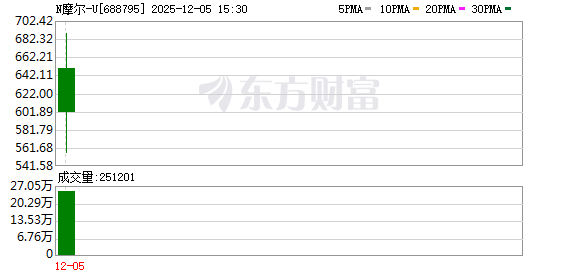
科创板迎来国产全功能GPU龙头 摩尔线程成功上市
Shang Hai Zheng Quan Bao· 2025-12-05 12:17
Core Viewpoint - Moore Threads officially listed on the Shanghai Stock Exchange's Sci-Tech Innovation Board on December 5, becoming the first fully functional GPU company to enter the A-share market in China, marking a significant milestone in the company's development and the advancement of China's computing power [2] Group 1: Company Milestones - The company achieved a listing price of 650 CNY per share, opening with a remarkable increase of 468.78%, and reaching a peak of 688 CNY during trading, allowing investors to earn over 267,000 CNY per share [4] - The founder and chairman, Zhang Jianzhong, emphasized the company's commitment to independent innovation and the development of a unified system architecture, MUSA, which supports AI computing acceleration, graphics rendering, physical simulation, and scientific computing on a single chip [6][11] - The company has successfully launched four generations of GPU architectures and five chips, establishing a comprehensive product layout from chips to clusters, serving various sectors including government, enterprises, data centers, and consumer terminals [9] Group 2: Financial Performance - From 2022 to June 2025, the company invested over 4.3 billion CNY in R&D, with over 77% of its workforce dedicated to research, resulting in a compound annual growth rate of 208.44% in revenue from 2022 to 2024 [12] - In the first half of 2025, the company reported revenue of 702 million CNY, surpassing the total revenue of the previous three years, with AI computing business contributing 94.73% of this revenue and a gross margin of 69.14% [12] Group 3: Industry Context - The listing of Moore Threads reflects the increasing support and determination from policies and market players for the development of high-tech and hard-tech enterprises under national strategies [14] - The company aims to contribute to the national strategy of enhancing computing power as a strategic resource, emphasizing the importance of GPU technology in the context of global technological competition [11][13] - The company plans to use the funds raised from the listing to focus on the development of next-generation AI training and inference chips, graphics chips, and AI SoC chips, aiming to strengthen its technological leadership in AI computing and graphics [20]