国际紧急经济权力法(IEEPA)

Search documents
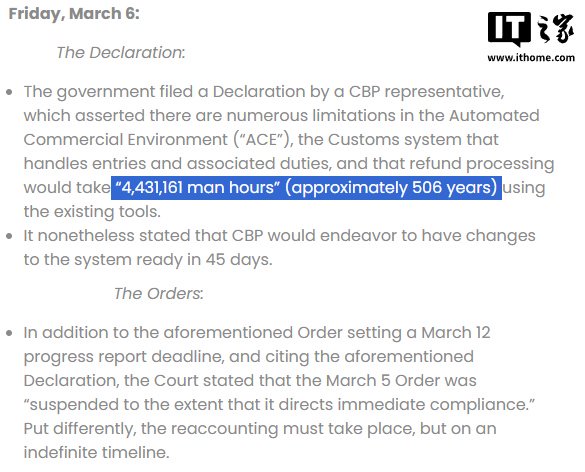
任天堂等企业退税遥遥无期:美政府称处理退款需 4431161 小时,约 506 年
Xin Lang Cai Jing· 2026-03-13 13:31
Core Viewpoint - Nintendo has filed a lawsuit against the U.S. federal government seeking a refund of import tariffs paid under the Trump administration's International Emergency Economic Powers Act (IEEPA) and corresponding interest [1][6] Group 1: Legal Proceedings - The U.S. Supreme Court ruled on February 20 that the actions of the Trump administration regarding IEEPA were "unconstitutional and overreaching," with a 6-3 majority [1][6] - Chief Justice Roberts stated that the IEEPA grants the president the power to "regulate imports" but does not include the power to impose tariffs [1][6] Group 2: Refund Process Challenges - The International Trade Court (CIT) has ordered the U.S. government to submit a report by March 12 regarding the progress on the refund process for IEEPA tariffs [1][6] - The U.S. government indicated that it may take approximately 4,431,161 hours (about 506 years) to manually process all refund applications, suggesting that refunds for companies like Nintendo may be delayed indefinitely [1][6][7] Group 3: Scale of Refund Applications - The scale of refund applications is described as "unprecedented," with U.S. Customs and Border Protection officials stating that existing administrative procedures and technical systems are inadequate to handle such a large task, necessitating significant manual intervention [4][7] - During the peak of the trade war initiated by the U.S., over 53 million product entries were subjected to illegal tariffs, affecting various goods including automobiles, toys, and clothing [4][7]


北美观察丨最高法院裁决“关税”越权 美贸易战“快捷键”失灵
Xin Lang Cai Jing· 2026-02-21 02:48
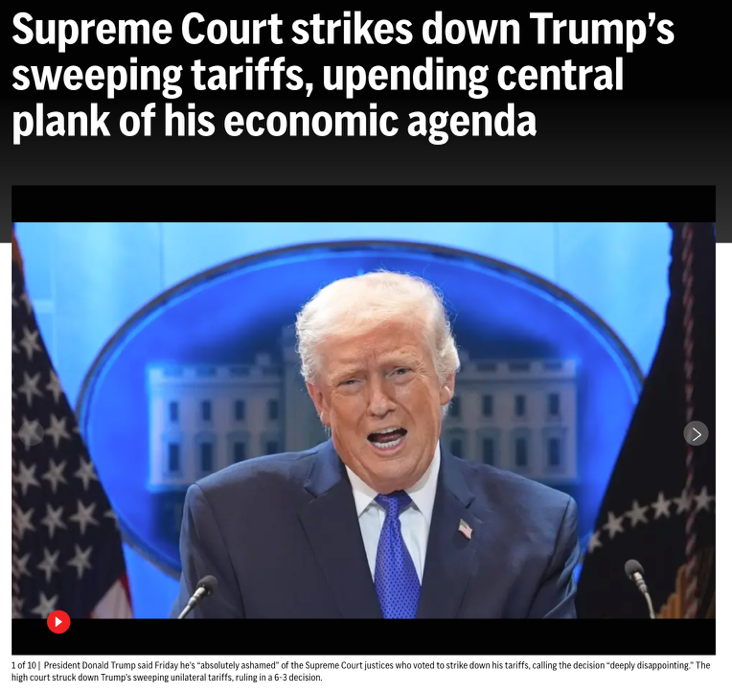
Core Viewpoint - The U.S. Supreme Court ruled against Trump's comprehensive tariff policy, stating that the tariffs imposed under the International Emergency Economic Powers Act (IEEPA) lacked legal basis and were invalid from the start, significantly impacting Trump's economic agenda and future presidential powers [2][12][16] Group 1: Legal Basis and Implications - The Supreme Court's decision emphasized that the IEEPA was intended for sanctions and not for imposing global tariffs, highlighting the absence of terms like "tariff" or "tariff rates" in the law [6][9] - The ruling reinforces that the power to levy taxes, including tariffs, is constitutionally assigned to Congress, and any delegation of this power must be explicit [10][11] - The court's majority opinion indicates that if Congress intends to grant the president the authority to impose tariffs, it must do so with clear and specific language, rather than vague terms [10][11] Group 2: Impact on Trump's Economic Agenda - The ruling is seen as a significant setback for Trump's economic strategy, which relied heavily on tariffs as a tool for negotiation and revenue generation [12][14] - The decision raises questions about the legality of tariffs already collected, with potential claims for refunds amounting to hundreds of billions of dollars, impacting fiscal revenue [13] - The ruling constrains future presidents' use of emergency powers for large-scale economic policies, requiring more caution in invoking such powers [13][14] Group 3: Future Actions and Strategies - In response to the ruling, Trump announced plans to impose a new 10% global tariff using a different legal framework, indicating a shift in strategy rather than a retreat [14][16] - The administration is expected to rely more on established trade tools like Section 232 and Section 301 of the Trade Act, which provide clearer legal grounds for imposing tariffs but involve more complex procedures [14][15] - The government may also explore non-tariff measures to influence trade and investment flows, such as stricter export controls and adjustments to procurement rules, to maintain pressure on foreign entities [15][16]
今夜!史诗级利好!
Zhong Guo Ji Jin Bao· 2026-02-20 16:31
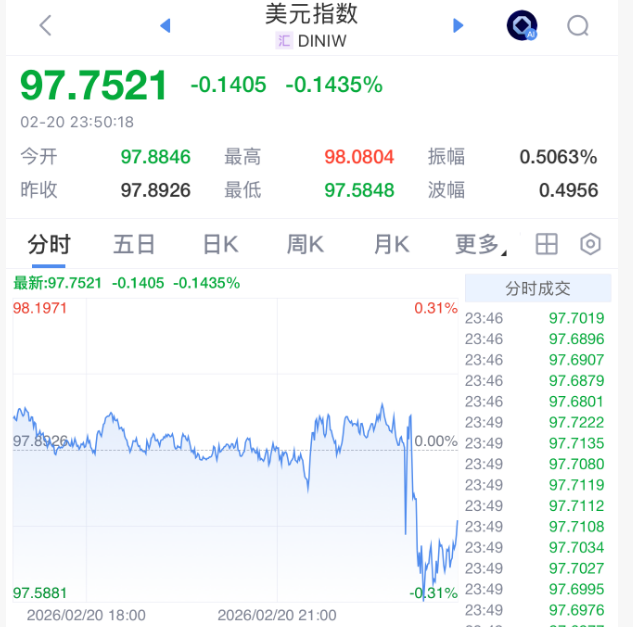
Core Viewpoint - The U.S. Supreme Court ruled that the tariffs imposed by the Trump administration were illegal, leading to significant market reactions, including a surge in U.S. stock indices and commodities like gold and silver [8][9]. Market Reactions - U.S. stock indices experienced a sharp increase, with the Nasdaq and other major indices rebounding after the court's decision [4][5]. - The dollar index fell sharply, indicating a market response to the Supreme Court ruling [2]. - Gold and silver prices saw significant volatility, with silver rising nearly 5% and gold increasing over 1% [3]. Chinese Market Impact - Chinese assets reacted positively, with the FTSE China A50 index rising nearly 1% and the Chinese yuan strengthening [4]. - The Nasdaq Golden Dragon China Index showed a slight increase, reflecting a recovery in Chinese stocks listed in the U.S. [5]. Legal and Political Context - The Supreme Court's decision was a rare defeat for Trump, as it ruled against the legality of tariffs imposed under the International Emergency Economic Powers Act (IEEPA) [8][9]. - The ruling was supported by a 6-3 majority, with Chief Justice Roberts stating that the President does not have the inherent power to impose tariffs during peacetime [10]. - The ruling has prompted the EU to analyze its implications and advocate for lower tariffs, emphasizing the importance of stable trade relations [9]. Economic Implications - The estimated total amount of tariffs collected under the IEEPA exceeds $175 billion, which may need to be refunded following the Supreme Court's ruling [11]. - A coalition of small businesses welcomed the ruling, calling for a quick and efficient refund process for the tariffs they paid [10].
下周决定特朗普关税命运日?美最高法院20日公布新一批裁决意见
Hua Er Jie Jian Wen· 2026-02-13 23:53
Core Viewpoint - The U.S. Supreme Court is set to announce decisions on key tariff policies from the Trump administration, which could significantly impact the legal standing of these tariffs and the associated costs for importers [1][2]. Group 1: Supreme Court Decisions - The Supreme Court will release opinions on February 20, 24, and 25, with the potential to overturn tariffs that currently cost importers over $16 billion monthly [1]. - The case under review involves the legality of tariffs imposed under the International Emergency Economic Powers Act (IEEPA), with estimates suggesting total tariffs could exceed $170 billion by February 20 [1]. - Justices have expressed skepticism regarding the president's unilateral authority to impose tariffs, indicating a possible challenge to Trump's actions [1][6]. Group 2: Congressional Challenges - The House of Representatives has passed legislation to terminate certain tariffs on Canadian imports, marking a significant political challenge to Trump's tariff policies [2]. - Six Republican representatives joined Democrats in supporting the bill, highlighting a weakening grip of Trump on the party as midterm elections approach [2]. - Senate Republican leaders expect a similar vote in the Senate, although Trump is likely to veto any legislation aimed at repealing his tariffs [2]. Group 3: Political Implications - Trump has warned Republican lawmakers that opposing his tariff policies could lead to severe political consequences in upcoming elections [3]. - The recent House vote represents a setback for House Speaker Mike Johnson, a key ally of Trump, as bipartisan support for the bill indicates growing discontent with Trump's economic agenda [3]. - The Democratic Party has capitalized on the situation, criticizing Republican lawmakers for supporting policies that increase living costs for voters [2][3]. Group 4: Economic Impact - The tariffs in question are estimated to impose over $16 billion in monthly costs on importers, which could have significant repercussions for the overall economy [1][6]. - The Supreme Court's decision on these tariffs will serve as a critical statement on presidential power and could influence future trade policies [6].
特朗普:若关税案裁决不利 还可考虑其他手段
Xin Lang Cai Jing· 2026-01-20 21:41
Group 1 - President Trump indicated that if the Supreme Court limits his tariff policy under the International Emergency Economic Powers Act (IEEPA), he will need to consider alternative measures [1][2] - Trump mentioned that he has arranged meetings with "related individuals" concerning Greenland during his time in Davos [2] - Trump does not believe that the threats related to Greenland will jeopardize European Union investments in the United States [2]
特朗普为攫取格陵兰岛暗示将征收新关税
Xin Lang Cai Jing· 2026-01-16 20:38
Core Viewpoint - President Trump indicated the possibility of imposing new tariffs on countries that do not cooperate with Greenland affairs, citing national security concerns as a reason for the U.S. need for Greenland [1][9]. Group 1: Tariff Strategy - Trump has been increasingly aggressive in his attempts to acquire Greenland, using tariffs as a diplomatic pressure tool [1][9]. - He has previously threatened multiple countries to either raise drug prices under the "most favored nation" agreement or face high tariffs on all goods exported to the U.S. [4][12]. - The average tariff rate has been raised to approximately 17% since Trump took office, with many tariffs implemented under the International Emergency Economic Powers Act (IEEPA) [5][13]. Group 2: Legal Challenges - The use of IEEPA for imposing tariffs has faced legal challenges, with several courts ruling such actions as illegal [5][13]. - The related disputes have been submitted to the U.S. Supreme Court, which may soon rule on the legality of Trump's tariff increases under IEEPA [6][14]. - Trump expressed that a negative ruling from the Supreme Court would severely undermine his policy agenda [7][15].
COMEX白银形成双顶 总统裁决或处“灰色地带”
Jin Tou Wang· 2026-01-08 04:21
Group 1 - The core viewpoint of the article indicates that Morgan Stanley's analysis suggests the upcoming Supreme Court ruling on President Donald Trump's tariff powers is unlikely to cause significant shifts in U.S. trade policy or the economy [3] - The most probable outcome is expected to fall into a "gray area," avoiding a complete victory for either side while maintaining trade restrictions and controlling economic consequences [3] - Analysts believe the Supreme Court may not fully abolish or support the use of the International Emergency Economic Powers Act (IEEPA), but will likely issue a more nuanced ruling [3] Group 2 - The analysis indicates that the Supreme Court has broad discretion and may limit the applicability of future tariffs or narrow the scope of existing tariffs without fully revoking them [3] - In the COMEX silver market, the price is currently trading below $77.76, with a recent high of $78.90 and a low of $77.30, indicating a bearish short-term trend [1] - The potential for a bearish double top reversal pattern is increasing in the COMEX silver price chart, with key resistance at $82.67 and support at $69.225 [4]
Trump Reverses Tariffs On Coffee, Bananas And Other Foods In Response As Prices Soar
Forbes· 2025-11-17 21:40
Core Points - President Trump initially imposed tariffs on food imports to enhance U.S. self-sufficiency but has now reversed some of these tariffs on agricultural products that cannot be produced domestically at scale, such as coffee, bananas, and orange juice [1][4] - The new tariff exemptions took effect retroactively on November 13, 2025, with Trump indicating that he does not foresee further policy rollbacks in the future [1][8] Tariffs and Economic Impact - Tariffs are taxes on imports aimed at protecting domestic industries and generating revenue, theoretically leading to reduced imports and increased domestic consumption [2] - Despite the intention behind tariffs, they cannot effectively stimulate production of items like coffee and bananas that are not feasible to grow in the U.S. [4][6] - Coffee prices surged over 40% year-over-year due to the tariffs, while banana prices increased nearly 9% [7] Legal Challenges - The tariffs have faced legal challenges, with a federal appeals court ruling that Trump overstepped his authority by imposing tariffs under the International Emergency Economic Powers Act (IEEPA) [9][11] - The Supreme Court is currently reviewing the case, with indications that justices may be skeptical of Trump's authority to impose such tariffs [12] Tariff Rebate Checks - Trump proposed a $2,000 per person tariff "dividend" to alleviate cost of living concerns, although this would require Congressional approval [13][14] - Despite claims of reduced prices, average grocery prices in the U.S. were reported to be 2.7% higher in September compared to the previous year [14]

特朗普:若最高法院作出不利于关税的裁决,美国将面临经济灾难
Ge Long Hui· 2025-11-11 07:19
Core Points - President Trump warned that a Supreme Court ruling against his use of emergency powers to impose tariffs could lead to an economic and national security disaster [1][3] - The Supreme Court justices expressed skepticism regarding Trump's authority under the International Emergency Economic Powers Act (IEEPA) to impose tariffs, as the act does not explicitly mention tariffs [3] - Trump claimed that the potential refunds due to a negative ruling could exceed $3 trillion, including tariff revenues and investments, which he described as a catastrophic impact on national security [4] Group 1 - Trump emphasized that the estimated refund amounts are too low and that the actual figure could exceed $3 trillion, which would have devastating effects on the economy and national security [4] - He stated that if the Supreme Court rules against him, it would create an insurmountable national security event that could jeopardize the future of the United States [4] - Trump's administration plans to use tariff revenues to provide $2,000 payments to middle- and low-income Americans and to reduce national debt [4] Group 2 - Trump's chief economic advisor noted that the government initially intended to use tariff revenues solely for deficit reduction, but now sees an opportunity to distribute bonuses due to increased tax revenues [4]

特朗普回应美最高法院大法官关税质疑
第一财经· 2025-11-07 10:15
Core Viewpoint - The article discusses the ongoing challenge in the U.S. Supreme Court regarding President Trump's authority to impose broad tariffs on trade partners under the International Emergency Economic Powers Act (IEEPA) [3][4]. Group 1: Supreme Court Proceedings - The Supreme Court held a three-hour oral argument regarding Trump's tariff authority, with most justices expressing skepticism about the government's legal basis [4]. - The current Supreme Court consists of six conservative justices and three liberal justices, with the liberal justices openly opposing Trump's use of emergency tariff powers [7]. - Chief Justice Roberts raised concerns about the absence of the term "tariff" in the IEEPA and emphasized that taxation is traditionally a congressional power [7]. Group 2: Economic Impact of Tariffs - According to Goldman Sachs, American consumers are expected to bear over 55% of the tariff costs, with businesses absorbing 22% and foreign exporters taking on 18% [7]. - The average effective tariff rate faced by U.S. consumers is estimated at 17.9%, the highest since 1934, leading to a projected 1.3% increase in price levels and an average loss of $1,800 per household [8]. - The tariffs are anticipated to raise the unemployment rate by 0.3 percentage points by the end of 2025 and by 0.7 percentage points by the end of 2026 [8]. Group 3: Potential Outcomes and Alternatives - If the Supreme Court rules against the emergency tariffs, companies involved in the lawsuit may receive refunds, while others might face complex administrative processes for reimbursement [9]. - The article mentions that the government has a "Plan B" in case of an unfavorable ruling, which could involve other legal provisions, though they may be less effective than IEEPA [10]. - The market has shown resilience despite the tariffs, indicating that if the court overturns them, it could be seen as a victory for institutional checks and balances, potentially strengthening long-term market confidence [10].