
工作与生活平衡

Search documents
视频|从中国回去后默茨急了,发表讲话时激动表示:从中国回来明显感受到工作与生活平衡,我们需要更努力
Xin Lang Cai Jing· 2026-02-28 03:13
Group 1 - The core message emphasizes the need for a better work-life balance, as expressed by Merz after returning from China, highlighting the observation of a four-day work week [1][2] - Merz's statement reflects a sense of urgency regarding Germany's long-term prosperity, suggesting that more effort is required to maintain it [1][2] - The audience's prolonged applause indicates strong support for Merz's views on work-life balance and economic efforts [1][2]
【春节随笔】新年新作为
Xin Lang Cai Jing· 2026-02-23 01:12
Group 1 - The core message emphasizes the importance of balancing work and life, suggesting that the essence of the Spring Festival is not to completely detach from work but to find equilibrium between life and work transitions [1] - The article highlights the emotional complexity experienced as the holiday ends, where individuals feel both reluctance to leave the comfort of the holiday and anticipation to return to normal life [1] - It suggests that high-quality relaxation during holidays can empower individuals to face work challenges, while a structured return to work can enhance the enjoyment of life [1] Group 2 - The narrative encourages individuals to quickly adjust their mindset and transform the joy of family reunions into motivation for career planning [2] - It calls for a proactive approach to work, urging individuals to channel their aspirations for a better life into concrete actions in their professional endeavors [2] - The message promotes a full commitment to work with enthusiasm and optimal readiness to meet new challenges [2]
突发!xAI联创杨格过劳病离职,给马斯克干活压力山大
Sou Hu Cai Jing· 2026-01-23 18:54
Core Viewpoint - The departure of Yang Ge, a co-founder of xAI, highlights the intense work culture at the company, which has led to health issues among its employees, raising concerns about work-life balance in Silicon Valley [2][5]. Group 1: Employee Departures - Yang Ge is the latest in a series of high-profile departures from xAI, following Igor Babuschkin, Christian Szegedy, and Kyle Kosic, among others [2][18]. - The turnover rate of executives directly under Elon Musk is reported to be 44%, significantly higher than that of companies like Meta, Amazon, and Netflix, which stand at 9% [18]. Group 2: Health and Work Culture - Yang Ge announced his departure due to health issues, specifically Lyme disease, which he attributes to the high-stress environment at xAI [2][5]. - The culture at xAI is characterized by extreme pressure and a lack of work-life balance, with employees often facing intense workloads and direct pressure from Musk [11][19]. Group 3: Management Style - Musk's management style emphasizes speed and high performance, often leading to a work environment where employees feel compelled to work excessively long hours [11][19]. - The organizational structure at xAI is highly flat, with only three levels, which allows for direct communication with Musk but also increases pressure on core team members [18][19]. Group 4: Industry Implications - The high turnover and health issues among employees at xAI may prompt a reevaluation of work culture in the tech industry, particularly regarding the sustainability of such high-pressure environments [5][19]. - Some analysts suggest that while Musk's approach may lead to rapid innovation, it also risks losing talent and creating a toxic work environment [19].

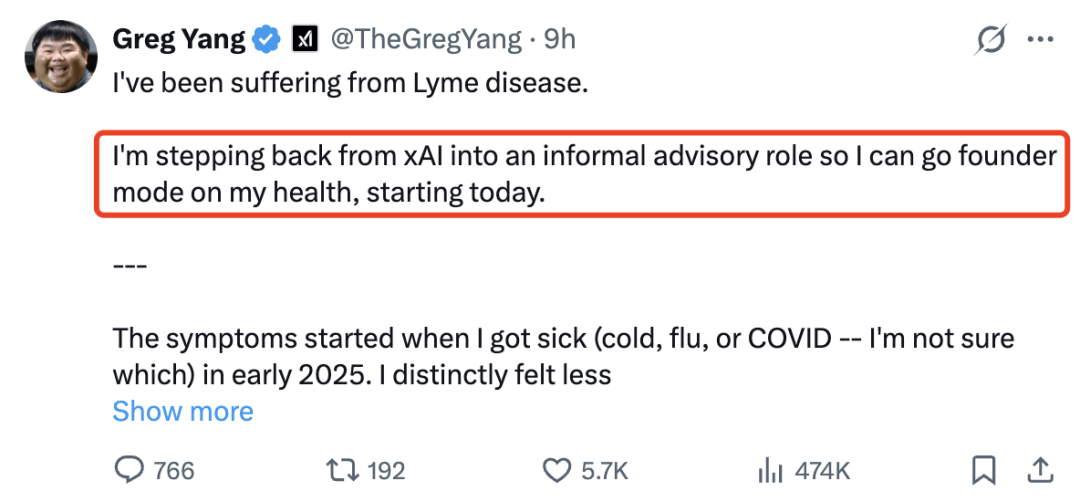
突发,xAI联创杨格过劳病离职,给马斯克干活压力山大
3 6 Ke· 2026-01-21 08:56
Core Insights - The departure of Greg Yang, a co-founder of xAI, highlights the intense work culture within the company, as he cited health issues stemming from long hours as the reason for his exit [2][3][6] - Yang's case raises concerns about work-life balance in Silicon Valley, particularly in high-pressure environments like xAI [3][6] - The trend of high executive turnover at xAI, with a 44% turnover rate among Musk's direct reports, suggests a challenging work environment [18][19] Group 1: Departure of Executives - Greg Yang's resignation is part of a broader pattern of executive departures from xAI, including notable figures like Igor Babuschkin and Christian Szegedy [2][18] - Yang's health issues, specifically Lyme disease, were exacerbated by the high-intensity work culture at xAI, which has been criticized for its lack of employee well-being [3][6] - Babuschkin previously expressed concerns about the unsustainable work culture in AI companies, advocating for a balance between work and rest [9] Group 2: Work Culture and Management Style - Musk's management style emphasizes extreme speed and high performance, which has led to a stressful work environment where employees feel pressured to deliver results quickly [12][19] - The flat organizational structure at xAI, with minimal layers between employees and Musk, contributes to the intense pressure felt by staff [18] - Critics argue that this culture may lead to burnout and high turnover, as employees struggle to meet the demanding expectations set by Musk [19][20]
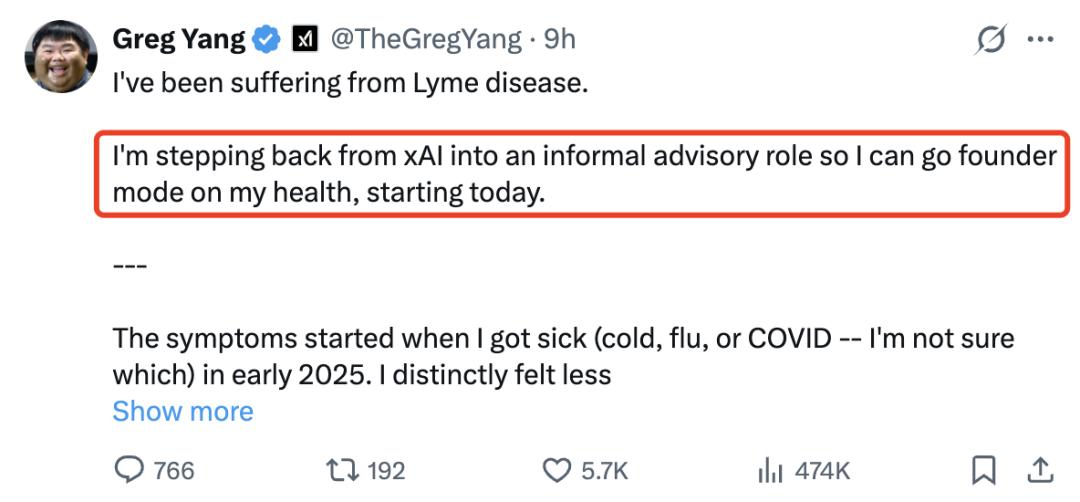
突发!xAI联创杨格过劳病离职,给马斯克干活压力山大
量子位· 2026-01-21 07:47
Core Viewpoint - The article discusses the high-pressure work culture at xAI, highlighted by the recent departure of co-founder Greg Yang due to health issues stemming from long hours and stress, raising concerns about work-life balance in Silicon Valley [2][4][15]. Group 1: Departure of Key Personnel - Greg Yang, a co-founder of xAI, announced his departure due to health issues related to Lyme disease, which he attributes to prolonged high-intensity work [2][4][5]. - Yang's situation is not isolated; other notable departures from xAI include Igor Babuschkin, Christian Szegedy, and Kyle Kosic, indicating a trend of high turnover among executives [26][33]. - The turnover rate among Musk's direct reports is reported at 44%, significantly higher than that of other tech giants like Meta and Amazon, which stand at 9% [35][36]. Group 2: Work Culture and Employee Well-being - Yang's departure has sparked discussions about the detrimental effects of xAI's work culture, with calls for a reassessment of employee health and workload balance [15][16]. - Former employees have criticized the lack of adequate time and mental space to produce quality work, suggesting that a healthier work culture could lead to better outcomes [17]. - Musk's extreme focus on speed and performance is exemplified by instances where he incentivized employees with rewards for rapid task completion, which may not be sustainable for all workers [20][21][22]. Group 3: Management Style and Organizational Structure - Musk's management style is characterized by strict expectations and high levels of direct pressure on employees, contributing to the high turnover rate [37][39]. - The organizational structure at xAI is notably flat, with only three levels, which allows for direct communication but also places significant pressure on core team members [38]. - Some perspectives suggest that this rigorous environment may ultimately filter out less capable employees, leaving a highly efficient core team [42].

AI能帮助你改善工作生活平衡?大厂CEO不乐观
财富FORTUNE· 2025-12-26 13:10
Core Viewpoint - The article discusses the increasing demand for work-life balance among Generation Z, yet highlights a paradox where many CEOs, including Jensen Huang of Nvidia, are reinforcing a culture of overwork in the face of AI advancements. Group 1: Work-Life Balance Expectations - By 2025, 74% of Generation Z will prioritize "work-life balance" when choosing jobs, surpassing any other generation, according to Randstad's data [1] - This marks the first time in over 20 years of Randstad's Workmonitor report that "work-life balance" has overtaken salary as the most valued factor by employees [1] Group 2: CEO Perspectives on Work Culture - Jensen Huang, CEO of Nvidia, works seven days a week, including holidays, driven by the intense AI competition and a persistent fear of failure [3] - Eric Yuan, CEO of Zoom, believes that the concept of work-life balance is a myth, stating "work is life" and prioritizing work over personal hobbies [4] - TIAA CEO Thasunda Brown Duckett refers to "work-life balance" as a "lie," advocating for a diversified approach to life where energy is allocated based on current priorities [6][7] Group 3: Success and Sacrifice - Alex Karp, CEO of Palantir, warns young professionals that achieving success often requires sacrificing aspects of their personal lives, emphasizing focus on career in youth [7][8] - Jeff Bezos, former CEO of Amazon, prefers the term "harmony" over "balance," arguing that both work and family can enhance each other rather than being in conflict [9][10] Group 4: Corporate Responsibility and Employee Well-being - Jamie Dimon, CEO of JPMorgan Chase, emphasizes that maintaining balance is ultimately the individual's responsibility, not the company's [11]

二十岁当保安,少走四十年弯路?
虎嗅APP· 2025-12-13 03:08
Core Viewpoint - The article discusses the rising popularity of security guard positions among young people, highlighting a cultural shift where these roles are now seen as desirable due to their perceived financial benefits and work-life balance [6][9][28]. Group 1: Job Market Trends - Security guard positions are among the fastest-growing jobs in the U.S., with a significant number of young individuals entering this field, particularly those aged 25-29 and 20-24 [10]. - In China, the perception of security guards has evolved, becoming a symbol of youth culture, with various online content celebrating this profession [13][15]. - The average salary for a security guard in China can start at around 7,000 yuan, with potential earnings in major cities reaching up to 9,000 yuan per month [30][31]. Group 2: Work Environment and Conditions - The job is often perceived as having low entry barriers, with minimal qualifications required, making it accessible to a wide range of individuals [40]. - There are two types of security guard roles: "soy sauce positions," which are more relaxed and indoor, and "warrior positions," which are more demanding and outdoor [37]. - Many young people are drawn to the perceived stability and leisure associated with security guard jobs, often depicted in social media as easy and stress-free [25][30]. Group 3: Economic Context and Cultural Shifts - The article notes a significant economic disparity, with the wealth of the top 1% increasing dramatically, leading to a growing demand for service jobs like security [55][57]. - The younger generation, particularly Gen Z, is prioritizing work-life balance over traditional career advancement, reflecting a shift in values compared to previous generations [52][53]. - The article suggests that the influx of young people into security roles may be a response to economic challenges and a desire to align closer to affluent lifestyles, despite the reality of the job often being less glamorous [62][68].

月薪 8000 双休还是月薪12000 单休?
3 6 Ke· 2025-10-22 07:30
Core Viewpoint - The article emphasizes the significant difference in life quality and happiness between working a single day off versus a double day off, highlighting that the extra income from a single day off is not worth the toll on personal well-being and life enjoyment [12][14][16]. Work-Life Balance - The experience of working a single day off leads to a fast-paced, exhausting lifestyle, where personal time is severely limited, resulting in a lack of enjoyment in life [6][10][12]. - In contrast, a double day off allows for a more balanced life, providing time for rest, personal growth, and social interactions, which enhances overall happiness [12][14]. Financial Considerations - The perceived financial benefit of an additional 4000 yuan for a single day off is outweighed by the stress and loss of life enjoyment it incurs, as the work-life balance is heavily skewed [14][16]. - The article argues that the true value of work should be measured by the quality of life it enables, rather than just the salary [16].

如何实现工作与生活的平衡:来自家族企业的启示
3 6 Ke· 2025-09-26 08:15
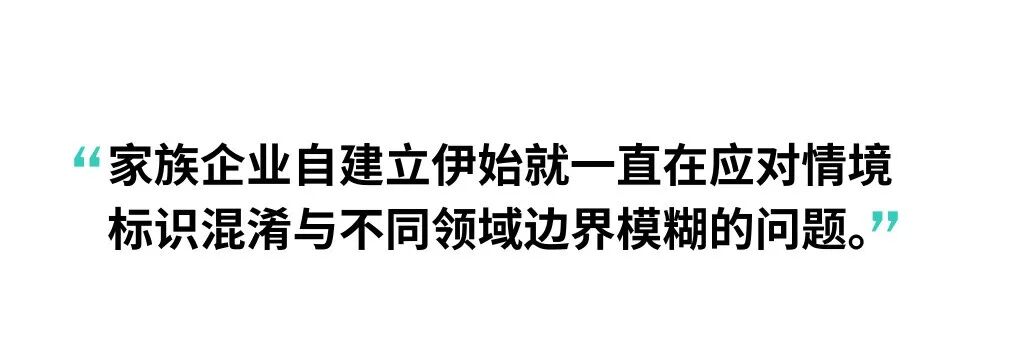
Core Insights - The article discusses the challenges leaders face in distinguishing between work and personal life, particularly exacerbated by the COVID-19 pandemic, leading to blurred boundaries and increased stress [1][17] Group 1: Context of Blurred Boundaries - The confusion of situational markers, which define environments through specific actions or items, has been intensified during the pandemic, affecting both personal and professional spaces [2] - Family businesses experience similar boundary confusion, where personal relationships and professional roles overlap, leading to identity conflicts and stress [2] Group 2: Lessons from Family Businesses - Family businesses implement structured governance practices and clear boundaries to manage the ambiguity of roles, using formal mechanisms like family councils and charters [4] - Establishing dedicated spaces for work and family discussions helps mitigate boundary overlap, as seen in the "four rooms" model proposed by Banyan Global [7][8] - Communication protocols in family businesses define when work discussions are appropriate, allowing for clear separation of work and family time [11] Group 3: Practical Strategies for Non-Family Businesses - Non-family business leaders can create dedicated spaces at home for work and family to avoid boundary confusion, which can be as simple as designating areas or furniture for specific discussions [7][8] - Setting clear time boundaries for work discussions, such as avoiding work talk during family meals, can help maintain focus on family [10][11] - Trusting team members to perform their tasks without micromanagement, even during non-working hours, fosters a healthier work-life balance [13] Group 4: Embracing Occasional Overlap - Recognizing that occasional overlap between work and personal life can be beneficial, as it allows for connection and learning opportunities [15][16] - Leaders can leverage these moments to enhance understanding and support within family dynamics, ultimately contributing to personal growth and resilience [16] Conclusion - The article emphasizes that leaders can learn from family businesses to navigate the complexities of work-life balance through intentional practices, reducing stress and fostering stronger relationships [17]
跑得最快的女护士,被骂过头了
Hu Xiu· 2025-09-04 06:02
Core Viewpoint - The article discusses the controversy surrounding Zhang Shuihua, a nurse who achieved significant success in marathon running while facing challenges in balancing her professional responsibilities and personal aspirations. The narrative highlights the societal expectations placed on individuals in the nursing profession and the need for a supportive work environment that allows for personal growth and self-fulfillment [2][3][16]. Group 1: Individual Achievement and Public Perception - Zhang Shuihua, known as the "fastest female nurse," won the domestic women's marathon championship with a personal best time of 2 hours 35 minutes 27 seconds [2][11]. - Following her victory, Zhang expressed a desire for support from her leadership to adjust her work schedule for future competitions, which sparked a backlash on social media, labeling her as self-serving and lacking emotional intelligence [2][5]. - The public reaction to her request reflects a broader issue of how personal ambitions are perceived in the context of professional duties, particularly in the nursing field [3][7]. Group 2: Work Environment and Professional Challenges - The nursing profession in China faces a significant shortage, with a registered nurse count of 5.63 million, translating to only 3.98 nurses per 1,000 people, which is below the World Health Organization's recommended standard [8]. - A survey indicated that 91% of nurses work over 8 hours daily, with 29% exceeding 10 hours, highlighting the excessive workload and stress faced by nurses [8]. - The article emphasizes that the challenges faced by Zhang are not unique but rather indicative of the collective struggles within the nursing profession, where personal aspirations often clash with professional obligations [7][8]. Group 3: Institutional Response and Support - The hospital where Zhang works has publicly stated its encouragement for employees to pursue personal interests, provided it does not interfere with their work responsibilities [6]. - Following the controversy, the hospital has yet to determine how Zhang's work schedule will be managed moving forward, indicating a need for clearer policies regarding work-life balance for nurses [6]. - The article suggests that a supportive work environment is essential for nurses to thrive both personally and professionally, advocating for a culture that respects individual aspirations while maintaining professional commitments [19][20].