
未来网络

Search documents
江苏这样留住青年心
Sou Hu Cai Jing· 2026-02-04 23:16
Core Insights - Jiangsu province is committed to creating a youth-friendly community that resonates with young people, particularly those in innovation and entrepreneurship, by implementing supportive policies and initiatives [1][2] Group 1: Policy Initiatives - By 2025, all 13 cities in Jiangsu will introduce 125 measures to promote youth development, including job subsidies and housing benefits, aiming to create over 2 million market-oriented job opportunities for young graduates [1] - Policies will be designed from the perspective of young people, integrating youth development into urban planning and ensuring accessible public services [2] Group 2: Community Development - The Suzhou district's Yijia Youth Community features smart apartments, fitness centers, and spaces for cultural and entrepreneurial activities, reflecting a modern living environment for young professionals [3] - Kunshan aims to create a "15-minute convenient living circle" with diverse facilities such as gyms, libraries, and co-working spaces, promoting a collaborative community for young innovators [3] Group 3: Innovation and Entrepreneurship - The rapid advancement of artificial intelligence is seen as a catalyst for youth innovation and entrepreneurship, necessitating a supportive ecosystem for young entrepreneurs [3] - Recommendations include the establishment of an AI entrepreneurship ecosystem and the provision of resources like "computing vouchers" to facilitate access to essential tools for young innovators [3] Group 4: Long-term Talent Development - Investment in human capital should not only focus on financial resources but also on providing time and strategic support for emerging talents in fields like AI and quantum information [4] - A call for a long-term evaluation and support mechanism for young leaders in strategic scientific fields to maximize their creative potential [4]


对科技趋势保持敏锐关注深挖阿尔法机会——访宏利成长混合基金经理孙硕
Shang Hai Zheng Quan Bao· 2026-01-25 14:24
Core Insights - The AI computing sector is expected to continue its steady growth until 2026, while the AI application field is still in the technology trigger phase, exploring core technology and application scenario matching [3][9] - Investment focus will shift towards AI applications post-2026 as technology matures and commercial viability becomes a core development theme, but the demand for AI computing will continue to grow alongside application expansion [3][9] - The technology investment landscape is transitioning from a simple beta market to a more complex alpha discovery phase, with significant differentiation in the drivers of corporate earnings and valuation expansion [4][8] Investment Philosophy - The investment strategy emphasizes dynamic adjustments based on market conditions, focusing on high-growth sectors where corporate earnings can exceed expectations, even if stock prices have risen significantly [5] - The observation that high growth often corresponds with low valuations and vice versa is highlighted, suggesting a need to focus on the growth potential rather than merely matching growth with valuation [5] Risk Management - Two key signals are monitored for risk assessment: changes in industry penetration rates and significant shifts in core technology routes, which could lead to industry restructuring and potential risks for certain companies [6] Sector Performance - The A-share technology sector has shown strong performance since 2026, with a notable divergence in the drivers of stock price increases across different sub-sectors [8] - The core driver for AI computing is substantial corporate earnings growth, while sectors like robotics and commercial aerospace rely more on valuation expansion [8] AI Application Development - The AI application sector is still in the early stages, and the expectation for a significant breakthrough in 2026 should be approached with caution, as true disruptive AI applications will represent a new industrial paradigm [9] - Continuous monitoring of specific sub-scenarios is necessary to validate their commercial value as the industry evolves [9] Other Technology Investment Opportunities - Besides AI, other technology sub-sectors such as robotics, autonomous driving, and commercial aerospace are expected to experience significant growth as they reach critical technological and commercial milestones [10] - Emerging fields like quantum computing and brain-machine interfaces are still in the technology trigger phase, requiring long-term investment strategies and close monitoring for clear signals of commercial viability [10]

利好来了!“国家队”投向明确!四部门联合发布
凤凰网财经· 2026-01-12 13:37
Core Viewpoint - The article discusses the recent issuance of guidelines by four government departments in China aimed at strengthening the planning and investment direction of government investment funds, marking a significant step in defining the future of these funds, which are crucial for supporting emerging and future industries [2][3]. Group 1: Government Investment Fund Guidelines - The guidelines, titled "Work Method for Strengthening the Layout Planning and Investment Direction of Government Investment Funds (Trial)," were jointly released by the National Development and Reform Commission, Ministry of Finance, Ministry of Science and Technology, and Ministry of Industry and Information Technology [3]. - The guidelines focus on three main aspects: where to invest, how to invest, and who manages the funds, proposing 14 policy measures to optimize fund allocation [3]. - Funds are required to support major strategies and key areas, particularly in sectors where market resources are inadequately allocated, emphasizing early, small, long-term investments in hard technology [3][5]. Group 2: Investment Direction and Evaluation - The investment direction must align with national major plans and encourage industries listed in the national industrial catalog, avoiding investments in restricted or eliminated sectors [4]. - Local development and reform departments are tasked with creating lists of key investment areas to optimize fund allocation based on regional characteristics [5]. - The guidelines also clarify the roles of national and local funds, with national funds focusing on supporting the modernization of the industrial system and overcoming key technological challenges [6]. Group 3: Evaluation Management Method - The "Management Method for Evaluating Investment Direction of Government Investment Funds (Trial)" was also released, establishing a comprehensive evaluation system that combines quantitative and qualitative assessments [6]. - The evaluation includes three primary indicators: policy compliance (60% weight), optimization of productivity layout (30% weight), and policy execution capability (10% weight) [6][7]. - The evaluation aims to ensure that funds effectively support new productive forces, technological innovation, and the development of the digital economy, among other areas [8].

从699天到1.6小时,数据传输如何“坐上火箭”?
Xin Hua Ri Bao· 2025-12-09 20:53
Core Insights - The "Future Network Experimental Facility" has been officially launched, marking a significant advancement in China's information and communication technology, enabling faster and more reliable data transmission for various industries [1][2][4]. Group 1: Project Overview - The facility is designed to address challenges in existing networks, such as scalability, mobility, security, and service quality, particularly in the context of industrial and computational internet [2][3]. - The project was initiated in 2013 and has taken over a decade to complete, culminating in a major technological breakthrough for the nation [2][4]. Group 2: Technical Capabilities - The facility features a "data high-speed rail" network that covers 40 cities with over 5.5 million kilometers of optical transmission, supporting 128 heterogeneous networks and 4096 parallel experiments [3][4]. - It offers deterministic transmission capabilities, maintaining a stable data transfer rate of 50Gbps even under interference, compared to non-deterministic networks that can drop to below 1Gbps [2][3]. Group 3: Applications and Impact - The facility has significantly improved data transfer speeds for scientific research, reducing the time to transfer 72TB of data from 699 days to just 1.6 hours, and potentially to 20 minutes with advanced technology [5][6]. - In the AI sector, it has enabled efficient cross-domain training of large models, reducing iteration times from over 20 seconds to approximately 16 seconds [5][6]. Group 4: Broader Implications - The facility is expected to enhance various sectors, including remote medical imaging, industrial automation, and education, by providing reliable and high-speed network support [6][7]. - It aligns with national strategies such as the "East Data, West Computing" initiative, facilitating intelligent scheduling and collaborative use of computing resources across regions [7][9]. Group 5: Future Prospects - The facility is positioned as an open experimental platform for research institutions and enterprises to test new technologies, fostering innovation and collaboration [7][8]. - It aims to contribute to the construction of a more efficient network infrastructure, supporting the digital transformation of various industries and enhancing the quality of life for citizens [9].

互联网“国之重器”在南京通过国家验收
Nan Jing Ri Bao· 2025-12-04 02:32
Core Insights - The future network experimental facility, China's first major national scientific infrastructure in the information and communication sector, has passed national acceptance and is officially operational, marking a significant advancement in China's internet capabilities [1][2] Group 1: Facility Overview - The facility features end-to-end determinism, distinguishing it from traditional internet systems, and aims to address various issues that have emerged in the traditional internet landscape [1] - The project was initiated in 2010 and construction began in 2015, with the facility now covering 40 cities nationwide and supporting 4096 parallel experiments [2] Group 2: Technical Achievements - The facility enables efficient, high-speed, low-latency data transmission with a packet loss rate of only one in a million, significantly outperforming traditional internet methods [2] - For instance, transferring 72TB of data via traditional internet would take 699 days, while the future network can accomplish this in just 1.6 hours [2] Group 3: Applications and Impact - The facility supports various sectors, allowing universities, research institutions, and enterprises to conduct theoretical and technical research, having already facilitated 120 innovative experiments during its trial run [3] - It is expected to enhance the quality of economic development by providing a robust platform for innovation and technology transfer, addressing challenges in high-end computing resources [3]
我国信息通信领域首个国家重大科技基础设施——未来网络试验设施通过国家验收,正式投入运行!
Yang Zi Wan Bao Wang· 2025-12-03 15:26
Core Insights - The Future Network Experimental Facility has successfully passed national acceptance, marking a significant milestone in China's information and communication technology infrastructure [1][2][3] - This facility is the first national major scientific and technological infrastructure in the field of information communication in China, aimed at addressing key technological challenges and promoting industrial development [1][2] Group 1: Project Overview - The Future Network Experimental Facility is led by the Jiangsu Future Network Innovation Research Institute in collaboration with several prestigious institutions, including Tsinghua University and the Chinese Academy of Sciences [1][2] - The facility will operate 24/7, covering 40 cities with over 88 backbone network nodes and 133 edge network nodes, totaling more than 55,000 kilometers of optical transmission [3] Group 2: Technological Achievements - The project has achieved breakthroughs in key technologies, including the development of the world's first distributed large-scale network operating system and a wide-area deterministic network [4] - It has established 206 international and domestic standards and has been granted 221 invention patents and 139 software copyrights [4] Group 3: Strategic Importance - The facility supports national strategic needs and serves as a comprehensive experimental environment for future network research, core device development, and application validation [2][4] - It is expected to enhance capabilities in various fields, including astronomical data transmission, industrial internet applications, and satellite internet testing [4][5] Group 4: Industry Impact - The facility has already served numerous national research institutions and major telecommunications operators, completing 120 significant innovation experiments across various critical dimensions [5] - It plays a crucial role in empowering national strategies such as "East Data West Computing," industrial internet, artificial intelligence, and low-altitude economy [5]
先生|刘韵洁:互联网“筑路人”
Yang Guang Wang· 2025-10-02 06:40
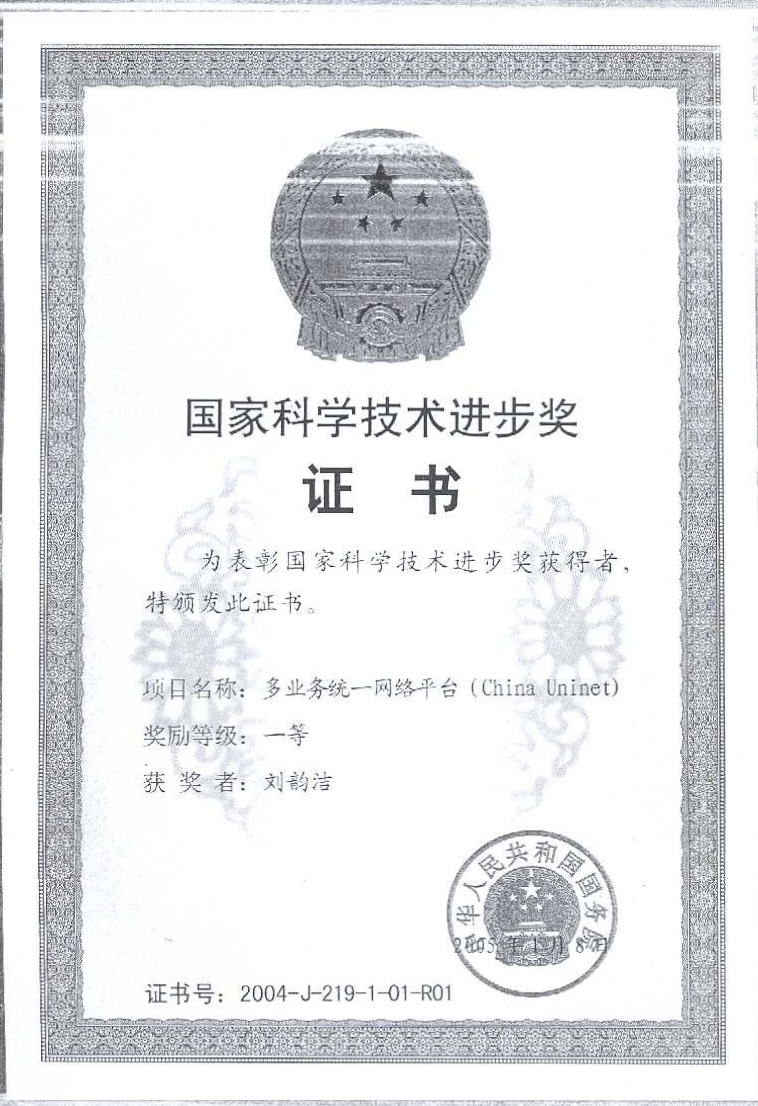
Core Viewpoint - Liu Yunjie is recognized as a pioneering figure in China's internet development, emphasizing the importance of perseverance and dedication in achieving success [2][3][18]. Group 1: Background and Achievements - Liu Yunjie, born in January 1943, is an academician of the Chinese Academy of Engineering and a key contributor to the development of China's internet infrastructure [3]. - He has received numerous national and ministerial awards for his contributions to technology and science [3]. - Liu led the development of the multi-service unified network platform (China Uninet), which won the National Science and Technology Progress Award First Class [7]. Group 2: Career Journey - Liu's career began in the semiconductor field, where he successfully developed high-power semiconductor transistors, a task deemed impossible at the time [8][9][11]. - He transitioned to the computer field in 1976, where he recognized the potential of computers to transform society, despite initially being a novice [13][14]. - Liu's foresight led him to focus on networking, addressing the challenge of connecting independent computer systems [14]. Group 3: Internet Development - In 1994, China achieved full functional connectivity with the international internet, marking a significant milestone in its digital evolution [14]. - Liu advocated for reducing internet access costs and increasing Chinese content online to encourage broader public engagement with the internet [15][16]. - By 1996, Liu's efforts culminated in the establishment of China's public computer internet backbone network, making internet access more affordable and widespread [16]. Group 4: Future Vision - Liu envisions a future where networks operate autonomously, driven by advanced models and intelligent systems, akin to self-driving cars [18]. - He believes that the next phase of internet development will focus on integrating digital technology into various sectors, enhancing productivity and connectivity [18]. - Liu is confident that with the right technological foundation, China will excel in the next stage of internet evolution, despite current disparities in high-end technology [18].
中国科学技术发展战略研究院:6省市综合科技创新水平领先全国
Huan Qiu Wang· 2025-09-23 00:58
Core Insights - China's comprehensive technology innovation level score reached 80.20, an increase of 1.77 points from the previous year, indicating ongoing growth in technology innovation input, output, and high-tech industries [1] - Six provinces and cities, including Shanghai, Beijing, Jiangsu, Guangdong, Zhejiang, and Tianjin, lead the nation in comprehensive technology innovation levels [1] - The second half of the year is crucial for ensuring the successful completion of the "14th Five-Year Plan" and laying a solid foundation for the "15th Five-Year Plan," emphasizing the deep integration of technology and industrial innovation [1] Group 1 - The report highlights the importance of technology innovation as a new driving force for productivity development and the cultivation of internationally competitive emerging pillar industries [1] - The Central Political Bureau of the Communist Party of China has called for a focus on technology innovation to promote the deep integration of technology and industrial innovation [1] Group 2 - Recommendations include encouraging local governments to promote advanced technologies in fields such as artificial intelligence, blockchain, low-altitude economy, future networks, and low-carbon energy [2] - The establishment of demonstrative and experiential technology application scenarios is encouraged to create replicable and promotable models and experiences [2] - Support for market-tested solutions through government procurement, pilot demonstrations, and priority issuance of relevant licenses is advised [2]
第九届未来网络发展大会打开诸多新话题:“下一代互联网,要让上网的人感觉更好”
Nan Jing Ri Bao· 2025-08-21 08:26
Core Insights - The Ninth Future Network Development Conference was held in Nanjing, focusing on global networking and future technologies [1] - Key technological advancements were showcased, including long-distance data transmission without intermediate relay [1][2] - The conference emphasized the importance of integrating computing resources across regions to enhance efficiency and support national projects [2][3] Group 1: Technological Innovations - A new optical-electrical fusion network technology allows for over 2000 kilometers of data transmission without loss, eliminating the need for multiple transfers [1] - China Telecom introduced a network model that enables self-diagnosis and automatic fault repair, improving operational efficiency by 40% in Jiangsu province [2] - The conference presented a comprehensive scheduling platform for computing resources, addressing the challenges of the "East Data West Computing" initiative [2][3] Group 2: Future Network Concepts - The concept of a future network is defined as a faster, simpler, cheaper, and safer next-generation internet centered around user experience [2] - The conference highlighted the need for a unified scheduling system to connect areas with surplus computing power to those with demand [3] Group 3: AI and Automation - A new AI-driven toolchain for baseband circuit design significantly reduces design time and costs, enhancing communication performance by 30% and reducing chip area by 70% [4] - The application of AI in network management is still in its early stages, facing challenges such as the need for high-quality intelligent agents and data security concerns [5] Group 4: Future Directions - The conference called for the development of a collaborative ecosystem for AI applications, emphasizing the need for interdisciplinary teams and infrastructure improvements [5] - A series of technical white papers were released, providing insights into future network technology development and collaborative computing [6]
发布三大科技成果,签约一批重大项目
Nan Jing Ri Bao· 2025-08-21 02:07
Group 1 - The Ninth Future Network Development Conference opened in Nanjing with the theme "Global Network, Winning the Future" aimed at creating a dialogue platform for technology exchange and industry cooperation in the field of network communication [1] - The conference featured discussions on hot topics such as computing-network integration, intelligent computing networks, network large models, and deterministic networks, including a main forum and 18 sub-forums [1] - Key officials emphasized the importance of advanced networks in supporting collaborative efforts in "network-computing-data" and highlighted the goal of building a world-leading national data infrastructure system [1] Group 2 - Academicians discussed China's AI innovation paths and strategies, as well as the integration of AI with future networks [2] - Major technological achievements were announced, including an integrated computing network scheduling platform and the first network large model for wide area networks [2] - Strategic cooperation agreements were signed between various cities and organizations to enhance the construction of a super computing network across important regions in the country [2]