造车

Search documents
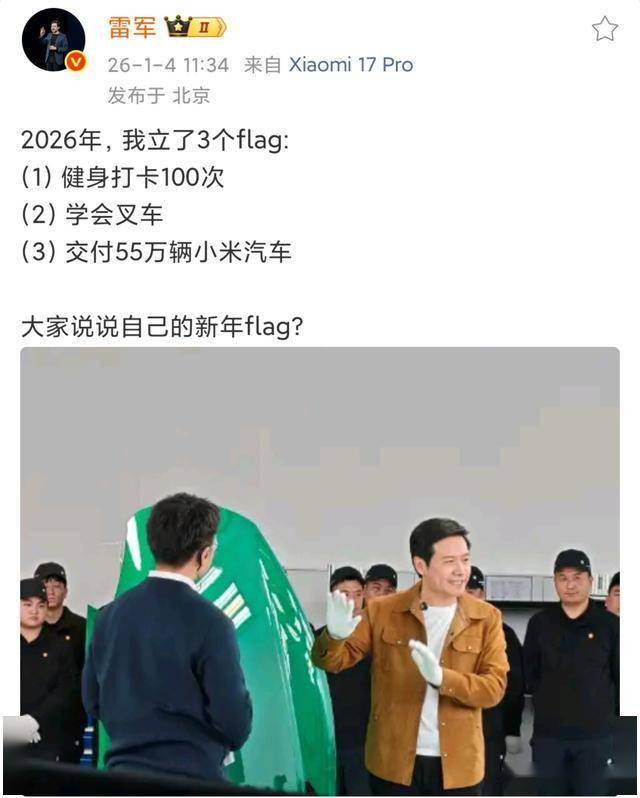
雷军造车如修行:既要卖出55万辆车,也要低头练好叉车、强体魄
Sou Hu Cai Jing· 2026-01-04 06:25
Core Insights - Lei Jun, the founder of Xiaomi, set three ambitious goals for 2026: completing 100 fitness sessions, obtaining a forklift N1 certification, and delivering 550,000 vehicles for Xiaomi Auto, reflecting both personal discipline and corporate ambition [1][4][9] Group 1: Personal Goals - The fitness goal of 100 sessions signifies Lei Jun's commitment to maintaining physical endurance necessary for high-intensity work, especially as competition in the automotive sector intensifies [4][11] - The forklift certification aims to deepen Lei Jun's understanding of logistics and production processes, enhancing Xiaomi Auto's delivery efficiency [7][11] Group 2: Corporate Goals - The target of delivering 550,000 vehicles in 2026 represents a 34% year-on-year growth, building on a strong performance in 2025 where Xiaomi Auto delivered 410,000 vehicles, exceeding its target by 17% [9][11] - Xiaomi's confidence in achieving this target stems from a well-rounded product matrix and enhanced ecosystem collaboration, alongside Lei Jun's strong execution capabilities [9][11][13] Group 3: Strategic Implications - The interconnectedness of these goals illustrates Xiaomi Auto's development logic: fitness ensures strategic focus, forklift skills provide practical industry insights, and vehicle delivery is the ultimate measure of success [11][13] - Unlike other entrepreneurs who may set vague goals, Lei Jun's objectives are actionable and measurable, which is a key factor in Xiaomi's successful transition from smartphones to the automotive industry [13]


传音越来越“小米”了
华尔街见闻· 2025-12-03 10:32
Core Viewpoint - The article discusses the challenges and strategies of Transsion Holdings as it prepares for its IPO in Hong Kong, highlighting its declining profits and increasing competition in the African market from companies like Xiaomi and Honor [1][5][18]. Group 1: Financial Performance - Transsion Holdings reported a revenue of 49.543 billion yuan and a net profit of 2.148 billion yuan for the first three quarters of 2025, representing a year-on-year decline of 3.33% and 44.97% respectively [1][5]. - The company's gross margin fell to 18.59% in Q3 2025, marking the lowest quarterly figure in five years [11]. - The company's market value has decreased by over 30% since the end of 2024, with a maximum drawdown exceeding 50% [19]. Group 2: Market Competition - Despite maintaining a market share of 51% in Africa with over 10 million units shipped in Q3 2025, Transsion's growth rate was only 25% year-on-year [7]. - Competitors like Xiaomi and Honor have shown significant growth in the African market, with year-on-year growth rates of 34% and 158% respectively for the same period [8]. - Xiaomi's localized strategies, such as launching the REDMI 15C smartphone with a 6000mAh battery, have enhanced its competitiveness in Nigeria [9]. Group 3: Strategic Initiatives - Transsion is expanding its product offerings beyond smartphones to include AIoT devices and electric vehicles, aiming to create a comprehensive smart ecosystem [20][21]. - The company has launched various sub-brands like Oraimo and Syinix, focusing on digital accessories and home appliances [21]. - Transsion is also venturing into the electric vehicle market in Africa, introducing brands like Revoo and TankVolt to cater to personal and business transportation needs [24][25]. Group 4: IPO and Future Prospects - The upcoming IPO in Hong Kong is Transsion's first equity financing since its 2019 listing on the STAR Market, aimed at addressing supply chain pressures and enhancing its competitive position [2][13]. - The company seeks to improve its brand recognition in Southeast Asia, where it faces stiff competition from Samsung and Xiaomi [14][15]. - Transsion's strategy to diversify its financing channels and enhance its international brand image is crucial for its long-term growth [17].


传音越来越“小米”了
Hua Er Jie Jian Wen· 2025-12-03 08:36
Core Viewpoint - The consumer electronics sector is witnessing an influx of companies aiming for A+H listings, with Transsion Holdings and Anker Innovations recently submitting their IPO applications to the Hong Kong Stock Exchange. Transsion is facing significant challenges, including a nearly halved net profit, as it competes against Chinese rivals like Xiaomi and Honor in its core African market [2][4][10]. Group 1: Financial Performance - Transsion Holdings reported a revenue of 49.543 billion yuan and a net profit of 2.148 billion yuan for the first three quarters of 2025, reflecting year-on-year declines of 3.33% and 44.97% respectively [2][6]. - The company's gross margin fell to 18.59% in Q3 2025, marking the lowest quarterly figure in five years, partly due to rising storage costs [8][11]. Group 2: Market Competition - Despite maintaining a leading position in Africa with over 10 million mobile units shipped and a market share of 51% in Q3 2025, Transsion's growth rate was only 25% year-on-year, while competitors Xiaomi and Honor experienced growth rates of 34% and 158% respectively [7][8]. - Xiaomi's strategy includes launching localized products like the REDMI 15C smartphone, which features a 6000mAh battery to address local power supply issues, and bundling sales with local telecom operators [8]. Group 3: Strategic Initiatives - Transsion is diversifying its product offerings beyond smartphones by developing an AIoT ecosystem, which includes home appliances, computers, and smart glasses, similar to Xiaomi's approach [3][12]. - The company is also venturing into the electric vehicle market in Africa, launching two-wheeled and three-wheeled electric vehicles to capture the motorcycle market [3][12]. Group 4: IPO and Future Prospects - The upcoming IPO marks Transsion's first equity financing since its 2019 listing on the STAR Market, aimed at bolstering its competitive edge and enhancing its international brand image [4][9]. - The company plans to utilize the funds from the IPO to address supply chain pressures and expand its presence in Southeast Asia, where it faces stiff competition from Samsung and Xiaomi [9][10].
新能源最大的“雷”恒大汽车,被谁接手?
凤凰网财经· 2025-11-21 13:05
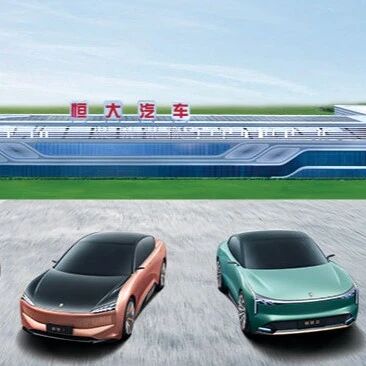
Core Viewpoint - Evergrande Auto, after spending 300 billion on car manufacturing, is now associated with abandoned land, leading to its reputation as the biggest "bomb" in the new energy vehicle sector [1]. Group 1: Company Transition - Evergrande Auto's land is back in the public eye, with news that it may soon be taken over by Guangzhou state-owned assets [2]. - Recent changes in business registration show that Guangzhou Poly Modern Industry Development Co., Ltd. has become the sole shareholder of Evergrande Intelligent Automobile (Guangdong) Co., Ltd. and Evergrande New Energy Automobile (Guangdong) Co., Ltd. [3]. - Guangzhou Poly, established in October 2024 with a registered capital of 2.64 billion, is backed by strong state-owned enterprises, indicating significant advantages in industrial investment and resource integration [4][5]. Group 2: Land and Financial Issues - The land in Nansha District, Guangzhou, was previously reclaimed due to Evergrande's failure to develop it, with a total investment commitment of at least 2.5 billion and a development deadline that was not met [12]. - Evergrande's financial troubles are evident, with total liabilities reaching 72.543 billion and a debt-to-asset ratio soaring to 208% [13]. - The company reported a revenue of 38.38 million in the first half of 2024, a 75.17% decrease from 154 million in the same period of 2023, alongside a net loss of 20.256 billion [13]. Group 3: Production and Market Challenges - Evergrande's only model, Hengchi 5, has faced significant market challenges, with initial high order numbers quickly declining, raising doubts about the authenticity of the orders [16]. - The production at Evergrande New Energy Automobile (Tianjin) Co., Ltd. has been fully suspended since January 2024 due to poor sales and operational difficulties [17]. - The company is undergoing bankruptcy proceedings, with a court-appointed administrator managing the liquidation process due to a lack of funds [19]. Group 4: Future Prospects - The effectiveness and execution of the restructuring plan by Guangzhou state-owned assets are under scrutiny, questioning whether Evergrande's legacy can be revitalized [22].
雷军发布年度演讲
Sou Hu Cai Jing· 2025-09-26 03:00
Core Insights - Lei Jun expressed anxiety during Xiaomi's tenth anniversary, feeling overwhelmed by competition from giants like Apple, Samsung, and Huawei, and acknowledged the fatigue within the team [1][3] - Lei Jun highlighted the internal struggles faced by Xiaomi due to online criticism and biases, which led to a period of introspection and decision-making to confront challenges head-on [3] - The introduction of new top talents to the executive team has significantly contributed to Xiaomi's development over the past few years [3] Group 1: Chip Development - Xiaomi's chip development began in 2014 with Pinecone Electronics, but after the release of the "Surge S1," the decision was made to halt SoC chip development due to challenges faced [5] - Lei Jun emphasized that self-developed SoC chips must target the high-end market to have a chance of success, and collaboration with the mobile team is essential [5] - In 2021, Xiaomi resumed chip development despite significant financial pressure, with over 10 billion yuan invested, and plans to launch the first chip, "Xuanjie O1," in May 2024 [5] Group 2: Automotive Ventures - Xiaomi initiated the SU7 Ultra project in December 2021, aiming to compete with luxury brands like Porsche and Tesla in the electric vehicle market [5] - After a challenging start, the SU7 project made significant progress by May 2022, leading to the decision to restart the Ultra project [7] - Lei Jun compared Xiaomi's YU7 model with Tesla's Model Y, acknowledging the latter's quality while promoting the YU7 as a competitive alternative [7]

全面对标iPhone的小米 17系列来了,最高价6999元!雷军回顾造芯造车艰辛:“只要你想,一定能改变”
Guo Ji Jin Rong Bao· 2025-09-25 22:17
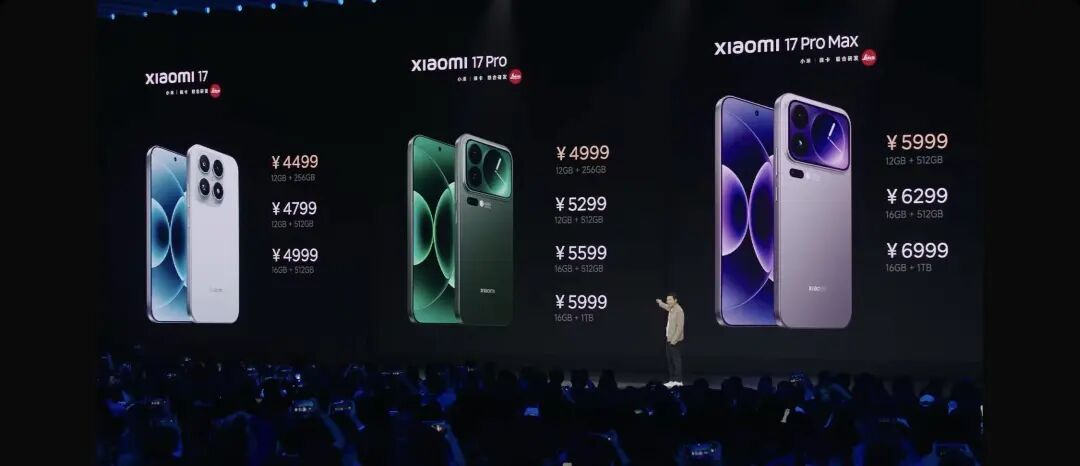
Core Insights - Xiaomi officially launched its latest smartphone series, the Xiaomi 17, aimed at directly competing with Apple's iPhone 17 series, highlighting a strategic shift in its product lineup [1][3] - The Xiaomi 17 series includes three models, with the Xiaomi 17 featuring a 7000mAh battery and a starting price of 4499 yuan, while the Xiaomi 17 Pro and Pro Max offer advanced features and higher price points [1][3] - CEO Lei Jun emphasized the company's commitment to core technology development and a transition from an "internet company" to a "hardcore technology company" during his annual speech [5][7] Product Launch - The Xiaomi 17 series was launched to directly compete with Apple's iPhone, with a focus on high-end specifications and features [1] - The Xiaomi 17 Pro series includes two models, both equipped with the latest Snapdragon 8 Gen 2 processor, and features a unique "back screen" design for enhanced user interaction [3] - Pricing for the Xiaomi 17 Pro starts at 4999 yuan, while the Pro Max starts at 5999 yuan, reflecting a premium positioning in the market [3] Strategic Direction - Xiaomi is focusing on self-developed chips and electric vehicles, with a commitment to invest at least 50 billion yuan over the next decade in chip development [7][8] - The company has faced challenges in its automotive project but has made significant progress, with the YU7 model achieving over 40,000 deliveries since its launch [8] - Lei Jun's annual speech highlighted the importance of talent acquisition, stating that Xiaomi is actively recruiting to support its rapid growth and innovation [7]

全面对标iPhone的小米 17系列来了 最高价6999元!雷军回顾造芯造车艰辛:“只要你想,一定能改变”
Guo Ji Jin Rong Bao· 2025-09-25 15:47
Core Viewpoint - Xiaomi has officially launched its latest smartphone series, the Xiaomi 17, aimed at directly competing with Apple's iPhone series, showcasing significant advancements in technology and design [2][4]. Product Launch - Xiaomi released three models in the Xiaomi 17 series, including the standard Xiaomi 17, which features the Snapdragon 8 Gen 2 processor, a 7000mAh battery, and a 6.3-inch display, with prices ranging from 4499 to 4999 yuan [2]. - The Xiaomi 17 Pro series includes the Xiaomi 17 Pro and Xiaomi 17 Pro Max, both equipped with the Snapdragon 8 Gen 2 processor, featuring a unique "back screen" design, and prices ranging from 4999 to 6999 yuan [4]. Strategic Direction - Xiaomi's founder and CEO Lei Jun emphasized the company's shift from an "internet company" to a "hardcore technology company," focusing on core technology investments and talent acquisition [6][8]. - The company aims to invest at least 50 billion yuan over the next decade in self-developed chips, marking a significant commitment to its technology roadmap [8]. Automotive Development - Xiaomi is also pursuing an automotive project, with the SU7 model aimed at competing with high-end electric vehicles like Tesla, and has successfully delivered over 40,000 units of the YU7 model since its launch [9].
热搜第一!雷军:小米非常非常缺人
Zhong Guo Ji Jin Bao· 2025-09-25 09:46
Core Insights - Lei Jun, the founder and CEO of Xiaomi, emphasized the company's significant need for talent during a recent video address, stating that Xiaomi is "very, very short of people" as it continues to grow rapidly [3][7]. Group 1: Talent Acquisition and Company Growth - The two most important tasks for Xiaomi are finding talent and accumulating financial resources to focus on major projects [6]. - Xiaomi has been actively promoting internal talent and recruiting externally to alleviate pressure on leadership [7]. - The company has experienced rapid growth, which has led to challenges in managing its workforce effectively [3][7]. Group 2: Addressing Criticism and Market Perception - Lei Jun acknowledged that Xiaomi's innovative business model has faced skepticism, but he believes that the company is changing perceptions through its actions [8]. - The launch of smart factories for mobile phones and cars has helped to counter negative perceptions of Xiaomi as merely an "assembly factory" [8]. Group 3: Product Development and Future Plans - Lei Jun indicated that while Xiaomi's high-end product strategy is progressing, it is too early to declare success [9]. - The upcoming launch of the Xiaomi 17 series and other high-end products is highly anticipated, with a focus on significant upgrades without increasing prices for certain models [14]. - The Xiaomi 17 series will feature the latest Surge OS 3 system, which has seen considerable improvements [14]. Group 4: Annual Speech and Strategic Vision - The 2025 annual speech by Lei Jun is set to cover the themes of change and innovation, including insights into Xiaomi's chip and automotive ventures [11][17]. - Lei Jun compared the challenges of entering the automotive and semiconductor industries to the pressures of supporting two children in college, highlighting the magnitude of the undertaking [19].
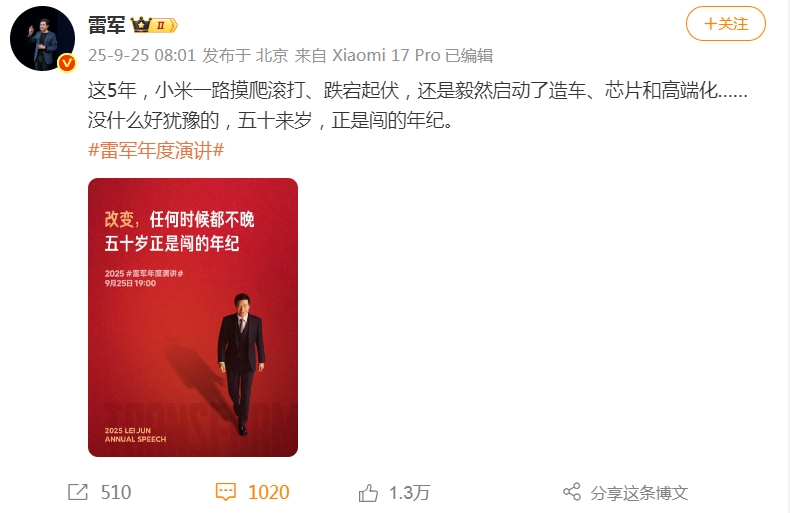
雷军:五十来岁正是闯的年纪!“同时造车和造芯,家底全押上了,压力巨大”!小米17系列今晚发布,这款处理器全球首发,公司股价大涨
Mei Ri Jing Ji Xin Wen· 2025-09-25 05:49
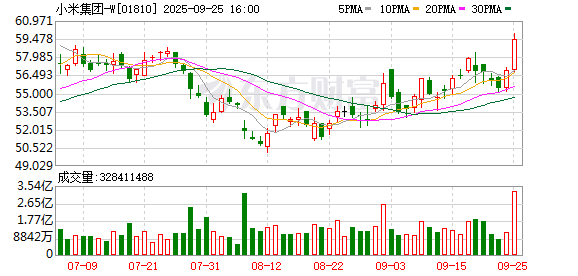
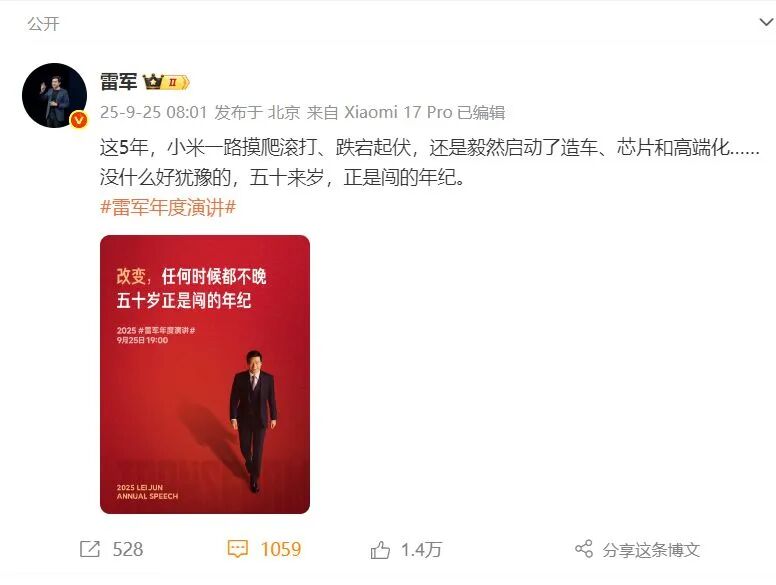
Core Viewpoint - Xiaomi's Chairman and CEO Lei Jun announced significant strategic decisions regarding the company's ventures into electric vehicles and chip development, emphasizing the company's commitment to innovation and high-end products [1][3][17]. Group 1: Company Strategy - Xiaomi is simultaneously pursuing electric vehicle production and chip development, investing heavily in these areas as part of its growth strategy [3][17]. - The company is set to launch the Xiaomi 17 series, which includes three models, highlighting its focus on high-end technology and performance [15][17]. - Lei Jun expressed confidence in the company's direction, stating that the past five years have been challenging yet transformative for Xiaomi [1][2]. Group 2: Financial Performance - Xiaomi's stock price increased by 3.6% to HKD 58.95, resulting in a market capitalization of HKD 1.53 trillion, an increase of over HKD 530 billion (approximately RMB 485 billion) [12]. - The company reported a record revenue of RMB 1159.6 billion for the second quarter of 2025, marking a 30.5% year-on-year growth, with a net profit of RMB 108.3 billion, up 75.4% [17]. - Xiaomi's investment in chip development has exceeded RMB 135 billion, with a projected R&D expenditure of over RMB 6 billion for the current year [19].
雷军“五十来岁正是闯的年纪”,出生于1969年,和余承东、陈明永同龄
Qi Lu Wan Bao· 2025-09-25 03:18
Group 1 - The core message of the news is that Xiaomi's founder, Lei Jun, reflects on the company's journey over the past five years, emphasizing the bold decisions to venture into car manufacturing and chip development, despite the challenges faced [1][4]. - Lei Jun's annual speech on September 25 will focus on the themes of change, revealing the stories behind Xiaomi's new chip and car initiatives [4]. - The decision to simultaneously pursue car manufacturing and chip development is described as a significant risk, with Lei Jun comparing it to the pressure of supporting two children in college, indicating the high stakes involved [4]. Group 2 - Lei Jun's annual speech was initially planned for June but was postponed to September to align with the launch of the Xiaomi 17 series flagship, which is expected to generate significant attention [4]. - The delay in the annual speech was seen positively by Lei Jun, as it allows for leveraging the publicity from the Xiaomi 17 series launch [4]. - The shared birth year of Lei Jun with other industry leaders like Huawei's Yu Chengdong and OPPO's Chen Mingyong highlights a generational shift in the tech industry [4].