
银行理财净值化转型

Search documents
跌了也要买,银行理财收益率跌落1.98%新低,规模登顶33万亿高峰
3 6 Ke· 2026-01-29 10:44
Core Viewpoint - The banking wealth management market is experiencing a significant transformation, with a notable increase in market size but a decline in average product yields, raising questions about the future of bank wealth management products. Group 1: Market Size and Growth - As of the end of 2025, the banking wealth management market reached a size of 33.29 trillion yuan, reflecting an 11.15% growth from the beginning of the year [2] - The total number of investors holding wealth management products reached 143 million, a 14.37% increase from the start of the year, marking the highest scale in the history of Chinese banking wealth management [3] - The growth in wealth management scale in 2025 was driven by multiple factors, including the outflow of funds from deposits, valuation adjustments, and the expansion of products with rights to enhance yields [3] Group 2: Yield Trends - The average yield of wealth management products fell to 1.98% in 2025, the lowest in history, down 67 basis points from 2024's average of 2.65% [1][6] - In 2025, wealth management products generated a total return of 730.3 billion yuan for investors, a 2.87% increase from the previous year [6] - The decline in yields is attributed to significant fluctuations in the stock and bond markets, as well as a general decrease in risk-free rates [5][6] Group 3: Future Outlook and Strategies - Analysts predict that the trend of deposit "disintermediation" will continue to drive funds towards wealth management, but the core demand from clients remains focused on stability [4][11] - Wealth management institutions are advised to enhance their research capabilities and adopt a systematic approach to risk management, particularly in response to bond market volatility and high underlying asset risks [1][9] - There is a call for wealth management firms to diversify their product offerings and focus on long-term strategies, particularly in areas such as retirement planning and green finance, to meet the evolving needs of investors [10][11]
银行理财市场迎转型深水区 行业共论平衡波动与收益
Zhong Guo Zheng Quan Bao· 2025-12-19 20:10
Core Insights - The banking wealth management industry is expected to accelerate innovation and deepen net value transformation in 2025, with a focus on balancing volatility control and yield enhancement [1] Group 1: Market Growth and Structure - The banking wealth management market is projected to grow at a rate exceeding 15% in 2025, with a notable contrast between scale expansion and structural adjustment [2] - The broad "fixed income +" wealth management products are anticipated to grow by approximately 50%, with mixed products doubling in scale at companies like China Post Wealth Management [2] - The growth in scale is attributed to both passive growth from short-term open-ended products and active growth from "fixed income +" and cross-border allocation products [2] Group 2: Investment Strategies - In 2025, major asset allocation and diversified investment strategies are expected to become mainstream, with companies like North Bank Wealth Management achieving results in asset securitization and private equity [2] - The investment approach will shift from relying on blockbuster products to building a comprehensive product matrix to meet diverse customer needs [2] - Companies are focusing on a balanced approach to risk and return, prioritizing risk control over yield, and establishing multi-scenario risk prevention mechanisms [2][3] Group 3: Differentiation and Research Capabilities - Establishing differentiated advantages is crucial for the net value transformation in the wealth management sector, with a strong emphasis on enhancing research capabilities [3] - Companies are encouraged to build a configuration framework that can guide investments more precisely, transitioning from simple directional judgments to a more detailed investment structure [3] - North Bank Wealth Management is leveraging regional advantages and expanding nationally while managing concentration risks through regional investment limits [3] Group 4: Cross-Border Investment and Risk Management - Companies like Huihua Wealth Management have significant experience in cross-border allocation and absolute return equity investments, utilizing global research resources and risk management practices [4] - The introduction of specialized teams for cross-border investments has led to improved precision in RMB entrustment and settlement [4] - The use of derivative tools for risk hedging is being implemented to effectively reduce volatility [4]
年末理财规模有望站上33万亿元
Zhong Guo Zheng Quan Bao· 2025-12-16 20:19
Core Viewpoint - The growth of bank wealth management scale in November is driven by seasonal patterns and the downward trend in deposit rates, with expectations that the year-end figure will exceed 33 trillion yuan despite potential short-term adjustments due to regulatory pressures [1][2] Group 1: Wealth Management Scale Growth - As of the end of November, the total wealth management scale reached 34 trillion yuan, an increase of 0.35 trillion yuan from the end of October [1] - Another report indicated that the wealth management scale was 33.57 trillion yuan, reflecting a slight increase of 729 billion yuan compared to the end of October [1][2] - The growth is attributed to seasonal factors and a noticeable trend of funds moving towards bank wealth management and non-money market funds due to declining deposit rates [2] Group 2: Yield Pressure - In contrast to the growth in scale, the yields of cash management and pure fixed-income wealth management products faced downward pressure in November [1] - The average annualized yield for cash management products was 1.23% as of December 7, still above the 1.10% average yield of money market funds, but expected to decline further in a loose monetary environment [2] - Pure fixed-income products saw their average annualized yield drop to 2.42% in November, influenced by fluctuations in the bond market [3] Group 3: Strategic Adjustments - Wealth management companies are actively adjusting strategies to enhance yield flexibility, with a focus on "fixed income plus" products [3] - Many firms are increasing their investments in exchange-traded funds (ETFs) and related strategies to improve yield while supporting capital market development [3] - The trend of extending the duration of closed-end products is emerging as a response to the regulatory deadline for valuation adjustments [4] Group 4: Long-Term Product Trends - The reliance on valuation methods suitable for short-term products is decreasing, as longer-term closed-end products can mitigate short-term redemption risks and provide stability [4] - The supply of long-term closed-end wealth management products is expected to continue expanding, driven by the need for stability in valuation and alignment with long-term retirement financial needs [4]
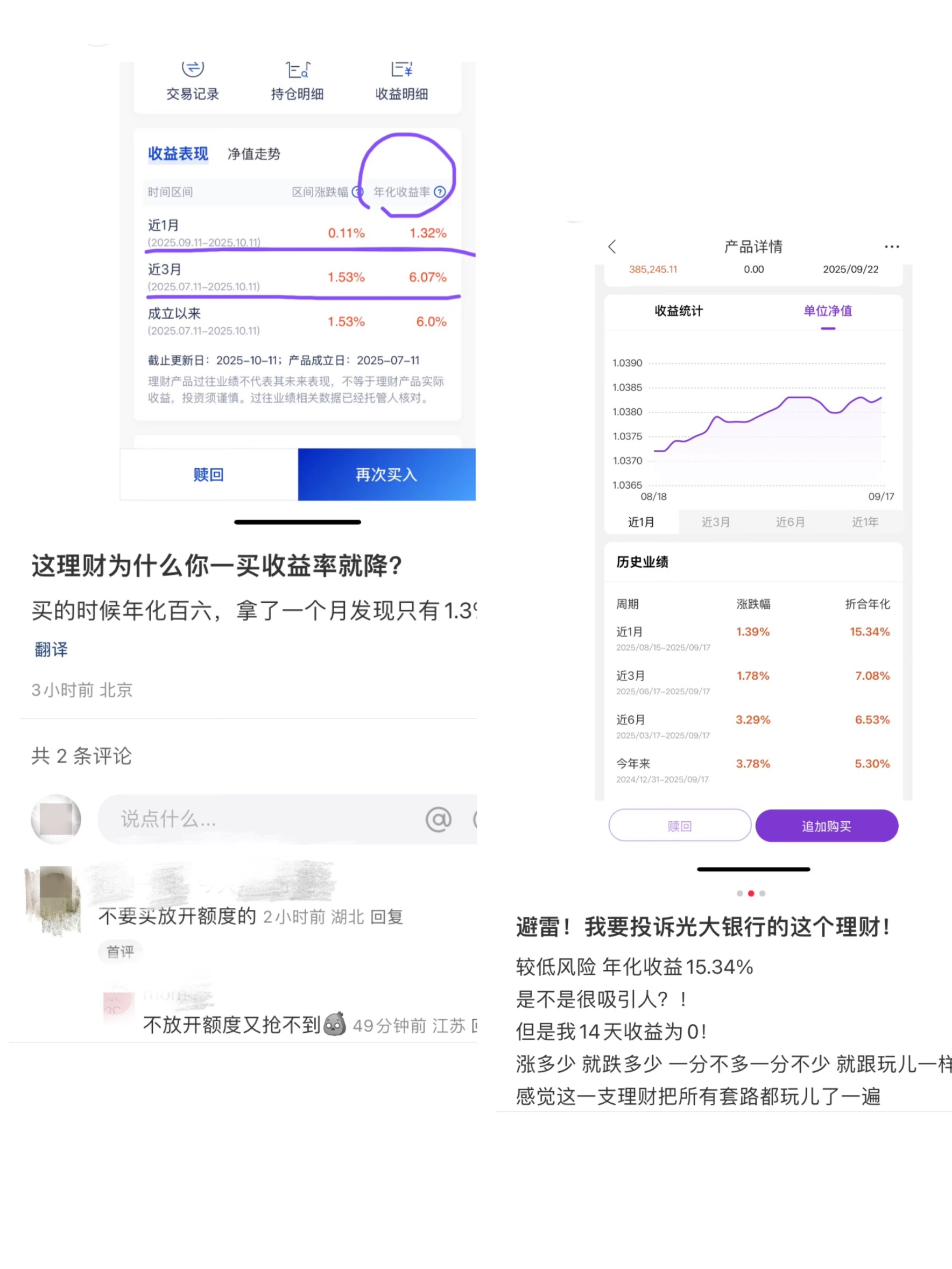
金改前沿 | “收益好的买不到,买到了收益肯定立马下降!”——银行理财产品频现“橱窗戏法”
Xin Hua Cai Jing· 2025-10-15 07:08
Core Viewpoint - The article highlights the persistent issue of inflated annualized returns displayed by banks for their wealth management products, leading to a significant trust deficit among investors [1][6][12]. Group 1: Market Trends - The shift from traditional savings accounts to bank wealth management products has become a new trend as the one-year fixed deposit rate falls below 1% [6]. - The total scale of the bank wealth management market reached 30 trillion yuan in the first half of the year [6]. Group 2: Issues with Product Display - Banks are criticized for showcasing the highest returns while hiding the actual performance, leading to confusion among investors [8][9]. - There is a lack of standardized information disclosure mechanisms, resulting in various performance metrics that complicate investor decision-making [8][10]. - Some banks only display historical performance for specific periods, omitting more relevant short-term returns [7]. Group 3: Investor Experience - Investors express frustration over the difficulty in accessing quality wealth management products, often requiring special permissions or facing limited availability [10][11]. - Many investors report that the performance metrics presented do not accurately reflect the long-term performance of the products, leading to misinterpretations of potential returns [9][12]. Group 4: Regulatory Environment - Regulatory bodies have issued guidelines to address the misleading display of wealth management product performance, yet issues persist in the market [12][13]. - The transition to a net asset value-based system for wealth management products is seen as a necessary step for improving transparency and accountability [12][13].

今日视点:银行理财规模不断攀升引发三大思考
Zheng Quan Ri Bao· 2025-08-08 07:23
Core Insights - The scale of bank wealth management has returned to a historical high, reaching 31.35 trillion yuan as of May 29, indicating a strong demand for stable returns in a low-interest-rate environment [1][2] - The transformation towards "net value" in bank wealth management has shown effectiveness, reflecting the industry's adaptation to changing market conditions [1] Group 1: Supporting the Real Economy - Bank wealth management funds primarily invest in fixed-income assets, with over 80% allocated to bonds, cash, and bank deposits as of the first quarter of this year [2] - There is a growing demand from emerging industries for equity and non-standard debt financing, necessitating innovation in financial services to better support the real economy [2] - Some banks have successfully launched specialized products to provide comprehensive funding support for sectors like semiconductors and biomedicine, demonstrating a positive shift in asset allocation [2] Group 2: Meeting Diverse Wealth Management Needs - With market interest rates declining, residents are seeking stable wealth management products that can replace traditional deposits, leading to a strong demand for flexible investment options [3] - The current asset allocation in bank wealth management poses challenges in meeting investor return expectations, necessitating an increase in equity investments and product innovation [3] - Enhancing risk management, innovation capabilities, and equity investment skills is crucial for banks to improve their competitive edge in the wealth management sector [3] Group 3: Increasing Market Participation - As of the first quarter, bank wealth management investments in equity assets exceeded 800 billion yuan, but only accounted for 2.6% of total investments, indicating significant room for growth [4] - Banks are encouraged to steadily increase their market participation to become a stabilizing force in the capital market, benefiting both investors and the overall financial ecosystem [4] - The transformation of bank wealth management must be approached with caution to mitigate risks associated with credit downgrades, investor expectations, and potential liquidity challenges [4]
【金融头条】银行理财寻路2024
Jing Ji Guan Cha Wang· 2025-08-08 04:36
Core Insights - The development of bank wealth management has lagged behind, with public fund scale surpassing bank wealth management for the first time by June 2023, indicating a shift in competitive advantages [2] - The bank wealth management industry is undergoing a reassessment of its service clientele, operational models, and positioning to regain competitiveness [2][4] - The industry is expected to transition towards professional asset management companies in 2024, enhancing risk preference, product structure, and investment research capabilities [2][4] Industry Challenges - The year 2023 has been challenging for the industry, with both scale and performance under pressure, leading to adjustments in product performance benchmarks and fee structures to attract investors [4][5] - Bank wealth management scale fluctuated significantly, increasing from 23.4 trillion yuan at the end of 2019 to 25.34 trillion yuan by mid-2023, but saw a notable decrease compared to 2022 due to declining product yields [4][5] - The low risk tolerance of clients and the contradiction with the net value of wealth management products have led to increased volatility in product scale, complicating investment strategies [5] Strategic Shifts - The investment environment for bank wealth management has undergone five key changes, including more rational market expectations, low client confidence recovery, and a shift towards stable asset structures [8] - The focus for 2024 will be on maintaining a balanced approach to asset allocation, emphasizing safety and supporting national strategies while managing risks effectively [11] - There is a need for bank wealth management companies to diversify their product offerings, including cash and short-term debt products, while also exploring higher volatility products to create a more comprehensive product system [9][10] Future Outlook - The bank wealth management sector is projected to achieve a 10% growth in scale in 2024, with total assets expected to reach between 31 trillion and 32 trillion yuan [13] - The performance benchmark for wealth management products is anticipated to stabilize and potentially rise, which could support growth in the sector [13] - The asset allocation strategy will continue to follow the "80-20 rule," with a focus on maintaining a balance between safe assets and higher-yielding investments [13]

亏损面扩大!上周近三成理财产品亏损
2 1 Shi Ji Jing Ji Bao Dao· 2025-08-05 09:20
Core Viewpoint - The report highlights the current state and trends in the banking wealth management industry, emphasizing the need for timely and accurate assessments to support the industry's transformation and development [1] Market Review - The bond market remained volatile with an overall balanced and loose funding environment; the weighted average of DR007 was 1.42% and the yield on 10-year government bonds closed at 1.695% [2] - In the stock market, major A-share indices declined, with the CSI 1000, ChiNext, and Shanghai Composite Index experiencing weekly declines of 0.54%, 0.74%, and 0.94% respectively; the pharmaceutical, communication, and media sectors showed the highest weekly gains [2] Break-even Situation - The number of products below par value is low, with 24,774 public wealth management products in existence as of August 3, 2025, of which 324 had a cumulative net value below 1, resulting in a comprehensive break-even rate of 1.31% [3] - The break-even rates for equity and mixed wealth management products were 40.48% and 5.46% respectively, while fixed income products had a break-even rate of 1.02% [3] - Fixed income products with 1-2 years and over 3 years had slightly higher break-even rates of 2.27% and 2.82% respectively; 210 newly established public wealth management products in July 2025 were temporarily below par [3] New Product Issuance - A total of 441 wealth management products were issued by 32 wealth management companies from July 28 to August 1, 2025, with the highest issuance from joint-stock banks [4] - The majority of new products were R2 (medium-low risk), closed-end net value type, and fixed income public products; only 8 mixed products and 1 equity product were issued [4] - The pricing of products varied, with short-term products under 1 month dropping below 2% to 1.98%, while products over 3 years saw a rebound to 2.51%, an increase of 0.36 percentage points [4] Focus on Key Products - Everbright Wealth launched a new product "Yixiang Sunshine Gold Enjoyment 2028 Phase 1," an open-ended "fixed income + equity" product with a term of 3 years and no redemption transactions during the period [5] - The product aims for stable low-volatility returns from fixed income and targets long-term value investment returns from equity investments in broad-based and dividend ETFs [5] Yield Situation - The average net value growth rate for fixed income wealth management products was only 0.0227% over the past week, while mixed and equity products had average growth rates of 0.0363% and -0.5417% respectively [6] - The proportion of negative yield products increased, with 29.63% of RMB public wealth management products yielding negative returns; the highest negative yield was observed in fixed income products with a 51.05% rate for those over 3 years [6] Industry Hotspots - Guangyin Wealth was penalized for irregular investment operations, with a total fine and confiscation amounting to 11.5988 million yuan due to issues such as data management and information registration [7] Industry Trends - The banking wealth management market is expected to exceed 32 trillion yuan in 2025, following a projected growth to 29.95 trillion yuan by the end of 2024; the market is anticipated to reach 45 trillion yuan by 2026 [9] - The industry faces challenges in profitability despite a growing scale, with competition leading to reduced management fees and a focus on maintaining scale and net value [8][9]
薛洪言:净值化时代需接受“收益非线性增长”,含权理财规模有望持续扩容
Xin Lang Cai Jing· 2025-08-04 02:30
Core Viewpoint - The financial industry is entering a new phase characterized by challenges and opportunities, with a focus on serving the real economy and promoting high-quality development through innovative financial products and services [1] Group 1: Bank Wealth Management Transformation - The transition to net value-based bank wealth management is reshaping market dynamics and investor behavior, breaking the expectation of "guaranteed returns" and increasing investor risk awareness [3][4] - Investors are more accepting of high-volatility products, creating better conditions for household wealth to enter the market [3][4] - The demand for innovative products is driven by the structural contradiction of abundant funds and a scarcity of quality assets, leading to a need for product innovation that balances stability and yield [4][5] Group 2: Personal Pension Wealth Management Market - The personal pension wealth management market is experiencing historic development opportunities due to aging demographics and increasing demand for retirement savings [10][11] - The government is supporting this market through policies that promote long-term investment in quality assets and improve the pension account system [10][11] - Financial institutions are responding by diversifying product offerings and enhancing service experiences to meet the evolving needs of consumers [10][11] Group 3: ESG Investment Trends - ESG investment in China is growing rapidly, driven by policy support and market expansion, with significant increases in ESG mutual funds and green bonds [13][14] - The integration of ESG factors into financial decision-making is becoming a competitive advantage for banks, as it can lower financing costs and enhance asset quality [14] - However, challenges remain, including data quality issues and the risk of "greenwashing" among companies [13][14] Group 4: Investment Strategies in Low-Interest Environment - Fixed-income funds need to adopt refined operational strategies to cope with declining yields, focusing on risk factor segmentation and dynamic asset allocation [15][16] - The market is facing complex risks, including interest rate sensitivity and liquidity issues, necessitating a comprehensive risk management framework [16][17] - Investors are advised to lower yield expectations and focus on matching holding periods with diversified asset allocations to navigate the low-interest environment [17]
一周银行速览(7.4—7.11)
Cai Jing Wang· 2025-07-11 08:01
Industry Focus - 17 listed banks have announced the cancellation of their supervisory boards, influenced by the revised Company Law and financial regulatory policies set to take effect in 2024 [1] Corporate Dynamics - Hangzhou Bank has completed the market-oriented conversion of 15 billion yuan in convertible bonds, marking significant progress in capital replenishment [4] - JiuTai Rural Commercial Bank is facing a pre-loss forecast of 1.7 billion to 1.9 billion yuan for 2024 and is set to delist following a voluntary conditional cash offer for its H-shares and domestic shares [5] - Chengdu Rural Commercial Bank plans to absorb and merge six village banks located in Sichuan Province [6] - Chongqing Rural Commercial Bank has obtained fund custody qualifications, becoming the first commercial bank to do so this year [7] - Shunde Rural Commercial Bank has withdrawn its IPO application after a prolonged lack of progress since its initial submission in 2019 [8] Financial Personnel - Zheshang Bank announced the resignation of Chairman Lu Jianqiang due to age, with Chen Haiqiang approved to take over as the new president [9][10]


银行理财规模不断攀升引发三大思考
Zheng Quan Ri Bao· 2025-05-29 15:41
Core Insights - The scale of bank wealth management has returned to a historical high, reaching 31.35 trillion yuan as of May 29, 2023, marking a new peak since 2022, reflecting the urgent demand for stable returns in a low-interest-rate environment and the effectiveness of the net value transformation in the industry [1][2] Group 1: Supporting the Real Economy - Bank wealth management has played a significant role in supporting the development of the real economy, with approximately 20 trillion yuan allocated to support the real economy and 126 million investors as of the end of Q1 2023 [1][2] - There is a need for banks to innovate financial services and increase investments in equity and non-standard debt assets to better serve the real economy, especially as new industries have a strong demand for such funding [2][3] Group 2: Meeting Diverse Wealth Management Needs - With market interest rates declining, residents are seeking stable wealth management products that can replace traditional deposits, leading to a strong demand for products with yield flexibility [3][4] - To enhance competitiveness, banks should increase investments in equity assets and innovate product offerings, which will require improved risk control, innovation capabilities, and equity investment skills [3][4] Group 3: Increasing Market Participation - As of the end of Q1 2023, bank wealth management funds invested over 800 billion yuan in equity assets, accounting for only 2.6% of total investments, indicating significant room for growth [4] - Banks should steadily increase their market participation to become a crucial stabilizing force in the market, which will also enhance returns for investors and promote balanced capital market financing [4]