
CPU

Search documents
ARM,失宠了
半导体行业观察· 2026-02-19 02:46
公众号记得加星标⭐️,第一时间看推送不会错过。 英伟达本周已出售所持 ARM 的最后剩余股份,与几年前曾试图收购该公司的情景已相去甚远。 英伟达与 ARM 的合作,在当代 AI 基础设施建设中至关重要 —— 正是凭借 ARM 的 CPU 架构,英 伟达才得以推出 Grace Hopper、Blackwell 等系列重磅产品。更重要的是,ARM 还将在英伟达即将 推出的Vera CPU中扮演关键角色,这类处理器的重要性正在急剧提升。 据彭博社报道,根据最新提交给美国 SEC 的文件,英伟达已出售其持有的 ARM 剩余股份,价值约 1.4 亿美元。耐人寻味的是,此举恰好发生在ARM 在未来 AI 竞赛中的地位开始受到质疑的节点。 很多人尚未意识到:CPU 近期正迎来空前重要的地位提升。原因在于推理 workload,尤其是智能体 (agentic)相关负载—— 这类场景的重心正从 GPU 计算转向更依赖 CPU 的任务,例如工具调用、 API 请求、内存查找与调度逻辑。 这一转向已非常明显:英特尔、AMD 均表示,超大规模云厂商对其数据中心 CPU 需求暴增,背后 正是 CPU 整体市场(TAM)的高速扩张。与此 ...



AIAgent沙箱化有望带来CPU新增量空间:看好 CPU 及相关产业链
CAITONG SECURITIES· 2026-01-26 05:45
Investment Rating - The industry investment rating is "Positive" and is maintained [2][10] Core Insights - The report highlights that the deployment of Al Agent sandboxing is expected to create new demand for CPUs, driven by the need to control potential risks associated with Al Agents [6] - The report suggests that as Al Agents continue to develop, the associated sandbox technology will likely be adopted, leading to new growth opportunities for CPU manufacturers and related supply chains [6] Summary by Sections Recent Market Performance - The report notes a recent market performance with a 20% increase [3] Key Companies and Investment Ratings - The report lists key companies with their investment ratings, including: - Haiguang Information: Market Cap 641.52 billion, EPS for 2024A is 0.83, with a PE of 332.53 [5] - Longxin Zhongke: Market Cap 77.39 billion, EPS for 2024A is -1.56 [5] - Tongfu Microelectronics: Market Cap 85.50 billion, EPS for 2024A is 0.45, with a PE of 125.20 [5] Industry Trends - The report discusses the increasing adoption of Al Agent sandboxing both domestically and internationally, with significant investments such as Meta's acquisition of Manus for over 2 billion USD [6] - The report emphasizes that the functionality of Al Agents is largely dependent on the richness and reliability of the tools they can access, with function calling being a core technology [6]


计算机行业周报20260124:Token需求“通胀”:从CPU到云服务-20260124
Guolian Minsheng Securities· 2026-01-24 12:44
Investment Rating - The report maintains a "Recommended" rating for the industry [4] Core Insights - The demand for Tokens is rapidly increasing, leading to a price increase trend that is expected to extend from upstream components to CPUs and cloud services. AWS has initiated price hikes, breaking the long-standing trend of decreasing cloud service prices, which may lead to a revaluation of cloud computing and related service providers [11][14][30] - The AI industry chain is experiencing inflation transmission, with cloud computing potentially being the next area to see price increases following storage and CPU [14] - The CPU sector is expected to have long-term growth prospects due to the increasing demand for AI computing power, with Intel indicating that supply constraints will persist into 2026 [16][23] - The database segment is also poised to benefit from the rising demand for cloud computing, with the potential for significant revenue growth as the number of database PCU nodes increases [26][29] Summary by Sections 1. AWS Price Increase Initiates Global Cloud Computing Price Trend - The AI industry chain is experiencing a price increase trend, with AWS leading the charge by raising prices for its EC2 machine learning capacity blocks by approximately 15% [14] - This price adjustment reflects a shift in supply-demand dynamics and may facilitate further price increases in the future [14] 1.1 Cloud Computing as the Next Inflation Direction - The demand for AI is driving price increases across various segments, with cloud computing expected to follow suit [14] 1.2 CPU: Long-term Development Prospects Under AI Agent Trend - Intel is facing supply constraints that may continue into 2026, with demand for CPUs expected to exceed supply [16] - The importance of CPUs is increasing as AI applications evolve, necessitating more robust processing capabilities [20][23] 1.3 Database: Another Key Beneficiary of Cloud Computing Industry Chain - The growth in demand for AI-driven applications is expected to increase the number of database PCU nodes, leading to significant revenue potential [26][29] 1.4 Investment Recommendations - The report suggests focusing on companies in the following sectors: 1) Cloud Computing: Alibaba, Kingsoft Cloud, UCloud, Deepin Technology, and others 2) CPU: Haiguang Information, China Great Wall, Loongson Technology, and others 3) Database: StarRing Technology, Dameng Database, and others [30]
Agent到底对CPU带来怎样的需求
2026-01-23 15:35
Summary of Conference Call Notes Industry and Company Involved - The discussion revolves around the demand for CPUs driven by the increasing number of Agents in AI systems, focusing on the implications for CPU usage and performance in AI applications. Core Points and Arguments - **Increased Demand for CPUs**: The rise in the number of Agents significantly increases the demand for CPUs, as each Agent requires substantial computational resources for data processing and logical scheduling [1][4] - **Virtual Machine Technology Changes**: Current AI clusters emphasize hardware resource binding, requiring virtual machines to start within 1 second and maintain a resident state, which escalates the need for high-performance CPUs [1][5] - **CPU Load Factors**: The core factors affecting CPU load include the duration and frequency of tasks. Long-duration tasks (2-4 hours) have a more significant impact on CPU load compared to short, frequent tasks [1][6] - **Memory Management Needs**: The development of large models necessitates more CPUs for memory scheduling, particularly with DRAM and SSD storage, which involves complex data communication [2][15] - **Agent Task Complexity**: AG tasks impose a heavy load on CPUs, with token consumption during processing being significantly higher than user input, leading to increased computational demands [1][11] - **Future CPU Usage Growth**: CPU usage growth is expected to be between linear and exponential, potentially doubling or quadrupling in the next few years, depending on the complexity of long-term tasks [2][12] - **Deepseek and Anagram Technologies**: These technologies enhance computational efficiency by offloading some calculations to CPUs, reducing GPU burden and improving query efficiency [1][10] - **CPU vs. GPU**: While CPUs can support smaller language models, GPUs remain essential for complex tasks in AI servers, indicating that CPUs are not a complete substitute for GPUs in high-demand scenarios [2][12][18] - **Agent Support by CPU Cores**: A single CPU core can support 2-5 Agents, but this number decreases for complex tasks, highlighting the need for more cores to handle increased workloads [2][13] - **Market Supply and Alternatives**: Despite the tight supply of CPUs, established vendors like Intel and AMD maintain a competitive edge due to their stable ecosystems, while newer architectures are still in development [2][22] Other Important but Potentially Overlooked Content - **Impact of High Concurrency**: In high-concurrency situations, even optimized simple tasks can place significant demands on CPUs, especially during peak usage times [2][19] - **Challenges in Performance Optimization**: As user scale increases, the effectiveness of CPU performance optimizations may diminish, with potential performance gains dropping during peak usage [2][20] - **General Computing vs. AI Servers**: General computing servers focus on storage integration, while AI servers prioritize GPU capabilities, indicating a divergence in design and application [2][21] - **Future Trends in General Computing Servers**: The maturity of general computing servers suggests a continued reliance on established platforms like Intel and AMD, particularly in cloud technology [2][23]
英特尔电话会:CPU需求激增却有单无货!CEO坦言库存耗尽且良率未达标,“我很失望无法满足需求”
Hua Er Jie Jian Wen· 2026-01-23 01:29
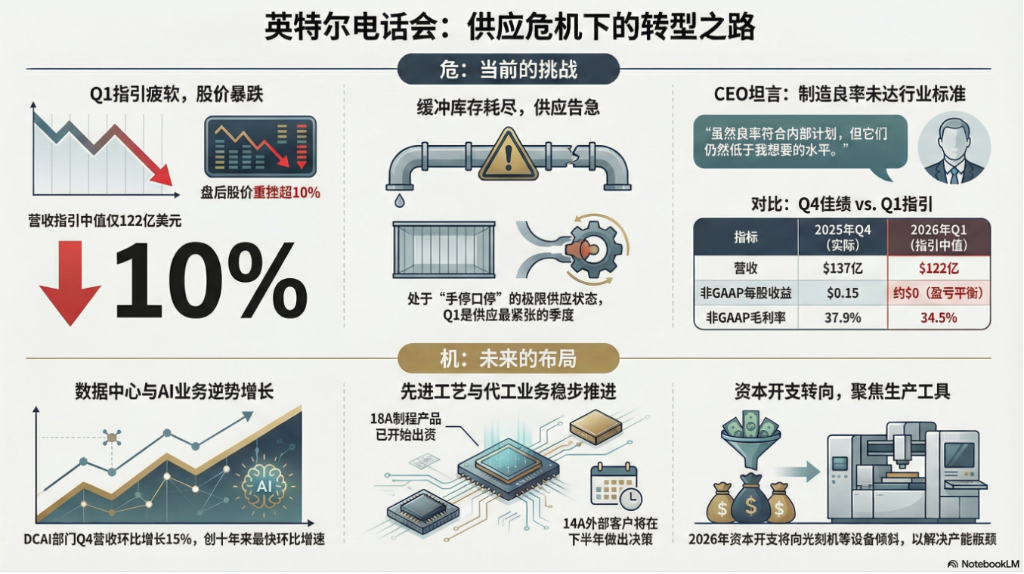
Core Insights - Intel reported mixed Q4 results, exceeding Wall Street expectations for revenue and profit, but provided disappointing guidance for Q1 2026 due to manufacturing yield issues and depleted inventory, leading to a stock drop of over 10% in after-hours trading [3][4][5] - CEO Pat Gelsinger expressed disappointment over the inability to meet market demand, highlighting that while semiconductor demand is unprecedented in the AI era, manufacturing yields are below desired levels [3][7] - Despite short-term challenges, Intel emphasized its long-term transformation is on track, particularly with the launch of the Core Ultra Series 3 based on the advanced 18A process and a strong recovery in the data center business [3][4][10] Financial Performance - In Q4, Intel achieved revenue of $13.7 billion, at the high end of prior guidance, with a non-GAAP EPS of $0.15, significantly above the expected $0.08 [4][29] - For Q1, Intel expects revenue between $11.7 billion and $12.7 billion, with a midpoint of $12.2 billion, indicating a decline from seasonal norms, and a non-GAAP gross margin forecasted to drop to 34.5% [4][36] - The company reported a Q4 operating cash flow of $4.3 billion and total capital expenditures of $4 billion, with adjusted free cash flow of $2.2 billion [29][30] Supply Chain and Inventory Issues - Intel acknowledged that its buffer inventory has been depleted, leading to a "hand to mouth" supply situation, particularly in Q1, which is expected to be the tightest quarter for supply [5][7] - The transition of wafer production towards server products began in Q3 but will not yield results until later in Q1, exacerbating supply constraints [7][36] - Manufacturing yield improvements are critical for addressing supply limitations, with current yields meeting internal plans but still below industry standards [7][8][12] AI and Data Center Strategy - Intel's management emphasized the underestimated role of CPUs in the AI era, stating that diverse AI workloads are creating significant capacity constraints, reinforcing the CPU's central role [9][10] - The DCAI (Data Center and AI) segment saw a 15% sequential revenue increase in Q4, but supply shortages prevented capturing even higher revenue [10][33] - The company is prioritizing high-margin data center business over client computing, with DCAI revenue reaching $4.7 billion in Q4, while client computing revenue declined by 4% [10][32] Future Outlook and Capital Expenditure - Intel plans to maintain or slightly reduce capital expenditures in 2026, focusing spending on wafer manufacturing tools rather than facility construction to address immediate capacity shortages [12][13] - The company expects external foundry customers to begin making firm supplier decisions in the second half of 2026, with significant advancements in the 14A process anticipated [12][36] - Intel's long-term goal is to establish a world-class foundry business, with early milestones achieved in advanced packaging and process technology [12][24]

Constellation's Wang on Google-Nvidia Chips Rivalry
Bloomberg Television· 2025-11-26 07:17
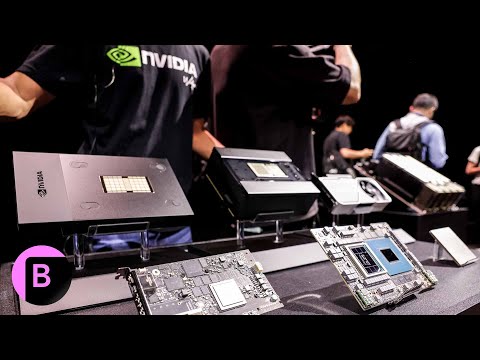
AI Chip Landscape - Tensor Processing Units (TPUs) are purpose-built for AI and deep learning, offering lower total costs and greater power efficiency compared to GPUs [1] - Google has been developing TPUs for some time, aiming for efficiency and supply chain diversification beyond Nvidia [2][3] - Google's full-stack approach, from chip to application, provides significant efficiencies of scale [5][6] - Diversifying chip base is crucial, as different chips excel in different tasks, similar to diversifying cloud providers [10][11] Market Demand and Competition - The AI market is projected to reach a $7 trillion market cap by 2030, indicating substantial demand [8] - The market demand is large enough to accommodate multiple players, suggesting it's not a zero-sum game between CPU and GPU [8][9] - Hyperscalers not directly competing with Google, pharmaceutical giants, energy companies, and governments are potential adopters of TPUs [13][14] - AMD and Google are positioned to provide alternatives to Nvidia's dominance in the AI chip market [15] Google's AI Capabilities - Gemini 3 is competitive with other leading large language models like ChatGPT, Claude, and Perplexity, excelling in various use cases [16][17] - Sovereign AI and companies building data centers/physical AI will drive market headlines in 2026 [24] Nvidia's Outlook - Models suggest Nvidia has the potential for another $1 trillion in sovereign AI market cap and another $1 trillion in physical AI market cap, potentially peaking around $6.5 to $7 trillion market cap [22][23]
苏姿丰:誓夺AI芯片市场“两位数”份额,预计到2030年AMD营收年增或超35%、利润增超两倍
华尔街见闻· 2025-11-12 10:12
Core Viewpoint - AMD's CEO, Lisa Su, provided an optimistic outlook for the AI market, projecting accelerated sales growth over the next five years, with a target of achieving a "double-digit" market share in the data center AI chip market [1][3]. Financial Goals - AMD aims for an annual revenue compound annual growth rate (CAGR) exceeding 35% over the next three to five years, with AI data center revenue expected to grow at an average of 80% [1][12]. - The company projects that its annual revenue from data center chips will reach $100 billion within five years, and profits are expected to more than double by 2030 [1][3]. - AMD's earnings per share (EPS) is anticipated to rise to $20 within three to five years, significantly higher than the current analyst expectations of $2.68 for 2025 [14][15]. Market Size and Growth - The total addressable market (TAM) for AI data centers is expected to exceed $1 trillion by 2030, up from approximately $200 billion this year, with a CAGR of over 40% [3][16]. - The AI processor market is projected to surpass $500 billion by 2028 [4]. Competitive Positioning - AMD aims to capture a "double-digit" market share in the AI chip sector, currently dominated by NVIDIA, which holds over 90% of the market [9]. - The company emphasizes the ongoing strong demand for AI infrastructure, countering previous expectations of a stabilization in AI investments [9][10]. Product Development and Strategy - AMD plans to launch its next-generation MI400 series AI chips in 2026, along with a complete "rack-scale" system to support large-scale AI models [17]. - The company is also focusing on enhancing its software ecosystem through strategic acquisitions in the AI software domain [17]. Recent Performance and Market Reaction - AMD reported a 36% year-over-year revenue increase to $9.246 billion for Q3, with data center revenue growing by 22% to $4.3 billion [19]. - Despite positive long-term projections, AMD's stock experienced volatility, reflecting investor concerns about the pace of returns from AI investments [20].


Automating Excellence: Transforming Work Through Technology | Tharun Theja S | TEDxVCE
TEDx Talks· 2025-10-13 15:57
Technology Industry Analysis - The traditional technology cycle understanding, starting with AI, is challenged; the speaker posits the cycle correctly begins with the motherboard [3][9] - A core understanding of technology fundamentals, specifically the motherboard, is lacking in many individuals, unlike engineers from the late 1980s and 1990s [9][10] - Over-emphasis on advanced technologies like AI, driven by product marketing, can lead to neglecting fundamental knowledge [13][14] - Simply listing numerous technologies (C, C++, data analytics, ML, NLP, AI, Python, Anaconda) on a CV does not guarantee employment; foundational understanding is key [16] Personal and Professional Development - A right attitude is crucial for success and career advancement [19][20] - The sequence for personal and professional growth should prioritize attitude, listening, talking, networking, and then skill set [19][20][21][22] - Networking is emphasized as being equivalent to net worth [21] - Skill sets can be trained, but attitude is intrinsic and cannot be taught [22][23] - Communication skills (including native languages) and interpersonal skills are essential to encapsulate the core sequence of attitude, listening, talking, networking and skill sets [24]

X @Avi Chawla
Avi Chawla· 2025-09-21 19:48
RT Avi Chawla (@_avichawla)PyTorch dataloader has 2 terrible default settings.Fixing them gave me ~5x speedup.When you train a PyTorch model on a GPU:- .to(device) transfers the data to the GPU.- Everything after this executes on the GPU.This means when the GPU is working, the CPU is idle, and when the CPU is working, the GPU is idle.Memory pinning optimizes this as follows:- When the model is trained on the 1st mini-batch, the CPU can transfer the 2nd mini-batch to the GPU.- This ensures that the GPU does ...
X @Avi Chawla
Avi Chawla· 2025-09-21 06:33
PyTorch dataloader has 2 terrible default settings.Fixing them gave me ~5x speedup.When you train a PyTorch model on a GPU:- .to(device) transfers the data to the GPU.- Everything after this executes on the GPU.This means when the GPU is working, the CPU is idle, and when the CPU is working, the GPU is idle.Memory pinning optimizes this as follows:- When the model is trained on the 1st mini-batch, the CPU can transfer the 2nd mini-batch to the GPU.- This ensures that the GPU does not have to wait for the ne ...