ETF基金

Search documents
2月24日港股信息技术ETF(159131)份额增加100.00万份
Xin Lang Cai Jing· 2026-02-25 01:20
Group 1 - The Hong Kong Information Technology ETF (159131) experienced a decline of 1.92% on February 24, with a trading volume of 74.6897 million yuan [1] - The ETF's shares increased by 1 million, bringing the total shares to 309 million, with a total increase of 23 million shares over the last 20 trading days [1] - The latest net asset value of the ETF is calculated to be 287 million yuan [1] Group 2 - The performance benchmark for the Hong Kong Information Technology ETF is the adjusted return of the CSI Hong Kong Stock Connect Information Technology Composite Index [1] - The fund is managed by Hua Bao Fund Management Co., Ltd., with fund managers Cao Xuchen and Zhang Fang [1] - Since its establishment on November 5, 2025, the ETF has recorded a return of -7.11%, with a one-month return of -5.63% [1]
港股科技延续涨势,恒生科技ETF易方达(513010)、港股通互联网ETF易方达(513040)等产品受关注
Mei Ri Jing Ji Xin Wen· 2026-02-11 10:42
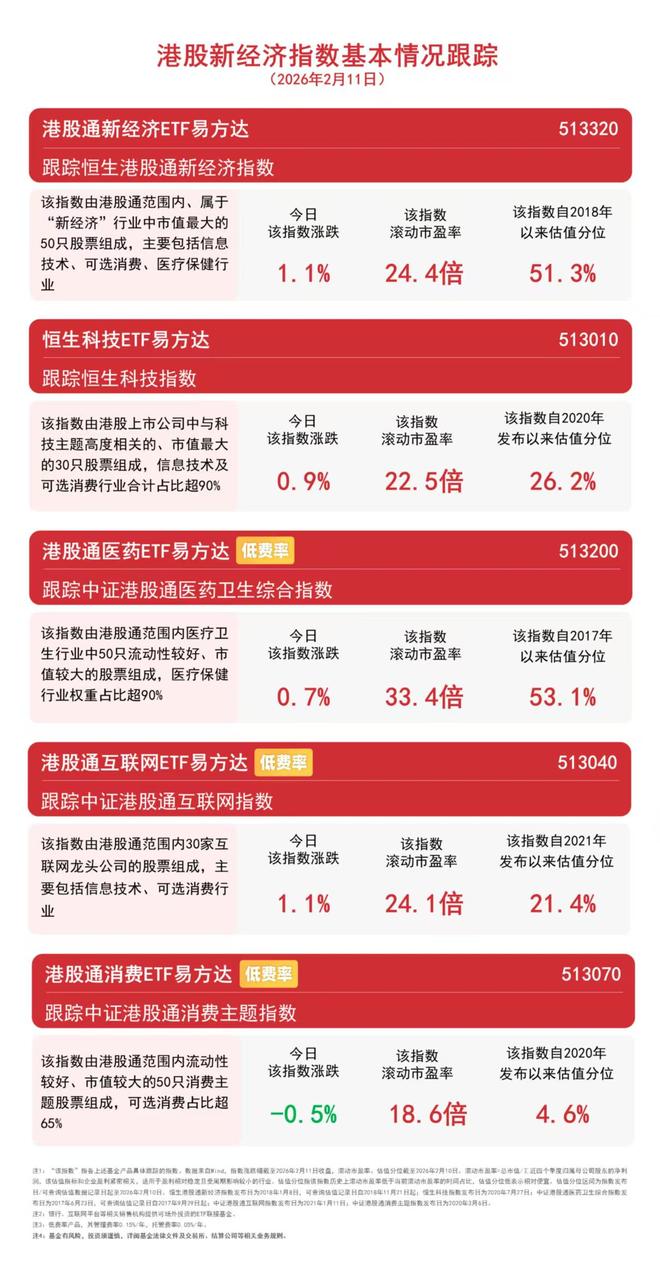
Group 1 - The core indices related to Hong Kong stocks showed positive performance, with the CSI Hong Kong Stock Connect Internet Index and the Hang Seng Hong Kong Stock Connect New Economy Index both rising by 1.1%, while the Hang Seng Technology Index increased by 0.9% and the CSI Hong Kong Stock Connect Healthcare Index rose by 0.7%. However, the CSI Hong Kong Stock Connect Consumer Theme Index declined by 0.5% [1] - The E Fund Hang Seng Technology ETF (513010) has seen a net inflow of funds for seven consecutive trading days, totaling 2.3 billion yuan [1] Group 2 - The Hang Seng Hong Kong Stock Connect New Economy Index consists of 50 stocks from the "new economy" sectors with the largest market capitalization, primarily including information technology, consumer discretionary, and healthcare [2] - The rolling price-to-earnings (P/E) ratio for the Hang Seng Hong Kong Stock Connect New Economy Index is 24.4 times, with a valuation percentile of 51.3% since its inception in 2018 [2] - The Hang Seng Technology Index is composed of 30 stocks highly related to technology, with over 90% of its composition from information technology and consumer discretionary sectors. Its rolling P/E ratio is 22.5 times, with a valuation percentile of 26.2% since its launch in 2020 [2] - The CSI Hong Kong Stock Connect Healthcare Index includes 50 liquid and high-value stocks in the healthcare sector, with a rolling P/E ratio of 33.4 times and a valuation percentile of 53.1% since its inception in 2017 [2] - The CSI Hong Kong Stock Connect Internet Index consists of 30 leading internet companies, with a rolling P/E ratio of 24.1 times and a valuation percentile of 21.4% since its launch in 2021 [2] - The CSI Hong Kong Stock Connect Consumer Theme Index is made up of 50 liquid and large-cap consumer stocks, with over 65% in consumer discretionary. Its rolling P/E ratio is 18.6 times, with a valuation percentile of 4.6% since its inception in 2020 [3]

科创板系列指数震荡走弱,关注科创200ETF易方达(588270)、科创50ETF易方达(588080)等布局机会
Mei Ri Jing Ji Xin Wen· 2026-02-02 06:08
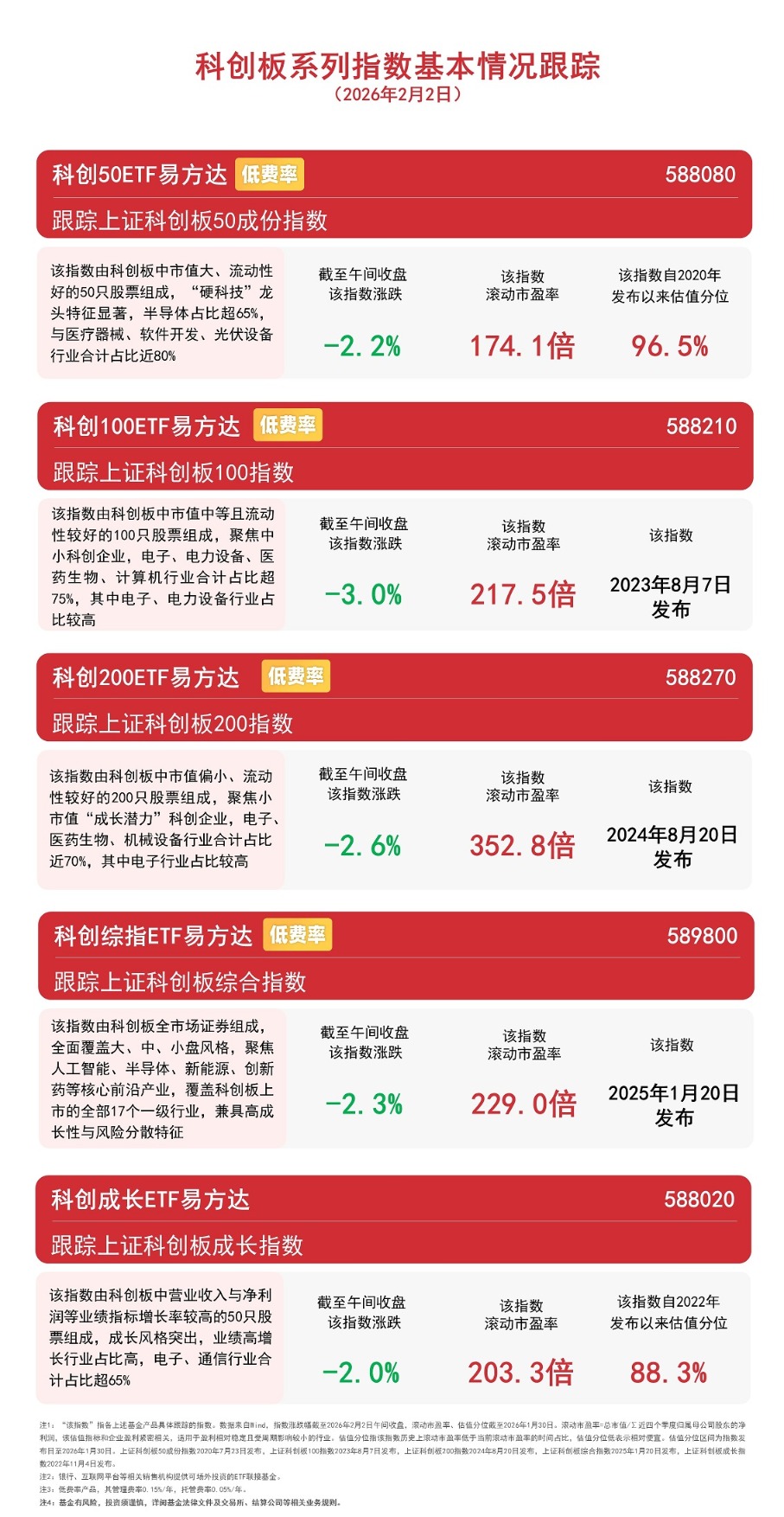
Core Viewpoint - The news discusses various ETFs tracking the STAR Market indices, highlighting their performance, composition, and fee structures, indicating a focus on technology and growth sectors in China. Group 1: ETF Performance and Composition - The STAR 50 ETF tracks the STAR Market 50 Index, consisting of 50 large-cap stocks with significant liquidity, primarily in the semiconductor sector, which accounts for over 65% of the index [2] - The STAR 100 ETF follows the STAR Market 100 Index, made up of 100 mid-cap stocks, with a focus on small and medium-sized tech companies, where electronics and power equipment sectors represent over 75% [2] - The STAR 200 ETF tracks the STAR Market 200 Index, comprising 200 small-cap stocks, with a high concentration in electronics, pharmaceuticals, and machinery, accounting for nearly 70% of the index [2] Group 2: Index Performance Metrics - The STAR 50 Index has a rolling P/E ratio of 174.1, with a performance change of -2.2% [2] - The STAR 100 Index has a rolling P/E ratio of 217.5, with a performance change of -3.0% as of August 7, 2023 [2] - The STAR 200 Index has a rolling P/E ratio of 352.8, with a performance change of -2.6% [2] Group 3: Growth Focus and Sector Representation - The STAR Growth ETF tracks the STAR Market Growth Index, consisting of 50 stocks with high growth rates in revenue and net profit, with over 65% in electronics and communications sectors [5] - The growth style is emphasized, indicating a focus on companies with strong performance metrics [5]
银河博时MSCI中国东盟经济互联指数ETF明日挂牌上市 每手入场费约1000港元
Zhi Tong Cai Jing· 2026-01-27 13:24
Core Viewpoint - Bosera Fund has launched the Galaxy Bosera MSCI China-ASEAN Economic Connectivity Index ETF (02805), set to be listed on January 28, which tracks the MSCI China-ASEAN Economic Connectivity Index [1] Group 1: ETF Details - The ETF will have a management fee of 0.5% per annum and requires a minimum investment of approximately 1,000 HKD based on an indicative net asset value of 10 HKD per share [1] - It offers trading in multiple currencies, including HKD, RMB (82805), and USD (09805) [1] Group 2: Index Composition - The MSCI China-ASEAN Economic Connectivity Index consists of two parts: the Hong Kong-listed component selected from the MSCI Southbound Hong Kong Index and the ASEAN-listed component selected from the MSCI AC ASEAN Index [1] - The index includes securities ranked in the top 50% based on their economic exposure to mainland China and Hong Kong, with a total of 89 constituent stocks as of September 30, 2025, and a total market capitalization of 16.2 trillion HKD [1]
ETF基金周度跟踪(0119-0123):黄金股ETF领涨,资金大幅流出沪深300ETF-20260124
CMS· 2026-01-24 09:48
1. Report Industry Investment Rating No relevant content provided in the given text 2. Core Viewpoints of the Report The report focuses on the performance of the ETF fund market, summarizing the past week's (January 19 - January 23, 2026) performance and fund flow of the ETF fund market, different popular sub - type ETF funds, and innovative theme and sub - industry ETF funds. Stock ETFs had a mixed performance this week, with commodity - type ETFs performing well. Funds mainly flowed into A - share cycle ETFs and A - share TMT ETFs, while significantly flowing out of A - share large - cap ETFs and A - share small - and medium - cap ETFs [1][2][3]. 3. Summary by Relevant Catalogs 3.1 ETF Market Overall Performance - **Market Performance**: This week, stock ETFs showed a mixed performance, with commodity - type ETFs performing well. Shanghai - Hong Kong - Shenzhen theme (mainly gold stocks), commodity, and cycle ETFs had the highest gains, with above - scale funds rising by 12.97%, 6.82%, and 5.10% on average respectively. Conversely, Hong Kong - listed pharmaceutical and biotech and Shanghai - Hong Kong - Shenzhen industries declined, with above - scale funds falling by 2.94% and 2.10% on average [2][5]. - **Fund Flow**: Funds mainly flowed into A - share cycle ETFs and A - share TMT ETFs, with net inflows of 17.825 billion yuan and 12.593 billion yuan respectively throughout the week. In contrast, A - share large - cap ETFs and A - share small - and medium - cap ETFs had significant net outflows of 271.992 billion yuan and 83.151 billion yuan respectively [3][7]. 3.2 Different Popular Sub - type ETF Funds Market Performance - **A - share ETFs**: Various sub - types of A - share ETFs, including broad - based index (full - market, large - cap, small - and medium - cap, science and technology/growth enterprise board), industry (TMT, manufacturing, consumption, pharmaceutical and biotech, cycle, finance and real estate), SmartBeta (value, growth, dividend, free cash flow), and theme ETFs, had different performance and fund flow situations. For example, in the TMT industry, the Huaxia CSI Grid Equipment Theme ETF had a net inflow of 7.643 billion yuan and a weekly increase of 4.91% [19][20]. - **Hong Kong - listed ETFs**: Similar to A - share ETFs, Hong Kong - listed ETFs in different sub - types (broad - based index, industry, SmartBeta, theme) also showed different trends. For instance, in the TMT industry, the Huatai - Ba瑞 Hang Seng Technology ETF had a net inflow of 575 million yuan but a weekly decline of 0.53% [31]. - **Shanghai - Hong Kong - Shenzhen ETFs**: Industry and theme Shanghai - Hong Kong - Shenzhen ETFs had their own performance characteristics. For example, the Yongying CSI Shanghai - Hong Kong - Shenzhen Gold Industry Stock ETF had a net inflow of 1.786 billion yuan and a weekly increase of 12.95% [35]. - **US - listed ETFs**: US - listed ETFs in broad - based index and industry sub - types also had different performance. For example, the Guangfa NASDAQ 100 ETF had a net inflow of 5 million yuan but a weekly decline of 0.64% [37]. - **Other QDII - ETFs (excluding Hong Kong and US)**: These ETFs had different trends. For example, the Huatai - Ba瑞 CSI Korea Exchange Korea - China Semiconductor ETF had a net inflow of 80 million yuan and a weekly increase of 1.04% [39]. - **Bond ETFs**: Different bond ETFs had different performance and fund flow. For example, the Bosera CSI Convertible Bonds and Exchange - able Bonds ETF had a net inflow of 2.456 billion yuan and a weekly increase of 2.94% [40]. - **Commodity ETFs**: Commodity ETFs, mainly gold and non - ferrous metal futures, performed well. For example, the Huaxia Gold ETF had a net inflow of 884 million yuan and a weekly increase of 7.88% [41]. 3.3 Innovative Theme and Sub - industry ETF Funds Market Performance - **TMT Innovative Theme**: The performance of different TMT innovative themes varied. For example, the Xinchuang theme had a weekly increase of 3.39%, and the representative fund, the E Fund China Securities Information Technology Innovation Theme ETF, had a weekly increase of 3.54% [43]. - **Consumption Sub - industry**: Different consumption sub - industries had different performance. For example, the Guozheng Grain theme had a weekly increase of 4.24%, and the representative fund, the Penghua Guozheng Grain Industry ETF, had a weekly increase of 4.25% [44]. - **Pharmaceutical Sub - industry**: The pharmaceutical sub - industries also showed different trends. For example, the CSI Traditional Chinese Medicine theme had a weekly increase of 0.57%, and the representative fund, the Huitianfu CSI Traditional Chinese Medicine ETF, had a weekly increase of 0.57% [45]. - **New Energy Theme**: New energy - related themes generally performed well. For example, the Photovoltaic Industry theme had a weekly increase of 6.95%, and the representative fund, the Huatai - Ba瑞 CSI Photovoltaic Industry ETF, had a weekly increase of 9.17% [46]. - **Central and State - owned Enterprises Theme**: Different central and state - owned enterprises themes had different performance. For example, the Central Enterprises Science and Technology Leading theme had a weekly increase of 4.34%, and the representative fund, the Southern CSI Guoxin Central Enterprises Science and Technology Leading ETF, had a weekly increase of 4.54% [47]. - **Stable - growth Theme**: Stable - growth themes such as building materials, chemical industry, and steel showed good performance. For example, the Building Materials theme had a weekly increase of 9.47%, and the representative fund, the Guotai CSI All - Industry Building Materials ETF, had a weekly increase of 9.70% [48]. - **Shanghai - Hong Kong - Shenzhen/Hong Kong Stock Connect Sub - industry**: These sub - industries had different trends. For example, the Hong Kong Stock Connect Consumption theme had a weekly increase of 3.11%, and the representative fund, the Yinhuazhong CSI Hong Kong Stock Connect Consumption ETF, had a weekly increase of 2.37% [49]. - **Dividend/Dividend Low - Volatility Index Family**: Different dividend - related indexes had different performance. For example, the CSI Dividend index had a weekly increase of 2.15%, and the representative fund, the E Fund CSI Dividend ETF, had a weekly increase of 2.19% [50]. - **Science and Technology/Growth Enterprise Board Index Family**: These indexes also showed different trends. For example, the Science and Technology Innovation 50 index had a weekly increase of 2.62%, and the representative fund, the Huaxia Shanghai Stock Exchange Science and Technology Innovation 50 ETF, had a weekly increase of 2.64% [51].
1月以来公告上市股票型ETF平均仓位22.45%
Zheng Quan Shi Bao Wang· 2026-01-14 04:41
Core Viewpoint - Three stock ETFs have recently published listing announcements, with varying stock positions indicating different investment strategies and market conditions [1] Group 1: ETF Stock Positions - The stock position of the GF Guozhen Industrial Software Theme ETF is 31.04% [1] - The stock position of the E Fund Shanghai Stock Exchange Science and Technology Innovation Board Chip Design Theme ETF is 5.36% [1] - The stock position of the E Fund CSI Hong Kong Stock Connect Medical Theme ETF is 4.78% [1] - The highest stock position among newly listed ETFs is 65.79% for the Penghua CSI General Aviation Theme ETF [1] - Other notable stock positions include 62.01% for the Xingquan CSI 300 Quality ETF, 40.68% for the Jianxin Growth Enterprise Board Comprehensive Enhanced Strategy ETF, and 35.10% for the Huaxia CSI All-Share Food ETF [1] Group 2: ETF Fundraising and Investor Structure - Since January, 15 stock ETFs have announced listings, with an average fundraising of 333 million shares [2] - The largest fundraising amounts are 1.157 billion shares for the Xingquan CSI 300 Quality ETF, 514 million shares for the Ping An Hang Seng China Central Enterprise Dividend ETF, and 300 million shares for the E Fund CSI Engineering Machinery Theme ETF [2] - Institutional investors hold an average of 11.17% of the shares, with the highest proportions being 25.59% for the Ping An Hang Seng China Central Enterprise Dividend ETF, 21.34% for the Penghua CSI General Aviation Theme ETF, and 20.28% for the Jianxin Growth Enterprise Board Comprehensive Enhanced Strategy ETF [2]
ETF主力榜 | 化工龙头ETF(516220)主力资金净流出519.10万元,居可比基金前2-20260107
Xin Lang Cai Jing· 2026-01-07 09:00
Group 1 - The core viewpoint of the article indicates that the Chemical Leaders ETF (516220.SH) experienced a decline of 0.52% on January 7, 2026, with a significant net outflow of main funds amounting to 519.10 thousand yuan, ranking it among the top two in comparable funds [1] - Over the past two days, the fund has seen an accelerated outflow of main funds totaling 625.83 thousand yuan, also ranking it among the top two in comparable funds [1] - The latest trading volume for the Chemical Leaders ETF is reported at 14.4 million shares, with a total transaction amount of 13.6 million yuan, placing it among the bottom three in comparable funds [1]
上证180指数ETF今日合计成交额1.53亿元,环比增加66.18%
Zheng Quan Shi Bao Wang· 2025-12-31 10:58
Core Viewpoint - The trading volume of the Shanghai Stock Exchange 180 Index ETFs increased significantly today, with a total trading amount of 153 million yuan, representing a week-on-week increase of 60.86 million yuan, or 66.18% [1] Trading Volume Summary - The Huazhong Shanghai 180 ETF (510180) had a trading volume of 94.61 million yuan, an increase of 50.34 million yuan from the previous trading day, with a week-on-week growth of 113.74% [1] - The Shang 180 ETF (530800) recorded a trading volume of 4.96 million yuan, up by 4.72 million yuan from the previous day, marking a week-on-week increase of 1927.86% [1] - The Southern Shanghai 180 ETF (530580) had a trading volume of 18.31 million yuan, an increase of 3.92 million yuan, with a week-on-week growth of 27.23% [1] Market Performance Summary - As of market close, the Shanghai 180 Index (000010) fell by 0.16%, while the average decline of related ETFs tracking the index was 0.12% [1] - The ETFs with the largest declines included the Ping An Shanghai 180 ETF (530280) and the Industrial Bank Shanghai 180 ETF (530680), which fell by 0.33% and 0.17%, respectively [1]
【晨星潜力基金系列】:盘点四只值得关注的ETF
Morningstar晨星· 2025-12-25 01:04
Core Insights - The article emphasizes the importance of independent research and long-term investment strategies in fund selection, highlighting four ETFs in the equity asset category that are worth attention for investors [1] Group 1: Market Trends - As of December 31, 2024, the one-year winning rate of active small-cap funds decreased from 49.6% in 2023 to 38.2%, and the three-year winning rate dropped from 58.7% to 37.6%, indicating a weakening ability of active funds to generate excess returns [2] - The market is increasingly favoring passive products, leading to improved pricing efficiency and overall market effectiveness [2] - The China Securities Regulatory Commission's action plan for promoting high-quality development of public funds is expected to further constrain the ability of active funds to create significant excess returns [2] Group 2: Index Overview - The index tracked by the passive funds is categorized as a mid-cap balanced stock fund, consisting of 500 stocks that are excluded from the CSI 300 index, reflecting the overall performance of mid to large-cap stocks [3][15] - The index is designed to balance market capitalization and liquidity, with a semi-annual adjustment mechanism to maintain stability and reduce turnover rates [4][16] Group 3: Fund Highlights - **E Fund CSI 500 ETF**: Established on August 27, 2015, this fund employs a full replication strategy to track the CSI 500 Index, managed by a team with extensive experience in index investment [7][8] - **Huatai-PB CSI 500 ETF**: Launched on May 13, 2015, this fund also follows a full replication method and is managed by a team with a clear division of responsibilities, focusing on daily index tracking and risk management [11][12] - **China Asset CSI 1000 ETF**: Founded on March 18, 2021, this fund utilizes a full replication strategy and has a robust operational framework supported by a stable team with significant experience in index fund management [19][20] - **E Fund CSI 1000 ETF**: Established on July 28, 2022, this fund follows a similar operational model as other E Fund products, focusing on systematic management and risk control [23][24] Group 4: Performance Metrics - As of September 30, 2025, the E Fund CSI 500 ETF had a scale of 2.95 billion, with a fee level in the lowest quartile among similar products [8] - The Huatai-PB CSI 500 ETF had a scale of 980 million as of September 30, 2025, also positioned in the lowest fee quartile [12] - The China Asset CSI 1000 ETF reached a scale of 45.47 billion by September 30, 2025, with a management fee reduced to 0.15%, placing it in the lowest fee quartile [20] - The E Fund CSI 1000 ETF had a scale of 1.56 billion as of September 30, 2025, with similar fee reductions, enhancing its cost competitiveness [24]

LOF涨停狂潮,谁制造的狂欢?
财联社· 2025-12-25 01:02
Core Viewpoint - The article discusses the recent surge in the trading of LOF funds, particularly the Guotou Silver LOF, amidst rising precious metal prices, highlighting the speculative behavior of retail investors and the regulatory responses to curb excessive trading activities [2][6][9]. Group 1: Market Dynamics - Guotou Silver LOF has experienced a continuous three-day trading halt due to a nearly 70% premium, leading to a wave of over 20 LOF funds hitting the trading limit [3][6]. - The surge in LOF prices is attributed to three main factors: rising international gold and silver prices, the impact of the Christmas holiday on overseas markets, and multiple products under Guotou Ruijin also reaching trading limits [6][9]. - The trading behavior has prompted multiple risk warnings from fund companies, indicating that the secondary market prices are significantly higher than the net asset values, raising concerns about potential losses for investors [5][6]. Group 2: Regulatory Actions - In response to the speculative trading, regulatory bodies have implemented strict measures, including monitoring abnormal trading behaviors and potentially restricting investor accounts [8][9]. - Guotou Silver LOF has adjusted its subscription limits multiple times, reflecting the challenges in managing investor demand and the inherent risks associated with the fund's structure [9][12]. Group 3: Future of LOF Funds - There is ongoing debate about the relevance of LOF funds in the current market, with some industry insiders suggesting that they may represent outdated financial products compared to ETFs [13][15]. - The article notes that many LOF funds are transitioning to ETF-linked funds, indicating a shift in investor preference towards more efficient investment vehicles [15]. - Concerns are raised about the operational inefficiencies of LOF funds, particularly regarding their cash-based redemption process and the lag in arbitrage opportunities, which may hinder their competitiveness in the long run [13][14].