
反垄断

Search documents
密歇根州起诉石油公司 指控其合谋遏制电动汽车竞争
Xin Lang Cai Jing· 2026-01-23 16:58
Core Viewpoint - The Attorney General of Michigan, Dana Nessel, has filed an antitrust lawsuit against four major oil companies, accusing them of colluding for decades to hinder competition in the renewable energy sector, including electric vehicles [1][2]. Group 1: Lawsuit Details - The defendants in the lawsuit include BP, Chevron, ExxonMobil, Shell, and the American Petroleum Institute [1][2]. - The lawsuit claims that these companies operate in a cartel-like manner, agreeing to reduce the production and distribution of renewable electricity and suppress the rise of electric vehicles and renewable energy technologies in the U.S. market [1][2].


佛山6家燃气企业拟投资合营新企业,市场监管总局叫停
Nan Fang Du Shi Bao· 2026-01-23 10:11
Core Viewpoint - The State Administration for Market Regulation has prohibited the establishment of a joint venture between several gas companies in Foshan, marking the first ban on concentration in the public utility sector since the implementation of the Anti-Monopoly Law in China [1][5]. Group 1: Joint Venture Proposal - In October 2024, six companies, including Bluebird Gas and Nanguan Gas, planned to establish a joint venture in Foshan to invest in and operate a liquefied petroleum gas storage and distribution station [3]. - The joint venture was intended to provide gas source procurement, storage, and filling services for bottled liquefied petroleum gas sold by the participating companies in the Nanhai District [3]. Group 2: Market Analysis - The market share of the six companies in the bottled liquefied petroleum gas market in Foshan was already between 60% and 65%, and the proposed joint venture would create a single entity with a market share exceeding 60%, significantly enhancing market control [3][4]. - The number of operators in the local bottled liquefied petroleum gas market would decrease from eight to four, with the Herfindahl-Hirschman Index (HHI) rising from 1967 to 4640, indicating a substantial increase in market concentration [4]. Group 3: Competitive Concerns - The concentration would lead to a higher likelihood of coordinated behavior among remaining competitors, as the market environment is stable with inelastic demand and high product homogeneity [4][5]. - The joint venture would increase transparency regarding costs, production, and sales, making it easier for operators to reach explicit or implicit agreements on pricing [5]. - The remaining competitors would struggle to effectively challenge price increases by the concentrated entity, as barriers to entry are high and existing competitors are expected to have high capacity utilization rates [4][5].

印度或罚苹果380亿美元
Guan Cha Zhe Wang· 2026-01-23 09:37
Core Viewpoint - India's antitrust agency has issued an ultimatum to Apple, threatening to proceed with an investigation that could result in fines up to $38 billion if the company continues to delay its response [1][2]. Group 1: Antitrust Investigation - The case against Apple dates back to 2022 when Match Group and several Indian startups accused the company of abusing its dominant market position by imposing unfair commissions on app developers, known as the "Apple tax" [1]. - The Indian Competition Commission (CCI) has preliminarily found that Apple has abused its market dominance, affecting developers' returns and growth [1]. - In 2024, India revised its antitrust laws to increase penalties for violations, allowing fines to be based on a company's global revenue, with a cap of 10% of the average global turnover over the past three years [1]. Group 2: Legal Proceedings - Following the CCI's findings, Apple filed a lawsuit in the Delhi High Court, claiming that the penalty regulations are unconstitutional and disproportionate [2]. - The CCI has pressured Apple to submit objections to the investigation results and provide global financial data for penalty assessment, but Apple has repeatedly requested extensions [2]. - The CCI issued a final ultimatum to Apple, stating that if no response is received within a week, it will unilaterally advance the case [2]. Group 3: Global Context - The legal challenges Apple faces in India are part of a broader trend, as regulatory bodies in regions like the EU and the US have also taken action against the "Apple tax" [3]. - In 2020, the EU initiated an antitrust investigation against Apple, resulting in a €1.84 billion fine in 2024 and new regulations requiring Apple to allow software downloads from outside its app store [3]. - In the US, Epic Games has successfully pushed for a court ruling requiring Apple to allow external payment links, leading to changes in Apple's App Store guidelines [4]. Group 4: Compliance Measures - In response to regulatory pressures, Apple has relaxed its App Store policies in Japan, reducing the commission rates for the "Apple tax" to between 10% and 21% [5].


顺丰同城股价持续走高,机构称即时配送行业具备需求动力,公司业务增长与盈利预期向好
Zhi Tong Cai Jing· 2026-01-23 05:32
Core Viewpoint - The State Council's Anti-Monopoly and Anti-Unfair Competition Committee is investigating the market competition in the food delivery platform service industry, which is expected to lead to more compliant competition in the instant retail sector, driving growth in higher-priced categories and providing more growth opportunities for logistics [3] Group 1: Market Competition and Growth - The investigation is based on the Anti-Monopoly Law of the People's Republic of China, indicating a regulatory focus on fair competition in the food delivery sector [3] - Increased compliance in competition is anticipated to shift product categories from food and beverages to higher-priced items, enhancing growth potential for logistics services [3] Group 2: Consumer Behavior and Order Growth - High-frequency subsidies have successfully cultivated consumer habits, with increased investment expected to directly boost the scale of instant delivery orders, becoming a key source of industry demand growth [3] - During the New Year holiday period in 2026, daily average orders for same-city delivery increased by 55% year-on-year, with beverage orders doubling and fast food orders increasing by over 90% [3] Group 3: Category Performance - Categories such as supermarkets, beauty products, and electronics also saw significant year-on-year growth in order volume, with all food and non-food categories experiencing high double-digit growth, supporting holiday consumption and business operations [3] Group 4: Impact on Logistics Providers - The competitive landscape is favorable for third-party logistics service providers, with companies like SF Express benefiting from the overflow of delivery volumes from the food delivery battle, leading to positive business growth and profit expectations [3]
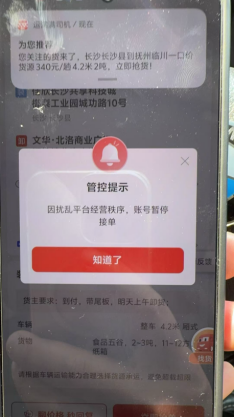
运满满陷“二选一”争议,司机贴竞品车贴遭封号,多重服务乱象引投诉
Zhong Guo Neng Yuan Wang· 2026-01-23 02:25
Core Viewpoint - The article discusses the competitive strategy of "Yunmanman" platform, which is perceived as a "choose one" approach, leading to account bans for drivers using "Huo Lala" branding, raising concerns about fair competition and industry regulations [1][17]. Group 1: Account Bans and Driver Experiences - Multiple drivers reported account bans or restrictions on the "Yunmanman" platform due to the presence of "Huo Lala" branding on their vehicles, which they claim disrupts their ability to operate normally [2][5][10]. - Drivers like "Cui" and "Hu" experienced account suspensions after uploading vehicle photos with "Huo Lala" branding, which were deemed to violate platform rules [2][5]. - The platform's customer service indicated that vehicles with competing brand advertisements could be considered non-compliant with operational standards, leading to restrictions on multi-platform order acceptance [8][10]. Group 2: Complaints and Service Issues - The "Yunmanman" platform has faced significant complaints, totaling 11,829, related to issues such as unfair terms, delayed payments, and forced branding [11][12]. - Complaints also include allegations of forced overloading and high-interest loans, with drivers expressing concerns over the platform's practices that may violate legal standards [16][19]. - The platform's practices have raised alarms regarding the potential abuse of market dominance, as highlighted by legal experts and previous cases involving other major platforms [19][20]. Group 3: Regulatory and Industry Implications - The article emphasizes the need for regulatory oversight in the freight industry, particularly concerning the "choose one" strategy and other unfair practices that undermine driver rights [18][20]. - Recent amendments to antitrust laws explicitly prohibit monopolistic behaviors, and the actions of "Yunmanman" may fall under scrutiny for violating these regulations [19]. - Industry experts advocate for a balanced competitive environment that protects the rights of drivers while allowing platforms to pursue brand exclusivity within legal boundaries [20].

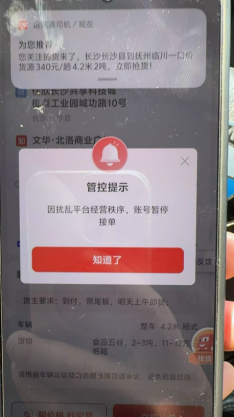
运满满陷 "二选一" 争议 司机贴竞品车贴遭封号 多重服务乱象引投诉
Zhong Guo Neng Yuan Wang· 2026-01-23 02:14
Core Viewpoint - The article discusses the competitive strategy of "er xuan yi" (choose one) employed by the logistics platform Yunmanman, which has led to account bans for drivers using the "Huo Lala" brand stickers, raising concerns about fair competition and industry regulations [1][17]. Group 1: Account Bans and Driver Impact - Multiple drivers reported account bans or restrictions on the Yunmanman platform due to the presence of "Huo Lala" brand stickers on their vehicles, which they claim has severely impacted their ability to conduct business [2][5][10]. - Drivers have received vague notifications regarding their account status, often linked to the presence of competitor branding, leading to confusion and frustration [10][7]. - The case of a driver named Cui, who had to remove the "Huo Lala" sticker to regain access to his account, exemplifies the challenges faced by drivers in maintaining multi-platform operations [2][10]. Group 2: Complaints and Service Issues - The Yunmanman platform has faced a significant number of complaints, totaling 11,829, related to issues such as unfair terms, delayed payments, and forced advertising [11][12]. - Specific complaints include allegations of forced overloading of vehicles and high-interest loans that exceed national standards, indicating a pattern of service irregularities [16][14]. - The platform's practices have raised concerns about the exploitation of drivers, with reports of penalties imposed for refusing to comply with unreasonable demands [16][14]. Group 3: Legal and Regulatory Concerns - The actions of Yunmanman may violate the Anti-Monopoly Law, particularly regarding the "er xuan yi" practice, which is seen as a potential abuse of market dominance [19][20]. - Regulatory bodies have been increasing efforts to protect the rights of truck drivers and ensure fair competition within the logistics industry [19][20]. - Experts emphasize the need for platforms to operate within legal frameworks and prioritize the rights of drivers and users, advocating for a balanced competitive environment [20].
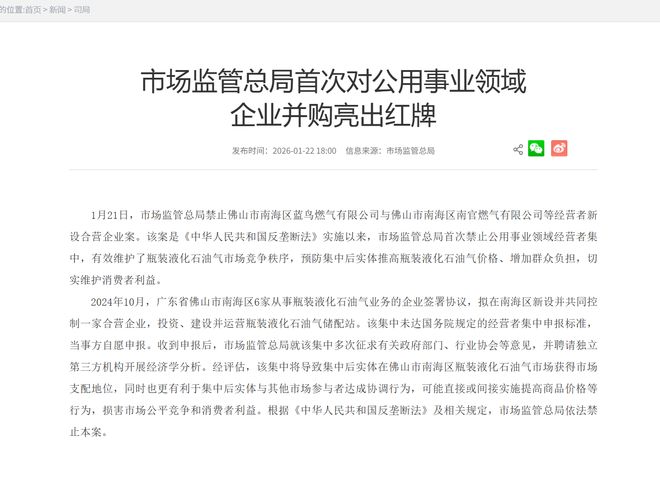
市场监管总局首次对公用事业领域亮“红牌”
Qi Huo Ri Bao Wang· 2026-01-23 01:28
Core Viewpoint - The State Administration for Market Regulation has prohibited the establishment of a joint venture between Bluebird Gas Co., Ltd. and Nanguan Gas Co., Ltd. in Nanhai District, Foshan, marking the first prohibition of a concentration in the public utility sector since the implementation of the Anti-Monopoly Law, aimed at maintaining competition in the bottled liquefied petroleum gas market and protecting consumer interests [1] Group 1 - The announcement is a response to a proposed joint venture by six companies in Foshan's bottled liquefied petroleum gas business, which intended to invest in and operate a gas storage and distribution station [1] - The proposed concentration did not meet the reporting standards set by the State Council, but the parties voluntarily submitted a report [1] - The market regulation authority conducted multiple consultations with relevant government departments and industry associations, and engaged an independent third-party organization for economic analysis [1] Group 2 - The evaluation indicated that the concentration would grant the involved entities a dominant market position in the bottled liquefied petroleum gas market in Nanhai District, potentially leading to coordinated actions that could harm fair competition and consumer interests [1] - The decision to prohibit the concentration is based on the provisions of the Anti-Monopoly Law and related regulations [1]
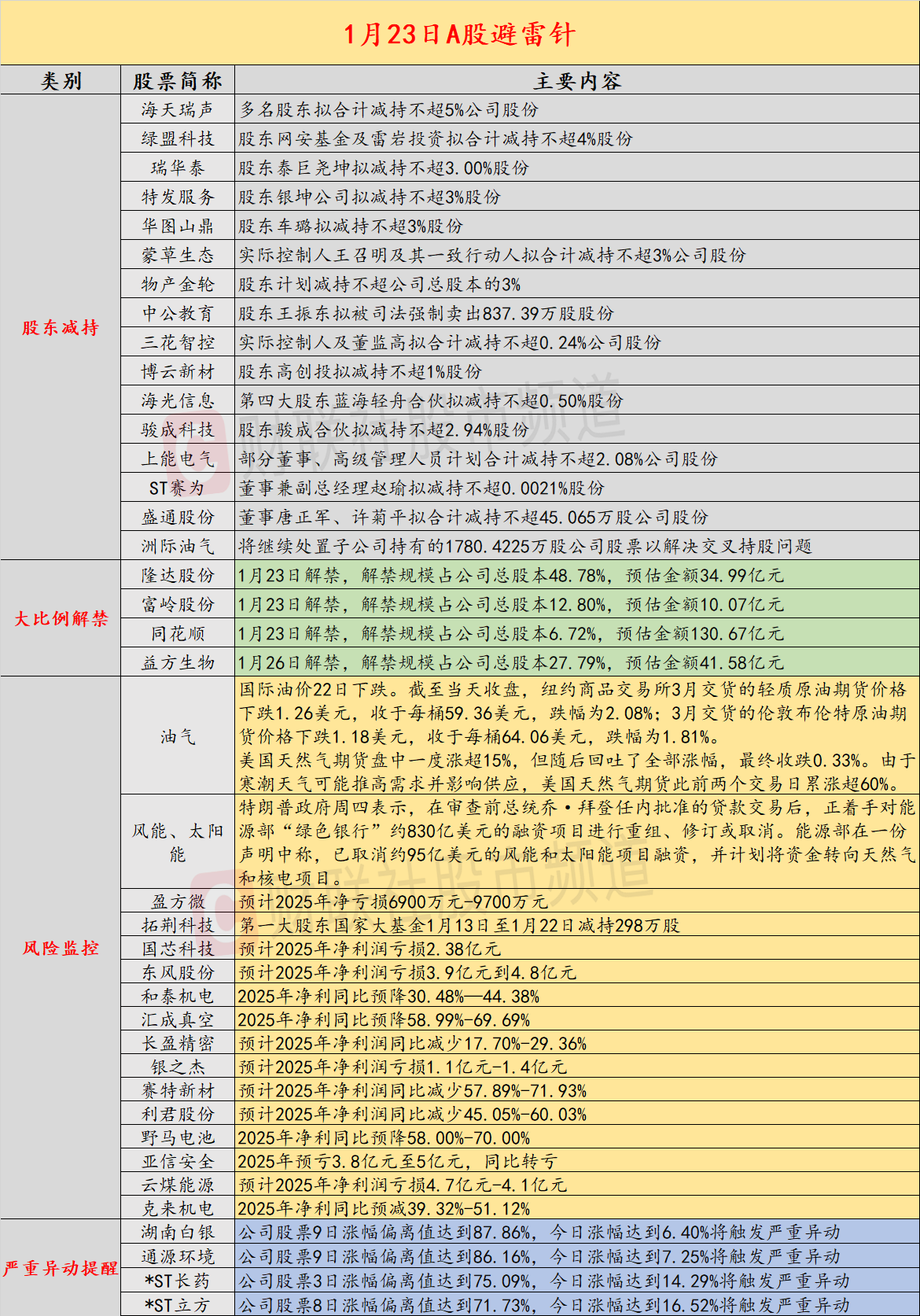
1月23日投资避雷针:3连板人气股公告 2025年预亏6900万元-9700万元
Xin Lang Cai Jing· 2026-01-23 00:24
Economic Information - The short-term consumer loan balance of residents in China has dropped below 9.5 trillion yuan, marking the lowest level in three years, with a decrease of 706.19 billion yuan or 6.93% from the previous year [2] - The State Administration for Market Regulation has prohibited the establishment of joint ventures in the public utility sector for the first time since the implementation of the Anti-Monopoly Law, aimed at maintaining competition in the liquefied petroleum gas market [2] Company Alerts - Yingfang Microelectronics expects a net loss of 69 million to 97 million yuan for 2025 [4] - Multiple shareholders of Huitian Ruisheng plan to reduce their holdings by no more than 5% of the company's shares [4] - Shareholders of various companies, including Green Alliance Technology and Ruihua Tai, are planning to reduce their holdings by up to 4% and 3% respectively [4][6] Overseas Alerts - Intel has issued a weak earnings forecast for the first quarter, expecting adjusted earnings per share of $0 and revenue between $11.7 billion and $12.7 billion, leading to a post-market drop of over 13% in its stock price [3] Risk Monitoring - Guoxin Technology anticipates a net loss of 238 million yuan for 2025 [6] - Dongfeng shares expect a net loss between 390 million and 480 million yuan for 2025 [6] - Various companies, including HeTai Machinery and Yema Battery, forecast significant declines in net profits for 2025, with reductions ranging from 30.48% to 70% [6][7]


预防推高瓶装液化石油气价格 公用事业领域并购首次被禁 市场监管总局:集中后实体将在当地获得垄断地位
Mei Ri Jing Ji Xin Wen· 2026-01-22 15:50
Core Viewpoint - The State Administration for Market Regulation (SAMR) has prohibited the establishment of a joint venture between several gas companies in Nanhai District, Foshan, marking the first ban on concentration in the public utility sector since the implementation of the Anti-Monopoly Law of the People's Republic of China. This decision aims to maintain competition in the bottled liquefied petroleum gas market and protect consumer interests by preventing price increases that could burden the public [1][2]. Group 1: Case Background - In October 2024, six companies engaged in bottled liquefied petroleum gas business in Nanhai District signed an agreement to establish a joint venture for investment, construction, and operation of a gas storage and distribution station [1][21]. - The concentration did not meet the reporting standards set by the State Council, but the parties voluntarily submitted a report to SAMR [1][2]. Group 2: Regulatory Process - SAMR received the antitrust report and found the initial submission incomplete, requiring additional information from the applicants [3]. - After reviewing the supplementary materials, SAMR determined that the case warranted acceptance despite not meeting the reporting threshold, initiating a preliminary review [5]. Group 3: Market Analysis - The joint venture was assessed to potentially grant the concentrated entity a dominant market position in the bottled liquefied petroleum gas market in Nanhai District, facilitating coordinated behavior among market participants and possibly leading to price increases [1][26]. - The market for this case was defined as bottled liquefied petroleum gas within the geographical scope of Nanhai District, Foshan [1][25]. Group 4: Competition Impact - The concentration is expected to significantly enhance the market control of the concentrated entity, with a post-concentration market share exceeding 60% and a Herfindahl-Hirschman Index (HHI) of 4640, indicating a high level of market concentration [1][28]. - The concentration could lead to a more stable market environment, high product homogeneity, and increased price transparency, making coordinated behavior among competitors more likely [1][28]. - Other competitors are projected to have a capacity utilization rate exceeding 85%, limiting the ability of downstream customers to switch suppliers and effectively constraining competition [1][28].

预防推高瓶装液化石油气价格,公用事业领域并购首次被禁,市场监管总局:集中后实体将在当地获得垄断地位
Mei Ri Jing Ji Xin Wen· 2026-01-22 13:02
Core Viewpoint - The State Administration for Market Regulation (SAMR) has prohibited the establishment of a joint venture between several gas companies in Nanhai District, Foshan, marking the first ban on concentration in the public utility sector since the implementation of the Anti-Monopoly Law in China, aimed at maintaining competition in the bottled liquefied petroleum gas market and protecting consumer interests [1]. Group 1 - On October 2024, six companies engaged in bottled liquefied petroleum gas business in Nanhai District, Foshan, signed an agreement to establish and jointly control a new joint venture for the investment, construction, and operation of a gas storage and distribution station [1]. - The proposed concentration did not meet the reporting standards set by the State Council, and the parties voluntarily submitted the proposal for review [1]. - The SAMR conducted multiple consultations with relevant government departments and industry associations, and commissioned an independent third-party organization to perform an economic analysis of the proposed concentration [1]. Group 2 - The evaluation indicated that the concentration would enable the involved entities to gain a dominant market position in the bottled liquefied petroleum gas market in Nanhai District, potentially facilitating coordinated behavior with other market participants, which could lead to price increases and harm fair market competition and consumer interests [1]. - Based on the findings, the SAMR legally prohibited the proposed concentration in accordance with the Anti-Monopoly Law and related regulations [1].
