
多边贸易体制

Search documents
德国外长:感谢中国
第一财经· 2025-12-08 14:16
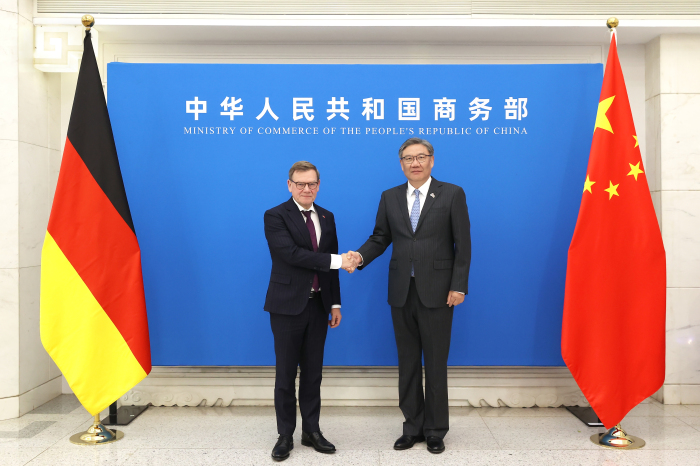
Core Viewpoint - The meeting between Chinese Commerce Minister Wang Wentao and German Foreign Minister Baerbock emphasizes the importance of strengthening China-Germany economic and trade relations, supporting free trade, and maintaining a multilateral trade system centered around the WTO [2][3][4]. Group 1: China-Germany Economic Relations - Wang Wentao highlighted the need to implement the important consensus reached by the leaders of both countries, focusing on opportunities presented by China's "14th Five-Year Plan" [3]. - The Chinese side encourages German companies to deepen cooperation in traditional sectors and explore new emerging fields, transforming the "opportunity list" into a "results list" [3]. - The Chinese government seeks a fair, open, and non-discriminatory policy environment for Chinese enterprises in Germany [3]. Group 2: Global Supply Chain Stability - Wang Wentao pointed out the rising trend of politicization and security concerns in economic issues, which severely disrupts global supply chain stability [3]. - The Chinese government is addressing German concerns regarding export controls and semiconductor issues, implementing a general licensing system for rare earths, and providing exemptions for semiconductor export licenses [3]. - The emphasis is placed on the need for the Dutch government to cease inappropriate administrative interventions to stabilize the semiconductor supply chain and prevent risks in the global automotive and consumer goods industries [3]. Group 3: Cooperation on Common Interests - Baerbock acknowledged China as Germany's most important economic partner, expressing a willingness to strengthen dialogue and practical cooperation on WTO reform, circular economy development, and climate change [4]. - The German government appreciates China's efforts in implementing a general licensing system for rare earths and is willing to collaborate on semiconductor issues to find long-term effective solutions [4].

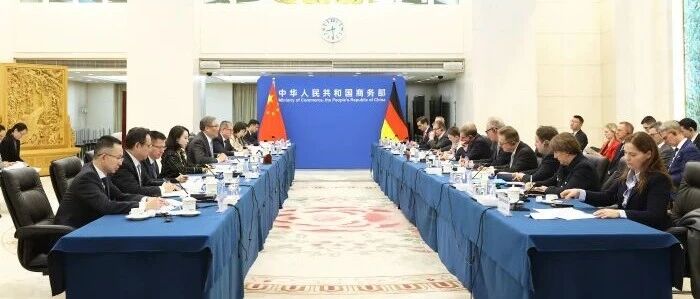
王文涛部长会见德国外长瓦德富尔
Shang Wu Bu Wang Zhan· 2025-12-08 13:24
Group 1 - The core viewpoint emphasizes the importance of deepening China-Germany economic and trade relations, as indicated by the recent meeting between Chinese Commerce Minister Wang Wentao and German Foreign Minister Baerbock [2][3] - Wang Wentao highlighted the need to implement the consensus reached by the leaders of both countries, advocating for free trade and the maintenance of a multilateral trade system centered around the WTO [3] - The Chinese side welcomes German companies to seize new opportunities presented by China's 14th Five-Year Plan and aims to convert the "opportunity list" into a "results list" through strengthened cooperation in both traditional and emerging sectors [3] Group 2 - Baerbock acknowledged China as Germany's most important economic partner, expressing a desire to enhance dialogue and pragmatic cooperation, particularly in areas like WTO reform and climate change [4] - The German government appreciates China's efforts in stabilizing the global supply chain, particularly regarding the implementation of a general licensing system for rare earths [4] - Both parties are committed to addressing semiconductor supply chain issues and finding long-term solutions collaboratively [4]
驻奥克兰总领馆经商处出席奥克兰大学国际经济学研讨会
Shang Wu Bu Wang Zhan· 2025-12-05 16:15
Group 1 - The first International Economics Seminar was held at the University of Auckland, featuring experts from various prestigious institutions discussing the evolution of multilateral trade systems and the impact of rising protectionism and unilateralism [2] - Topics included global value chain adjustments and national industrial policy trends, indicating a comprehensive examination of current economic challenges [2] Group 2 - The Consul Wang Chengguang emphasized that the Global South is reshaping the world trade landscape, with China actively supporting economic globalization [4] - The launch of the Eastern Airlines route from Shanghai to Auckland to Buenos Aires is expected to enhance cross-border movement of people and goods, aligning with New Zealand's "South Link" development concept [4]

中法联合声明
券商中国· 2025-12-05 09:00
Core Viewpoint - The joint statement emphasizes the commitment of China and France to strengthen global governance and multilateralism, highlighting the importance of the United Nations and the need for reforms to create a more inclusive international system [2][3]. Group 1: Multilateralism and Global Governance - China and France reaffirm their dedication to multilateralism as the cornerstone of international order, essential for promoting international cooperation and addressing global challenges [2]. - Both countries support the UN Secretary-General's "UN 80th Anniversary Reform Initiative" aimed at enhancing the representation of developing countries in governance platforms [3]. - The two nations advocate for a rules-based multilateral trading system centered around the World Trade Organization, aiming to create a free, open, transparent, and inclusive trade and investment environment [3]. Group 2: Economic Cooperation and Challenges - The statement acknowledges current global economic challenges, including insufficient growth momentum and imbalanced governance structures, calling for major economies to enhance dialogue and coordinate macroeconomic policies [3]. - France will assume the G7 presidency in 2026, while China will host the Asia-Pacific Economic Cooperation, with both countries expressing a willingness to engage in inclusive dialogue to address global governance challenges [3].
中国和法国发布关于加强全球治理的联合声明
Xin Jing Bao· 2025-12-05 05:10
Core Points - The visit of French President Emmanuel Macron to China from December 3 to 5, 2025, is aimed at reinforcing multilateralism and global governance [1] - Both leaders reaffirmed their commitment to maintaining the authority of the United Nations and supporting its reform initiatives [1][1][1] Group 1: Multilateralism and Global Governance - China and France emphasize the importance of multilateralism as the foundation of international order, essential for international cooperation and addressing global challenges [1][1] - The two countries support the UN Secretary-General's "UN 80th Anniversary Reform Initiative" to enhance the representation of developing countries in governance platforms [1][1][1] - They advocate for a rules-based multilateral trading system centered around the World Trade Organization, aiming for a free, open, transparent, and inclusive trade environment [1][1] Group 2: Economic Cooperation - Both nations call for major economies to enhance dialogue and coordinate macroeconomic policies to promote balanced and sustainable global economic development [1][1] - France will hold the G7 presidency in 2026, while China will host the Asia-Pacific Economic Cooperation, indicating a willingness to engage in inclusive dialogue on global governance challenges [1][1][1]
李强会见法国总统
Yang Guang Wang· 2025-12-05 04:46
Core Viewpoint - The meeting between Chinese Premier Li Qiang and French President Macron emphasizes the commitment to deepen bilateral relations and enhance cooperation in various sectors amidst increasing international economic and trade tensions [1] Group 1: Bilateral Relations - Li Qiang highlighted the direction set by the meeting between President Xi Jinping and President Macron for further developing China-France relations [1] - The Chinese side expressed willingness to continue traditional friendship, strengthen political mutual trust, and expand two-way openness [1] Group 2: Economic Cooperation - Both leaders discussed the need for timely communication and understanding to address economic and trade frictions, advocating for cooperation and proper resolution of mutual concerns [1] - Macron expressed France's intention to enhance dialogue and cooperation in areas such as trade, agriculture, and renewable energy [1] Group 3: Global Trade and Governance - The meeting underscored the importance of maintaining free trade and a multilateral trading system, as well as reforming and improving the global governance system [1]
商务部谈欧盟终止诉我世贸争端案件:是正确的选择
21世纪经济报道· 2025-12-04 11:16
我想再次强调的是,中方一贯严守世贸组织规则,将继续以实际行动坚定维护以规则为基础的 多边贸易体制。 来源:央视新闻 有媒体问:据报道,欧盟已宣布终止在世贸组织诉我贸易限制措施案(案号:DS610)。请问 您有何评论? 答:我注意到你所说的情况。中方始终认为,欧方启动案件缺乏依据。因此,欧方决定终止案 件审理是正确的选择。 商务部条约法律司负责人就欧盟终止诉我世贸争端案件答记者问。 ...
商务部回应欧盟终止诉中国世贸争端案:“是正确的选择”
Xin Hua Wang· 2025-12-04 10:11
新华社北京12月4日电(记者谢希瑶)商务部新闻发言人4日就欧盟终止诉中国世贸争端案件答记者 问时表示,欧方决定终止案件审理是正确的选择。 发言人强调,中方一贯严守世贸组织规则,将继续以实际行动坚定维护以规则为基础的多边贸易体 制。 【纠错】 【责任编辑:施歌】 有媒体问:据报道,欧盟已宣布终止在世贸组织诉中国贸易限制措施案。请问有何评论? 商务部新闻发言人说,中方始终认为,欧方启动案件缺乏依据。因此,欧方决定终止案件审理是正 确的选择。 ...
商务部谈欧盟终止诉我世贸争端案件:是正确的选择
Yang Shi Xin Wen· 2025-12-04 10:09
商务部条约法律司负责人就欧盟终止诉我世贸争端案件答记者问。 答:我注意到你所说的情况。中方始终认为,欧方启动案件缺乏依据。因此,欧方决定终止案件审理是 正确的选择。 我想再次强调的是,中方一贯严守世贸组织规则,将继续以实际行动坚定维护以规则为基础的多边贸易 体制。 有媒体问:据报道,欧盟已宣布终止在世贸组织诉我贸易限制措施案(案号:DS610)。请问您有何评 论? ...
商务部条约法律司负责人就欧盟终止诉我世贸争端案件答记者问
Shang Wu Bu Wang Zhan· 2025-12-04 09:16
答:我注意到你所说的情况。中方始终认为,欧方启动案件缺乏依据。因此,欧方决定终止案件审理是 正确的选择。 有媒体问:据报道,欧盟已宣布终止在世贸组织诉我贸易限制措施案(案号:DS610)。请问您有何评 论? 我想再次强调的是,中方一贯严守世贸组织规则,将继续以实际行动坚定维护以规则为基础的多边贸易 体制。 (文章来源:商务部网站) ...