机构库存

Search documents
公募规模创新高,为啥我们还是赚不到钱?
Sou Hu Cai Jing· 2026-01-01 03:41
Group 1 - The core point of the article highlights that despite the increasing scale of public funds, which reached 37.02 trillion yuan by the end of November, this does not necessarily translate to profits for individual investors [1][3] - The article emphasizes that while institutions hold 80% of circulating shares, their lack of active trading can lead to losses for retail investors, as seen in the example of a fund that grew in size but resulted in a 20% loss [3][4] - It is noted that many investors focus on superficial metrics like fund size and market trends without understanding the underlying trading intentions of institutions, which can lead to misguided investment decisions [3][9] Group 2 - The article discusses the concept of "false trends" in the stock market, where superficial price movements can mislead investors into making poor decisions [4][6] - It stresses that understanding trading behavior is significantly more valuable than merely observing price trends, as trading actions ultimately dictate market movements [8][9] - The importance of using quantitative data to analyze institutional trading behavior is highlighted, suggesting that this approach can provide clearer insights into market dynamics compared to traditional methods like following news or price charts [8][9]

苏州科创军团崛起,58家上市,总市值6700亿!
Sou Hu Cai Jing· 2025-12-31 12:50
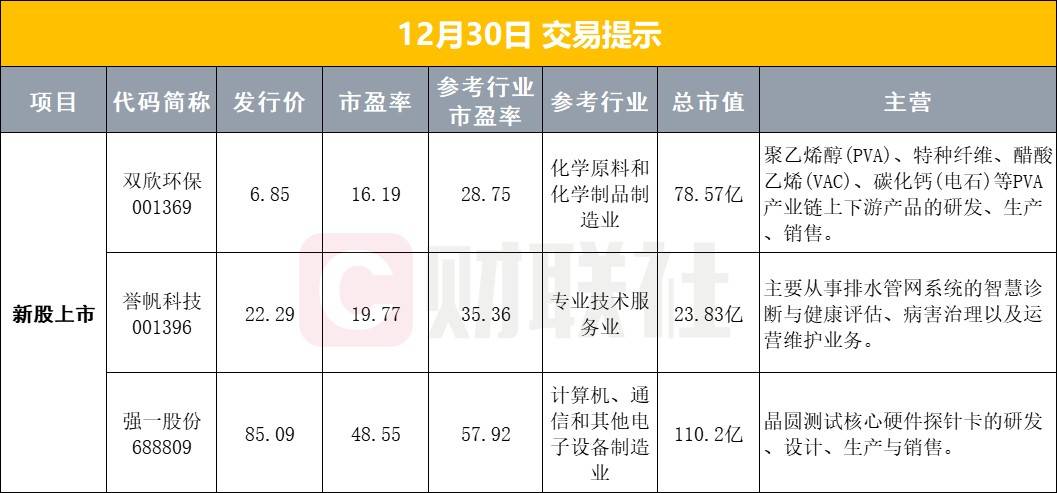
最近看到一条新闻,让我对咱们国家的科技创新实力有了更直观的感受。从2019年7月22日"科创板第一股"华兴源创登场,到2025年12月30日强一股份成功 上市,苏州的科创板企业数量已经达到了58家,占全国总数的9.6%,排在全国第三。更厉害的是,这些企业IPO融资总额超过了720亿元,总市值加起来有 6700亿左右,妥妥的"科创军团"。前三季度,这些公司研发投入就高达80亿,平均占收入的18%,硬科技底色十足。 看到这里,我就在想,这当然是地方经济和企业自身努力的结果。但对我们普通观察者来说,一个更实际的问题是:当这样的"利好"新闻出现,或者某个行 业、某个概念被市场热捧时,相关的公司是不是就一定能乘风破浪,表现亮眼呢?现实往往比想象复杂。 一、 新闻背后的市场逻辑:资金态度是关键 新闻里提到的苏州科创企业,覆盖了新一代信息技术、高端装备、生物医药等多个前沿领域,业绩和成长性都不错。这无疑为相关上市公司提供了坚实的基 本面支撑。但是,在资本市场上,一个公司的价值被市场发现和认可,除了自身质地,更离不开资金的持续关注和参与。 这就好比一个再好的剧本,也需要有实力的导演和演员投入热情去演绎,才能成为一部叫好又叫座 ...

AI政策+IPO升温,我靠这招看机构布局
Sou Hu Cai Jing· 2025-12-31 05:36
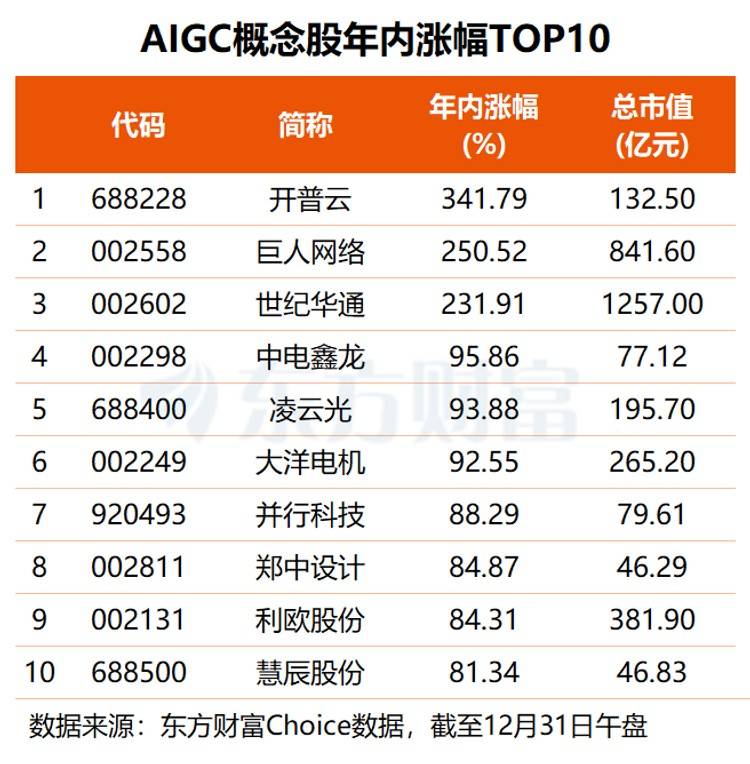
你有没有过这种经历?明明市场在反弹,手里的股票却涨得比别人慢;明明新闻说利好,自己买的股却纹丝不动?其实问题就出在"机构有没有参与"——我 用的大数据系统里,有个"机构库存"数据,能帮着看清机构的态度。 一、AI板块的热度,藏在机构的"干活痕迹"里 2025年4月市场反弹的时候,几乎所有股票都在涨,但有的涨得稳,有的却"晃来晃去"。我当时查了两只股票:左边那只,反弹时下面的橙色柱体(机构库 存)一直在线,说明机构一直在"干活"(持续参与交易),所以后面一路涨;右边那只,虽然也反弹,但橙色柱体几乎没有,说明机构没参与,结果后来就 拉胯了(看图1)。 好多朋友问我:"这些新闻会不会让手里的股票涨?"其实我想先说句实在话——新闻只是"引子",真正让股票涨得稳的,是机构大资金有没有在里面"实实 在在干活"。我们普通人跟机构比,差的就是"信息差":人家有渠道有资源,能提前知道消息、选好标的;我们研究政策、看基本面,根本赶不上节奏。但 我有个用了十多年的"笨办法",能看懂机构在选什么,今天就跟大家聊聊。 | | 代码 | 简称 | 年内涨幅 (%) | 总市值 (亿元) | | --- | --- | --- | --- ...
融资净买入多≠稳涨?看这数据才懂
Sou Hu Cai Jing· 2025-12-30 11:19
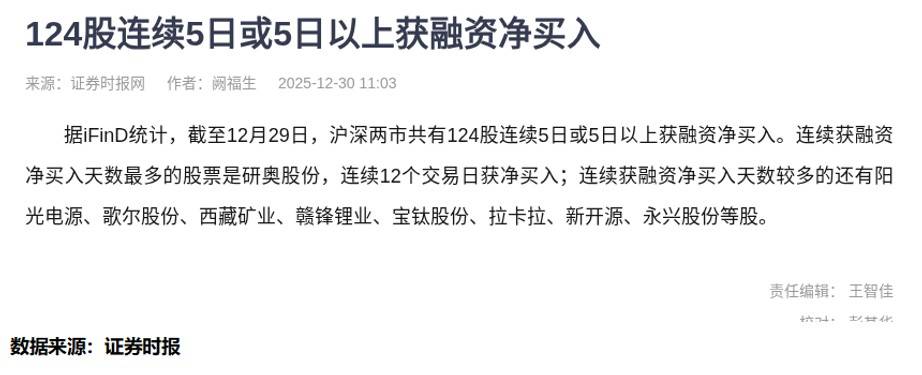
12月29日刷到个市场数据:沪深两市有124只股票连续5天甚至更久都获得融资净买入——最长的研奥股份连12个交易日都是净买 入。身边好几个朋友追着问:"这是不是要涨的信号?我要不要跟着买?"说实话,光看"融资净买入"这几个字真没用——就像你看 邻居天天买食材,却不知道他是自己做饭还是给别人带,得往深了看机构到底在里面"动没动"。 其实我早年炒股也踩过"看表面"的坑:遇到走势反复的股票,要么慌慌张张卖早了,要么死扛到套牢,后来才明白——走势是"假 动作",机构的交易行为才是"真内核"。而能看清这一点的,藏在"机构库存"这个数据里。 一、融资净买入背后,得看机构是不是"真在玩" 很多人觉得"融资买的人多=股票要涨",但我见过太多反例:有的股融资净买入堆得高,可机构压根没参与,最后股价越跌越深; 有的股融资没那么多,但机构一直在里面"折腾",反而涨得稳。关键就在"机构库存"——它不是说机构"买了多少",而是机构大资 金有没有在积极参与交易:要是机构根本没动或者动得太少,这数据就会消失;要是机构一直在里面"动作",数据就会保持活跃。 比如我之前跟踪过一只股,走势跟坐过山车似的,三次大跌又涨回来(看图1)。换作以前,我 ...
白银LOF闪崩后的资金启示
Sou Hu Cai Jing· 2025-12-26 19:12
Group 1 - The core point of the article is that the recent volatility of Guotou Silver LOF is driven by the dynamics of capital flow, particularly the actions of arbitrage funds, which led to a rapid price drop after a period of significant gains [2][3]. - The price surge of Guotou Silver LOF was due to a combination of limited external subscription and scarcity of on-market shares, resulting in a peak premium of 68% [2]. - The drop in price on December 25 was a result of arbitrage funds exiting the market as the premium decreased from 68% to 45%, indicating a narrowing profit margin for early sellers [2]. Group 2 - Liquidity is described as the "water" of the market, with stock prices being the "boats" floating on it, emphasizing that capital is the primary driver of price movements in both A-shares and US stocks [3]. - Historical examples are provided, such as the liquidity influx in 2014 and 2020 that led to significant market rallies in A-shares, demonstrating the importance of capital flow in driving market trends [5]. - The volatility of Guotou Silver LOF reflects the principle that increased buying leads to price increases, while increased selling results in price declines, highlighting the importance of capital quality over quantity [7]. Group 3 - The article discusses the example of the white liquor stocks' decline in May 2025, which was misinterpreted as a "black swan" event, while institutional funds had already signaled their lack of interest through trading behavior [9]. - It is noted that institutional participation is crucial for sustaining market trends, as retail and arbitrage funds often lead to short-term fluctuations rather than long-term stability [11]. - Conversely, some stocks can rise despite negative news if institutional funds are actively buying, indicating that institutional behavior can outweigh negative sentiment [11]. Group 4 - The article emphasizes the importance of using data to understand capital flows and avoid being caught in market traps, such as the sudden drop in Guotou Silver LOF or the decline in white liquor stocks [13]. - Data tools are likened to a "mirror" that reveals the true behavior of institutional funds, allowing investors to make more informed decisions based on market dynamics [14]. - The article concludes that understanding capital movement is essential for identifying market opportunities and avoiding pitfalls, advocating for the use of data to enhance investment decision-making [14].
融资客加仓电子行业,该跟着买还是先看这个?
Sou Hu Cai Jing· 2025-12-26 13:38
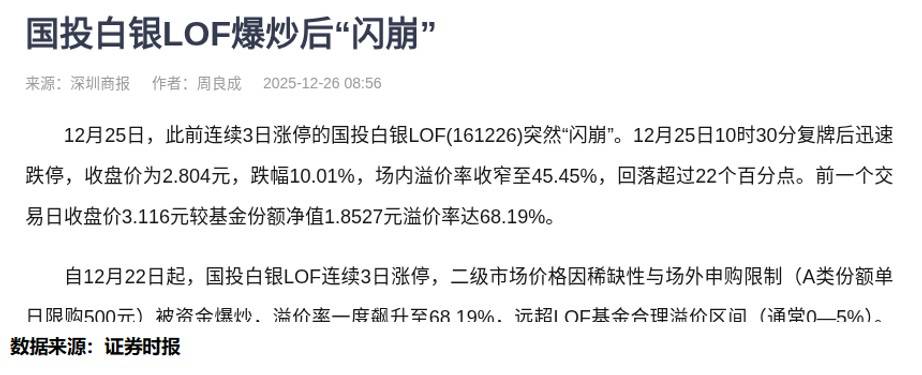
12月25日,Wind数据显示申万31个一级行业里有18个获得融资净买入,其中电子行业以46.34亿元的净买入额排在首位,电力设 备、机械设备等行业也在前列;个股方面,工业富联、航天电子等51只股票的融资净买入额超过1亿元。不少投资者看到这样的消 息,可能会第一反应——"融资客都在买,是不是该跟着布局?"但其实比"谁在买"更关键的,是"买的人在怎么操作"。毕竟市场里 的波动从来不是靠"资金流入"就能简单定义的:有些股票看着资金在进,可背后是机构在"洗盘";有些股票资金在出,反而藏 着"布局"的机会。接下来我们就借着这个融资数据的新闻,聊聊怎么用数据看清交易行为的真相,文章最后我会说这个新闻的结 论。。 一、融资加仓的方向,为什么不能直接跟着走? 很多投资者都有过这样的经历:看到某板块被融资客大幅加仓,赶紧冲进去,结果刚买就遇到剧烈调整,要么被吓止损,要么套在 高位。就像这次电子行业被融资加仓,要是单纯跟着买,很可能遇到"慢牛快调"的陷阱——股价明明长期在涨,可短期调整的幅度 能达到20%甚至30%,没几个人能扛住这种波动。 这里要先说明"机构库存"是什么:它不是指某个具体机构(比如基金、券商),也不是资金流入 ...
2026年美股或将有三大意外
Sou Hu Cai Jing· 2025-12-26 00:06
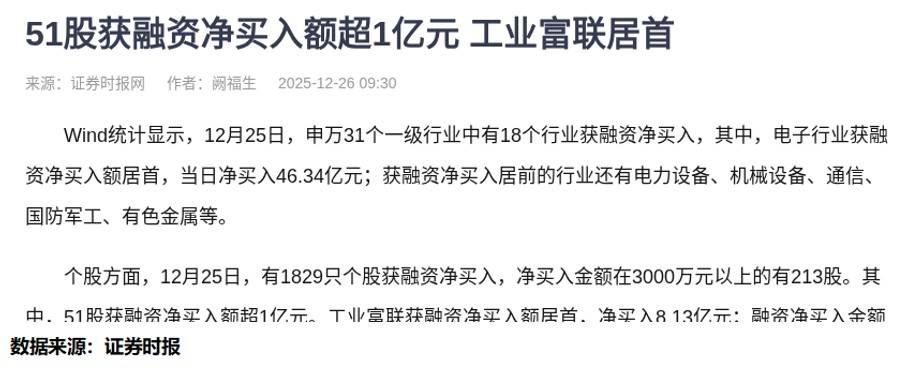
最近看智通财经的消息,华尔街对2026年美股行情的讨论挺热——摩根士丹利提了三个"意外"变化:经济增长但就业没起来(能压通胀、美联 储可能多降息)、股债又回到反向关系(以前股票涨债券跌,2025年两者都涨,明年可能变回去)、大宗商品(能源、金属)继续涨价(美元 贬值+中国经济反弹)。不少投资者问我:"这些新闻靠谱吗?会不会影响A股?"其实对普通股民来说,新闻再热闹,最头疼的还是"踩节 奏"——比如新闻出来时,行情是不是已经结束了?就像A股里常说的"买传闻卖新闻",核心从来不是新闻本身,是得看机构大资金的真实动 作。 一、新闻再热,不如看机构的真实动作 我有个做美股的朋友,去年踩过个大雷:美联储要降息的新闻出来当天,他冲进去买科技股,结果买了就套——后来才知道,机构早在新闻出 来前一个月就埋伏好了,等新闻落地正好出货。还有次,某公司出利空,他赶紧卖了,结果股价反而涨了,因为机构在利空时偷偷吸筹。这事 儿让他感慨:"新闻是给散户看的,机构早把节奏走完了。" A股里这种事儿更常见。比如2024年某新能源公司要搞重组,传闻刚出来时股价就涨了30%,等正式新闻发布那天,股价直接跌停——机构早 就在传闻期买够了,新闻出来 ...
136股连获融资净买,得看机构参与度
Sou Hu Cai Jing· 2025-12-25 07:26
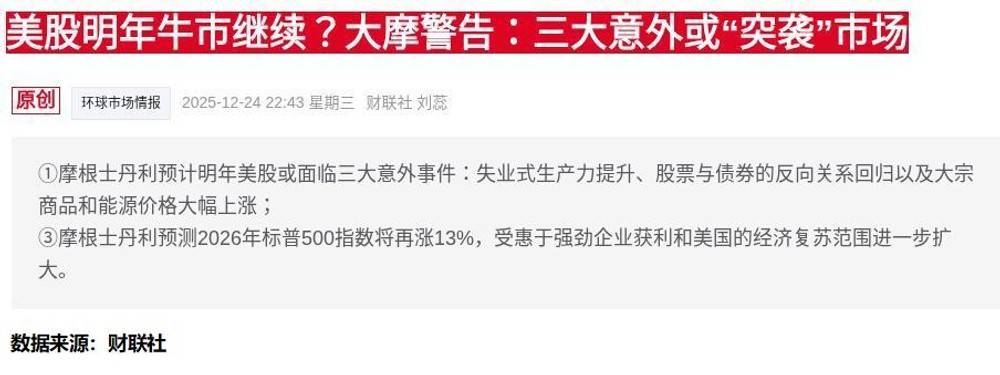
Core Viewpoint - The article emphasizes the importance of understanding institutional investor behavior in the stock market, particularly during periods of volatility in a bull market, to make informed investment decisions. Group 1: Market Conditions - The current bull market has experienced significant volatility, with a 35-day consolidation period from August 25 to October 17, which is longer than any previous bull market [3]. - Since the market rally began in April, only about 2,500 stocks have outperformed the index, indicating that many stocks are lagging behind [3]. Group 2: Institutional Investor Behavior - The article highlights the importance of monitoring institutional investor actions, as many retail investors struggle with decision-making during market fluctuations [4][9]. - A case study illustrates that stocks can experience multiple peaks and corrections, and the behavior of institutional investors can significantly influence whether a stock rebounds or declines after a peak [5][9]. - The "institutional inventory" data, which reflects the active participation of institutional investors, is crucial for understanding market dynamics. Active participation correlates with stock price recovery, while a lack of participation can lead to declines [7][10]. Group 3: Financing and Stock Selection - As of December 24, there are 136 stocks that have seen net financing inflows for five consecutive days or more, including notable companies like Innotec and China Mobile [1][10]. - It is essential to determine whether institutional investors are actively participating in these stocks, as mere financing inflows do not guarantee price stability or growth [10][12].
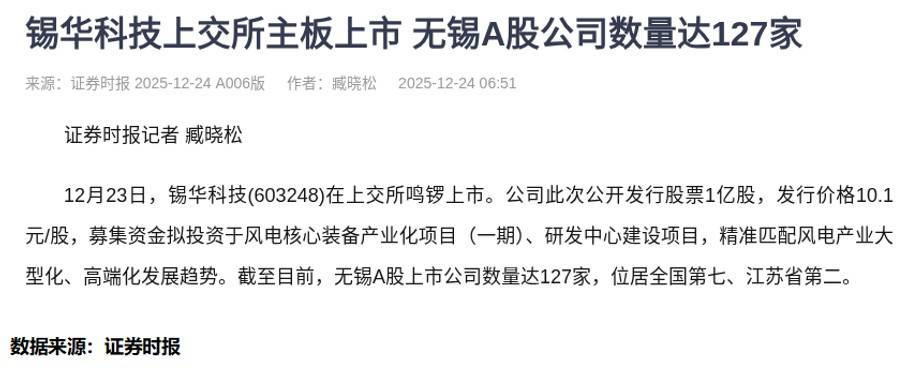
锡华科技上市 无锡A股再上台阶
Sou Hu Cai Jing· 2025-12-24 16:56
Core Insights - Wuxi's capital market welcomed a new player, Xihua Technology, which specializes in wind power core equipment components, marking the city's A-share listed companies at 127, ranking seventh nationwide and second in Jiangsu [1] Group 1: Market Performance - The recent bull market from April to October 2025 saw the index rise nearly 1000 points, with a growth rate exceeding 20%, yet less than 40% of individual stocks outperformed the index, indicating that the majority of investors earned less than the market average [3] - An example illustrates that an investor with a principal of 100,000 yuan earning 15% would make 15,000 yuan, but with the market average at 20%, their profit would diminish significantly during market corrections [3] Group 2: Trading Behavior - Many investors rely on intuition, often selling at perceived highs and buying at perceived lows, leading to missed opportunities as sold stocks continue to rise and bought stocks continue to fall [4] - A friend's experience with a telecommunications stock demonstrates how selling at various points led to missed gains, highlighting the pitfalls of relying solely on technical analysis [4] Group 3: Institutional Participation - Understanding whether institutional investors are actively participating in trading is more valuable than merely analyzing stock trends; consistent institutional inventory indicates ongoing interest and potential for sustained price movements [17] - Xihua Technology's successful listing is attributed to its 20% global market share in wind power gearbox components, showcasing the importance of "hard power" in attracting institutional investment [18]
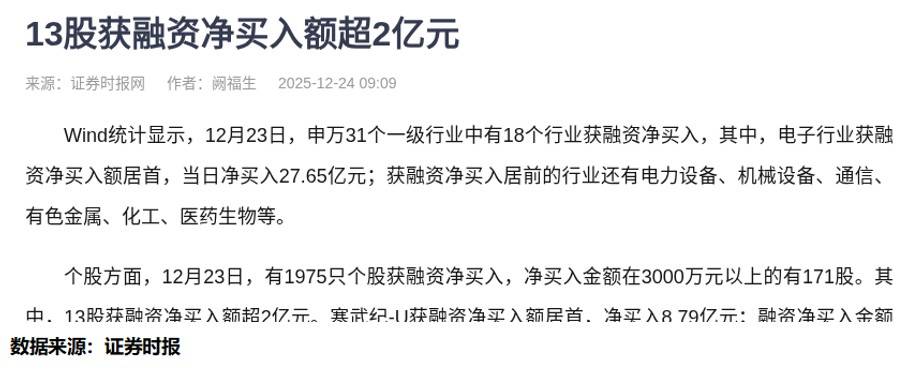
融资买得欢,为何你没赚到?
Sou Hu Cai Jing· 2025-12-24 09:08
最近股市里不少人盯着融资数据看——毕竟真金白银往里砸的方向,总该有机会吧?可身边朋友却念叨:"明明电子、电力设备这些行业融资买得凶,我手 里的股怎么就是不涨?"其实这个问题,早藏在"指数涨了钱没赚"的老麻烦里了。12月23日(周二)Wind统计显示,申万31个一级行业里18个获融资净买 入,电子行业净买入27.65亿元排第一,寒武纪-U、英维克这些个股净买入超2亿。可看着这些数字,有人高兴有人懵:融资砸进去的钱,怎么没落到自己账 户里?别急,文章最后我会说清这个新闻背后的关键,。 很多人觉得牛市是"躺赢局",可股市本来就有博弈属性——你赚的钱是别人亏的,哪有只赚不赔的道理?反而牛市里交投更活跃,大资金更容易用"假突 破""假回调"骗你下车。就像我邻居买的医药生物股,跟着行业融资净买入进去,结果买在"假企稳"的高点,熬了两周才解套——不是他选的行业不对,是 他没看懂走势背后的"冷处理"。 二、走势里的假动作,比你想的多 一、指数涨了钱没赚,真不是分化的锅 自从10月28日上证指数越过4000点,"赚了指数不赚钱"的吐槽就没断过。有人把这归为市场分化,可我翻了组数据——4月7日上证指数止跌企稳到10月30日 破4 ...