国产替代

Search documents
兴业证券:AIDC赋能固态断路器成长 内资企业有望逐步实现国产替代
智通财经网· 2026-01-27 06:47
Group 1 - The core viewpoint is that the rapid development of AI technology is driving IDC to accelerate its transition to AIDC, with expected capacity reaching 20GW by 2025 and 61GW by 2028, indicating rapid industry growth [1] - The demand for circuit breakers is increasing alongside the rapid development of AIDC, with solid-state circuit breakers expected to become essential under the 800V architecture, allowing domestic companies to gradually achieve localization and increase market share [1] - Circuit breakers are defined as switching devices that can connect, carry, and interrupt current under normal and abnormal conditions, categorized into high-voltage and low-voltage types, with high-voltage devices being those rated above 3kV [1] Group 2 - The circuit breaker market is anticipated to expand significantly due to the ongoing global digital transformation and the growing demand for data center construction, with enhanced technical requirements for circuit breakers as 10kV direct current systems transition to 750V [2] - Solid-state circuit breakers (SSCB) are based on power semiconductor devices and include various control switch components, enabling rapid current interruption [2] Group 3 - Solid-state circuit breakers are expected to become a necessity for the 800VDC architecture due to their ability to address issues such as large voltage fluctuations and slow protection times of traditional mechanical breakers, with a market potential of approximately 10 billion yuan by 2027 [3]

上市首日开门红!科创芯片ETF华宝(589190)大涨3%
Mei Ri Jing Ji Xin Wen· 2026-01-27 06:34
Group 1 - The A-share market showed resilience with a rebound, particularly in the hard technology sector, as evidenced by the performance of the Huabao Sci-Tech Chip ETF (589190), which saw an intraday increase of over 3% [1] - Dongxin Co., during an investor relations event, indicated that the industry upcycle has led to overseas storage manufacturers shifting capacity to high-profit product lines, resulting in a relative supply shortage for niche storage products, which are currently experiencing price increases [1] - Samsung Electronics plans to raise the supply price of NAND flash memory by over 100% in the first quarter of this year, significantly exceeding market expectations, and is preparing for new negotiations regarding NAND prices for the second quarter, with a general market expectation of continued price increases [1] Group 2 - The Huabao Sci-Tech Chip ETF (589190) was launched on January 27, passively tracking the Shanghai Stock Exchange Sci-Tech Chip Index, with nearly 80% coverage in key areas such as chip design, semiconductor materials, and equipment, aligning with themes of domestic substitution and technological self-reliance [2] - As of the end of 2025, the annualized return of the Shanghai Stock Exchange Sci-Tech Chip Index since its base date is 17.93%, significantly outperforming similar indices such as the Sci-Tech Innovation Semiconductor Index and the National Chip Index [2]


英伟达AI服务器液冷:大陆厂商的破晓之路与星辰大海
Quan Jing Wang· 2026-01-27 06:18
Core Insights - The article emphasizes the transformation of liquid cooling technology from a niche to a necessity in the AI computing era, driven by advancements in AI chip power consumption and the need for efficient cooling solutions [1] - It highlights the shift from reliance on foreign technology to a robust domestic industry capable of competing on a global scale, marking a significant milestone in China's manufacturing capabilities [1] Group 1: Technological Breakthroughs - The iteration of liquid cooling technology is described as a brutal elimination race, with domestic manufacturers overcoming technical barriers and moving from a follower to a competitor position [2] - Domestic companies like Readore and Envicool have achieved significant milestones by obtaining NVIDIA certification for critical components, indicating a shift in market dynamics and the potential for capturing substantial market share [3] Group 2: Comprehensive Industry Development - The article discusses the collaborative efforts across the entire liquid cooling supply chain, with domestic players filling gaps left by foreign companies, particularly in the production of cooling fluids and system components [4] - The establishment of a complete domestic liquid cooling ecosystem is highlighted, which is crucial for resisting foreign competition and ensuring self-sufficiency [4] Group 3: Market Opportunities - The current market landscape shows that cold plate liquid cooling holds a 65% market share, making it an ideal entry point for domestic manufacturers amid supportive government policies and market demand [5] - The rapid growth of the Chinese liquid cooling server market, projected to exceed $3.39 billion by 2025, provides a solid foundation for domestic companies to expand their market presence [8] Group 4: Competitive Landscape - The article notes a significant shift in the competitive landscape, with domestic manufacturers moving from being mere subcontractors to becoming key players in the global liquid cooling supply chain [6] - The entry of domestic brands into high-profile projects, such as Google's TPU solution, signifies a transition from passive participation to active competition for core market shares [7] Group 5: Future Prospects - The global liquid cooling market is expected to reach $14 billion by 2026, with a compound annual growth rate of nearly 50%, presenting a substantial opportunity for domestic manufacturers to establish themselves on the global stage [10] - The article concludes that the journey of domestic manufacturers is just beginning, with ongoing advancements in technology and the potential for expansion into new sectors, reinforcing the notion that domestic innovation is key to future success [10]


阿里平头哥筹备上市背后:加速“从内向外”,但可能没那么快
Xin Lang Cai Jing· 2026-01-27 06:11
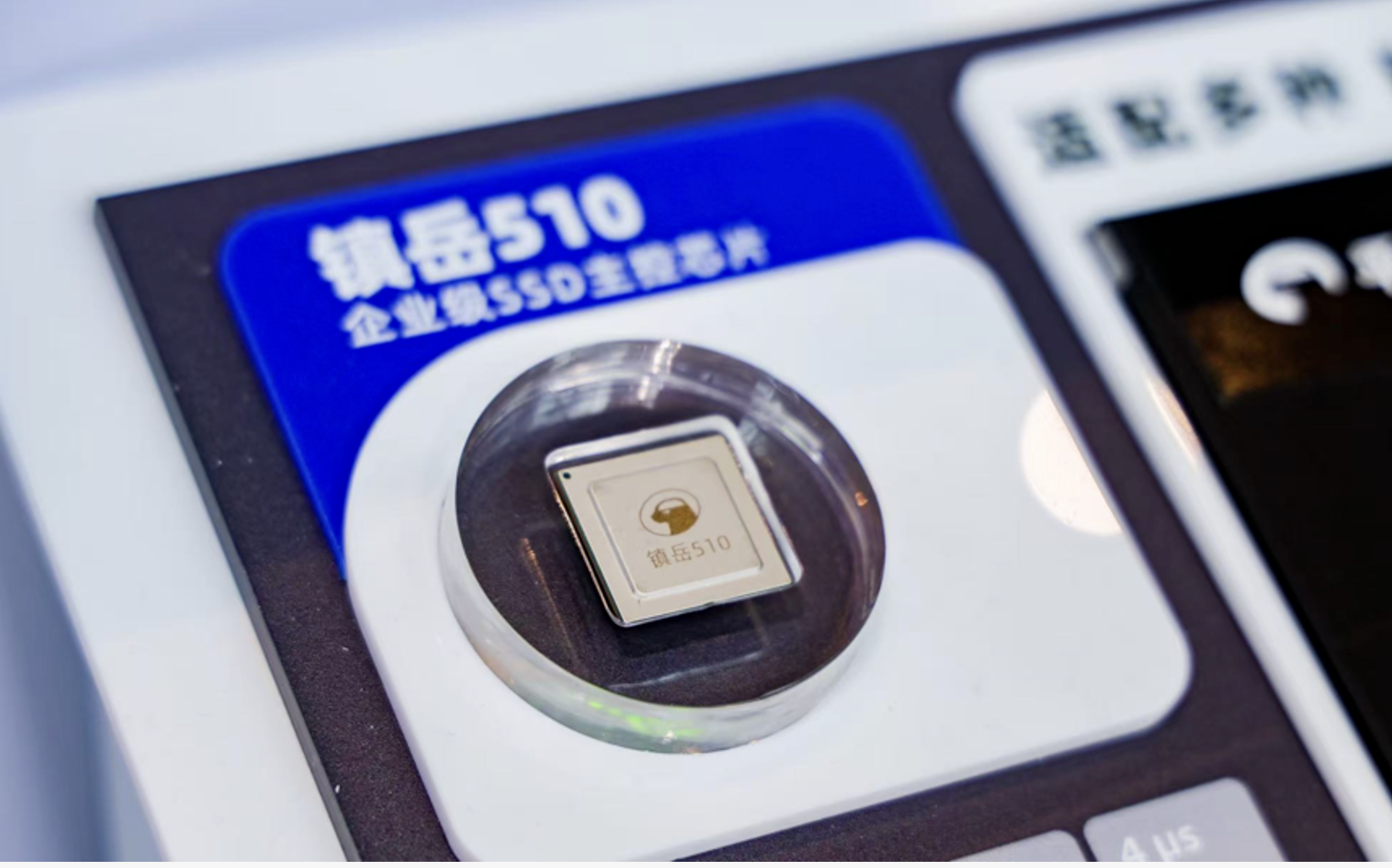
Core Viewpoint - Alibaba Group is planning to restructure its semiconductor design unit, Pingtouge Semiconductor, into an independent entity partially owned by employees, with a potential IPO on the horizon. This plan is still in the preliminary stages, and no official response has been provided by Alibaba as of the report's publication [1][12][13]. Company Developments - The push for Pingtouge's IPO is driven by the progress of its products in external markets, particularly the new self-developed AI accelerator chip, PPU, which is expected to be used internally by Alibaba Cloud in 2024 and to perform well in external sales by 2025, especially in the smart driving sector [1][14]. - Pingtouge's PPU chip features key specifications such as 96GB HBM2e memory, 700GB/s interconnect bandwidth, PCIe 5.0 ×16 interface, and a power consumption of under 400W, positioning it competitively against mid-range products like A800 and even Nvidia's H20 [1][14]. Market Context - The AI computing market is experiencing explosive demand, with significant opportunities for domestic high-performance AI chips, particularly in inference markets driven by large model applications [2][14]. - The timing for Pingtouge's IPO preparation is seen as reasonable given the current market environment, where there is high enthusiasm for quality semiconductor assets, as evidenced by the substantial first-day gains of other domestic GPU manufacturers listed recently [9][21]. Product Development - Pingtouge has developed a comprehensive product series that includes data center chips, processor IP licensing, and IoT chips, achieving full coverage of the chip design chain [4][15]. - The SSD controller chip, Zhenyue 510, has been deployed at scale in Alibaba Cloud's EBS storage solutions, with several storage manufacturers already utilizing this chip [4][16]. Business Model - Pingtouge's revenue is closely tied to Alibaba Cloud, making it challenging for external observers to assess its independent profitability [7][19]. - As part of its IPO strategy, Pingtouge aims to accelerate its market expansion and external sales, responding to market expectations with announcements about the deployment of its Zhenyue 510 chip in various AI and storage applications [20]. Future Challenges - Despite the IPO plans, there are concerns regarding the timeline, with analysts expressing skepticism about the likelihood of completing the IPO by 2026. Key challenges include expanding external customer bases, establishing independent governance, and clarifying pricing mechanisms with Alibaba [10][22].

板块大涨2.65%!存储芯片概念股全线走强,算力需求引爆涨价潮,国产替代窗口期开启
Jin Rong Jie· 2026-01-27 06:06
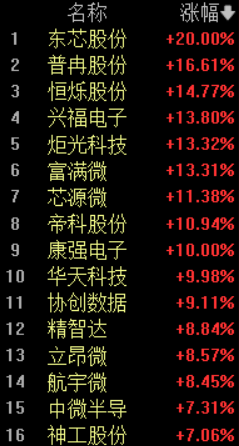
Core Viewpoint - The storage chip sector in the A-share market has experienced a V-shaped rebound, with significant gains driven by multiple favorable factors, including strong performances from key companies like Dongxin Co. and SK Hynix [1][3]. Group 1: Market Performance - The storage chip index initially dropped by 1.8% but later surged to a gain of 2.65% [1]. - Dongxin Co. achieved a strong 20% limit-up, with a single order amount exceeding 1 billion yuan [1]. - More than ten stocks, including Purun Co. and Juguang Technology, saw gains exceeding 9% [1]. Group 2: Industry Developments - SK Hynix's stock rose by 7% following the announcement of Microsoft's new AI inference chip, Maia 200, which features a total memory capacity of 216GB and a 36% performance improvement over its predecessor [3]. - Samsung Electronics announced a 100% price increase for NAND flash memory, marking the largest single-quarter increase in history [3]. - Micron Technology plans to invest $24 billion to expand its NAND factory in Singapore, with production expected to commence in 2028 [3]. Group 3: Market Trends and Projections - The global storage market is projected to reach $551.6 billion by 2026, with a year-on-year increase of 134%, driven primarily by AI server demand [3]. - DRAM prices are expected to continue rising, with DDR5 modules increasing by 60% compared to September, and NAND contract prices anticipated to rise by 33%-38% in Q1 2026 [3]. - The storage chip industry is entering a new cycle driven by "compute density + bandwidth density," with a significant supply-demand imbalance between traditional consumer storage and high-end AI storage [3]. Group 4: Industry Structure and Opportunities - The market is dominated by three major players—Samsung, SK Hynix, and Micron—who hold 70% of the global market share and are shifting 80% of their capacity towards high-end products like HBM and DDR5 [4]. - Domestic manufacturers are poised for growth, with Zhaoyi Innovation raising 4.6 billion HKD through its Hong Kong listing and Changxin Technology's IPO on the Sci-Tech Innovation Board being accepted, aiming to raise 29.5 billion yuan [4]. - Analysts predict that domestic storage companies may alleviate supply pressures by 2026 through technological breakthroughs and capacity expansion, although short-term shortages in consumer electronic storage remain a risk [4].

莱特光电(688150):巩固OLED有机材料优势,布局Q布及钙钛矿市场
China Post Securities· 2026-01-27 06:03
Investment Rating - The investment rating for the company is "Buy" and is maintained [1] Core Views - The company is expected to benefit from the production of the 8.6 generation OLED line, which will significantly increase the demand for OLED materials and accelerate domestic substitution [3] - The company is actively expanding into the Q fabric and perovskite materials market, leveraging its core competencies and industry trends [4] - The company plans to issue convertible bonds to raise up to 766 million yuan, with a significant portion allocated for the construction of a new materials production base [5] Company Overview - The latest closing price is 28.83 yuan, with a total market capitalization of 11.6 billion yuan [2] - The company has a total share capital of 4.02 billion shares and a debt-to-asset ratio of 15.8% [2] - The company is led by its largest shareholder, Wang Yalong [2] Financial Projections - Revenue projections for 2025, 2026, and 2027 are 570 million yuan, 860 million yuan, and 1.15 billion yuan respectively, with net profits of 250 million yuan, 390 million yuan, and 560 million yuan [8] - The company anticipates a significant growth rate in revenue and net profit over the next few years, with a projected net profit growth rate of 49.6% in 2025 [10] Financial Metrics - The company is expected to maintain a high gross margin, projected at 74.2% in 2025 and 76.0% in 2027 [11] - The earnings per share (EPS) is projected to increase from 0.42 yuan in 2024 to 1.39 yuan in 2027 [10]

牛!这家上市电子材企宣布:核心产品电子封装材料满产满销
Sou Hu Cai Jing· 2026-01-27 05:38
Core Viewpoint - Jiemai Technology aims to become a leading provider of one-stop services and overall solutions for electronic component packaging materials and processes, focusing on electronic-grade film materials, electronic chemicals, and materials related to new energy [3]. Group 1: Company Developments - Jiemai Technology has been actively engaging with numerous institutions for research since January 16, including Shanxi Securities, Huatai Securities, and Tianhong Fund [1]. - The company has achieved a leading global market share in paper carrier tape, breaking the near monopoly held by foreign companies [3]. - Jiemai Technology is expanding its product offerings from electronic packaging materials to include electronic-grade film materials, achieving mass production of products such as release films and composite current collectors [3]. Group 2: Market Conditions - The electronic packaging materials sector is currently experiencing high demand, with core products operating at full production capacity [4]. - The acceleration of global digitalization, coupled with policies like "new infrastructure" and "old-for-new" electronic product exchanges, is driving demand in markets such as 5G, cloud computing, and new energy vehicles [4]. - The industry is in a period of explosive growth, with effective supply-demand matching being crucial for market capture [4]. Group 3: Pricing and Supply Chain - Recent price increases from downstream clients like Yageo and Walsin indicate a potential for Jiemai Technology to adjust its product prices in response to rising demand in sectors such as AI servers and new energy vehicles [5]. - Jiemai Technology has successfully transitioned to stable mass supply of MLCC release films to major clients, completing product validation with Korean and Japanese customers [5][6]. - The company has signed strategic supply agreements with major polarizer manufacturers for release films and is continuously developing high-end release films to replace foreign products [6]. Group 4: Acquisition and New Products - Jiemai Technology completed the acquisition of Jiangxi Rouzhen Technology, which specializes in polymer-metal composite film materials, enhancing its product portfolio for lithium-ion batteries [6][7]. - The new products from Rouzhen Technology, including composite aluminum and copper foils, are aimed at various battery applications, with a planned annual production capacity of 5 million square meters [7].

指数微红,个股普跌,近4600家绿盘!现在的A股到底该怎么玩?
Sou Hu Cai Jing· 2026-01-27 05:35
Market Overview - The market is characterized by a "split" where indices appear stable but individual stocks are predominantly declining, with over 4600 stocks experiencing losses [1] - The Shanghai Composite Index slightly increased by 0.03% to 4134.03 points, while the ChiNext Index and the STAR Market Index rose by 0.44% and 0.57% respectively [1] - In contrast, the Hong Kong market showed stronger performance, with the Hang Seng Index rising by 1.08%, supported by a policy boost from the central bank [1] Sector Performance - The technology sector, particularly the communication and electronics segments, saw significant gains, with the communication sector up by 2.13% and electronics by 1.50% [1] - The banking sector also rose by 1.03%, contributing to market stability [1] Drivers of Technology Sector - The strong performance in communication and electronics is driven by major advancements in the AI industry, including Alibaba's release of the Qwen3-Max-Thinking model and significant funding for another AI company [2] - Investment is flowing into the entire industry chain, from upstream hardware to related software applications, indicating a long-term trend towards technology and self-sufficiency [2] Market Sentiment and Trends - The current market sentiment reflects a preference for technology growth sectors over traditional cyclical industries, with a structural market trend likely to continue [3] - A-shares may continue to experience volatility, with funds likely to seek balance between technology and undervalued financial blue chips [3] Investment Strategy - Investors are advised to focus on understanding industry trends rather than chasing hot stocks, particularly in areas like AI and domestic substitution [3] - Attention should also be given to sectors with high growth forecasts, such as biopharmaceuticals, while maintaining a rational approach amidst market fluctuations [3]
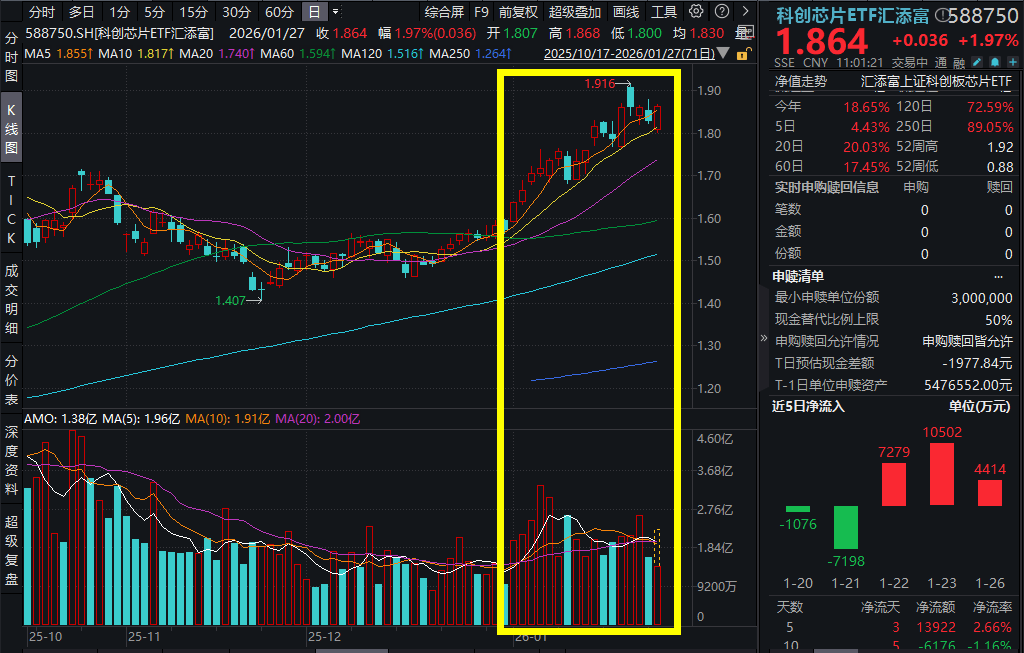
太空算力概念火热!科创芯片ETF汇添富(588750)大涨2%,近3日强势吸金超2.2亿元!上海先导产业母基金出手,聚焦三大方向!
Sou Hu Cai Jing· 2026-01-27 05:18
Core Viewpoint - The A-share market is experiencing fluctuations, but the sci-tech chip sector is showing resilience and strength, with significant capital inflow driven by "AI catalysis and independent innovation" [1][6]. Group 1: Market Performance - As of 11:01 on January 27, the sci-tech chip ETF Huatai (588750) rose by 2%, with over 220 million yuan net inflow for three consecutive days [1]. - Major component stocks of the sci-tech chip ETF saw significant gains, with Dongxin Co. hitting the daily limit, and other stocks like Chip Source Micro and Yuanjie Technology rising over 14% and 11% respectively [3][4]. Group 2: Industry Trends - The chip sector is receiving strong financial support, with the Shanghai three major leading industries mother fund announcing the selection of 17 sub-funds, including 4 for integrated circuits, totaling 22.89 billion yuan [6]. - The demand for storage chips is driven by AI, with a structural reconfiguration leading to price increases in high-end storage products like HBM and DDR5, expected to continue through 2026 [7]. - The demand for computing chips is surging as AI transitions from training to large-scale inference, resulting in a supply-demand imbalance across all categories of computing chips [8]. Group 3: Domestic Innovation and Market Opportunities - Domestic innovation and localization are accelerating in the chip industry, supported by top-level design and policy funding, creating a rapid growth window for domestic computing leaders [10]. - The domestic equipment procurement rate is projected to rise from approximately 18% in 2022 to around 30% by 2025, with potential growth to 60%-70% in the future [11]. - The sci-tech chip sector is positioned to benefit from both AI demand and domestic substitution, with the Huatai ETF focusing on core segments of the chip industry, showcasing higher growth potential and elasticity [12][14]. Group 4: Investment Insights - The Huatai sci-tech chip ETF is expected to show a net profit growth rate of 94% in the first three quarters of 2025, significantly outperforming peers [14]. - The ETF has demonstrated a maximum increase of 173% since September, indicating strong upward elasticity compared to other industry indices [15].
募资12亿+!安路科技冲刺FPGA国产替代
是说芯语· 2026-01-27 05:01
Core Viewpoint - Shanghai Anlu Information Technology Co., Ltd. plans to raise up to 1.262 billion yuan through a private placement of A-shares to enhance its FPGA chip development and product upgrades, aiming to strengthen its core technology barriers and seize domestic substitution opportunities [1][2]. Group 1: Company Overview - Anlu Technology is a leading player in the domestic FPGA chip market, focusing on advanced process platforms and large-scale FPGA chip R&D [1]. - The company has a strong technical foundation with over ten years of experience in the FPGA field, having developed a complete technical system including hardware architecture and EDA software tools [5]. - As of September 2025, Anlu Technology has obtained 322 intellectual property rights, including 124 invention patents, and has achieved the R&D and industrialization of FinFET process FPGA chips [5]. Group 2: Market Context - The global FPGA market is projected to exceed $19 billion by 2030, with a compound annual growth rate (CAGR) of 10.5% from 2025 to 2030, driven by the deployment of 6G networks and advancements in artificial intelligence [2]. - In 2023, China's FPGA chip self-sufficiency rate is only 23%, indicating significant room for domestic substitution [2]. Group 3: Fundraising and Project Allocation - The fundraising will target two main projects: 726 million yuan for advanced process platform FPGA chip R&D and 536 million yuan for upgrading and industrializing planar process platform FPGA & FPSoC chips [4]. - The R&D project will focus on overcoming key technologies such as large-scale FPGA architecture and high-speed interface IP, while the upgrade project aims to support new bus protocols and enhance security features [4]. Group 4: Talent and Supply Chain - Anlu Technology has a high proportion of R&D personnel at 81.89%, with 65.36% holding master's or doctoral degrees, and a core team with over ten years of industry experience [6]. - The company has established stable partnerships with leading wafer manufacturing and packaging testing companies, ensuring a robust supply chain [6]. Group 5: Future Outlook - Following the completion of the fundraising, Anlu Technology's total share capital and net asset scale will significantly increase, leading to a more robust financial structure [6]. - The implementation of the fundraising projects is expected to enhance the company's product offerings and accelerate the development of the domestic integrated circuit industry [6][7].