
新质战斗力

Search documents
早餐 | 2025年5月12日
news flash· 2025-05-11 23:28
周一亚市盘初,美股期货涨超1%,原油期货上涨,黄金期货盘中跌超1.9%。 中美经贸中方牵头人、国务院副总理何立峰出席新闻发布会表示,中美达成重要共识,会谈取得 实质性进展。 中国4月CPI同比降0.1%、与上月持平,PPI同比降幅扩大至2.7%。 人民日报刊文:加快解放和发展新质战斗力。 日本首相石破茂重申"零关税",要求美国全面取消汽车关税。 印巴双方宣布停火后不久,印控克什米尔地区再次传出爆炸声。印度指巴基斯坦违反停火协议, 巴方否认。 乌克兰准备无条件停火至少30天,普京提议5月15日恢复俄乌谈判。泽连斯基:乌克兰已做好与俄 罗斯举行会谈的准备。 ...
军工主题一马当先 基金看好四大细分领域
Zheng Quan Shi Bao· 2025-05-11 21:57
Core Viewpoint - The military industry stocks have shown strong performance recently, with the China Securities Military Industry Index rising by 5.82% in the past week, indicating a potential recovery in the sector [1][2]. Group 1: Market Performance - Several military stocks have experienced significant gains, with ST Lihang achieving four consecutive daily limit-ups, and companies like Chengfei Integration and Tianjian Technology seeing three consecutive limit-ups [2]. - The average increase for military-themed funds was approximately 5.3%, with specific funds like the Huaxia Military Safety Fund rising by 9.22% [2]. - Over 37 out of 40 military stocks in the index saw price increases during this period, reflecting strong market interest [2]. Group 2: Fundamental Improvements - The military sector is expected to see a significant improvement in performance starting from the second quarter, with many companies likely to report better earnings [2][4]. - There is a notable recovery in military demand, with some upstream companies reporting improved order volumes both year-on-year and month-on-month [1][5]. - The military industry is positioned as one of the few sectors experiencing a positive economic cycle this year, with defensive attributes that may lead to independent market performance [3][5]. Group 3: Investment Opportunities - The military sector is currently undervalued, with a price-to-book ratio of approximately 3.12, which is relatively low compared to other technology sectors [4]. - Key areas of investment interest include low-altitude economy, military electronics, and advanced military materials, which are expected to benefit from increased orders and market demand [6][7]. - The military industry is anticipated to experience a significant increase in global defense budgets starting in 2025, further stimulating the military trade market [5][7].




周一,开盘必读!
格兰投研· 2025-05-11 14:56
这周末消息很多,对盘面影响都挺大的,今天的文章给大家讲清楚。 那很多同学可能都很关注军工板块开盘到底会怎么样? 老规矩,先从宏观开始。 周末市场讨论比较多的是印度和巴基斯坦的事。 周六上午巴基斯坦还在说全面反击,又是击落战斗机又是摧毁防控基地的。到了晚上又有新闻爆出来两边同意谈判了。 川普又把这功劳揽自己头上了,特意发文,说两边都给了他面子。 结果又被啪啪打脸,说其实是双方自己接触的。确实也容易理解,巴铁毕竟整体国力弱于印度,无意久战。 这次印度先动手,恰恰就在万斯去访问煽风点火之后,结果被打的屁滚尿流, ,从西方购买的"先进武器"已经被中国歼10扯下了遮羞布,也是赶 紧罢手,毕竟再打就真露馅儿了。 不过之后又有消息,说停火没坚持住,双方还有摩擦,这也正常, 但双方继续打下去的意愿确实都不高。 人民日报还专门发表了一篇关于新质战斗力文章,又给了不少想象力。 我讲一讲我的观点。 很简单,从当前来说,军工仍然局限于题材,印巴冲突,一定会影响题材的热度,会出分歧。 但是,有分歧不意味着军工就彻底熄火了,因为印巴冲突实际上是一个国产武器的"亮相"时刻。 之前不管纸面数据怎么牛,没有实战,中东土豪们是不信的。 一个在中 ...


国防军工本周观点:中国军工的价值重估时刻已到-20250511
Huafu Securities· 2025-05-11 13:27
行 业 华福证券 国防军工 2025 年 05 月 11 日 研 究 国防军工 军工本周观点:中国军工的价值重估时刻已到 投资要点: 本周核心观点: 行 业 定 期 报 告 5 月 7 日,巴基斯坦表示,印度当天凌晨向巴基斯坦本土及巴控克什米尔 地区的三处地点发射了导弹,印巴冲突升级,直至 5 月 10 日,印巴双方同 意立即停火;而巴基斯坦为我国主要武器装备出口国,根据海国图智研究 院援引的斯德哥尔摩国际和平研究所(SIPRI)统计,2023 年中国军贸出 口占全球市场份额的 5.80%,其中约 60%的出口对象为巴基斯坦,且交战 期间相关实况报道进一步验证了中国军事装备近年快速发展的强实力,因 此本周军贸主题及其相关标的跑出明显超额,带动国防军工板块表现优异, 本周(5.6-5.9)申万军工指数(801740)上涨 6.33% ,同期沪深 300 指数 上涨 2.00%,相对超额 4.32pct。 5 月 11 日,人民日报刊文《加快解放和发展新质战斗力》,文中写到:"向 新而生,向质图强。当前,新一轮科技革命和产业变革蓬勃发展,大量高 新技术武器用于实战,智能技术、无人装备、大数据应用等成为战斗力新 的 ...
加快解放和发展新质战斗力(金台点兵)
Ren Min Ri Bao· 2025-05-10 21:49
Group 1 - The core viewpoint emphasizes the urgent need for military forces to innovate and develop new combat capabilities in response to modern warfare demands [1][2] - The integration of advanced technologies such as intelligent systems, unmanned equipment, and big data applications is identified as a new growth point for combat effectiveness [1][2] - The military is focusing on self-reliance and independent innovation to overcome challenges in developing core technologies and enhancing new combat capabilities [2] Group 2 - The development of new combat capabilities requires high-quality, specialized military personnel to support innovation efforts [3] - Initiatives like the "Kunpeng Wings" software development group demonstrate how military personnel are actively contributing to enhancing operational effectiveness through innovative solutions [3] - The military is accelerating the construction of a high-quality new type of military talent pool to ensure strong support for future warfare [3]
ETF投资周报 | 五月强势开局,军工板块异军突起,相关ETF全线大涨
Mei Ri Jing Ji Xin Wen· 2025-05-09 08:59
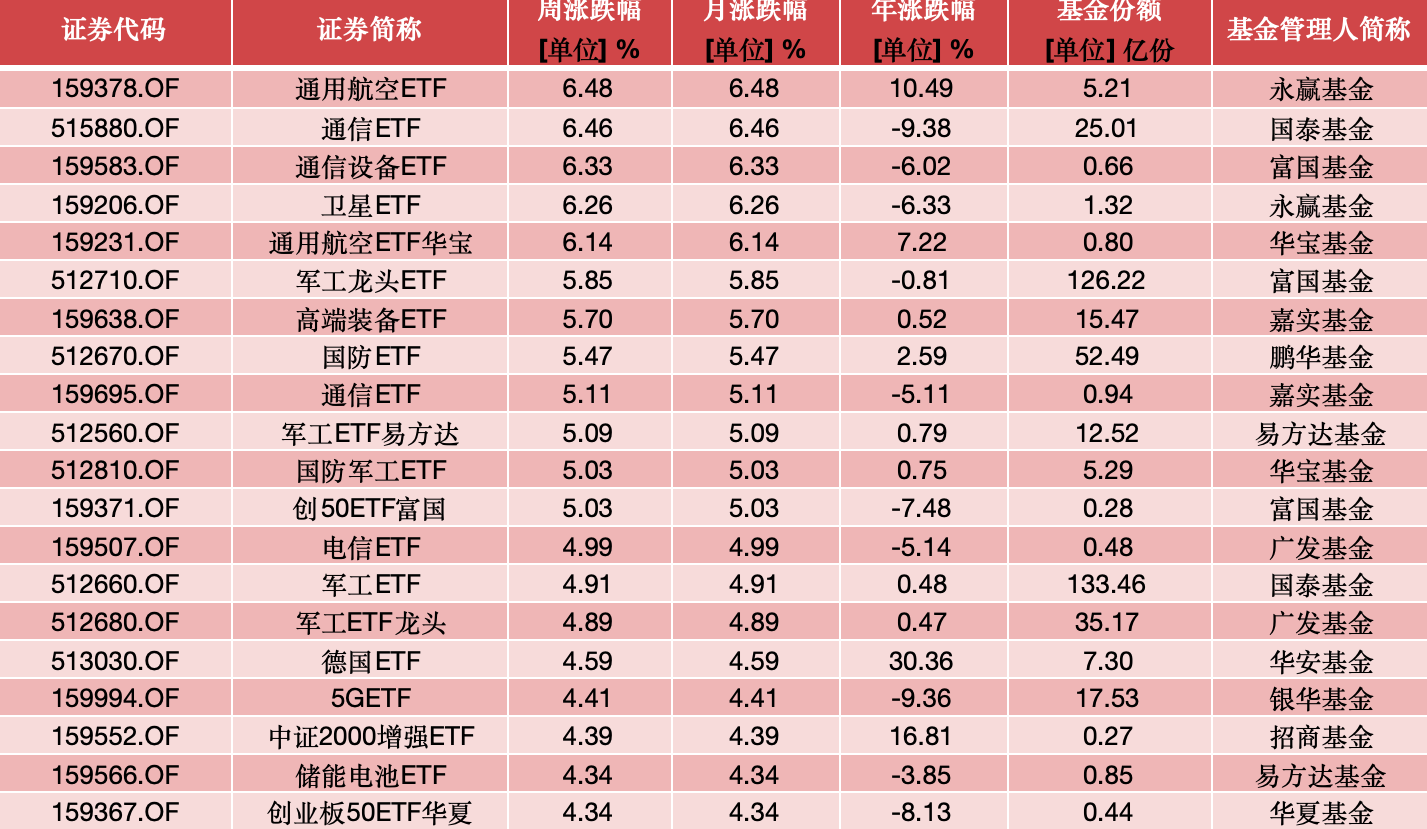
Market Overview - The A-share market has started May with strong momentum, with the Shanghai Composite Index rising nearly 2% for the week and closing above 3300 points [1] ETF Performance - The military industry sector has shown significant growth, with related ETFs such as general aviation, military, high-end equipment, and national defense all ranking high in terms of weekly gains [2][3] - Over 1100 ETFs recorded positive returns this week, with a median market increase of 1.81%, indicating a notable uptick compared to the pre-May Day period [3] Top Performing ETFs - The top-performing ETF this week was the General Aviation ETF (159378), which saw a weekly increase of 6.48%. Notable stocks within this ETF, such as Aerospace Rainbow, experienced gains exceeding 14% [4][5] - Other ETFs related to the military sector, including the Military Leader ETF and High-End Equipment ETF, also reported weekly gains exceeding 5% [5] Communication Sector - The Communication ETF (515880) achieved a weekly increase of 6.14%, primarily driven by a rebound in the optical communication sector, with leading stocks like Zhongji Xuchuang and Tianfu Communication seeing substantial rises [5] Declining Sectors - The Hong Kong innovative drug sector has experienced significant volatility, with several ETFs related to this sector appearing on the weekly decline list [6] - The largest decline was seen in the NASDAQ Biotechnology ETF (513290), which fell by 4.93%, followed closely by the S&P Biotechnology ETF (159502) with a drop of 4.86% [7][8]
视频|中航证券王宏涛:主题活跃+业绩提振,军工未来“二重奏”可期
Xin Lang Zheng Quan· 2025-05-08 09:17
Core Viewpoint - The A-share military industry sector continues to rise, with nearly 20 stocks hitting the daily limit or increasing by over 10%, indicating a potential for further market performance driven by active themes and improving fundamentals [1] Summary by Relevant Categories Market Trends - Since the beginning of the year, themes such as low-altitude economy, commercial aerospace, deep-sea technology, large aircraft, and military intelligence have been highly active [1] - The military industry is expected to experience a sustained recovery in fundamentals, leading to a dual boost from active themes and performance improvements [1] Investment Recommendations - Focus on sectors that have previously experienced significant declines and where pessimistic expectations are fully reflected, such as military electronics and military materials [1] - Pay attention to index-weighted stocks in major indices like CSI 300 and A500 that are related to the military sector [1] - Monitor the "double hit" in the industry as the "14th Five-Year Plan" orders and performance gradually materialize, along with the clarity of the "15th Five-Year Plan," which will enhance both performance and valuation [1] - Consider sectors with special industry premiums, such as mergers and acquisitions, market value management expectations, geopolitical stimuli, and new productivity and combat capabilities [1]
关税战火淬炼军工硬核 中航证券王宏涛九大主线解码国防军工投资新逻辑
Xin Lang Zheng Quan· 2025-05-08 08:45
Core Viewpoint - The article discusses the implications of the U.S. "tariff war" and the record-high defense budget proposal of $1 trillion for the fiscal year 2026, which is a 12% increase from 2025, highlighting potential investment opportunities in the military and defense sectors amid rising geopolitical tensions [1][4]. Group 1: Military Technology Trends - The focus on military automation and intelligence is emphasized, with the U.S. defense budget prioritizing AI military capabilities. The emergence of unmanned and intelligent equipment is transforming combat systems, indicating a shift towards autonomous decision-making in military operations [5]. - The acceleration of next-generation weaponry development is anticipated, particularly in strategic weapons, as global military competition intensifies. The ongoing geopolitical conflicts are expected to increase the urgency for countries to enhance their strategic weapon reserves [6]. - The deep-sea military presence is becoming crucial, with nations expanding their underwater monitoring networks to secure maritime resources and trade routes amid rising international competition [7]. Group 2: Material and Technology Development - The tariff increases are driving advancements in 3D printing and recycled materials in the military sector, as companies seek to reduce costs through innovative material manufacturing processes [7]. - The push for self-sufficiency in high-end military electronics and integrated circuits is accelerating, with the domestic semiconductor industry expected to benefit from the ongoing tariff situation, leading to increased market opportunities [8]. - The commercial space sector is rapidly developing integrated aerospace and satellite internet applications, with significant competition from global players like SpaceX, indicating a growing market for satellite technology [8]. Group 3: Economic and Industrial Impacts - The tariff situation is prompting a shift towards domestic production of large aircraft, with the C919 gaining attention due to increased costs associated with U.S. aircraft imports. This shift is expected to enhance the competitiveness of domestically produced aircraft in international markets [9]. - The low-altitude economy is emerging as a new growth engine for local economies, with various regions in China developing low-altitude economic platforms to stimulate industrial transformation [10]. - The robotics industry is becoming a key driver of domestic demand growth, supported by government policies and market needs, with AI-driven automation projected to contribute significantly to GDP growth [11]. - The military trade sector is expected to grow as China's production capabilities improve, with a shift from focusing solely on domestic needs to exploring international markets due to changing global demand dynamics [12].

内外兼修,左右逢源——论印巴冲突对军工行业的影响
AVIC Securities· 2025-05-08 03:54
Investment Rating - The report maintains an "Accumulate" investment rating for the defense industry [3]. Core Viewpoints - The intensification of the India-Pakistan conflict has drawn significant attention to the military industry, with defense stocks rising by 3.70% on May 7, 2025, marking the highest increase among 31 sectors [1][6]. - The report highlights that geopolitical events can have a short-term impact on military stock performance, influenced by the relevance of the event to China, market risk appetite, and the duration of the event [2][6]. - In the medium to long term, the India-Pakistan conflict is expected to strengthen global military trade logic, with China being a key supplier to Pakistan, which has a high dependency on Chinese military imports [7][8]. Summary by Sections Short-term Impact of the India-Pakistan Conflict - The conflict is likely to provide ongoing support for military stock performance due to its proximity to China and the heightened geopolitical tensions [6][7]. - The market's risk appetite has been somewhat restored following recent financial policy adjustments, which may further bolster military stocks [6]. Medium to Long-term Impact on Military Trade - Pakistan is a significant importer of Chinese military products, with 63.02% of China's military exports going to Pakistan from 2020 to 2024, and 81.15% of Pakistan's military imports coming from China [7][8]. - The report anticipates that the military trade market will continue to grow, driven by China's competitive advantages and the evolving global security landscape [17][25]. Investment Trends and Directions - The military industry is expected to remain in a favorable cycle, with a focus on unmanned equipment, military intelligence, satellite internet, and electronic countermeasures as key investment opportunities [13]. - The report emphasizes the importance of military trade in the context of the "Belt and Road" initiative, suggesting that it will serve as a new growth driver for China's military industry [25][30]. Global Military Trade Development - The global military trade market is projected to maintain a high level of activity, with increased military spending across various nations due to ongoing geopolitical conflicts [20][21]. - China's military exports are expected to shift from a recovery phase to a supply-demand resonance-driven growth phase by the end of the 14th Five-Year Plan [30][32]. Military Product Focus - The report indicates that military products will continue to concentrate on aviation, aerospace, and new domain weaponry, reflecting China's growing capabilities in these areas [49][50].
国防军工行业周报(2025年第18周):季报利空逐渐出尽,订单有望持续兑现-20250427
Shenwan Hongyuan Securities· 2025-04-27 11:41
行 业 及 产 业 行 业 研 究 / 行 业 点 评 - 证券分析师 韩强 A0230518060003 hanqiang@swsresearch.com 武雨桐 A0230520090001 wuyt@swsresearch.com 穆少阳 A0230524070009 musy@swsresearch.com 达邵炜 (8621)23297818× dasw@swsresearch.com 国防军工 研究支持 达邵炜 A0230124030001 dasw@swsresearch.com 联系人 2025 年 04 月 27 日 季报利空逐渐出尽,订单有望持续 兑现 看好 —— 国防军工行业周报(2025 年第 18 周) 本期投资提示: ⚫ 上周申万国防军工指数上涨 0.15%,中证军工龙头指数下跌 0.38%,同期上证综指上 涨 0.56%,沪深 300 上涨 0.38%,创业板指上涨 1.74%,申万国防军工指数跑输创 业板指、跑输沪深 300、跑输上证综指、跑赢军工龙头指数。1、从细分板块来看,上 周国防军工板块 0.15%的涨幅在 31 个申万一级行业涨跌幅排名第 22 位。2、从我们构 建的 ...