人工智能(AI)

Search documents
第三季度营业收入12.12亿元 中国电影董事长傅若清:市场如何在AI冲击与进口片回暖中站上500亿元?
Mei Ri Jing Ji Xin Wen· 2025-12-13 09:26
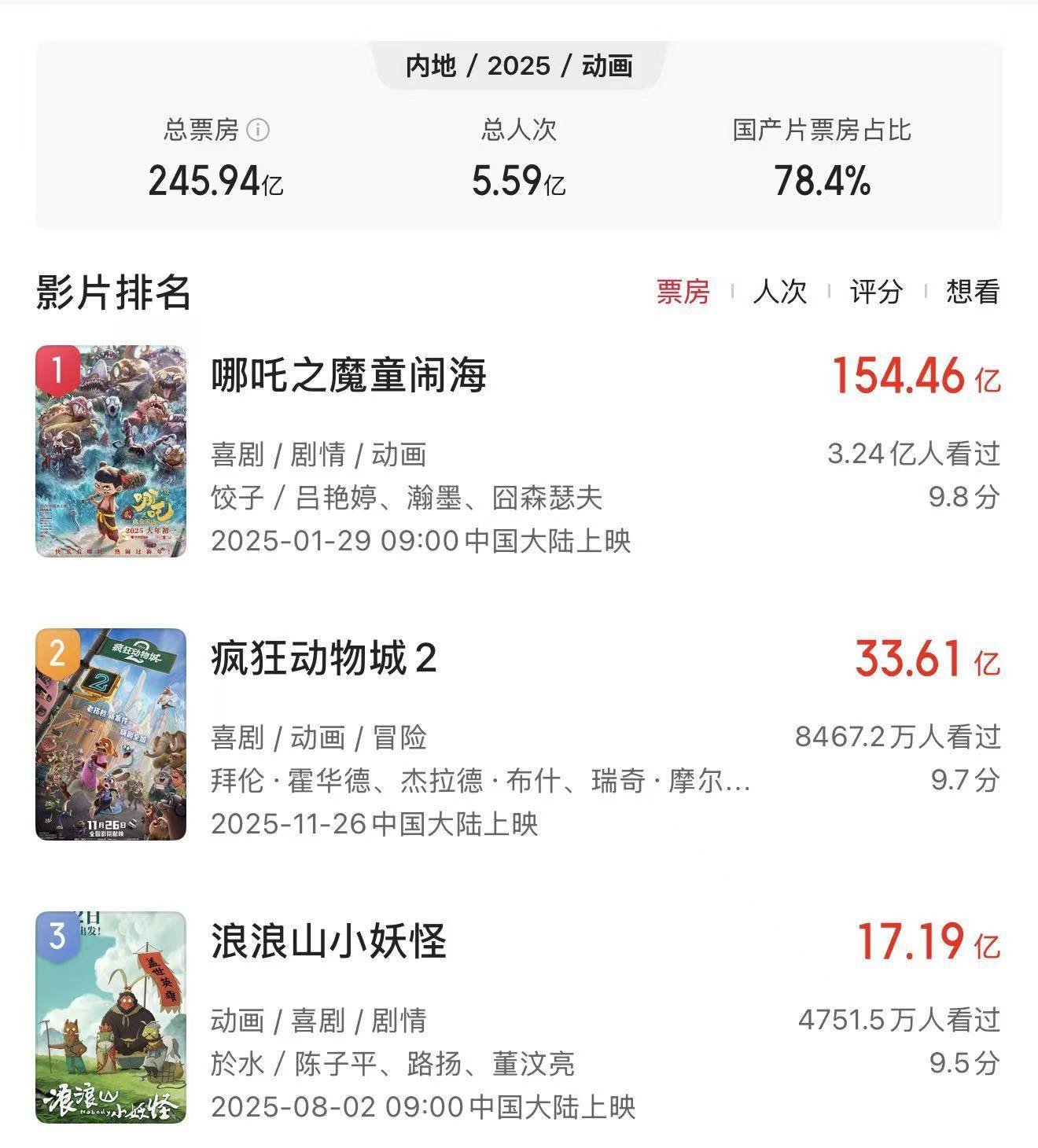
Core Insights - The Chinese film industry is experiencing a resurgence with the release of "Zootopia 2," pushing annual box office revenues towards 50 billion yuan, while the influx of AI technology is reshaping content creation and audience preferences [2][12]. Financial Performance - For the first three quarters of the year, the company reported revenue of 2.928 billion yuan, a year-on-year decline of 2.90%, and a net profit attributable to shareholders of 66.36 million yuan, down 69.22% [2]. - In Q3, the company achieved revenue of 1.212 billion yuan, a year-on-year increase of 35.61%, and a net profit of 177 million yuan, up 1463.17% [2]. Project Pipeline - The company has nearly 90 projects in its pipeline, with around 50 being original projects, aiming for a steady annual production to maintain market supply [3]. - The "Youth Filmmaker Program" is being implemented to support low to mid-budget productions [3]. Impact of AI - AI is significantly impacting the industry, particularly in short videos and low-budget films, due to its higher efficiency and lower costs. However, it is noted that AI lacks the originality and artistic depth of high-quality films [3]. Animation Market - The animation sector is identified as a clear growth area, with national animation box office revenues exceeding 24.5 billion yuan, accounting for about 50% of total box office [3]. - The company is advancing several animation projects and exploring collaborations with local resources to build a more comprehensive animation industry chain [3]. Strategic Shifts - The company is transitioning from traditional cinema investment to modern cinema management, focusing on refined, branded, and technology-driven operations to enhance competitiveness [10]. - The integration of cinema chains is underway, with market share rising to the second position nationally as of November 2025 [10]. International Collaborations - The company is enhancing its distribution capabilities with the recovery of imported films, expecting a significant increase in overseas film sources by 2026, including major international IPs [11]. - The collaboration with "Avatar 3" is seen as a pivotal moment for showcasing the CINITY technology on a global scale, with expectations of boosting international recognition [12][13]. Box Office Projections - The annual box office target of 50 billion yuan is considered nearly certain, bolstered by the success of recent imported films and the anticipated performance of "Avatar 3" [12][13]. - The company has established a subsidiary for importing films to expand its supply of foreign films, aiming to provide audiences with a richer selection [13].


第三季度营业收入12.12亿元,中国电影董事长傅若清:市场如何在AI冲击与进口片回暖中站上500亿元?
Sou Hu Cai Jing· 2025-12-13 09:17
复苏之上,中国电影要稳住什么? 面对投资者"影视投资是否可量化"的提问,傅若清表示,艺术创作很难通过指标严格量化,但公司正通过"精品+多元"方式提升单项目质量,并加大题材与 类型的覆盖。 他介绍,目前中国电影储备了近90个项目,其中,原创项目有近50个,"要做到逐年投产、形成梯队,有节奏地保持市场供应"。在中小成本创作端,"中影 青年电影人计划"正在补位。 对于人工智能(AI)对行业的冲击,中国电影独立董事张树武表示,生成式AI已开始对短视频、微短剧乃至中低成本电影形成强烈冲击,因为其"效率更 高、成本更低"。但他强调,AI仍停留在经验拼贴与素材重组,与原创艺术存在本质差异。"《阿凡达》《流浪地球》这种高工业化、强原创性的电影,AI难 以复制。经历审美疲劳之后,文化艺术还是会回到原创、求真求美和极致体验上来。" 12月12日,中国电影召开三季报业绩说明会。 随着《疯狂动物城2》一路狂奔,电影院在年末重新热闹起来了,全年票房正冲击500亿元;与此同时,AI(人工智能)像潮水一样涌入内容行业,进口片 开始"卷土重来",观众的审美也在悄悄偏移。 行业从"冷清"转向"繁忙",却也潜藏着一股席位重排的暗流。这一轮洗牌里 ...
近四成调研股上涨,商业航天与AI机器人成掘金焦点
Huan Qiu Wang· 2025-12-13 03:05
Core Insights - The report highlights a significant increase in institutional research activity, with 164 companies hosting investor meetings during the week of December 8-12, leading to notable stock performance among these companies [1][3]. Group 1: Stock Performance - Nearly 40% of the companies that were researched experienced positive stock returns, with several stocks showing remarkable gains [1][3]. - Notable performers included Chaojie Co., which saw a weekly increase of 39.03% and reached its daily limit, while other companies like Holleywo, Sry New Materials, and Boying Special Welding also recorded gains exceeding 30% [3]. Group 2: Commercial Aerospace Focus - Chaojie Co. attracted significant attention, receiving inquiries from 73 institutions regarding its commercial aerospace business [4]. - The company announced the completion of its assembly line for aerospace structural components, capable of producing parts for 10 rockets annually, with a product range that includes shell segments and engine valves [4]. - Chaojie Co. has begun small-scale deliveries, estimating that the structural components for a mainstream commercial rocket are valued at approximately 15 million yuan [4]. Group 3: AI and Robotics Sector - The AI and robotics sectors remain focal points for institutional research, with Shenghong Technology and Fengli Intelligent both receiving attention from over 40 institutions [5][6]. - Shenghong Technology is leveraging opportunities from AI computing advancements and data center upgrades, emphasizing its technological leadership in the AI server domain [5][6]. - Fengli Intelligent has expanded its product line to include precision mechanical components and is focusing on humanoid robots and low-altitude economy sectors for 2024 [6].


担忧雪上加霜!甲骨文被爆部分数据中心推迟至2028年竣工,AI股大跌
美股IPO· 2025-12-13 02:19
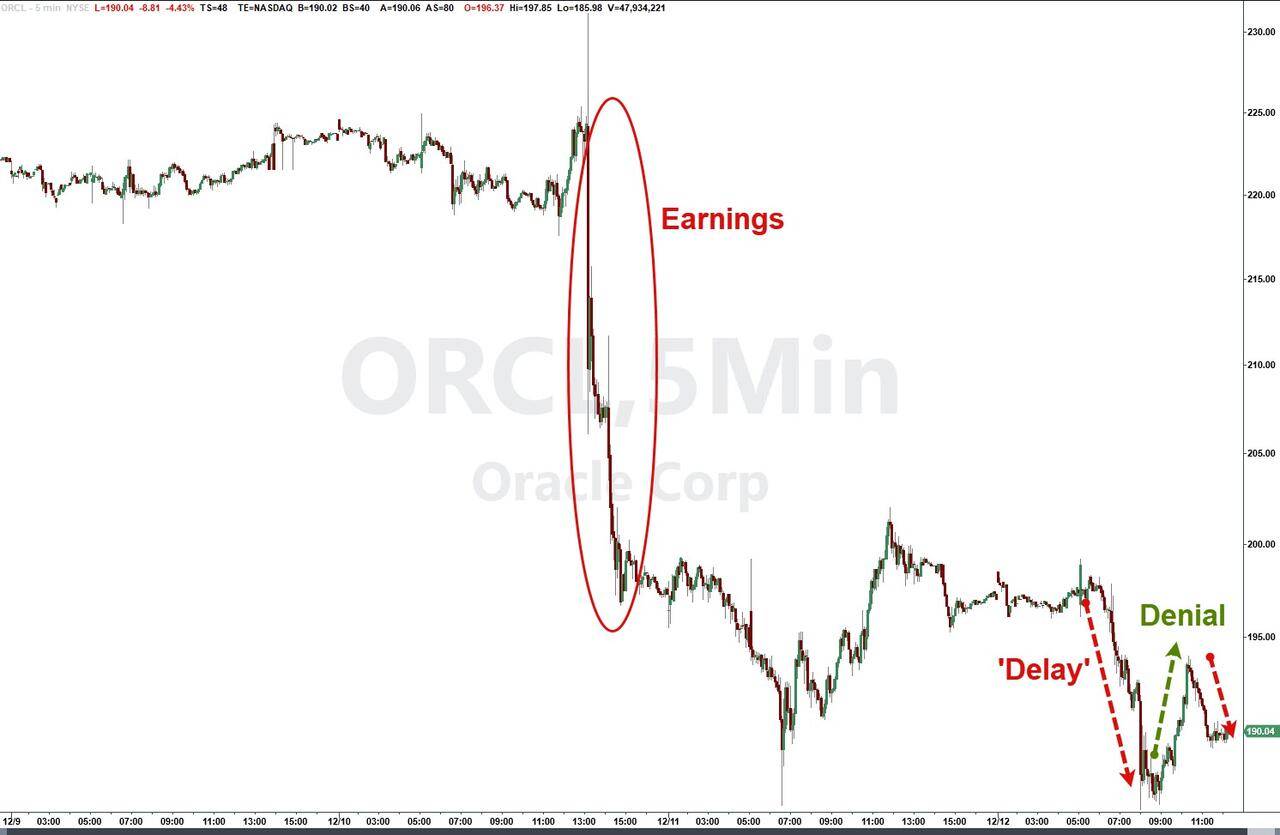
在甲骨文AI支出激增、博通业绩电话会未达投资者高预期后,媒体称,甲骨文将部分为OpenAI开发的数 据中心竣工日期从2027年推迟至2028年。甲骨文盘中跌超6%,抛售甚至波及电力股。后公司否认消 息,称所有合约数据中心均未出现延误,股价收跌4.5%。 继甲骨文和博通的业绩表现引发投资者担忧后,周五甲骨文传出的数据中心延期消息令AI概念股雪上加 霜,投资者对人工智能(AI)领域泡沫的疑虑加剧。 美东时间12日周五美股早盘,媒体报道称,甲骨文将部分为OpenAI开发的数据中心竣工时间从2027年 推迟至2028年。美股午盘时段,甲骨文否认此消息,该司发言人在电邮中表示: "选址和交付时间表是在与OpenAI签署协议后密切协调制定,并经双方共同商定。所有履行合同义务所需的 (数据中心)地址均未出现延误,有望按计划达成所有里程碑。" 甲骨文和OpenAI均拒绝对周五的数据中心消息置评。 周五当天,甲骨文盘中跌幅一度扩大至6%以上,进一步加剧了前一日业绩公布后暴跌11%后的颓势, 甲骨文否认媒体消息后,午盘跌幅还超过4%,收跌近4.5%,公布财报后两日累跌14.8%。截至周五收 盘,股价已较9月10日的巅峰跌去40% ...



担忧雪上加霜!甲骨文被爆部分数据中心推迟至2028年竣工,AI股大跌
Sou Hu Cai Jing· 2025-12-12 23:00
Core Insights - Oracle's delay in data center completion for OpenAI has heightened investor concerns about the AI sector's potential bubble [1][9] - Following Oracle's earnings report, the stock experienced a significant decline, exacerbated by the data center delay news [1][11] - Broad sell-off in AI-related stocks occurred, with major companies like Broadcom and Nvidia also facing substantial losses [3][12] Oracle's Performance and Challenges - Oracle's stock fell over 14.8% in two days following its earnings report, with a peak decline of over 40% from its September high [1][11] - The company reported a 14% year-over-year revenue growth and a 34% increase in cloud sales, both below analyst expectations [11] - Capital expenditures surged to $12 billion in the second fiscal quarter, a 41% increase from the previous quarter, raising concerns about the pace of revenue conversion [11][12] AI Sector Impact - The delay in Oracle's data center projects has raised doubts about the sustainability of infrastructure spending that supports AI growth [8][10] - The Philadelphia Semiconductor Index fell over 5%, marking its largest drop in two months, reflecting broader market concerns [3][8] - Investor sentiment has shifted, with increased scrutiny on the costs and timelines associated with AI infrastructure development [12][14] Broadcom's Situation - Despite strong earnings, Broadcom's stock dropped nearly 12%, the largest decline in 10 months, due to investor disappointment over future guidance [12][14] - Broadcom reported a 30% year-over-year revenue increase, with AI semiconductor revenue expected to double in the upcoming quarter [13][15] - Concerns arose regarding the lack of comprehensive guidance for AI revenue in 2026 and the implications of a $73 billion backlog of AI product orders [14][15]
Wall Street Roundup: Market Reacts To Earnings
Seeking Alpha· 2025-12-12 19:15
分组1: Oracle - Oracle's stock dropped 11% after mixed earnings results, beating earnings expectations but missing revenue targets, following a previous 36% increase after its last report [4][5] - The company's remaining performance obligations (RPO) increased by 438% to $523 billion, indicating strong future contracted revenue, yet concerns about rising debt and expenses are affecting investor sentiment [6][7] - Cloud revenue grew by 34%, but operating expenses for the cloud software segment rose by 45%, highlighting a trend of increasing costs outpacing revenue growth [6][7] 分组2: Broadcom - Broadcom reported strong earnings and a positive forecast, but management warned of margin pressures due to a higher mix of AI revenue, leading to a 10% decline in stock price [8][9] - The situation reflects a broader concern in the tech sector regarding the sustainability of revenue growth in light of rising costs associated with AI infrastructure [10] 分组3: AutoZone - AutoZone's stock fell 7% after missing earnings expectations, despite a 4.8% increase in same-store sales, as inflation and rising costs impacted margins [11][12] - The company typically benefits from economic downturns as consumers opt to maintain older vehicles, but it is currently struggling to capitalize on this trend due to cost pressures [12][13] 分组4: Airlines - Airline stocks experienced a relief rally following the end of the government shutdown, with the Jets ETF up 14% since the shutdown ended [14][15] - Southwest Airlines saw a significant increase of 31% since the shutdown, attributed to its turnaround plans and the critical holiday travel season [16][18] 分组5: Streaming Industry - A bidding war is ongoing in the streaming industry, particularly between Netflix and Paramount, with implications for antitrust discussions and the future of content production [19][20] - The competition for content indicates a sustained interest in traditional media, as streaming services seek to enhance their offerings with live events and established franchises [21][22] 分组6: Upcoming Earnings - Upcoming earnings reports from Nike and FedEx are anticipated to provide insights into consumer spending habits and holiday shipping trends, respectively [22][23] - Reports from homebuilders like Lennar and KB Home are also expected, shedding light on the housing market amidst affordability concerns [24] 分组7: Federal Reserve Policy - The Federal Reserve is facing uncertainty in its policy direction, with multiple dissents regarding interest rate cuts, complicating predictions for future rate movements [40][41] - Current consensus suggests a potential for one interest rate cut in 2026, with inflation expected to remain above the 2% target for the next few years [43][44]


美国2026-2028展望:萧条还是繁荣?(英文版)-瑞银集团
Sou Hu Cai Jing· 2025-12-12 16:33
Economic Outlook - UBS predicts a "moderate growth and inflation pressure" scenario for the US economy from 2026 to 2028, with GDP growth rates expected to be 1.6% in 2026 and 1.8% in 2027, indicating a gradual slowdown in economic expansion [1][3] - The current economic expansion is characterized by "narrow momentum" and "unstable foundations," with sectors like residential investment and non-residential construction already in decline [1][3] Inflation and Tariff Impact - Inflation pressure is identified as a core challenge, significantly driven by tariff policies, with the current average tariff rate at 13.6%, which has surged fivefold since the beginning of the year [1][3] - UBS estimates that tariffs will increase the core Personal Consumption Expenditures (PCE) inflation rate by 0.8 percentage points in 2026, maintaining a price increase around 3.5% even if other inflationary pressures ease [1][3] Labor Market Dynamics - The labor market is showing signs of cooling, with a risk of transitioning from "moderate slowdown" to "accelerated weakness," which poses a significant uncertainty for future economic performance [1][3] - Despite a gradual decline in job growth, the labor market remains resilient, but households outside the top 20% income bracket are experiencing a significant drop in liquidity, affecting their ability to cope with inflation [2][3] Policy and Technological Support - Policy adjustments, including potential interest rate cuts by the Federal Reserve in late 2026, and technological advancements, particularly in AI, are expected to support economic stability and growth [2][3] - The "One Big Beautiful Bill Act" (OBBBA) is anticipated to provide economic stimulus through tax reductions and corporate expense deductions, partially offsetting the deficit increase from tariff revenues [2][3] Market Strategy - UBS maintains an overweight stance on the US stock market, expecting it to navigate short-term economic headwinds while focusing on AI-driven profit corrections and policy support [2][3] - High-quality stocks are projected to continue driving strong earnings, with a weaker dollar providing additional advantages compared to European markets [2][3]


Dow Turns Lower as AI Selloff Deepens
Barrons· 2025-12-12 16:31
Core Viewpoint - The Dow has experienced selling pressure after a period of outperformance, indicating a potential shift in market sentiment [1] Group 1: Market Performance - The Dow was down 283 points, or 0.6%, reflecting a decline in investor confidence [1] - Prior to the decline, the Dow was on track for its largest three-day outperformance against the Nasdaq since March 10 and was approaching another record high [1] - The S&P 500 and Nasdaq also faced losses, with the S&P 500 down 1.3% and the Nasdaq down 2%, highlighting broader selling pressure in U.S. equities [1]
美股芯片巨头大跌,“带崩”科技股
Shang Hai Zheng Quan Bao· 2025-12-12 15:54
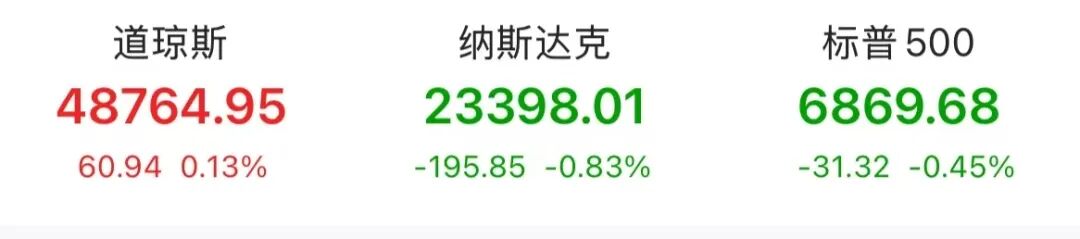
Core Viewpoint - The U.S. stock market showed mixed performance with the Dow Jones slightly up while the Nasdaq and S&P 500 experienced minor declines, particularly impacted by technology stocks like Broadcom, which saw a significant drop of over 9% in intraday trading [1]. Group 1: Market Performance - As of the latest update, the Dow Jones Industrial Average was at 48,764.95, up by 60.94 points or 0.13% [2]. - The Nasdaq Composite Index was at 23,398.01, down by 195.85 points or 0.83% [2]. - The S&P 500 Index was at 6,869.68, down by 31.32 points or 0.45% [2]. Group 2: Broadcom Financial Performance - Broadcom reported Q4 revenue of $18.02 billion, a year-over-year increase of 28%, and adjusted EBITDA of $12.12 billion, up 34%, both exceeding market expectations [3][4]. - The semiconductor business revenue reached $11.1 billion, growing 35% year-over-year, driven by AI semiconductor sales of $6.5 billion, which surged 74% [6]. Group 3: AI Product Orders and Market Sentiment - Broadcom has a backlog of $73 billion in AI product orders, which has raised concerns in the market despite the strong performance [4]. - The CEO indicated that the backlog is a baseline figure and is expected to grow as new orders accelerate, with delivery times ranging from six months to a year [6]. Group 4: Future Guidance and Dividend Increase - For Q1 2026, Broadcom forecasts total revenue of $19.1 billion and adjusted EBITDA of $6.7 billion, with AI chip revenue expected to double year-over-year to $8.2 billion, contributing over 40% of total revenue [6]. - The company announced a 10% increase in its quarterly dividend to $0.65 per share, marking the highest annual dividend of $2.6 per share in its history [7]. Group 5: Analyst Target Price Adjustments - Multiple institutions have raised their target prices for Broadcom, with Goldman Sachs increasing its target from $435 to $450, citing the company's strengthening position in custom chips and AI business fundamentals [9]. - Other firms, including Piper Sandler and Melius Research, have also raised their target prices significantly, reflecting positive sentiment despite potential short-term stock price pressures [10].
深夜新高,美联储,重磅发声
Zheng Quan Shi Bao· 2025-12-12 15:11
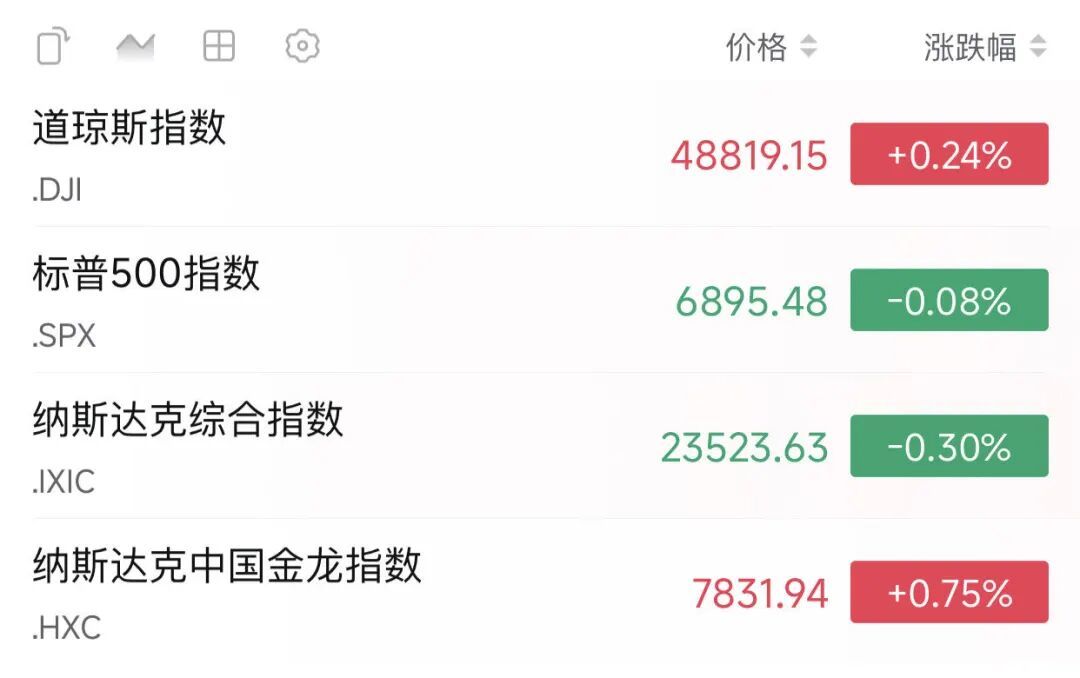
当地时间12月12日(周五),美股三大股指走势分化,道指创下历史新高。截至发稿,道指涨0.24%,标普500指数跌0.08%,纳指跌0.3%。 | 口 △ 田 (0) | 价格 = | 涨跌幅 ◆ | | --- | --- | --- | | 道琼斯指数 | 48819.15 | +0.24% | | .DJI | | | | 标普500指数 | 6895.48 | -0.08% | | .SPX | | | | 纳斯达克综合指数 | 23523.63 | -0.30% | | .IXIC | | | | 纳斯达克中国金龙指数 | | | | | 7831.94 | +0.75% | 消息面上,周五,多位美联储官员发声。美联储施密德表示,劳动力市场正在降温,但仍基本保持平衡;通胀仍过高,经济呈现增长势头,希望保持货币 政策适度限制性。 芝加哥联储主席古尔斯比表示,他之所以在本周投下反对票,是因为他希望等待更多经济数据,以确定关税对通胀的影响是否只是暂时的。就2026年降息 幅度预期而言,降息次数将多于中值预测。 美国克利夫兰联储主席哈玛克表示,美联储在获得新数据后将拥有更好的可见度。"我倾向于采取略微更具限 ...