
并购重组

Search documents
6500亿巨无霸并购诞生!A股重组五大新趋势引爆市场
2 1 Shi Ji Jing Ji Bao Dao· 2025-08-06 13:30
Core Viewpoint - The recent wave of mergers and acquisitions among state-owned enterprises (SOEs) in China, exemplified by China Shenhua's plan to acquire 13 energy companies, reflects a strategic response to new regulations encouraging industry consolidation and integration [1][4]. Group 1: Mergers and Acquisitions Trends - China Shenhua's acquisition plan involves a total asset scale exceeding 650 billion yuan, aiming to create an integrated operational system across the energy supply chain [4]. - The acquisition includes companies across coal mining, coal power, coal chemical, and logistics, enhancing resource capacity and operational efficiency [4]. - The new regulatory environment supports industry consolidation, with policies encouraging leading listed companies to integrate within their core business sectors [5]. Group 2: Cross-Industry Mergers - Since the introduction of the "merger six guidelines" in September 2024, there has been a notable increase in cross-industry mergers, particularly in technology sectors like semiconductors and high-end manufacturing [7][8]. - Successful cross-industry mergers are characterized by the acquirer's operational compliance, logical alignment with traditional industry upgrades, and strong business synergies post-acquisition [9]. Group 3: Support for Loss-Making Companies - Loss-making companies can acquire other firms, provided they meet strict criteria, including the necessity for strong business synergies and robust capital strength [14]. - Recent examples include semiconductor companies engaging in acquisitions despite both parties being in a loss position, indicating a shift in regulatory acceptance of such transactions [12][14]. Group 4: Regulatory Flexibility - The regulatory environment has become more accommodating, allowing for flexible payment methods and autonomous arrangements regarding performance commitments in mergers [17]. - New policies support diverse valuation methods for determining transaction prices and encourage long-term capital participation in mergers [18].

8月6日涨停股:25股封单资金均超1亿元
Zheng Quan Shi Bao Wang· 2025-08-06 10:49
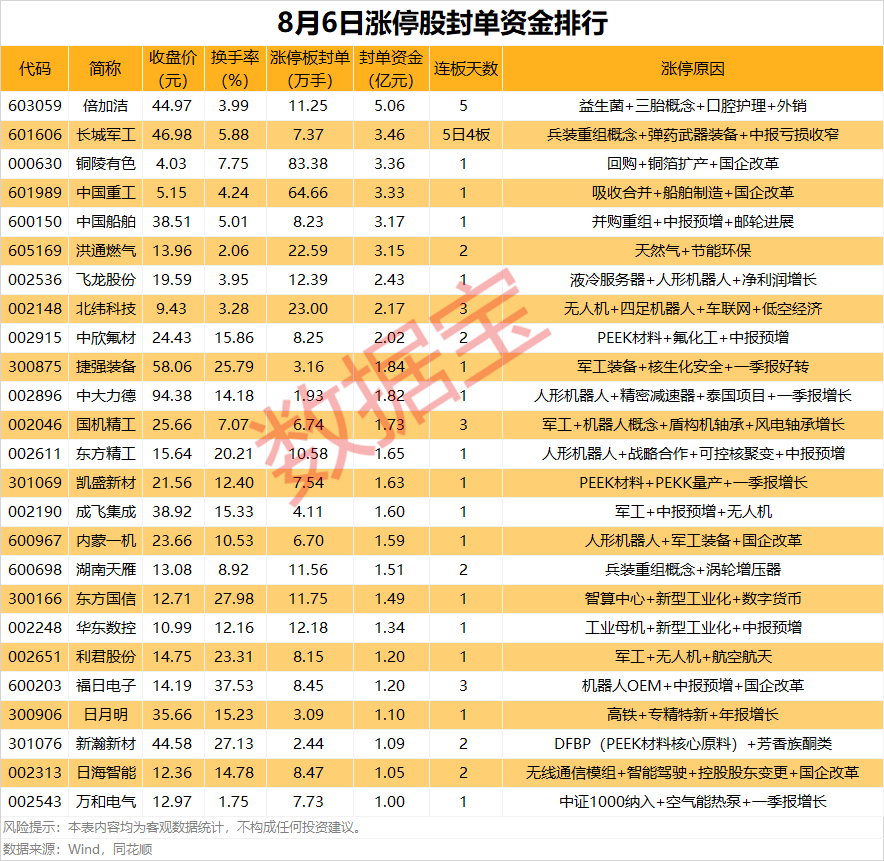
Market Overview - On August 6, a total of 77 stocks in the A-share market hit the daily limit, with 63 stocks remaining after excluding 14 ST stocks, resulting in an overall limit-up rate of 75.49% [1] - The highest limit-up order volume was recorded by Tongling Nonferrous Metals, with 833,800 hands, followed by China Shipbuilding Industry, Zhong An Keji, and Beiwai Technology, with limit-up orders of 646,600 hands, 288,300 hands, and 230,000 hands respectively [1] Limit-Up Stocks Summary - The top three stocks by limit-up order funds were Beijiajie (5.06 billion), Changcheng Jincheng (3.46 billion), and Tongling Nonferrous Metals (3.36 billion) [1] - Beijiajie closed at 44.97 yuan with a turnover rate of 3.99%, driven by probiotics, the three-child policy concept, oral care, and exports [2] - Changcheng Jincheng closed at 46.98 yuan with a turnover rate of 5.88%, influenced by military equipment restructuring, ammunition and weaponry, and a narrowed mid-term loss [2] - Tongling Nonferrous Metals closed at 4.03 yuan with a turnover rate of 7.75%, supported by share buybacks, copper foil expansion, and state-owned enterprise reform [2] - China Heavy Industry closed at 5.15 yuan with a turnover rate of 4.24%, boosted by absorption and merger, shipbuilding, and state-owned enterprise reform [2]


全球最大上市船企来了,“两船”完成合并在即,股价双双涨停
2 1 Shi Ji Jing Ji Bao Dao· 2025-08-06 05:28
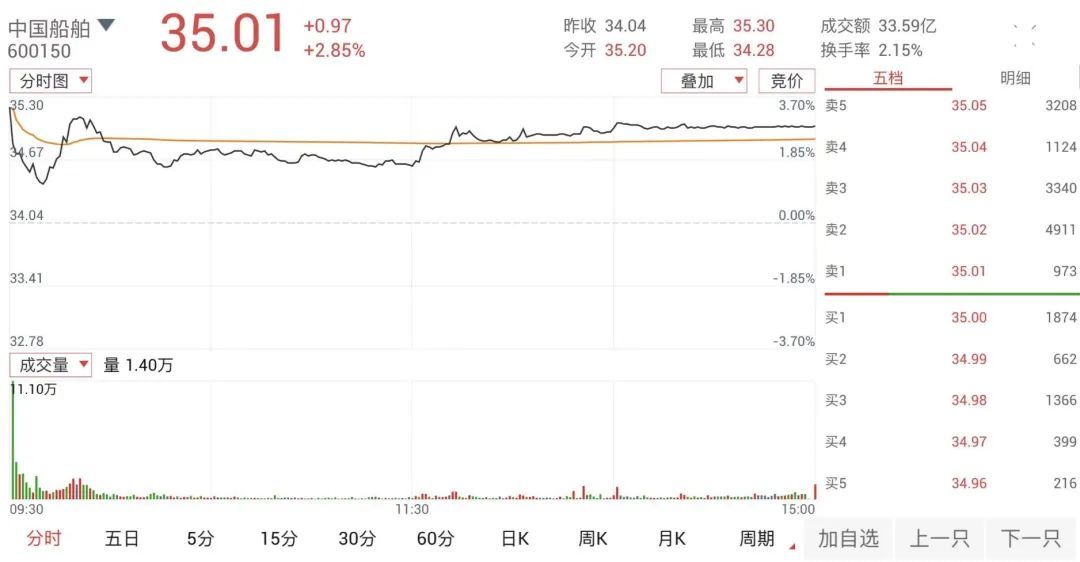
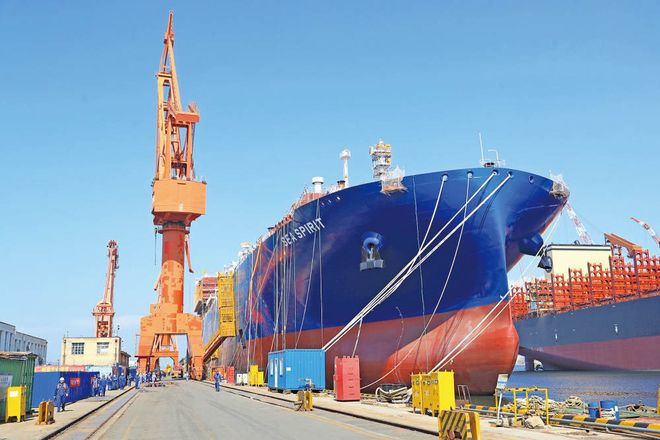
Core Viewpoint - The merger between China Shipbuilding Industry Corporation (CSIC) and China State Shipbuilding Corporation (CSSC) marks a significant consolidation in the Chinese shipbuilding industry, with the approval from the China Securities Regulatory Commission (CSRC) and the upcoming stock suspension indicating a major shift in the sector [1][2][5]. Group 1: Merger Details - The merger involves a share swap where CSSC will absorb CSIC, leading to CSIC's delisting [1]. - The dissenting shareholders of both companies have the option to cash out at prices of 30.01 CNY per share for CSSC and 4.03 CNY per share for CSIC, totaling approximately 5.56 billion CNY and 13.02 billion CNY respectively [1]. - The merger is expected to enhance resource synergy and operational efficiency within the shipbuilding sector [2][4]. Group 2: Financial and Operational Impact - Post-merger, the combined total assets of CSIC and CSSC are projected to exceed 400 billion CNY, surpassing the 300 billion CNY asset scale of the previous "South-North Train" merger [4]. - For the year 2024, CSIC and CSSC are expected to achieve revenues of 785.84 billion CNY and 554.36 billion CNY respectively, with combined profits exceeding 50 billion CNY [4]. - The order backlog for CSIC stands at 322 vessels with a total weight of 24.61 million tons valued at 216.96 billion CNY, while CSIC holds 216 vessels with a total weight of 30.31 million tons valued at 233.76 billion CNY, together accounting for 15% of the global order backlog [4]. Group 3: Market Context and Future Outlook - The merger is seen as a response to the ongoing consolidation trend in the state-owned enterprise sector, with a rapid approval process of just 71 days highlighting the supportive regulatory environment [5]. - Analysts predict that the successful merger will lead to increased activity in the M&A market, potentially accelerating further consolidation in the industry [6]. - The global shipbuilding industry is entering a new growth cycle, with Chinese shipyards expected to benefit from a robust order book and improved capabilities compared to previous cycles [8].

千亿级并购连环爆!下一个是谁?
Di Yi Cai Jing Zi Xun· 2025-08-06 03:46
Group 1 - The core viewpoint of the article highlights the active M&A restructuring in the A-share market, with significant developments in state-owned enterprise mergers and innovative restructuring cases emerging [2][5][6] - China Shipbuilding Industry Corporation (China Shipbuilding) and China State Shipbuilding Corporation (China State Shipbuilding) have received approval from the China Securities Regulatory Commission (CSRC) for a share swap merger, with the transaction amounting to 115.15 billion yuan [6][7] - The merger will enhance the operational quality and core competitiveness of the listed company, while also addressing issues of industry competition and protecting minority shareholders' rights [7][9] Group 2 - The "M&A Six Guidelines" have stimulated the market, leading to over 2,400 listed companies disclosing M&A restructuring announcements since its release [5][10] - The recent M&A activities include China Shenhua's acquisition of assets from the State Energy Group, involving coal and related assets from over 13 companies, indicating a trend towards large-scale transactions [8][10] - The payment methods for M&A transactions have diversified, with companies utilizing various financial instruments such as convertible bonds and M&A loans to facilitate deals [10][12] Group 3 - The restructuring activities are primarily driven by state-owned enterprise reforms, industrial upgrades, and asset securitization, with a focus on integrating resources and enhancing market competitiveness [6][13] - Investment institutions and brokerage firms are actively participating in the M&A market, adjusting their strategies to focus on M&A business and enhancing their service capabilities [13][14] - Future M&A activities are expected to emphasize industrial integration and transformation, with companies adopting a more cautious approach towards restructuring [15]



千亿级并购连环爆,下一个是谁?
Di Yi Cai Jing· 2025-08-06 03:46
Core Viewpoint - The A-share market is experiencing a surge in mergers and acquisitions (M&A), with significant developments in state-owned enterprises (SOEs) and innovative restructuring cases emerging [1][6][8] Group 1: Major M&A Activities - China Shipbuilding Industry Corporation (CSIC) and China State Shipbuilding Corporation (CSSC) have received approval for a share-swap merger, with the transaction valued at 115.15 billion yuan [7][8] - China Shenhua Energy Company is planning to acquire assets from the State Energy Group, involving over 13 companies, indicating a trend of large-scale M&A transactions [9] - Since the introduction of the "M&A Six Guidelines," over 2,400 listed companies have announced M&A activities, highlighting the active market environment [4][6] Group 2: Trends in M&A - The integration of SOEs and hard technology acquisitions are identified as two core trends in the current M&A wave [6][10] - The "M&A Six Guidelines" have led to a more vibrant market, with diverse payment methods becoming a notable feature of recent M&A transactions [11][12] - The recent M&A activities are driven by multiple factors, including state-owned enterprise reform policies and the need for industrial transformation and upgrading [7][10] Group 3: Innovative Payment Methods - The introduction of various payment methods, such as shares, convertible bonds, and M&A loans, has enhanced the flexibility and success rate of M&A transactions [11][12] - Companies like China Power and Changhong High-Tech are utilizing convertible bonds as part of their M&A strategies, showcasing the innovative financing tools available [12][13] - The relaxation of M&A loan requirements has further facilitated the acquisition process, allowing for higher loan-to-value ratios [12][13] Group 4: Institutional Participation - Investment institutions and brokerage firms are actively engaging in the M&A market, adjusting their strategies to focus on M&A activities [15][16] - The establishment of strong information networks and dedicated M&A teams is crucial for successful transactions, enabling better valuation and execution [16] - The future of the M&A market is expected to emphasize industrial integration and transformation, with companies becoming more cautious and strategic in their approaches [16]
千亿级并购连环爆!下一个是谁?
第一财经· 2025-08-06 03:34
Core Viewpoint - The A-share market is experiencing a surge in mergers and acquisitions (M&A), with significant developments in state-owned enterprises (SOEs) and innovative restructuring cases emerging [5][6]. Group 1: Recent M&A Activities - On August 4, China Shipbuilding (600150.SH) and China State Shipbuilding Corporation (601989.SH) announced that their share-swap merger has received approval from the China Securities Regulatory Commission (CSRC), set to be implemented with stock suspension starting August 13 [5][8]. - The merger transaction is valued at approximately 115.15 billion yuan, with a swap ratio of 1:0.1339, allowing shareholders of China State Shipbuilding to exchange their shares for those of China Shipbuilding [8][9]. - China Shenhua (601088.SH) is also planning to acquire assets from the State Energy Group, involving over ten companies, indicating a trend of large-scale M&A transactions in the market [10][11]. Group 2: Policy and Market Trends - The "M&A Six Guidelines," introduced by the CSRC in September 2024, has led to over 2,400 listed companies in the A-share market announcing M&A activities, with a notable increase in innovative cases and diverse payment methods [6][8]. - The integration of SOEs and hard technology acquisitions has become a core trend in the current M&A wave, driven by national policies supporting SOE reform and industry upgrades [8][9]. - Since the introduction of the "M&A Six Guidelines," three major M&A transactions exceeding 100 billion yuan have been recorded, highlighting the growing trend of large-scale mergers [9]. Group 3: Diverse Payment Methods - The revised "Major Asset Restructuring Management Measures" introduced in May 2025 has facilitated various payment methods for M&A, including installment payments and convertible bonds, enhancing market activity [14][15]. - Companies like China Power and Changhong High-Tech are utilizing convertible bonds as a payment tool in their acquisitions, reflecting the trend of innovative financing mechanisms in M&A [15][16]. - The introduction of new policies allowing for increased leverage in acquisition loans has further stimulated M&A activities, with companies like Foxit Software planning to utilize bank loans for acquisitions [15][16]. Group 4: Institutional Involvement - Investment firms and securities companies are actively participating in the M&A market, adapting their strategies to align with the evolving regulatory environment and market dynamics [18][19]. - Securities firms are enhancing their capabilities in M&A services, focusing on valuation, transaction execution, and post-merger integration to better support clients [19][20]. - The trend of institutional involvement in M&A is expected to continue, with a focus on industry integration and transformation, leading to more cautious and strategic approaches to restructuring [20].

“两船”完成合并在即,总资产超4000亿元
2 1 Shi Ji Jing Ji Bao Dao· 2025-08-06 00:00
Core Viewpoint - The merger between China Shipbuilding and China State Shipbuilding has received official approval from the China Securities Regulatory Commission, marking a significant step in the restructuring of China's shipbuilding industry [2][5]. Group 1: Merger Details - The merger involves a share swap where China Shipbuilding will absorb China State Shipbuilding, leading to the latter's delisting [2]. - The stock of both companies will be suspended from trading starting August 13, with no specified date for resumption [2][4]. - Dissenting shareholders have the option to cash out at prices of 30.01 yuan per share for China Shipbuilding and 4.03 yuan per share for China State Shipbuilding, with total values of 5.56 billion yuan and 13.02 billion yuan respectively [5]. Group 2: Financial and Operational Impact - The combined total assets of the two companies will exceed 400 billion yuan by the end of 2024, surpassing the 300 billion yuan asset scale of the previous "South-North Train" merger [7]. - In 2024, China Shipbuilding and China State Shipbuilding are projected to achieve revenues of 78.58 billion yuan and 55.44 billion yuan, respectively, with combined annual revenues exceeding 100 billion yuan [7]. - The order backlog includes 322 vessels for China Shipbuilding valued at 216.96 billion yuan and 216 vessels for China State Shipbuilding valued at 233.77 billion yuan, totaling 15% of the global order backlog [8]. Group 3: Market Context and Future Outlook - The merger is seen as a response to the ongoing consolidation trend in the state-owned enterprise sector, with a streamlined approval process taking only 71 days [8]. - The merger is expected to enhance resource synergy, improve bargaining power, and facilitate the integration of green ship technology and military-civilian fusion experiences [7][11]. - Analysts predict that the Chinese shipbuilding industry will remain busy due to a long-term supply-demand imbalance, benefiting from a new cycle of demand in the global shipbuilding market [11].
“两船”完成合并在即,总资产超4000亿元
21世纪经济报道· 2025-08-05 23:47
Core Viewpoint - The merger between China Shipbuilding and China State Shipbuilding has received regulatory approval, marking a significant step in the restructuring of China's shipbuilding industry, with the aim of enhancing resource synergy and market competitiveness [1][4][8]. Group 1: Merger Details - The merger involves a share swap where China Shipbuilding will absorb China State Shipbuilding, leading to the latter's delisting [1][4]. - The merger has been in the works for over a year, with the approval process taking only 71 days, indicating strong support for state-owned enterprise consolidation [8]. - Following the merger, both companies will halt trading on August 13, with a resumption date yet to be determined [1][3]. Group 2: Financial and Operational Impact - Combined assets of the two companies will exceed 400 billion yuan, surpassing the asset scale of previous major mergers in the industry [7]. - In 2024, the two companies are projected to achieve combined revenues exceeding 1 trillion yuan and net profits over 50 billion yuan [7]. - The order backlog for China Shipbuilding stands at 322 vessels with a total weight of 24.61 million tons, valued at 216.96 billion yuan, while China State Shipbuilding has 216 vessels valued at 233.77 billion yuan, together accounting for 15% of the global order backlog [7]. Group 3: Strategic Advantages - The merger will facilitate the integration of complementary technologies and enhance bargaining power in the market [7][11]. - The consolidation is expected to reduce internal competition and improve supply chain resilience, positioning the new entity to better capitalize on the upcoming shipbuilding cycle [11]. - The merger aligns with the trend of state-owned enterprises leveraging capital markets for integration, potentially leading to more M&A activities in the future [8][11].
浙江建投: 发行股份购买资产并募集配套资金暨关联交易报告书(草案)摘要(修订稿)
Zheng Quan Zhi Xing· 2025-08-05 16:32
Group 1 - The company Zhejiang Construction Investment Group Co., Ltd. plans to acquire 13.05% equity in Zhejiang First Construction Group, 24.73% equity in Zhejiang Second Construction Group, and 24.78% equity in Zhejiang Third Construction Group through a share issuance [19][24] - The total transaction price for the acquisition is set at 128,318.03 million RMB, excluding the funds raised [19] - The company aims to enhance its core competitiveness and overall strategic layout by achieving 100% control over the acquired companies, which are significant players in the construction industry [24][27] Group 2 - The company will raise 45,000 million RMB through the issuance of 62,674,094 shares to Zhejiang Provincial State-owned Capital Operation Co., Ltd. as part of the transaction [21][22] - The raised funds will be allocated to the construction of the Zhejiang Provincial Fitness Center project and to supplement working capital, with 33.33% and 66.67% of the funds respectively [21][22] - The issuance price for the shares is set at 7.18 RMB per share, which is 80% of the average trading price of the company's A-shares over the 20 trading days prior to the pricing date [22][23] Group 3 - The transaction is expected to have no immediate impact on the company's total assets, revenue, or net profit, as the acquired companies are already included in the consolidated financial statements [24][27] - Post-transaction, the company's equity attributable to shareholders is projected to increase, enhancing its profitability and core competitiveness [27][32] - The controlling shareholder, Zhejiang Provincial State-owned Capital Operation Co., Ltd., has expressed support for the transaction, emphasizing its benefits for the company's sustainable operations and shareholder rights [28][29]

浙江建投: 浙江天册律师事务所关于浙江省建设投资集团股份有限公司发行股份购买资产并募集配套资金的补充法律意见书(一)
Zheng Quan Zhi Xing· 2025-08-05 16:32
Core Viewpoint - The legal opinion letter discusses the issuance of shares by Zhejiang Construction Investment Group Co., Ltd. to acquire assets and raise supporting funds, emphasizing the necessity and compliance of the transaction with relevant laws and regulations [1][2]. Group 1: Transaction Overview - The transaction involves Zhejiang Construction Investment Group acquiring minority stakes in its subsidiaries from Guoxin Jianyuan Equity Investment Fund, aiming to enhance control and operational efficiency [3][4]. - The investment is part of a broader strategy to reduce the company's debt ratio and improve financial health, aligning with national policies on debt-to-equity swaps [24][25]. Group 2: Financial Impact - Post-transaction, the company's total assets are projected to increase slightly from 12,088,242.38 million to 12,133,242.38 million, reflecting a 0.37% change [29]. - The total liabilities are expected to decrease from 11,136,902.52 million to 11,021,277.32 million, marking a -1.04% change, while the owner's equity will rise significantly by 16.88% [29]. Group 3: Strategic Importance - The construction industry is positioned for high-quality development, supported by government initiatives aimed at optimizing infrastructure and promoting sustainable growth [22][23]. - Zhejiang Construction Investment Group plays a crucial role in major infrastructure projects, contributing to regional economic development and aligning with national strategic goals [22][23]. Group 4: Governance and Control - Following the transaction, the company will hold 100% ownership of the acquired subsidiaries, enhancing its governance and operational control over these entities [28]. - The investment allows for the appointment of directors from Guoxin Jianyuan Fund, ensuring that the fund has a say in significant company decisions, thereby influencing management practices [12][15].