稳定币

Search documents
稳定币,走向何方?
Sou Hu Cai Jing· 2025-08-02 04:49
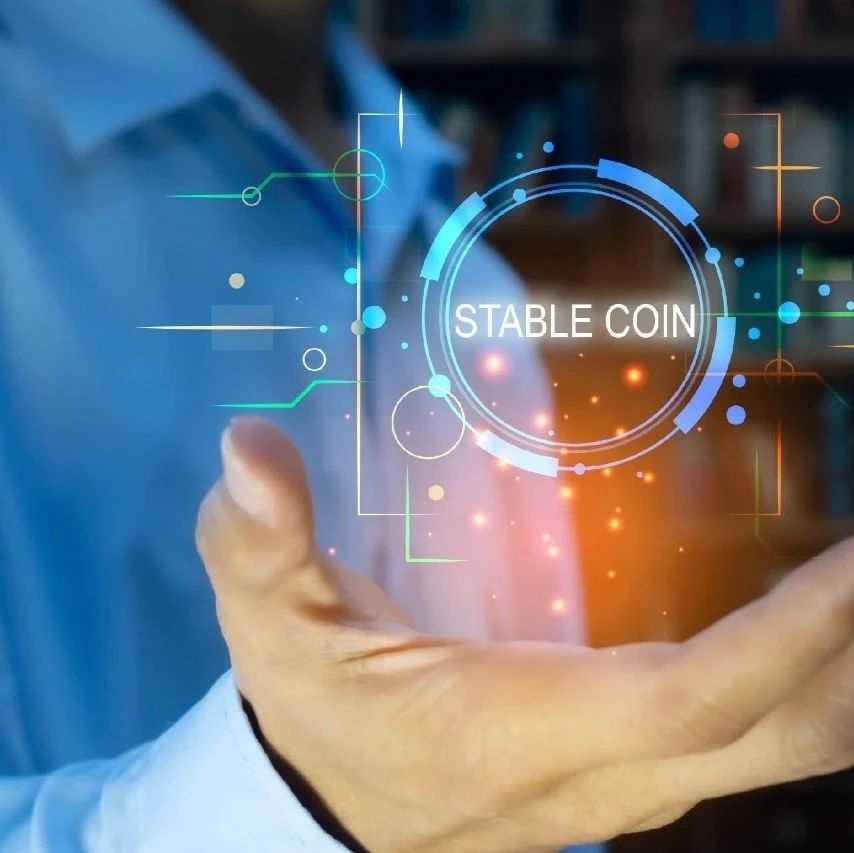
读书,是使你拥有打破人生边界的底气,积累不断超越自己的资本。中国商报特别栏目 "阅"见商道来了,每期挑选一部书籍伴您同行。 关于投资,你最近关注哪个领域? 香港《稳定币条例》已于8月1日正式生效。 稳定币(Stablecoin)是一种基于区块链技术的加密数字货币,通过锚定法定货币、大宗商品、主流加密资产,或依赖算法机制调节供应量,实现价格的 相对稳定。 根据ARK Invest报告, 2024年稳定币全年交易额达15.6万亿美元,分别相当于Visa和Mastercard的119%和200%,显示其在全球支付系统中的重要性日益上 升。OKG Research预计, 到2030年全球稳定币总供应量将达到3万亿美元,年度交易额有望突破100万亿美元。 7月31日早盘,稳定币指数上涨2.01%,机构资金净流入3.78亿元,大户资金净流入1.24亿元。成分股中数字认证涨停。 从现货比特币ETF上市到稳定币崛起,全球货币未来走向何方? 今天咱们一起看看《加密货币与金融大变局》↓ 艾利艾咨询 成立于2008年,总部设在北京,在雄安、中国香港、新加坡等地设有子分公司。多年来,艾利艾咨询专注于战略研究、网络舆情及风险管理、战略 ...


两部门:恢复征收国债等利息收入增值税|南财早新闻
Sou Hu Cai Jing· 2025-08-01 23:48
Government Policies - The Ministry of Finance and the State Taxation Administration announced that starting from August 8, interest income from newly issued national bonds, local government bonds, and financial bonds will be subject to value-added tax [1] - The People's Bank of China emphasized the continuation of a moderately loose monetary policy and the importance of executing various monetary policy measures effectively [1] Macroeconomic Developments - The National Development and Reform Commission reported that the third batch of 690 billion yuan in special bonds for consumer goods replacement has been fully allocated, with a fourth batch planned for October [2] - The Supreme People's Court clarified that any agreement regarding "non-payment of social insurance" is invalid, effective from September 1 [2] - The Ministry of Culture and Tourism reported that domestic tourist trips reached 3.285 billion in the first half of the year, a year-on-year increase of 20.6% [2] Investment News - The Hong Kong Stablecoin Regulation came into effect on August 1, requiring licenses for issuing stablecoins pegged to the Hong Kong dollar [3] - The Hong Kong Stock Exchange published a consultation summary on optimizing IPO pricing and public market regulations, allowing a reduction in the minimum allocation ratio for IPOs from 50% to 40% [3] Company Developments - Wahaha Group's inheritance dispute has progressed, with the Hong Kong High Court approving asset preservation requests related to approximately 1.8 billion USD in HSBC accounts [5] - Tencent has adjusted its WeChat payment withdrawal fee structure, charging a service fee of 0.1% on amounts exceeding the free withdrawal limit [5] - New energy vehicle companies reported July delivery figures, with Leap Motor delivering over 50,000 units for the first time, while BYD's sales reached 344,300 units, a slight year-on-year increase [5] - Hikvision announced a revenue of 41.818 billion yuan for the first half of the year, a year-on-year increase of 1.48%, with a net profit of 5.657 billion yuan, up 11.71% [5]
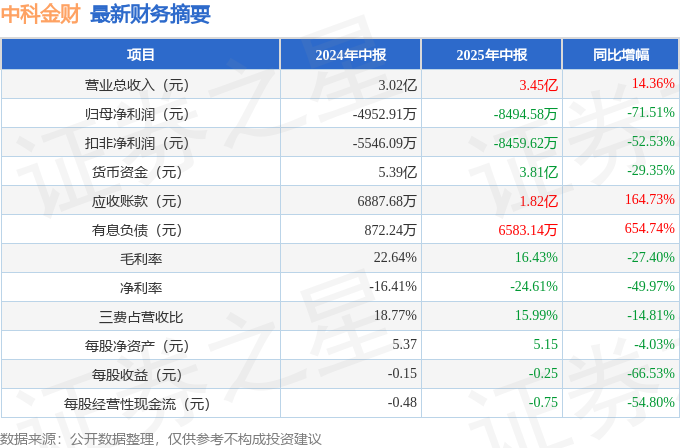
中科金财2025年中报简析:增收不增利
Zheng Quan Zhi Xing· 2025-08-01 22:33
Financial Performance - The company reported a total revenue of 345 million yuan for the first half of 2025, an increase of 14.36% year-on-year, but a net profit attributable to shareholders of -84.95 million yuan, a decline of 71.51% year-on-year [1] - The gross margin decreased to 16.43%, down 27.4% year-on-year, while the net margin was -24.61%, a decrease of 49.97% year-on-year [1] - The company’s operating cash flow per share was -0.75 yuan, a decrease of 54.8% year-on-year, and earnings per share were -0.25 yuan, down 66.53% year-on-year [1] Cash Flow and Financial Position - Cash and cash equivalents decreased by 29.35% to 381 million yuan due to increased procurement payments [3] - Accounts receivable increased significantly by 164.73% to 182 million yuan, indicating potential cash flow issues [1] - Interest expenses rose by 71.01%, reflecting increased borrowing costs [18] Investment and Asset Management - The company has been exploring stablecoin business opportunities, focusing on compliance and collaboration with banks to leverage global assets and business scenarios [42] - The global stablecoin market is projected to reach a market cap of nearly 2.5 trillion USD, with significant growth expected in transaction volumes [43] - The company has developed various digital currency solutions, including smart contract security planning platforms and compliance management systems [41] Industry Context - The stablecoin market has seen a growth of over 22 times in the past five years, with expectations of reaching a transaction volume of 10 trillion USD by 2025 [43] - The company is positioned as a key player in the blockchain and digital asset sectors, having established itself as a think tank for government and regulatory bodies [41]

香港《稳定币条例》正式实施,沾“币”即涨的“十倍股”!稳定币泡沫化,监管喊话“降温”
Sou Hu Cai Jing· 2025-08-01 13:52
Core Points - The Hong Kong "Stablecoin Regulation" has officially come into effect, establishing the world's first comprehensive regulatory framework for fiat-backed stablecoins [2][6] - The implementation of the regulation is seen as a milestone for the sustainable development of Hong Kong's stablecoin and digital asset ecosystem, igniting investment enthusiasm in the capital markets [3][20] - Despite the positive outlook, many companies are still in the early stages of stablecoin-related business and have not yet generated actual performance [3][17] Regulation Details - The regulation requires any institution issuing or promoting fiat stablecoins in Hong Kong to operate under a license, with severe penalties for non-compliance [7] - The initial licensing process is expected to issue only a limited number of licenses, with stringent requirements including a minimum paid-up capital of HKD 25 million and sufficient liquid assets [7][10] - The Hong Kong Monetary Authority (HKMA) plans to launch a "Stablecoin Issuer Sandbox" in March 2024 to allow participants to demonstrate feasible stablecoin issuance processes [8] Market Performance - The stablecoin index has risen by 60% year-to-date as of August 1, with several stablecoin concept stocks in both A-shares and Hong Kong stocks seeing significant price increases [3][14] - Notable stocks include Hengbao Co., Sifang Jingchuang, and Jingbeifang, which have doubled in price this year [3][15] - However, on the day the regulation was implemented, many stablecoin concept stocks experienced a decline, indicating market volatility [3][17] Future Outlook - The total market capitalization of stablecoins has exceeded USD 260 billion, with projections suggesting it could reach USD 3.7 trillion by 2030 [4][20] - Major companies like Ant Group and JD.com are expected to apply for stablecoin licenses, leveraging their blockchain technology and application scenarios [9][10] - The cautious approach of the HKMA in issuing licenses may lead to disappointment among many applicants, as only a few licenses are anticipated in the initial phase [10][17] Risks and Concerns - The market has shown signs of over-excitement regarding stablecoins, with concerns about the potential for excessive conceptualization and bubble formation [16][17] - Instances of illegal financial activities related to stablecoins have been reported, highlighting the need for regulatory vigilance [18][19]

稳定币能否重塑全球货币
Hu Xiu· 2025-08-01 13:49
Core Viewpoint - Hong Kong's "Stablecoin Management Ordinance" marks a significant regulatory step, establishing it as the first major international financial center in Asia to comprehensively regulate the stablecoin market, amidst growing interest from major tech companies like JD.com and Ant Group in enhancing cross-border payment efficiency through stablecoins [1][4]. Group 1: Regulatory Framework - The new regulation requires all stablecoin transactions to occur through regulated exchanges, prohibiting direct peer-to-peer transfers between wallets, and mandates strict KYC (Know Your Customer) and KYT (Know Your Transaction) compliance for every transaction [2][21]. - The regulatory approach aims to prevent the influx of gray capital, ensuring that stablecoin development adheres to compliance and safety standards, even if it slows initial progress [2][31]. Group 2: Market Dynamics - Major tech companies are entering the Hong Kong stablecoin market primarily to improve cross-border payment efficiency and to capitalize on the potential for stable revenue generation through interest on deposited funds [18][17]. - The challenge for new stablecoins, particularly those pegged to the Hong Kong dollar, lies in overcoming the established dominance of USDT and USDC, which have created a robust "on-chain dollar" ecosystem [19][20]. Group 3: Systemic Risks and Opportunities - The essence of stablecoins as financial tools lies in their ability to connect on-chain and off-chain economies, but their stability is fundamentally dependent on the quality of the underlying assets [8][9]. - The emergence of stablecoins is reshaping the international monetary system, allowing tech companies to participate in currency creation, which poses significant challenges to traditional financial frameworks [3][39]. Group 4: Future Trends - There is potential for stablecoins backed by other real-world assets (RWA) such as gold or commodities to gain traction, especially as market confidence in the dollar fluctuates [25][24]. - The regulatory landscape is evolving, with different regions adopting varying approaches; for instance, the EU is likely to push for euro-backed stablecoins while the US maintains a more permissive stance [22][28].

【财闻联播】“国补”继续!690亿元资金10月下达!最高法明确:“不缴社保”约定无效
券商中国· 2025-08-01 13:46
Macro Dynamics - The Ministry of Finance announced that starting from August 8, 2025, interest income from newly issued national bonds, local government bonds, and financial bonds will be subject to value-added tax. Existing bonds issued before this date will continue to be exempt from VAT until maturity [2] Financial Institutions - The Financial Regulatory Bureau reported that a coordination mechanism to support financing for small and micro enterprises has achieved positive results. By June 2025, over 90 million small and micro businesses were visited, resulting in new credit of 23.6 trillion yuan and new loans of 17.8 trillion yuan, with 32.8% being credit loans [3] Market Data - On August 1, A-shares saw a collective decline, with the Shanghai Composite Index down 0.37% and the Shenzhen Component Index down 0.17%. The total trading volume was approximately 1.598 trillion yuan, a decrease of about 337.7 billion yuan from the previous trading day [10] - The Hong Kong stock market closed with the Hang Seng Index down 1.07% and the Hang Seng Tech Index down 1.02%. Notably, stablecoin concept stocks led the decline, while smart transportation and charging pile concepts were active [11] Company Dynamics - Three major telecommunications companies have unified their outbound marketing numbers to standardize telemarketing practices. The official outbound marketing numbers are China Telecom 10001, China Mobile 10085, and China Unicom 10016. Users who refuse telemarketing should not be contacted again [12] - Jinghe Integrated announced plans to issue H-shares and list on the Hong Kong Stock Exchange. The company is currently discussing specific details with relevant intermediaries, and this move will not change the controlling shareholder or actual controller [13]
对话香港最大持牌虚拟资产交易所:稳定币启航,如何行稳致远?
财富FORTUNE· 2025-08-01 13:28
Core Viewpoint - The global stablecoin landscape is undergoing significant transformation, with the U.S. Stablecoin Act accelerating the tokenization process dominated by the dollar, while adjustments in Singapore's crypto ecosystem create development opportunities for Hong Kong [2][3]. Group 1: Hong Kong's Regulatory Framework - Hong Kong's Stablecoin Regulation came into effect on August 1, with the Hong Kong Monetary Authority (HKMA) indicating that institutions wishing to apply for licenses must express their intent by the end of August and submit applications by September 30 [2]. - The HKMA plans to issue the first phase of licenses by early 2026, with the initial number expected to be in single digits [2]. - HKMA's President emphasized the positive implications of stablecoins as emerging payment tools but cautioned against excessive market speculation, advocating for a prudent and sustainable approach to implementing the Stablecoin Regulation [2]. Group 2: HashKey Exchange's Position - HashKey Exchange, as Hong Kong's largest licensed virtual asset exchange, aims to avoid excessive speculation on stablecoins, focusing instead on sustainable innovation within a compliant framework [3][4]. - The exchange has established partnerships with traditional financial institutions, simplifying fiat-to-crypto processes and facilitating the tokenization of money market fund ETFs [4]. - HashKey's CEO noted a significant increase in stablecoin usage for cross-border payments, particularly in large trade settlements, highlighting the exchange's plans to collaborate with stablecoin license applicants to list HKD stablecoins [5]. Group 3: Market Dynamics and Opportunities - Stablecoins have emerged as a crucial alternative for cross-border payment settlements, especially in countries with unstable local currencies, where they serve as a financial substitute [5][12]. - The U.S. Treasury estimates that the stablecoin market could grow from approximately $250 billion to $2 trillion, creating a substantial buyer market for U.S. Treasury bonds [13]. - The potential for RMB internationalization could be enhanced through stablecoins, particularly with the introduction of offshore RMB stablecoins, which may improve payment efficiency and coverage [14][15]. Group 4: Competitive Landscape - Hong Kong's rapid advancement in stablecoin regulation positions it favorably against Singapore, which has tightened regulations on non-compliant entities, inadvertently benefiting Hong Kong's digital asset ecosystem [17]. - The Middle East, particularly Dubai, poses a competitive challenge to Hong Kong, with its more flexible regulatory environment and aggressive push for blockchain integration in financial services [18]. - HashKey's diverse ecosystem includes digital asset trading, asset management, and on-chain services, which distinguishes it from other exchanges and enhances its competitive edge [10][21]. Group 5: Compliance and Innovation - HashKey emphasizes compliance as a competitive advantage, implementing stringent KYC and anti-money laundering measures that exceed traditional banking standards [6][20]. - The exchange's commitment to compliance has fostered trust among institutional clients, enabling it to navigate regulatory challenges while pursuing innovative solutions [20]. - The company actively engages with regulators to optimize operational costs and enhance service offerings, ensuring that innovation aligns with compliance requirements [20].

专访宋敏:稳定币能否重塑全球货币
经济观察报· 2025-08-01 12:27
Core Viewpoint - The introduction of real assets is crucial for the future development of stablecoins, as the stability of stablecoins fundamentally depends on the quality of the underlying assets [1][3]. Regulatory Framework - The Hong Kong Stablecoin Management Ordinance, effective from August 1, 2025, marks Hong Kong as the first Asian financial center to comprehensively regulate the stablecoin market [2][5]. - The ordinance requires all stablecoin transactions to occur through regulated exchanges, prohibiting direct peer-to-peer transfers between wallets, and mandates strict KYC (Know Your Customer) and KYT (Know Your Transaction) compliance [3][17]. - This regulatory approach, while enhancing compliance, may undermine the decentralized advantages of blockchain technology [3][17]. Market Dynamics - Major Chinese tech companies like JD.com and Ant Group are actively entering the Hong Kong stablecoin market, primarily to enhance cross-border payment efficiency and capitalize on the stablecoin's profit model [16][18]. - The dominance of USDT and USDC in the global market creates challenges for new entrants, as user acceptance is heavily influenced by existing network effects [16][19]. Asset Quality and Stability - The stability of stablecoins is directly linked to the quality of the underlying assets; assets with clear ownership and predictable cash flows, such as fiat currencies or gold, provide greater stability [11][19]. - The potential for tokenizing real-world assets (RWA) hinges on the clarity of ownership and the ability to generate reliable cash flows [11][12]. Global Financial Implications - Stablecoins are reshaping the international monetary system, allowing tech companies to create currency-like assets, which poses significant challenges to traditional financial frameworks [4][30]. - The reliance on the US dollar as the primary backing for most stablecoins is due to the large offshore dollar market, but this dominance may not be permanent [19][20]. Future Considerations - The relationship between stablecoins and central bank digital currencies (CBDCs) is complex, with potential models suggesting that CBDCs could serve as a foundation for stablecoins issued by tech companies [26][27]. - The balance between innovation and regulation remains a critical issue, as overly stringent regulations may stifle technological advancements in the stablecoin space [23][30].
Coinbase(COIN.US)FY25Q2电话会:目前衍生品业务处于初期 但交易量已实现周环比翻倍
智通财经网· 2025-08-01 12:26
Core Insights - Coinbase is optimistic about its derivatives business roadmap, having recently launched its first perpetual contract product for U.S. retail users, with trading volume doubling week-over-week and significant growth in open interest [1][18] - The company is focusing on enhancing liquidity and trading volume in the short term, rather than immediate profitability, with plans to provide further details on revenue contributions in upcoming quarters [1][18] - Coinbase emphasizes collaboration with traditional financial institutions like Visa and Mastercard rather than competition, while also acknowledging the competitive landscape posed by decentralized protocols [1][9] Derivatives Business - Derivatives trading accounts for 75% of the cryptocurrency market, with over 90% of this activity occurring overseas [1][18] - In Q2, Coinbase reported over $1 trillion in derivatives trading volume and a record open interest of $1 billion, indicating significant progress in this area [1][18] Strategic Partnerships - Coinbase is expanding its market reach through partnerships, such as with PNC Bank and Shopify, to provide infrastructure and services to businesses entering the crypto space [5][6] - The company aims to integrate its services into major financial institutions, allowing them to leverage Coinbase's expertise without building their own complex systems [5][14] Stablecoin and Payment Solutions - The stablecoin market has seen rapid growth, with annual transaction volume increasing from nearly zero two years ago to approximately $100 billion [7][10] - Coinbase's payment solutions include a full-stack approach with low transaction fees and partnerships with trusted stablecoin providers like Circle [8][10] Tokenization and Securities - Coinbase is excited about the potential of tokenized securities, which could revolutionize the financial system by enabling real-time settlement and 24/7 trading [3][11] - The company is exploring opportunities in the tokenized securities market, although specific timelines for implementation remain unclear [3][11] User Experience and Security - Following a recent data breach, Coinbase is focusing on improving customer service and security measures, including bringing more processes in-house and investing in automation and AI [19] - The company is also enhancing its customer support infrastructure to better handle user inquiries and improve overall satisfaction [19]

专访宋敏:稳定币能否重塑全球货币
Jing Ji Guan Cha Wang· 2025-08-01 11:46
Core Viewpoint - Hong Kong's "Stablecoin Management Ordinance" marks a significant regulatory step, making it the first Asian financial center to comprehensively regulate the stablecoin market, amidst growing interest from major tech companies like JD.com and Ant Group in enhancing cross-border payment efficiency [2][3][4] Group 1: Regulatory Framework - The new ordinance requires all stablecoin transactions to occur through regulated exchanges, prohibiting direct peer-to-peer transfers between wallets, and mandates strict KYC (Know Your Customer) and KYT (Know Your Transaction) compliance [3][15] - This regulatory approach aims to enhance compliance and transparency but may compromise the decentralized nature of blockchain technology [3][15] - The ordinance is seen as a cautious yet necessary step to prevent risks associated with unregulated stablecoins, such as USDT, and serves as a potential model for mainland China's future stablecoin regulations [3][20][23] Group 2: Market Dynamics - Major tech companies are entering the Hong Kong stablecoin market primarily to improve cross-border payment efficiency and capitalize on the profit potential from stablecoin issuance [14][15] - The success of a stablecoin depends on its ability to create network effects, as user trust in its widespread adoption is crucial [15][16] - The existing dominance of USDT as a "chain-based dollar" poses challenges for new entrants, particularly in terms of user acceptance and market competition [15][16] Group 3: Asset Quality and Stability - The stability of a stablecoin is fundamentally linked to the quality of its underlying assets, with a focus on ensuring that these assets have clear ownership and predictable returns [3][10] - The introduction of real-world assets (RWA) into the stablecoin ecosystem is seen as essential for enhancing financial robustness, provided these assets are of high quality [3][10][18] - The potential for stablecoins backed by other scarce assets, such as gold or carbon credits, is increasing, reflecting a shift in market dynamics and trust in the dollar [18][19] Group 4: Global Financial Implications - Stablecoins are reshaping the international monetary system by enabling tech companies to create currency-like assets, challenging traditional banking structures [4][28] - The emergence of stablecoins as a new form of banking raises questions about regulatory frameworks and the need to redefine risk boundaries in algorithm-driven financial ecosystems [5][28][29] - The regulatory landscape varies globally, with Europe and the U.S. adopting different approaches to stablecoin regulation, which may influence the competitive dynamics of the market [16][21][22]