跨境电商

Search documents
赛维时代涨2.04%,成交额9020.13万元,主力资金净流入828.74万元
Xin Lang Cai Jing· 2025-10-29 05:44
Core Insights - The stock price of Saiwei Times increased by 2.04% on October 29, reaching 24.50 CNY per share, with a total market capitalization of 9.885 billion CNY [1] - The company has seen a year-to-date stock price increase of 8.84% and a 5-day increase of 8.65% [1] Financial Performance - For the period from January to September 2025, Saiwei Times reported a revenue of 8.188 billion CNY, representing a year-on-year growth of 20.39%, and a net profit attributable to shareholders of 210 million CNY, up 7.34% year-on-year [2] - The company has distributed a total of 421 million CNY in dividends since its A-share listing [2] Shareholder Information - As of October 20, 2025, the number of shareholders for Saiwei Times was 14,700, a decrease of 2.89% from the previous period, while the average circulating shares per person increased by 2.97% to 13,248 shares [2] - Notable institutional shareholders include China Europe Economic Growth Fund, which is the fifth largest shareholder with 2.679 million shares, and Hong Kong Central Clearing Limited, the eighth largest shareholder with 1.6313 million shares, both of which are new entrants [2] Business Overview - Saiwei Times, established on May 31, 2012, and listed on July 12, 2023, is primarily engaged in technology-driven cross-border e-commerce, with 92.32% of its revenue coming from this segment [1][2] - The company operates within the Shenyuan industry classification of retail trade, specifically in the internet e-commerce and cross-border e-commerce sectors [1]
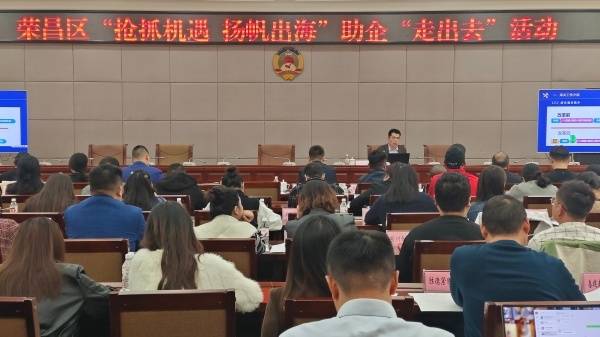
荣昌区举办“抢抓机遇 扬帆出海”助企“走出去”活动
Sou Hu Cai Jing· 2025-10-29 04:36
Core Insights - The event "Seize Opportunities and Set Sail" was held in Rongchang District to support local enterprises in expanding into international markets, focusing on policy interpretation, resource connection, and risk management [2][3] - Rongchang is leveraging its "2335" modern manufacturing cluster system, particularly in the electronic circuit and biopharmaceutical sectors, with the electronic circuit industry experiencing a growth of 103.2% in the first nine months of this year [2] - The event featured experts from Chongqing Customs, tax authorities, and cross-border e-commerce to provide practical guidance and insights into market trends and export processes [2][3] Policy and Support Measures - Chongqing Customs and the tax bureau provided detailed explanations of export tax rebates and foreign trade support policies, clarifying specific measures for subsidy applications and service guarantees [3] - The "New Outbound 2035 Plan" was introduced to assist enterprises in building overseas brands and channels [2] Future Plans - Rongchang will continue to upgrade its foreign trade comprehensive service platform and implement subsidies for cross-border e-commerce and brand cultivation, providing full-process support for enterprises going abroad [3] - The district aims to deepen the integration of its characteristic industries with the cross-border e-commerce ecosystem to enhance the international competitiveness of "Rongchang Manufacturing" and promote high-quality foreign trade development [3]

拉卡拉涨2.02%,成交额3.94亿元,主力资金净流入548.10万元
Xin Lang Zheng Quan· 2025-10-29 03:14
Core Viewpoint - Lakala's stock price has shown a significant increase of 42.72% year-to-date, despite a recent decline over the past 60 days, indicating volatility in its market performance [1][2]. Company Overview - Lakala Payment Co., Ltd. was established on January 6, 2005, and went public on April 25, 2019. The company is headquartered in Beijing and primarily provides payment services to small and micro enterprises, as well as personal payment services to individual users [1]. - The company's main business revenue is entirely derived from payment services, accounting for 100% of its income [1]. Financial Performance - For the period from January to September 2025, Lakala reported a revenue of 4.07 billion yuan, representing a year-on-year decrease of 7.33%. The net profit attributable to shareholders was 339 million yuan, down 33.90% compared to the previous year [2]. - Since its A-share listing, Lakala has distributed a total of 2.615 billion yuan in dividends, with 1.035 billion yuan distributed over the last three years [3]. Shareholder Information - As of September 30, 2025, Lakala had 104,400 shareholders, a decrease of 26.11% from the previous period. The average number of circulating shares per shareholder increased by 35.37% to 7,038 shares [2]. - The top ten circulating shareholders include notable entities such as Huabao Zhongzheng Financial Technology Theme ETF and Hong Kong Central Clearing Limited, with significant changes in their holdings [3].
潮宏基涨2.08%,成交额8191.95万元,主力资金净流出102.85万元
Xin Lang Cai Jing· 2025-10-29 02:41
Core Viewpoint - Chao Hong Ji's stock price has shown significant growth this year, with a year-to-date increase of 160.99%, indicating strong market performance and investor interest [1][2]. Company Overview - Chao Hong Ji, established on March 7, 1996, and listed on January 28, 2010, is headquartered in Shantou, Guangdong, and specializes in high-end fashion jewelry design, research, production, and sales, along with handbag business [2]. - The company's revenue composition includes 48.53% from fashion jewelry products, 44.63% from traditional gold products, 3.00% from brand agency and franchise services, 2.99% from leather goods, and 0.46% from other income [2]. Financial Performance - For the first half of 2025, Chao Hong Ji reported a revenue of 4.102 billion yuan, representing a year-on-year growth of 19.54%, and a net profit attributable to shareholders of 331 million yuan, up 44.34% year-on-year [2]. - The company has distributed a total of 1.897 billion yuan in dividends since its A-share listing, with 800 million yuan distributed over the past three years [3]. Shareholder Structure - As of June 30, 2025, the number of shareholders increased by 51.55% to 40,400, with an average of 21,446 circulating shares per person, down 33.99% [2]. - Notable institutional shareholders include Hong Kong Central Clearing Limited, which holds 65.4136 million shares, and several new entrants among the top ten shareholders [3]. Market Activity - On October 29, the stock price rose by 2.08% to 14.25 yuan per share, with a trading volume of 81.9195 million yuan and a turnover rate of 0.67% [1]. - The stock has appeared on the daily trading leaderboard six times this year, with the most recent occurrence on June 5, where it recorded a net buy of 130 million yuan [1].

恒林股份第三季度净利暴增近112%,社保基金新进重仓
Zheng Quan Shi Bao Wang· 2025-10-29 02:36
Core Insights - Henglin Co., Ltd. reported a total revenue of 8.488 billion yuan for the first three quarters of 2025, representing a year-on-year growth of 8.66% [1] - The company's net profit attributable to shareholders reached 279 million yuan, up 4.81% year-on-year, with a significant turnaround in the third quarter where net profit surged by nearly 112% [1][3] - The company is recognized as a leading developer of health-oriented seating and is one of the largest manufacturers and exporters of office chairs in China [1] Financial Performance - In Q3 2025, Henglin Co., Ltd. achieved a net profit of approximately 97.4 million yuan, marking a year-on-year increase of nearly 112% [1] - The company's non-recurring net profit for the same period was about 93 million yuan, also showing a growth of over 110% year-on-year [1] - The overall net profit growth for the year is projected to be 49.18% according to institutional forecasts, with continued high growth expected in the coming years [3] Business Strategy and Development - Henglin Co., Ltd. is transitioning towards smart home solutions and has established itself as one of the top ten brands in smart office furniture in China [2] - The company aims to become a world-class green home enterprise, focusing on a "manufacturing + service" transformation strategy [2] - The proportion of OBM (Original Brand Manufacturer) business revenue reached 55.36% of total revenue in the first half of the year, indicating a balanced development between ODM and OBM [2] Technological Advancements - The company is enhancing its production automation and smart manufacturing capabilities by introducing various automated equipment such as stacking robots and sorting robots [2] - Henglin Co., Ltd. has implemented a fully automated warehouse equipped with a digital control platform to achieve comprehensive informationization and visualization of the manufacturing process [2] Market Position and Shareholder Dynamics - Cross-border e-commerce is identified as a key driver for revenue growth, supported by global capacity layout and overseas warehouse construction [3] - Recent data indicates that the number of shareholders in Henglin Co., Ltd. has been decreasing for two consecutive quarters, suggesting a concentration of shares among larger investors [3]

牧高笛跌2.01%,成交额756.58万元,主力资金净流入18.61万元
Xin Lang Cai Jing· 2025-10-29 02:26
Core Viewpoint - The stock price of Muguo Di has shown a decline recently, with a year-to-date increase of 13.71% but a notable drop in the last 60 days by 9.43% [2] Financial Performance - For the first half of 2025, Muguo Di reported a revenue of 605 million yuan, representing a year-on-year decrease of 27.45%. The net profit attributable to shareholders was 47.21 million yuan, down 40.35% year-on-year [2] - Cumulative cash dividends since the company's A-share listing amount to 491 million yuan, with 220 million yuan distributed over the last three years [3] Stock Market Activity - As of October 29, Muguo Di's stock price was 24.39 yuan per share, with a market capitalization of 2.277 billion yuan. The trading volume was 7.5658 million yuan, with a turnover rate of 0.33% [1] - The net inflow of main funds was 186,100 yuan, with large orders accounting for 8.15% of purchases and 5.69% of sales [1] Shareholder Structure - As of June 30, 2025, the number of shareholders was 12,800, a decrease of 10.29% from the previous period. The average circulating shares per person increased by 11.47% to 7,275 shares [2] - New institutional shareholders include Huaxia Xingyang One-Year Holding Mixed Fund and Nuoan Multi-Strategy Mixed Fund, holding 404,100 shares and 401,800 shares respectively [3] Business Overview - Muguo Di, established in October 2006 and listed in March 2017, operates in the outdoor products sector, focusing on its own brand operations and OEM/ODM for camping tents. The revenue composition includes tents and equipment (89.46%), clothing and shoes (7.23%), and accessories (3.20%) [2] - The company is categorized under the textile and apparel industry, with concepts including outdoor camping, cross-border e-commerce, small-cap stocks, sports industry, and e-commerce [2]

众鑫股份跌2.09%,成交额548.58万元
Xin Lang Cai Jing· 2025-10-29 02:04
Core Viewpoint - Zhongxin Co., Ltd. has experienced a stock price decline of 2.09% on October 29, 2023, with a current price of 72.04 CNY per share, reflecting a total market capitalization of 7.365 billion CNY. The company has seen a year-to-date stock price increase of 57.19% [1]. Company Overview - Zhongxin Co., Ltd. is located in Jinhua City, Zhejiang Province, and was established on January 8, 2016. The company specializes in the research, production, and sales of biodegradable plant fiber molding products [1]. - The company was listed on September 20, 2024, and operates within the light industry manufacturing sector, specifically in packaging and printing [1]. Financial Performance - For the first half of 2025, Zhongxin Co., Ltd. reported a revenue of 675 million CNY, representing a year-on-year decrease of 4.57%. The net profit attributable to shareholders was 116 million CNY, down 14.76% compared to the previous year [1]. - As of June 30, 2025, the company has distributed a total of 98.1492 million CNY in dividends since its A-share listing [2]. Shareholder Information - As of June 30, 2025, the number of shareholders decreased by 36.22% to 5,236, while the average number of circulating shares per person increased by 56.78% to 3,905 shares [1]. - Notable institutional shareholders include Guangfa Stable Growth Mixed Fund, which is the second-largest shareholder with 750,000 shares, and several other new institutional investors [2].
西王食品跌2.13%,成交额986.32万元,主力资金净流入16.21万元
Xin Lang Cai Jing· 2025-10-29 02:02
Company Overview - Xiwang Food Co., Ltd. is located in Zouping City, Shandong Province, established on January 31, 2011, and listed on November 26, 1996. The company primarily engages in the production and sales of corn oil, as well as the research, production, and sales of sports nutrition and weight management products [1]. Financial Performance - As of September 30, Xiwang Food reported a revenue of 3.507 billion yuan for the period from January to September 2025, representing a year-on-year decrease of 8.04%. The net profit attributable to the parent company was 2.2219 million yuan, down 96.45% year-on-year [2]. - The company has cumulatively distributed 370 million yuan in dividends since its A-share listing, with no dividends distributed in the past three years [3]. Stock Performance - On October 29, Xiwang Food's stock price fell by 2.13%, trading at 3.21 yuan per share, with a total market capitalization of 3.465 billion yuan. The stock has decreased by 10.83% year-to-date, with a slight increase of 0.94% over the last five trading days and a 2.88% increase over the last 20 days [1]. - The number of shareholders as of September 30 was 46,900, a decrease of 19.99% from the previous period, while the average circulating shares per person increased by 24.99% to 22,997 shares [2]. Business Segments - The main business revenue composition of Xiwang Food includes: 44.83% from nutritional supplements, 44.47% from plant oils, and 10.70% from other sources [1]. - The company operates within the food and beverage industry, specifically in food processing and health products, and is associated with concepts such as NMN, new retail, sugar substitutes, sports industry, and cross-border e-commerce [1].

密尔克卫跌2.01%,成交额1877.96万元,主力资金净流入42.32万元
Xin Lang Cai Jing· 2025-10-29 02:02
Core Viewpoint - The stock of Milkway experienced a decline of 2.01% on October 29, with a current price of 58.14 CNY per share and a market capitalization of 9.194 billion CNY. The company has seen a year-to-date stock price increase of 15.15% but has faced a decline of 1.89% over the past five trading days and 9.93% over the past twenty days [1]. Financial Performance - As of September 30, 2025, Milkway reported a revenue of 10.670 billion CNY, reflecting a year-on-year growth of 11.70%. The net profit attributable to shareholders was 525 million CNY, marking a 7.04% increase compared to the previous year [2]. - The company has distributed a total of 444 million CNY in dividends since its A-share listing, with 288 million CNY distributed over the past three years [3]. Shareholder Structure - The number of shareholders for Milkway decreased by 9.63% to 11,300 as of September 30, 2025. The average number of circulating shares per person increased by 10.66% to 14,034 shares [2]. - Among the top ten circulating shareholders, Hong Kong Central Clearing Limited is the third largest, holding 11.3135 million shares, a decrease of 1.3328 million shares from the previous period. New entrant Qianhai Kaiyuan Public Utilities Stock holds 6.1037 million shares [3].

铭普光磁涨2.13%,成交额2364.36万元,主力资金净流入133.63万元
Xin Lang Cai Jing· 2025-10-29 01:54
Core Viewpoint - The stock of Mingpu Optoelectronics has shown fluctuations in recent trading days, with a slight increase on October 29, 2023, despite a year-to-date decline in stock price [1][2]. Company Overview - Mingpu Optoelectronics, established on June 25, 2008, and listed on September 29, 2017, is located in Dongguan, Guangdong Province. The company specializes in the research, production, and sales of optical and magnetic communication components [2]. - The revenue composition of the company includes: magnetic components (58.20%), optical communication products (19.16%), power adapters (12.23%), communication power supply system equipment (7.55%), and others (2.84%) [2]. Financial Performance - For the period from January to September 2025, Mingpu Optoelectronics reported a revenue of 1.213 billion yuan, representing a year-on-year decrease of 1.31%. The net profit attributable to the parent company was -150 million yuan, a year-on-year decrease of 7.27% [2]. - Since its A-share listing, the company has distributed a total of 45.4802 million yuan in dividends, with 6.9802 million yuan distributed over the past three years [3]. Shareholder Information - As of September 30, 2025, the number of shareholders for Mingpu Optoelectronics was 48,000, a decrease of 26.59% from the previous period. The average circulating shares per person increased by 36.23% to 3,698 shares [2]. - Among the top ten circulating shareholders, Hong Kong Central Clearing Limited is the fourth largest, holding 2.0473 million shares as a new shareholder [3].