
城乡融合发展

Search documents
学习规划建议每日问答丨如何理解发展各具特色的县域经济
Xin Hua She· 2025-12-31 05:18
新华社北京12月31日电 郡县治,天下安。县域面积约占全国国土面积9成,人口约占全国总人口的一 半。县域经济是我国经济的基本单元,是发展经济、保障民生、维护稳定、促进国家长治久安的重要基 础。《中共中央关于制定国民经济和社会发展第十五个五年规划的建议》提出"发展各具特色的县域经 济",对分类推进以县城为重要载体的城镇化建设、促进城乡融合和区域协调发展具有重大意义。 第三,以改革激发县域发展活力。突出放权赋能导向,赋予县级与事权相匹配的管理权,扩大县级自主 权,推动资源下沉。适应人口流动趋势,重点提高县城综合承载能力,提升生活品质、增加就业机会、 完善公共服务,引导县域人口进一步向县城集中。以县域为整体、县城为核心,引导产业链供应链各环 节在县城、乡镇、村庄合理布局,促进县乡村功能衔接互补。对县域内公共服务进行整体规划、前瞻规 划、合理布局,统筹利用各类公共服务资源。推动人口小县精简机构、压缩层级,降低财政供养比例、 提升行政效率。 第四,坚持兴业强县富民一体发展。发展县域经济要坚持系统思维,强化全局性、战略性谋划,科学决 策、整体推进,注重长远发展、可持续发展。切实改善群众生产生活条件,严禁搞政绩工程形象工程 ...
资讯早班车-2025-12-31-20251231
Bao Cheng Qi Huo· 2025-12-31 01:34
1. Report's Industry Investment Rating No relevant information provided. 2. Core Views of the Report - The 2026 national subsidy program for consumer goods replacement is released, with changes in subsidy targets and amounts [2][13]. - Multiple factors are driving copper prices to new highs, and the price is expected to continue rising in 2026 [5]. - The Fed agreed to cut interest rates in December, but officials have significant differences. Further rate cuts may be appropriate if inflation declines as expected [3][15]. - The real - estate market has new policies, such as a reduction in the VAT rate for short - term housing sales, which will impact the market [14]. 3. Summary by Relevant Catalogs 3.1 Macro Data - In Q3 2025, GDP grew at a 4.8% year - on - year rate, down from 5.2% in the previous quarter but up from 4.6% in the same period last year [1]. - In November 2025, the manufacturing PMI was 49.2%, slightly up from 49.0% in the previous month but down from 50.3% last year [1]. - The non - manufacturing PMI business activity in November 2025 was 49.5%, down from 50.1% in the previous month and 50.0% last year [1]. 3.2 Commodity Investment 3.2.1 Comprehensive - The 2026 national subsidy plan for equipment renewal and consumer goods replacement is announced, including subsidy details for new cars and home appliances [2][13][14]. - The list of state - owned trading enterprises for tungsten, antimony, and silver exports from 2026 - 2027 is released [2]. - On December 30, 2025, there were 31 positive - basis and 37 negative - basis domestic commodity varieties [3]. 3.2.2 Metals - On December 30, 2025, COMEX gold futures rose 0.20% to $4352.30 per ounce, and COMEX silver futures rose 7.88% to $76.02 per ounce [4]. - Indonesia plans to cut nickel production in 2026 to balance supply and demand [5]. - Multiple factors are driving copper prices to new highs, and it's expected to continue rising in 2026 [5]. 3.2.3 Coal, Coke, Steel, and Minerals - As of mid - December 2025, the price of coke (quasi - first - class metallurgical coke) decreased 2.79% month - on - month, hitting a new low since late October [7]. 3.2.4 Energy and Chemicals - On December 30, 2025, WTI crude oil futures fell 0.22% to $57.95 per barrel, and Brent crude oil futures fell 0.24% to $61.34 per barrel [9]. - OPEC+ is expected to maintain the suspension of production increases [9]. 3.2.5 Agricultural Products - Since 2025, domestic pig prices have declined, and it's expected to recover in the second half of 2026 [10]. - In 2025, the national grain purchase volume reached 830 billion jin, remaining stable for three years [10]. 3.3 Financial News 3.3.1 Open Market - On December 30, 2025, the central bank conducted a 7 - day reverse repurchase operation of 312.5 billion yuan, with a net injection of 253.2 billion yuan [12]. 3.3.2 Key News - The 2026 national subsidy plan for consumer goods replacement is released [2][13]. - The VAT rate for short - term housing sales is reduced from 5% to 3% starting in 2026 [14]. - The Fed agreed to cut interest rates in December, but officials have differences [3][15]. 3.3.3 Bond Market - The sentiment of ultra - long bonds has recovered slightly, while other maturities are still weak. Bond futures show differentiation [20]. - Currency market interest rates mostly rose, with some short - term rates hitting new highs or lows [22]. 3.3.4 Foreign Exchange Market - The on - shore RMB against the US dollar closed at 6.9901 on December 30, 2025, up 197 points [25]. - The US dollar index rose 0.22% to 98.22 in New York trading [25]. 3.3.5 Research Reports - Huatai Fixed - income believes that the bond market will remain volatile and slightly weak in Q1 2026 [26]. - CICC Fixed - income believes that the overall credit risk of central and state - owned real - estate enterprises is controllable in 2026 [26]. - CITIC Securities expects a more active fiscal policy and a moderately loose monetary policy in 2026 [27]. 3.4 Stock Market - The A - share market had a narrow - range adjustment, with the Shanghai Composite Index slightly down, and the Shenzhen Component Index and ChiNext Index up [30]. - The Hong Kong stock market rose, with the Hang Seng Index up 0.86% and the Hang Seng Tech Index up 1.74% [30]. - In 2025, the Hong Kong IPO scale ranked first globally. It's predicted that about 160 new stocks will be listed in 2026 [31].
林武周乃翔会见中国农业发展银行客人
Da Zhong Ri Bao· 2025-12-31 01:19
Core Viewpoint - The meeting between Shandong provincial leaders and the chairman of China Agricultural Development Bank focused on enhancing financial services for rural revitalization and promoting urban-rural integration [1] Group 1: Financial Services and Rural Revitalization - The discussion emphasized the importance of financial services in supporting rural revitalization and the construction of a higher-level "Qilu Granary" [1] - Both parties agreed to strengthen policy alignment and industry-financial cooperation to innovate financial products and services [1] Group 2: Project Development and Risk Management - The meeting highlighted the need to promote project construction and address financial risks effectively [1] - There was a commitment to jointly advance rural revitalization area development and ensure stable income growth for farmers [1]
中国农业发展银行聚焦服务乡村振兴战略 奋力发挥农村金融体系中的主体和骨干作用
Jin Rong Shi Bao· 2025-12-31 00:49
Core Viewpoint - The Agricultural Development Bank of China (ADBC) is committed to implementing the Party's leadership and policies throughout its operations, focusing on rural revitalization and agricultural modernization during the 14th Five-Year Plan period [1][3][15]. Group 1: Party Leadership and Governance - ADBC emphasizes the integration of Party leadership into strategic planning and policy execution, ensuring adherence to the central authority and promoting a culture of innovation and education within the organization [1][2]. - The bank has established a comprehensive supervision and management system to enhance accountability and prevent corruption, aligning with the central government's directives [2]. Group 2: Rural Revitalization and Agricultural Support - ADBC focuses on four key areas: food security, agricultural modernization, urban-rural integration, and rural ecological civilization, aiming to support national agricultural policies [3][4]. - The bank has provided over 1.5 trillion yuan in loans for grain and oil purchases, accounting for more than 50% of the total national grain procurement [4]. - ADBC has implemented various projects to enhance agricultural productivity, including support for high-standard farmland construction and innovative financing models for grain trade [4][5]. Group 3: Poverty Alleviation and Economic Development - ADBC has invested nearly 2.5 trillion yuan in targeted poverty alleviation efforts, maintaining a strong focus on supporting vulnerable populations and ensuring the sustainability of poverty alleviation outcomes [5]. - The bank has facilitated initiatives that connect urban and rural economies, such as supporting local industries and employment opportunities for relocated populations [5][10]. Group 4: Infrastructure and Urban-Rural Integration - ADBC has launched initiatives to improve rural infrastructure, with over 5 trillion yuan in loans allocated to urban-rural integration projects, significantly increasing investment in rural development [8][10]. - The bank supports major water conservancy projects and rural road upgrades, contributing to the overall enhancement of rural living conditions [8][10]. Group 5: Ecological and Sustainable Development - ADBC is committed to promoting green development, with a 254% increase in green loan balances since the beginning of the 14th Five-Year Plan, focusing on ecological restoration and pollution prevention [9]. - The bank supports various environmental projects, including clean energy initiatives and rural waste management, to foster sustainable rural communities [9]. Group 6: Financial Innovation and Institutional Development - ADBC is enhancing its financial products and governance structures to improve operational efficiency and risk management, aligning with national financial reform goals [13][14]. - The bank has become a major player in the bond market, significantly increasing its asset base and optimizing its liability structure to support agricultural financing [14].
放开落户,下一步的发展动力,就靠这3亿农民进城了!
Sou Hu Cai Jing· 2025-12-31 00:06
可以说,内需也提了好几年了,但重要性从来没有像2026年这样重过。 说白了这也是形势所逼,今年前11个月,外贸顺差就超过了1万亿,看似可喜,但背后说明我们对于出 口的依赖已经到了极致了。 这些隐线,又都围绕着一个核心主干,这个主干就是两周前的中央经济工作会议所制定的2026年度经济 任务。 今天我们就来梳理一下。 这次的中央经济会议,将2026年的核心经济政策,定为——坚持内需主导,建设强大国内市场。 再扩大下去,可能就会适得其反,导致反噬,引发全球抗议。 12月底的政策真是层出不穷。但当我们细心梳理之后,你会发现所有的政策背后都有一条隐线。 目前来看,第一项还是增收,但这个也说了两三年了,这两年每年都说。 在刚刚结束的全国财政工作会议上,财政部部长蓝佛安公布了增收计划,总结起来就是: 1、尽量保证充分就业;因为有就业就会有一定收入; 2、从财政角度通过减税、增加社保、各种助学育儿补助等增加收入。 其实你会发现都是老政策了,但却很重要,因为这些都是用来托底的,是最基础的保障,也只是最稳妥 的保障,这个不多说吧。 在增收之外,我觉得这一次最大的突破是城乡二元体制的进一步破障。解放后,城市户口和农村户口是 一道天 ...
南宁“菜篮子专线”一年运送农产品近百吨,服务群众数十万人次
Xin Lang Cai Jing· 2025-12-29 17:12
Core Viewpoint - The introduction of the "Vegetable Basket Special Line" (805 Route) in Nanning significantly enhances the convenience for farmers and urban residents, facilitating the transportation of fresh produce and improving the livelihoods of local farmers [1][2][10]. Group 1: Service Impact - The 805 Route has operated for 365 days, completing 22,000 trips and transporting nearly 100 tons of agricultural products, serving 340,000 people [1]. - The service has transformed from merely providing transportation to enhancing the quality of life for farmers, allowing them to sell fresh produce directly in urban markets [5][10]. - The route has been optimized to include designated areas for agricultural products, ensuring that fresh vegetables are safely transported without damage [7][8]. Group 2: Community Engagement - The service was developed in response to direct feedback from farmers during field research, highlighting the importance of community engagement in service design [7]. - The introduction of the "Vegetable Basket Special Line 2.0" includes improved vehicle layouts and additional facilities to better serve farmers [8]. - The 809 Route, an extension of this initiative, connects urban residents with rural markets, enhancing the cultural and economic exchange between the two areas [9]. Group 3: Future Development - The government emphasizes the importance of continuing to refine and expand these services to meet the evolving needs of the community, suggesting potential integration with agricultural education and rural tourism [10]. - The ongoing development of these routes reflects a commitment to urban-rural integration and the enhancement of public services in Nanning [10].

新思想引领新征程丨深入推进城乡融合发展 促进城乡共同繁荣
Yang Guang Wang· 2025-12-29 10:36
Group 1 - The core viewpoint emphasizes the integration of new urbanization and comprehensive rural revitalization to promote a new pattern of urban-rural integration and development [1][2] - Since the "14th Five-Year Plan," various regions have been planning and implementing urban and rural development as a whole, ensuring that urban and rural residents share a high-quality life [1][3] - The urbanization rate of the resident population has increased to 67%, and the income ratio between urban and rural residents has decreased from 2.56:1 in 2020 to 2.34:1 in 2024 [3] Group 2 - The government is accelerating the application of new information technologies such as 5G and big data in rural areas, optimizing the allocation of land and talent resources [2] - In Guangdong, the "Hundred Counties, Thousand Towns, and Ten Thousand Villages High-Quality Development Project" has led to GDP growth in 57 counties exceeding the provincial average for two consecutive years [3] - Nationwide, the rural water supply coverage has reached 94%, and the average reliability of rural power supply is 99.9% [3][4]
城乡要素流动更加顺畅
Ren Min Ri Bao· 2025-12-29 05:22
报告指出,我国城乡要素流动更加顺畅,城区常住人口300万以下城市落户限制基本取消,城区常住人 口300万至500万城市落户条件进一步放宽,超大特大城市积分落户政策不断优化,城镇基本公共服务覆 盖范围持续扩大。在加强乡村人才引进培育方面,培育高素质农民近500万人次、农村实用人才带头人 25万余人,返乡创业人员超过1430万人。农村土地制度改革稳妥有序推进,完善承包地"三权分置"制 度,扎实开展第二轮土地承包到期后再延长30年试点,扎实做好房地一体宅基地确权登记颁证,稳步推 进农村集体经营性建设用地入市改革。农业农村投入持续扩大,全国一般公共预算农林水支出稳步增 长,2024年达到2.7万亿元、较2019年增长18.4%,土地出让收入用于农业农村的比例稳步提高。 城乡基础设施联通水平稳步提升。报告显示,超过2/3省份实现县县通高速公路,具备条件的乡镇和建 制村全部通硬化路、通客车。农村自来水普及率达到94%,规模化供水工程覆盖农村人口比例达到 65%。农村电网平均供电可靠率达到99.9%,行政村100%通宽带、90%以上通5G网络,建制村快递服务 覆盖率超过95%。农村生活垃圾村收集、镇转运、县处理等模式不断完 ...
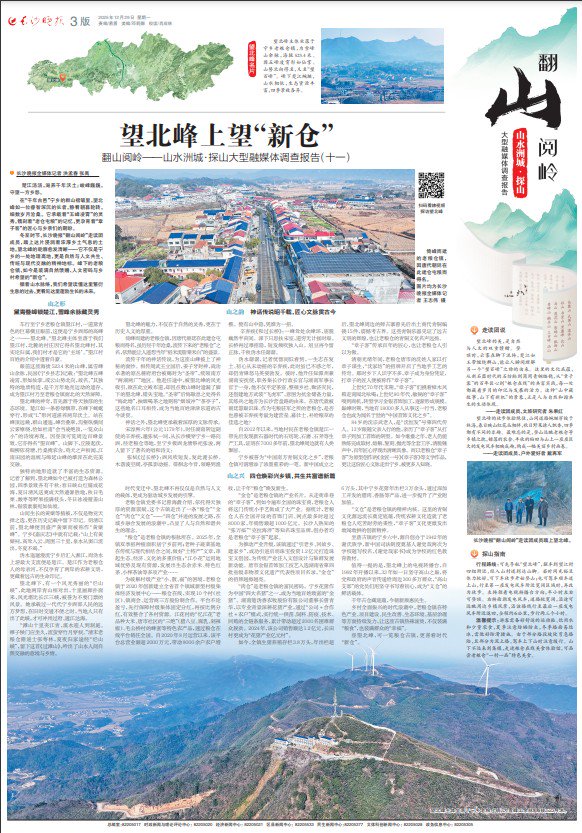
望北峰上望“新仓” | 翻山阅岭——山水洲城·探山大型融媒体调查报告⑪
Xin Lang Cai Jing· 2025-12-28 23:33
Core Viewpoint - Wangbei Peak serves as a natural and cultural landmark in Ningxiang, integrating ecological resources and historical significance, while driving local economic development through various industries [6][12][21]. Group 1: Natural and Ecological Significance - Wangbei Peak, with an elevation of 523.4 meters, is part of the Xuefeng Mountain range and is characterized by its unique geological structure and rich ecological environment [8][9]. - The surrounding area features diverse seasonal landscapes, including blooming flowers in spring, a cool retreat in summer, wild fruits in autumn, and a winter wonderland [9]. - The Chu River, flowing at the foot of the peak, nourishes the fertile land, contributing to the agricultural richness of the region [10]. Group 2: Cultural and Historical Context - The name "Wangbei Peak" reflects its historical significance, with legends and stories dating back to the Tang Dynasty, linking it to notable historical figures [12][13]. - The area has a rich cultural heritage, including the legacy of the "Zhangzi Ke" craftsmen, who have transformed traditional skills into a thriving industry [15][19]. - Archaeological findings indicate human habitation around Wangbei Peak dating back over 7,000 years, highlighting its long-standing importance to local civilization [14]. Group 3: Economic Development and Industry - The town of Laoliangcang has developed a multi-faceted economic model, including agriculture ("grain warehouse"), jewelry ("gold warehouse"), livestock ("meat warehouse"), and cultural tourism ("cultural warehouse") [17][18]. - The jewelry industry, rooted in the craftsmanship of local artisans, has expanded significantly, with sales exceeding 100 billion yuan at its peak [19]. - Innovative initiatives like "Grain Warehouse Online" have facilitated the integration of local products into broader markets, generating over 20 million yuan in revenue since its inception [18]. Group 4: Community and Social Impact - The local government has implemented strategies to enhance community welfare, including the establishment of cooperative economic models that benefit over 8,000 households [18][21]. - The cultural and historical significance of Wangbei Peak fosters a sense of identity and pride among residents, contributing to social cohesion and community development [24][25].

除个别超大城市外拟放开放宽落户限制
Xin Lang Cai Jing· 2025-12-28 18:23
Core Viewpoint - The report presented by the State Council emphasizes the need to establish and improve the mechanisms for urban-rural integration development, highlighting the progress made and the challenges that remain in achieving equal exchange and flow of resources between urban and rural areas [1][4]. Group 1: Urbanization and Population Mobility - The urbanization rate of the national resident population is projected to increase from 62.7% in 2019 to 67% by 2024, while the ratio of per capita disposable income between urban and rural residents is expected to narrow from 2.64 to 2.34 [1]. - The restrictions on household registration in cities with a permanent population of less than 3 million have been largely lifted, and conditions for cities with populations between 3 million and 5 million have been further relaxed [2]. - The proportion of migrant children in compulsory education attending public schools or enjoying government-purchased private school placements has increased to 97% [2]. Group 2: Talent Development and Rural Support - Nearly 5 million high-quality farmers and over 143,000 rural practical talent leaders have been cultivated, with more than 14.3 million individuals returning to rural areas for entrepreneurship [2]. - The report emphasizes the need to strengthen the talent pool in rural areas by encouraging urban talents to serve in rural settings and enhancing training for farmers [5][6]. Group 3: Agricultural Investment and Financial Support - The general public budget for agriculture, forestry, and water resources is expected to reach 2.7 trillion yuan in 2024, an increase of 18.4% compared to 2019, with a steady rise in the proportion of land transfer income allocated to agriculture and rural areas [3][7]. - Financial support for agriculture is being strengthened, with continuous growth in agricultural loans [3]. Group 4: Land Reform and Resource Allocation - The report outlines the need for steady progress in rural land system reform, including the extension of land contracts for an additional 30 years and the improvement of the pricing mechanism for land management rights [6]. - There is a call for better mechanisms for equal exchange of urban-rural resources and deeper integration of public resource allocation [4].