新基建

Search documents
申万宏源证券晨会报告-20260108
Shenwan Hongyuan Securities· 2026-01-08 00:42
Core Insights - The report maintains a "Buy" rating for Tonghuashun (300033), projecting net profits for 2025-2027 at 28.54 billion, 35.13 billion, and 43.08 billion yuan, with growth rates of 57%, 23%, and 23% respectively, indicating a significant upward revision from previous estimates [2][11] - The report highlights four key growth factors for Tonghuashun: strategic determination, product technology core, comprehensive layout, and C-end advantages, which contribute to its resilience in both bull and bear markets [11] - The report identifies three major incremental growth areas: increased market attraction from long-term capital inflows, technological breakthroughs in AI data and the WenCai platform, and customer expansion through competitive pricing and overseas market strategies [11] Summary by Sections Company Overview - Tonghuashun has a strong strategic focus on building a comprehensive and intelligent financial information service platform, maintaining a leading position in mobile app market share with a 21% market share in the securities service application market [11] - The company has shown resilience during market downturns by actively exploring new fields, including product innovation and customer expansion [11] Financial Projections - The projected net profits for Tonghuashun for 2025-2027 are significantly higher than previous estimates, with a current PE ratio of 51x for 2026, suggesting over 20% upside potential [2][11] Market Dynamics - The report notes that the capital market's attractiveness has improved significantly, with higher returns and investment value compared to previous years, which is expected to drive increased market participation [11] - The report emphasizes the importance of AI technology in enhancing Tonghuashun's data capabilities, with significant investments in AI since 2006, leading to successful monetization of both C-end and B-end AI applications [11] Strategic Initiatives - The report discusses the company's competitive pricing strategy for its iFinD platform, which is positioned to benefit from the industry's trend towards cost reduction and efficiency [11] - Tonghuashun's overseas market expansion is highlighted, with a significant pricing advantage over competitors like Bloomberg, indicating a strong potential for growth in international markets [11]

政策高频 | 2026年“两新”首批额度下达(申万宏观·赵伟团队)
申万宏源宏观· 2026-01-07 16:05
Group 1 - The core viewpoint of the article emphasizes the implementation of new policies for equipment updates and consumer goods trade-in subsidies in 2026, aimed at boosting consumption and investment in key sectors [2][3][5] - The 2026 policy expands the support scope for equipment updates to include the installation of elevators in old residential areas, elderly care institutions, and other fields, while optimizing the application process for small and medium-sized enterprises [2][3] - The subsidy for new energy passenger vehicles is set at 12% of the vehicle price, with a maximum of 20,000 yuan, while fuel vehicles will receive a 10% subsidy, capped at 15,000 yuan [3][4] Group 2 - The 2026 budget for early investment includes approximately 2,950 billion yuan, with 2,200 billion yuan allocated for "two heavy" projects focusing on urban underground pipelines and high-standard farmland [5][6] - The new personal housing sales tax policy reduces the VAT rate for homes sold within two years from 5% to 3%, while homes sold after two years are exempt from VAT, simplifying the transaction process [7][9] - The national fiscal work conference emphasizes the continuation of a more proactive fiscal policy, focusing on expanding domestic demand, supporting innovation, and promoting green transformation [10][11] Group 3 - The State Council meeting outlines measures to promote cross-border trade facilitation, emphasizing the importance of efficient logistics and the development of new business models such as green trade and cross-border e-commerce [12][13] - The construction of a national water network is highlighted as a strategic initiative to optimize water resource allocation and enhance flood prevention capabilities, contributing to domestic demand expansion [14]

政策高频 | 2026年“两新”首批额度下达(申万宏观·赵伟团队)
申万宏源宏观· 2026-01-07 15:15
报告正文 (一) 2026年"两新"首批额度下达,设备更新范围扩大 2026年"两新"首批政策下达,优化补贴方式、扩大设备更新范围等。 12月29日,国家发改委、财政部 发文,扩大设备更新支持范围至新老小区加装电梯等领域,并明确消费品以旧换新补贴方式。例如,新能源 乘用车补12%、最高2万元,从固定额度补贴变为按比例补贴;补贴资金按东部85%、中部90%、西部95% 的比例分担。12月30日,商务部等的发文,明确汽车报废 / 置换更新、6类家电以旧换新、4类数码智能产品 购新四大全国统一补贴领域,各地不得变更品类或调整标准。地方配套资金用于该四大领域需遵统一要求, 其余可在政策框架内自主确定补贴相关。 | 补贴类型 | 对比维度 | 2026 年首批"两新"政策 | 2025 年直批"两新"政策 | 核心变化 | | --- | --- | --- | --- | --- | | | 补贴总金额 | 未明确总额,延续央地 9:1 分担,按李度分 | 超长期特别国债 5000亿元(消费品 | | | | | 批次下达 | 3000 亿 + 设备 2000 亿) | | | | 汽车以旧换新补贴方式 | 按新车销 ...
热点思考 | 地方如何适度超前“新基建”?(申万宏观·赵伟团队)
申万宏源宏观· 2026-01-07 15:15
Core Viewpoint - The article discusses the "15th Five-Year Plan" proposal emphasizing "moderate advanced new infrastructure construction," highlighting the need for local governments to implement this requirement and adapt their strategies based on regional characteristics [1][59]. Group 1: Understanding "Moderate Advanced New Infrastructure" - The "15th Five-Year Plan" proposes "moderate advanced construction," focusing on the development of information communication networks, integrated computing networks, and major technological infrastructure, while also promoting the digital transformation of traditional infrastructure [2][60]. - The scope of new infrastructure has significantly expanded compared to the "14th Five-Year Plan," now covering communication networks, data, and computing fields, driven by the digital transformation of the economy [2][9]. - From 2019 to November 2025, investments in electricity, heat, internet software, and logistics have increased by 10.4%, 5.0%, and 4.1% respectively, indicating the core investment attributes of new infrastructure [12][61]. Group 2: Commonalities and Differences in Local Infrastructure Layout - Local governments focus on integrating infrastructure and enhancing information infrastructure, with 28 regions proposing the digital transformation of traditional infrastructure [3][62]. - The North China region emphasizes the construction of national data hubs and energy transition, with Beijing leading in data management and resource centers [4][29]. - The East and South China regions leverage their advantages in low-altitude economy and water transport, focusing on low-altitude infrastructure and smart upgrades of water transport systems [4][35]. Group 3: Policy Support for New Infrastructure in 2026 - Fiscal policies have increased support for new infrastructure through policy financial tools, with the China Development Bank allocating 98.02 billion yuan to digital economy and AI projects [5][43]. - Monetary policies have introduced tools like technology innovation loans to support new infrastructure, with green loans and infrastructure upgrade loans growing at rates of 17.5%, 25.1%, and 22.3% respectively by the third quarter of 2025 [6][49]. - Regulatory measures will optimize spatial layouts, control hidden debts, and prevent redundant construction, aiming to enhance the overall effectiveness of new infrastructure development [6][52].

城地香江:扬州算力中心项目B04—B05机房楼商务条件发生重大变化 预计减少约10.92亿元收入
Zheng Quan Shi Bao Wang· 2026-01-07 12:49
Core Viewpoint - The company announced a significant change in the business conditions of the B04-B05 data center project, resulting in a reduction of expected revenue by approximately 1.09 billion yuan, while also decreasing future capital investment and operational risks [1][2]. Group 1: Project Changes - The B04-B05 data center buildings will now be constructed by China Mobile, and the company will no longer fulfill its contractual obligations for these buildings, leading to a revenue decrease of about 1.09 billion yuan [1]. - The company has completed the delivery of the B01-B03 buildings, meeting a total IT resource service demand of 84MW, generating revenue of 102 million yuan since delivery, with an expected additional revenue of approximately 2.01 billion yuan over the next ten years [2]. Group 2: Strategic Transition - The company has successfully transitioned from traditional infrastructure to new infrastructure, focusing on IDC/AIDC-related businesses, and has been delivering projects on time, including several significant data center projects [3]. - The company anticipates achieving a revenue of 1.714 billion yuan in the first three quarters of 2025, representing a year-on-year increase of 106.96%, and has turned a profit with a net income of 2.853 million yuan [3].

\十五五\规划研究系列之五:\新\新基建,地方如何适度超前?
Shenwan Hongyuan Securities· 2026-01-07 10:30
Group 1: New Infrastructure Development - The "14th Five-Year Plan" emphasizes "moderate advance" in new infrastructure, focusing on information communication networks and integrated computing networks[2] - New infrastructure has expanded significantly, covering communication networks, data, and computing fields, driven by economic digital transformation[11] - From 2019 to November 2025, investment in electricity, internet software, and logistics has increased by 10.4%, 5.0%, and 4.1% respectively, highlighting the core investment attributes of new infrastructure[13] Group 2: Regional Strategies - Local governments focus on integrating infrastructure and enhancing traditional infrastructure's digital transformation, with 28 regions proposing smart upgrades[3] - The North China region emphasizes the construction of national data hubs and energy transition, with Beijing leading in data management and resource centers[22] - Eastern and Southern regions prioritize low-altitude infrastructure and smart upgrades in water transport, with Guangdong promoting comprehensive low-altitude flight infrastructure[24] Group 3: Policy Support for New Infrastructure - Fiscal policies have increased support for new infrastructure through policy financial tools, with 980.2 billion yuan allocated for digital economy and AI projects in 2025[5] - Monetary policy tools like technology innovation loans have been expanded to support new infrastructure, with green loans growing at rates of 17.5% and 25.1% for infrastructure upgrades[40] - Regulatory measures will optimize spatial layouts and control hidden debts to prevent redundant construction and "involution" competition[42]
“十五五”规划研究系列之五:“新”新基建,地方如何适度超前?
Shenwan Hongyuan Securities· 2026-01-07 08:44
Group 1: New Infrastructure Development - The "14th Five-Year Plan" emphasizes "moderate advance" in new infrastructure, focusing on information communication networks and integrated computing networks[3] - New infrastructure has expanded significantly, covering communication networks, data, and computing fields, driven by economic digital transformation[3][16] - From 2019 to November 2025, investment in electricity, internet software, and logistics has increased by 10.4%, 5.0%, and 4.1% respectively, indicating the core investment attributes of new infrastructure[4][19] Group 2: Regional Development Strategies - Local governments focus on integrating infrastructure and enhancing traditional infrastructure's digital transformation, with 28 regions proposing smart upgrades[5][21] - In North China, the focus is on national data hub construction and energy transition, with Beijing leading in data management and resource centers[29] - Eastern and Southern regions prioritize low-altitude infrastructure and smart water transport upgrades, leveraging their geographical advantages[32][33] Group 3: Policy Support for New Infrastructure - Fiscal policies have increased support for new infrastructure, with policy-based financial tools allocating 98.02 billion yuan to digital economy and AI projects in 2025[7][40] - Monetary policy tools like technology innovation loans have been expanded to support new infrastructure, with green loans growing at 17.5% and infrastructure loans at 25.1% as of Q3 2025[49] - Regulatory measures will optimize spatial layouts and control hidden debts, preventing redundant construction and "involution" competition[51]
A股行业中观景气跟踪月报(2025年12月):涨价链和非银开门红可期-20260106
Shenwan Hongyuan Securities· 2026-01-06 15:38
Investment Rating - The report indicates a positive outlook for the coal mining, black metal mining, and pharmaceutical manufacturing sectors, suggesting potential investment opportunities in these areas [2][3]. Core Insights - The report highlights that the industrial sector is experiencing a recovery in both volume and price indicators, particularly in midstream manufacturing and upstream resource sectors such as coal, oil extraction, black metal mining, and pharmaceutical manufacturing [2][3]. - The manufacturing PMI for December 2025 has returned to the expansion zone at 50.1%, indicating improved order sentiment and operational expectations across various industries [7]. - Consumer confidence has rebounded to a two-year high, although certain sectors like automotive and home appliances are facing challenges due to high base effects and demand saturation [2][3]. Summary by Relevant Sections Industrial Sector Overview - As of November 2025, revenue, industrial added value, and profit growth rates for major industrial enterprises show signs of improvement, particularly in coal, oil extraction, black metal mining, and pharmaceutical manufacturing [2][5]. - The supply side indicates that industries such as pharmaceuticals, food and beverage, textiles, and chemicals are experiencing inventory reduction and low fixed asset growth [2][6]. Manufacturing and Economic Indicators - The overall manufacturing PMI has improved, with new orders and business activity expectations showing recovery, particularly in high-tech manufacturing and consumer goods sectors [7]. - The report notes that the consumer market is seeing a decline in growth rates for discretionary spending, while service consumption remains strong [2][3]. Sector-Specific Insights - In advanced manufacturing, sectors like photovoltaic and lithium battery materials are experiencing price increases due to high demand and supply chain adjustments [3]. - The insurance sector is seeing a slowdown in premium income growth, but there is an expectation for a rebound in early 2026 as companies prepare for new business initiatives [3]. Commodity and Price Trends - The report discusses fluctuations in energy prices, with crude oil supply exceeding demand and coal prices remaining low due to high inventory levels and weak heating demand [3][6]. - Industrial metal prices are on the rise, supported by a weaker dollar and increased demand in the context of global economic conditions [3][6].
开年政策如何做?——从部委工作会议看政策脉络
陈兴宏观研究· 2026-01-05 14:14
Core Viewpoints - Fiscal expansion will shift focus from scale to efficiency, emphasizing structural improvements and effectiveness in 2026, with debt instruments enhancing collaboration to amplify multiplier effects [2][9][12] - Monetary policy will prioritize coordination with fiscal measures, maintaining stable interest rates during periods of government leverage slowdown, with a focus on managing debt risks and other long-term variables [2][15][18] Expanding Domestic Demand - Broad fiscal expansion aims to stabilize investment, with a focus on utilizing new special bonds for "new infrastructure" and "green infrastructure" to promote investment recovery [21][23] - Subsidy policies will be optimized to enhance consumption, with a shift towards nationwide standardized subsidies and a focus on supporting quality service supply [26][27][28] Addressing Overcapacity - The core of addressing overcapacity involves curbing unreasonable incremental capacity expansion and cleaning up overdue payments to alleviate corporate burdens [30][31] New Growth Drivers - Emphasis on bridging gaps in the technology service sector, with a focus on converting technological advantages into competitive advantages in industries [32][33] - The integration of artificial intelligence with manufacturing is highlighted as a key direction for growth, opening new markets and enhancing manufacturing capabilities [33][34] Trade Structure Adjustment - Export structures need adjustment, with a focus on optimizing supply chain layouts to mitigate external shocks, encouraging service exports to enhance resilience against external policy uncertainties [35][36]

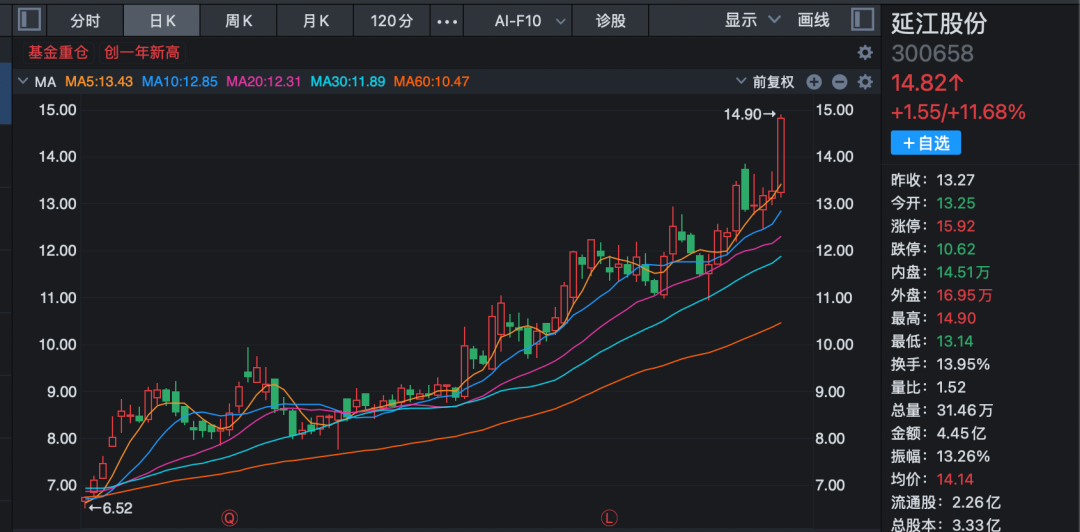
300658,重大资产重组,前一交易日股价大涨超11%
Zheng Quan Shi Bao· 2026-01-04 11:59
Core Viewpoint - Yanjiang Co., Ltd. is planning a significant asset restructuring by acquiring control of Ningbo Yongqiang Technology Co., Ltd. through a combination of share issuance and cash payment, which may constitute a major asset restructuring [1] Group 1: Acquisition Details - The acquisition is still in the planning stage, with specific details regarding the share purchase ratio and transaction parties yet to be finalized [1] - Yanjiang Co. has reached a preliminary agreement with the controlling shareholder of Yongqiang Technology and its associates as of December 31, 2025 [1] Group 2: Market Performance - Yanjiang Co. shares rose by 11.68% on December 31, 2025, closing at 14.82 yuan per share, with a market capitalization of 4.9 billion yuan [2] Group 3: Yongqiang Technology Overview - Yongqiang Technology, established in 2019, specializes in the R&D and production of IC substrates and high-end display substrates, with applications in 5G/6G communications, AI, and data centers [4] - The company has received multiple rounds of financing, achieving a valuation exceeding 1 billion yuan [4] Group 4: Yanjiang Co. Business Overview - Yanjiang Co. primarily engages in the R&D, production, and sales of materials for disposable hygiene products, indicating a cross-industry acquisition [5] - The company has a strong position in the disposable hygiene product sector, serving major clients like Procter & Gamble and Kimberly-Clark [5] Group 5: Financial Performance - For the first three quarters of 2025, Yanjiang Co. reported revenue of 1.295 billion yuan, a year-on-year increase of 22.99%, and a net profit of 42.5 million yuan, up 27.95% [5] - The net profit for the third quarter reached 16.66 million yuan, with a year-on-year growth rate of 209.1% [5] Group 6: International Expansion - Yanjiang Co. has established localized factories in Egypt, the USA, and India, benefiting from global capacity layout and product upgrades [6] - The Egyptian subsidiary has a theoretical production capacity of 12,000 tons per year, with an expected ramp-up in the first half of 2026 [6] Group 7: Profitability - The net profit margins for both the domestic parent company and the Egyptian subsidiary have increased year-on-year, with the Egyptian subsidiary showing significant growth [7]