
十五五规划

Search documents
发挥独特优势 积极把握“十五五”发展机遇——习近平主席重要讲话鼓舞香港各界奋发前行
Xin Hua She· 2025-12-17 15:49
香港各界人士表示, 习近平 主席的重要讲话 充分体现了中央对香港的高度重视、对香港同胞的深 情厚谊,展现了中央固"一国"之本、扬"两制"之利,保持香港长期繁荣稳定的决心和信心。 全国政协常委、中国和平统一促进会香港总会会长姚志胜表示, 习近平 主席高度重视和支持香港 发展,进一步坚定了香港社会对"一国两制"的制度自信。香港各界要积极支持特区政府护国安、拼经 济、谋发展、惠民生工作,更好对接国家"十五五"规划。 新华社香港12月17日电 题:发挥独特优势 积极把握"十五五"发展机遇—— 习近平 主席重要讲话 鼓舞香港各界奋发前行 新华社记者孟佳 国家主席 习近平 16日会见来京述职的香港特别行政区行政长官 李家超 ,听取他对香港当前形势和 特别行政区政府工作情况的汇报。香港各界人士表示, 习近平 主席充分肯定特区政府勇于担当、积极 进取的工作成效,并就香港发展作出重要指示,指引前进方向。香港社会各界充分感受到中央的高度重 视、深切关怀与殷切期望,对未来更加充满信心。 李家超 述职后接受媒体采访时表示,衷心感谢 习近平 主席对他本人和特区政府工作的充分肯定。 他会继续带领团队,统筹发展和安全,深化改革,发挥香港" ...
华源晨会精粹20251217-20251217
Hua Yuan Zheng Quan· 2025-12-17 13:08
Group 1: Fixed Income Market Insights - The economic indicators continue to show weakness, with consumption and investment under significant pressure, leading to a potential slowdown in GDP growth in Q4 compared to Q3 [2][7] - The core contradiction in the current economic operation is the coexistence of "old momentum adjustment drag and new momentum growth," with real estate sluggishness and cautious consumer spending posing short-term constraints [2][7] - The central economic work conference emphasizes the role of domestic demand and the importance of enterprise innovation, with new macro policies focusing on increasing counter-cyclical and cross-cyclical adjustment efforts [2][7] Group 2: Construction and Building Materials Sector - The construction sector is expected to experience a "spring rally" as the 14th Five-Year Plan concludes and the 15th Five-Year Plan begins, with infrastructure investment showing signs of recovery in Q1 2026 [16][17] - Historical data indicates a "front high, back stable" investment rhythm in five-year plans, suggesting that the upcoming period may see a concentration of project disclosures and investment signals [16][17] - The first quarter of 2026 is anticipated to have elastic infrastructure investment growth due to low base effects from the previous year, with significant project announcements expected from various provinces [16][18][19] Group 3: Company-Specific Developments - The company, Chuangyuan Xinke, plans to acquire 100% of Weiyu Tiandao for 886 million yuan, aiming to provide comprehensive testing solutions across ground, low-altitude, and satellite domains [3][24] - The strategic partnership with the China Academy of Information and Communications Technology focuses on advancing "6G+AI" and "6G+Satellite" technologies, enhancing the company's competitive edge in high-end wireless communication testing [3][25] - The company reported revenues of 156 million yuan and a net profit of 4.01 million yuan for the first three quarters of 2025, with future profit projections indicating growth [3][26]
以例释理、以情动人、以知促行——内蒙古、福建、重庆、共青团中央组织开展多种形式宣讲活动
Xin Hua She· 2025-12-17 11:57
新华社北京12月17日电 题:以例释理、以情动人、以知促行——内蒙古、福建、重庆、共青团中 央组织开展多种形式宣讲活动 新华社记者 从一线到荧屏,从"五老"奉献到青春担当,从理论解读到凝聚民心……连日来,内蒙古、福建、重 庆、共青团中央等各地区各部门宣讲团结合自身实际,深入基层一线,精心组织、广泛动员,开展分众 化、多形式的宣讲活动,推动党的二十届四中全会精神深入人心、落地生根。 走进包头市青山区乌素图街道建华社区,老干部正能量宣讲团负责人李玉然正围绕健全社会保障体 系、促进高质量充分就业等全会部署进行生动解读,引发听众兴趣和共鸣。 "原来'十五五'规划建议和我们老百姓的养老保障、就业增收关系这么大,李老师用咱社区的真实 案例举例,讲基本养老保险、灵活就业的扶持政策,大伙儿一听就明白,心里更踏实了。"社区居民王 长林听后深受鼓舞。 讲师团干部、"百姓名嘴"、科技工作者、"五老"人员、乌兰牧骑……近段时间,内蒙古组织1800多 支"理论学习轻骑兵"宣讲小分队,深入农村牧区、街道社区、各类企业学校等开展宣讲,让党的创新理 论"声"入基层、"润"入心田。 想要增强宣讲效果,就必须提升宣讲质量。 12月16日上午,结 ...
李迅雷专栏 | 中央经济工作会议将如何优化“存量”与“增量”
中泰证券资管· 2025-12-17 11:33
Core Viewpoint - China's economy has entered an era dominated by stock economy, facing higher demands for optimizing stock and seeking incremental growth due to its large economic scale and accumulated debt [2][4]. Group 1: Economic Environment and Policy Direction - The recent Central Economic Work Conference highlighted the deepening impact of external environmental changes, indicating increased confidence in responding to external pressures such as tariffs and technology blockades [4][5]. - The conference emphasized the need to practice internal strength to tackle external challenges, maintaining the principle of "seeking progress while ensuring stability" and better coordinating domestic economic work with international trade struggles [4][5]. - The "14th Five-Year Plan" outlines that major country relations significantly influence international situations, which in turn deeply affect domestic development, necessitating consideration of international trade dynamics in future economic work [5][6]. Group 2: Consumption and Investment Strategies - Expanding domestic demand is a strategic measure to effectively respond to external shocks, with a focus on boosting consumption through actions like implementing urban and rural resident income increase plans [6][7]. - The Central Economic Work Conference called for stabilizing investment and increasing the scale of central budget investments, aligning with major project initiations in the first year of the "14th Five-Year Plan" [6][9]. - The manufacturing sector, which accounts for about 30% of global value added, faces challenges due to external demand pressures, necessitating a focus on global capacity layout and trade protectionism concerns [6][9]. Group 3: Fiscal and Monetary Policy Adjustments - The economic work for the coming year will focus on "stability and quality improvement," with a continuation of proactive fiscal policies and moderately loose monetary policies [9][10]. - Fiscal policies will maintain necessary deficits and total debt levels, with an expected slight increase in the fiscal deficit rate from around 4% to 4.2-4.5% to support economic growth [9][10]. - Monetary policy will utilize various tools flexibly, with expectations of a 25-50 basis point reduction in reserve requirements and a 10-20 basis point interest rate cut, emphasizing the importance of reasonable price recovery [10][11]. Group 4: Innovation and Structural Reforms - The focus on innovation-driven growth is critical, with plans to establish international technology innovation centers and promote high-quality development of key industrial chains [14][15]. - The conference reiterated the importance of addressing "involution" as part of the unified national market construction, emphasizing the need for tailored approaches based on local conditions [14][15]. - Local governments are encouraged to promote new industries and models while enhancing traditional industries through new technologies, aiming for a balanced development of manufacturing and service sectors [15][17]. Group 5: Real Estate and Risk Management - The conference aimed to stabilize the real estate market through city-specific policies, inventory reduction, and promoting the construction of quality housing [17][18]. - Measures to address local government debt risks were emphasized, including proactive debt management and improving the local tax system to enhance fiscal autonomy [18].


学习新语·展望“十五五”|绘就共同富裕新画卷
Xin Hua She· 2025-12-17 11:13
共同富裕是社会主义的本质要求,是中国式现代化的重要特征。习近平总书记就"十五五"规划建议起草 的有关情况作说明时指出,"《建议》稿在指导思想中突出强调全体人民共同富裕迈出坚实步伐,这是 指导'十五五'时期经济社会发展的一个总体性要求。" 迈向"十五五",人民对美好生活的期盼更加广泛、更加多元,要始终坚持以人民为中心的发展思想,不 断把人民对美好生活的向往变为现实,让现代化建设成果更多更公平惠及全体人民。 制作:王欢 胡碧霞 新华社出品 策划:石锋 统筹:黄庆华 周年钧 ...

民革十四届四中全会在京开幕
Xin Hua She· 2025-12-17 09:47
新华社北京12月17日电 中国国民党革命委员会第十四届中央委员会第四次全体会议12月17日在北 京开幕。会议主要议题是学习贯彻中共二十届四中全会精神,听取和审议第十四届中央常务委员会工作 报告和中央内部监督委员会工作报告,审议民革中央参政议政工作情况报告等。民革中央主席郑建邦代 表民革第十四届中央常务委员会作工作报告,民革中央常务副主席何报翔主持开幕会。 郑建邦指出,2025年是民革"履职能力建设年"。民革坚持以习近平新时代中国特色社会主义思想为 指导,认真学习贯彻中共二十大和二十届历次全会精神,深入学习贯彻习近平总书记关于坚持好、发展 好、完善好中国新型政党制度的重要论述,提出把提高政治能力作为履职能力建设的首要任务。一年 来,民革自身建设展现出蓬勃生机,各项履职工作取得累累硕果:开展"学规定、强作风、树形象"主题 教育,持续巩固多党合作共同思想政治基础;持续推动组织发展与干部人才队伍建设,扎实推进组织体 系建设;出台关于进一步加强履职能力建设的意见,更好凝聚全党智慧;高质量完成长江生态环境保护 民主监督收官阶段各项任务;坚持贯彻新时代中国共产党解决台湾问题的总体方略,推动民革祖国统一 工作全员参与、全域覆 ...
于变局中开新局:2026年度策略系列报告
Huafu Securities· 2025-12-17 09:30
Group 1 - The year 2025 marks the conclusion of the "14th Five-Year Plan" and the initiation of the "15th Five-Year Plan," with a series of high-level and systematic efforts throughout the year to establish a comprehensive framework for the new plan [2][8] - The "15th Five-Year Plan" aims to build a modern industrial system, emphasizing the importance of solidifying the foundation of the real economy while promoting innovation [3][19] - The plan highlights the need for high-level technological self-reliance and strength, with increased R&D investment expected to enhance national strategic technological capabilities [3][32] Group 2 - The plan anticipates a boost in domestic consumption to activate growth momentum, with policies expected to reflect stronger systemic and coordinated efforts to balance supply and demand [3][33] - The construction of a financial powerhouse is emphasized, with expectations for the A-share market to maintain a steady expansion pace, better serving national strategies and industrial upgrades [3][32] - The dynamic balance of Sino-American relations is projected to remain a key theme, with the interplay of political cycles and trade agreements influencing the competitive landscape [3][19] Group 3 - The "15th Five-Year Plan" outlines the goal of achieving significant results in high-quality development, with a focus on enhancing self-reliance in technology and deepening reforms [19][37] - The plan aims to strengthen the domestic market, promoting effective investment and breaking down barriers to create a unified national market [33][37] - The emphasis on expanding high-level opening-up and enhancing regional economic coordination is intended to optimize the economic layout and promote sustainable development [37][38]
新“国九条”下全方位加强市值管理路径——基于政策制定与管理方式视角
Zheng Quan Ri Bao Wang· 2025-12-17 09:05
Group 1: Significance and Challenges of Market Value Management - The introduction of new policies such as the "National Nine Articles" and the "Guidelines for the Supervision of Listed Companies No. 10 - Market Value Management" provides clearer policy guidance and regulatory frameworks for market value management [1] - Effective market value management connects high-quality development of listed companies, protection of investors' legal rights, and a healthy capital market ecosystem [1] - Current challenges in China include the need for a unified theoretical framework, improved evaluation systems, and better integration of market value management with long-term corporate strategies and national industrial policies [1] Group 2: International Comparison and Development Path - China's market structure and regulatory logic differ from mature markets, leading to variations in market value management paths [2] - The high proportion of individual investors in China contrasts with the institutional investor dominance in the US and Japan, affecting the market value management approach [2] - China's regulatory framework aims to guide companies towards long-term sustainable development rather than short-term capital operations, aligning with the goals of enhancing investment value and protecting small investors [2] Group 3: Case Insights and Value Creation - Successful market value management is rooted in continuous value creation, supported by appropriate capital market tools [3] - International examples include Japan's corporate governance reforms and the use of stock buybacks in the US as tools for managing capital structure and returning value to shareholders [3] - Domestic practices show diverse strategies, with mature companies focusing on stable cash flows and dividends, while growth-oriented firms link market value management to innovation strategies [3] Group 4: Core Insights - Market value management must align with the company's lifecycle, industry characteristics, and national strategies, particularly integrating into the "14th Five-Year Plan" for modern industrial system construction and green transformation [4] Group 5: Constructing a Comprehensive Market Value Management System - A collaborative effort is needed across regulatory, corporate, and market ecological levels to implement effective market value management under the new policy framework [5] Group 6: Regulatory Level - The regulatory framework should be optimized and detailed, with industry-specific guidelines to encourage innovative practices and integrate market value management into overall corporate performance evaluations [6] - Policies should align with national strategic areas, providing incentives for companies that invest in key sectors and demonstrate strong ESG performance [6] - The responsibility of intermediary institutions should be reinforced to provide high-quality market value management consulting services [6] Group 7: Corporate Level - Companies should enhance governance effectiveness and establish committees to evaluate strategic alignment with national policies and oversee market value management goals [7][8] - Focusing on value creation, companies should improve operational efficiency and utilize mergers and acquisitions to optimize industry layout [8] - Investor relations management should be elevated to a strategic level, ensuring transparent communication of long-term strategies and risk management [8] Group 8: Market Ecological Level - Efforts should be made to cultivate long-term institutional investors and encourage their participation in corporate governance [9] - The capital market should gradually open up to foreign investments, enhancing international visibility and pricing power for listed companies [9] - A strong emphasis on maintaining market integrity is essential, with strict measures against fraudulent activities related to market value management [9]
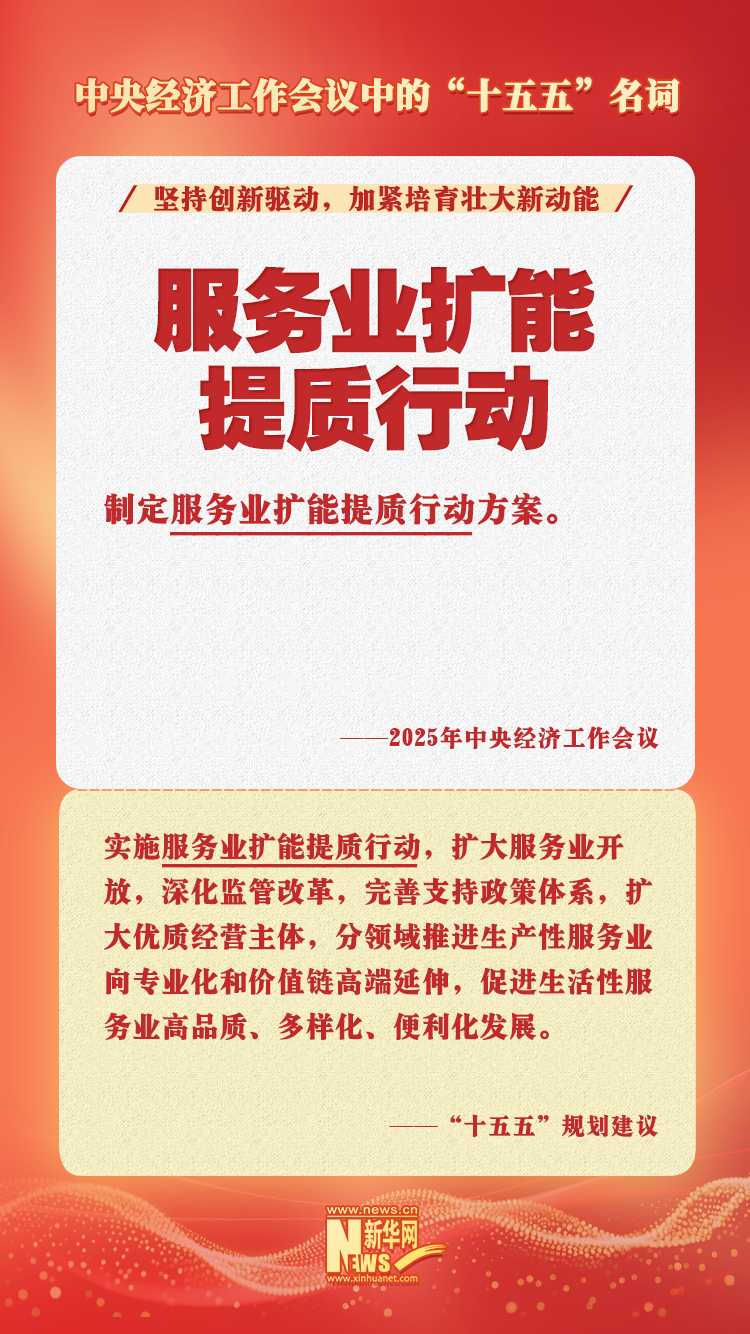
中央经济工作会议中的“十五五”名词:服务业扩能提质行动
Xin Hua Wang· 2025-12-17 09:05
Group 1 - The core viewpoint of the article emphasizes the importance of the "15th Five-Year Plan" and the economic work outlined in the recent Central Economic Work Conference, which aims to enhance the service industry's capacity and quality [1][4]. - The implementation of the service industry capacity expansion and quality improvement action is a crucial measure for promoting high-quality and efficient development in the service sector [4][5]. - The action plan focuses on addressing prominent contradictions and issues faced by the service industry, aiming to deepen reforms, expand openness, strengthen regulation, and promote innovation [4][6]. Group 2 - The action plan aims to balance effective supply expansion with quality improvement, emphasizing a target-oriented and problem-oriented approach [5][6]. - Key tasks include expanding service industry openness, aligning with international high-standard trade rules, and enhancing market access [6][7]. - The plan also highlights the need for a robust policy framework to support service industry development, including financial support and attracting social capital [6][9].
中国学者答巴西友人:展望“十五五”,如何以科技创新推动高质量发展?| 问答中国
Zhong Guo Xin Wen Wang· 2025-12-17 06:23
Group 1 - The core viewpoint of the article emphasizes the importance of integrating empathy, altruism, and human-centered approaches into technological development during China's "14th Five-Year Plan" period [1][2] - The "14th Five-Year Plan" aims to significantly enhance China's level of technological self-reliance and strength, signaling a commitment to open cooperation and mutual benefit in technological advancements [2] - The plan highlights the principle of high-quality development, advocating for a new development philosophy that promotes sustainable economic growth and comprehensive social progress [2] Group 2 - The "14th Five-Year Plan" includes initiatives for green manufacturing, the establishment of emerging pillar industries, and the construction of a beautiful China, reflecting China's emphasis on green production and lifestyle [2] - The five development concepts of "innovation, coordination, green, openness, and sharing" are expected to inject strong momentum into China's high-quality economic development and contribute to global sustainable development [2] - The plan outlines a clear development strategy that aims to create a win-win situation through high-level opening up and cooperation in technological development [2]