
国际经贸斗争

Search documents
李迅雷专栏 | 中央经济工作会议将如何优化“存量”与“增量”
中泰证券资管· 2025-12-17 11:33
Core Viewpoint - China's economy has entered an era dominated by stock economy, facing higher demands for optimizing stock and seeking incremental growth due to its large economic scale and accumulated debt [2][4]. Group 1: Economic Environment and Policy Direction - The recent Central Economic Work Conference highlighted the deepening impact of external environmental changes, indicating increased confidence in responding to external pressures such as tariffs and technology blockades [4][5]. - The conference emphasized the need to practice internal strength to tackle external challenges, maintaining the principle of "seeking progress while ensuring stability" and better coordinating domestic economic work with international trade struggles [4][5]. - The "14th Five-Year Plan" outlines that major country relations significantly influence international situations, which in turn deeply affect domestic development, necessitating consideration of international trade dynamics in future economic work [5][6]. Group 2: Consumption and Investment Strategies - Expanding domestic demand is a strategic measure to effectively respond to external shocks, with a focus on boosting consumption through actions like implementing urban and rural resident income increase plans [6][7]. - The Central Economic Work Conference called for stabilizing investment and increasing the scale of central budget investments, aligning with major project initiations in the first year of the "14th Five-Year Plan" [6][9]. - The manufacturing sector, which accounts for about 30% of global value added, faces challenges due to external demand pressures, necessitating a focus on global capacity layout and trade protectionism concerns [6][9]. Group 3: Fiscal and Monetary Policy Adjustments - The economic work for the coming year will focus on "stability and quality improvement," with a continuation of proactive fiscal policies and moderately loose monetary policies [9][10]. - Fiscal policies will maintain necessary deficits and total debt levels, with an expected slight increase in the fiscal deficit rate from around 4% to 4.2-4.5% to support economic growth [9][10]. - Monetary policy will utilize various tools flexibly, with expectations of a 25-50 basis point reduction in reserve requirements and a 10-20 basis point interest rate cut, emphasizing the importance of reasonable price recovery [10][11]. Group 4: Innovation and Structural Reforms - The focus on innovation-driven growth is critical, with plans to establish international technology innovation centers and promote high-quality development of key industrial chains [14][15]. - The conference reiterated the importance of addressing "involution" as part of the unified national market construction, emphasizing the need for tailored approaches based on local conditions [14][15]. - Local governments are encouraged to promote new industries and models while enhancing traditional industries through new technologies, aiming for a balanced development of manufacturing and service sectors [15][17]. Group 5: Real Estate and Risk Management - The conference aimed to stabilize the real estate market through city-specific policies, inventory reduction, and promoting the construction of quality housing [17][18]. - Measures to address local government debt risks were emphasized, including proactive debt management and improving the local tax system to enhance fiscal autonomy [18].


中央经济工作会议释放八大政策信号 | 热点观察
Sou Hu Cai Jing· 2025-12-13 17:50
Core Insights - The central economic work conference highlighted the structural contradiction of "strong supply and weak demand" as the main issue facing China's economy, emphasizing the need for a dual approach of expanding domestic demand while optimizing supply structure [1][7] - The conference reiterated the importance of "investing in people" alongside "investing in material," signaling a shift towards prioritizing human capital and social welfare in economic policy [2][8] - The concept of "international economic and trade struggles" was reaffirmed, indicating that external economic pressures will be a long-term variable in China's economic strategy [3][11] - The need for synergy between stock and incremental policies was emphasized to enhance macroeconomic regulation and address structural issues [4][12] Group 1: Economic Judgments - The conference identified "strong supply and weak demand" as a critical economic contradiction, necessitating a balanced approach to address consumption weakness and price declines [1][7] - It was noted that previous strategies focused primarily on demand expansion, but the current situation requires a more nuanced approach that includes supply-side adjustments [7] Group 2: Policy Framework - The "Five Musts" framework was introduced, emphasizing the integration of "investing in material" and "investing in people" to enhance economic growth and address current challenges [2][8] - The focus on human capital investment aims to improve productivity and support long-term economic development, particularly in technology and innovation sectors [9] Group 3: International Relations - The conference's emphasis on "international economic and trade struggles" reflects a strategic response to ongoing global trade tensions, particularly with the U.S., and highlights the importance of maintaining a high level of openness while enhancing technological self-sufficiency [3][11] Group 4: Macroeconomic Policies - The integration of stock and incremental policies is crucial for effective macroeconomic governance, with a focus on enhancing the effectiveness of both types of policies to stabilize economic growth [4][12][14] - The conference called for increased efforts in counter-cyclical and cross-cyclical adjustments to address both short-term and long-term economic challenges [12][13] Group 5: Fiscal and Monetary Policies - Fiscal policy will maintain necessary deficits and spending levels, with an emphasis on supporting key projects and enhancing public welfare [5][16] - Monetary policy will remain moderately accommodative, with a focus on ensuring reasonable price recovery while supporting domestic demand and innovation [5][17] Group 6: Key Economic Tasks - The conference prioritized "domestic demand-led growth" as a key economic task, with specific actions to boost consumption and increase residents' income [6][18] - The emphasis on urban renewal and strategic projects aims to stimulate investment and consumption, aligning with broader economic goals [20] Group 7: Market Integration and Competition - The conference highlighted the need for a unified national market and deeper measures to combat "involution" in competition, aiming to enhance market efficiency and resource allocation [7][21][22] Group 8: Real Estate Market Stability - The focus on stabilizing the real estate market includes city-specific policies to manage supply and demand, as well as measures to address local government debt risks [8][23][24]

12.8政治局会议学习体会:2026年我国将继续在国际经贸斗争中“占优”,“绿色”主题排序“跨越式”上升
British Securities· 2025-12-12 11:32
Economic Growth Outlook - The GDP growth target for 2026 is likely to remain around "5.0%" based on the successful achievement of 2025's economic goals[8] - To meet the "5.0%" GDP growth target, the fourth quarter GDP must reach approximately 375,043.96 billion yuan, with a year-on-year growth of 4.61%[8] International Trade and Economic Strategy - China is expected to continue to "gain the upper hand" in international economic and trade struggles in 2026, building on previous successes against U.S. tariffs[10] - The U.S. unemployment rate is projected to rise to at least 5.0% in 2026, which may pressure the U.S. government's domestic and foreign policies[12] Employment and Market Stability - The average number of employees in industrial enterprises decreased by 1.40% year-on-year in October, indicating challenges in employment stability[14] - The total profit of industrial enterprises increased by 1.90% year-on-year in October, but the number of loss-making enterprises rose to 4.0%, the highest since February 2025[14] Policy Direction and Focus Areas - The 12.8 Politburo meeting emphasized the need for a more proactive macroeconomic policy, focusing on stabilizing employment, enterprises, markets, and expectations[13] - The meeting outlined eight key tasks for 2026, highlighting the importance of green development, which has seen a "leap" in priority[19]
热点思考|增量政策,如何“审时度势”?
赵伟宏观探索· 2025-05-15 15:40
Core Viewpoint - The article discusses the new signals released during the policy window period in late April, emphasizing the need for flexible and timely incremental policies in response to external uncertainties, particularly regarding tariff negotiations and economic stability [2][11][70]. Group 1: New Signals from the Policy Window - The April Central Political Bureau meeting highlighted the importance of stabilizing employment, economy, market, and expectations, while maintaining vigilance against external risks, marking the first use of the term "international economic and trade struggle" [3][11][70]. - The meeting emphasized the need for a flexible and unconventional policy toolbox, advocating for timely incremental reserve policies based on changing circumstances [3][11][70]. - Subsequent press conferences focused on stabilizing employment and the market, detailing policies aimed at boosting domestic demand and supporting the private economy [4][12][13]. Group 2: Incremental Policy Adjustments - The current 90-day tariff "grace period" serves as a crucial window for implementing existing policies and strengthening incremental policy reserves, with strong export performance driven by "export grabbing" [5][16][70]. - Financial policies have been introduced, including comprehensive reserve requirement ratio cuts and structural monetary policy tool interest rate reductions, aimed at lowering borrowing costs for banks [18][19][70]. - The government is closely monitoring the issuance and utilization of debt limits for existing policies while focusing on the potential for incremental policy "continuity" [21][28][70]. Group 3: Potential Focus Areas for Incremental Funding - If tariff negotiations progress smoothly, future policy focus may shift towards long-term institutional reforms and structural policy support [46][79][70]. - Consumer spending needs to be supported through mechanisms that reduce burdens and increase income, with a particular emphasis on improving income distribution and social security systems [46][79][70]. - Investment in new infrastructure, particularly in emerging industries like AI, is expected to become a new growth point, alongside traditional infrastructure projects [57][80][70].
热点思考|增量政策,如何“审时度势”?
申万宏源宏观· 2025-05-15 08:07
Core Viewpoint - The article discusses the new signals released during the policy window period in late April, emphasizing the need for flexible and timely incremental policies in response to external uncertainties and internal economic conditions [2][11][70]. Group 1: New Signals from the Policy Window - The April Politburo meeting highlighted the importance of stabilizing employment, economy, market, and expectations, while maintaining vigilance against external risks, marking the first use of the term "international economic and trade struggle" [3][11][70]. - The meeting emphasized the need for a flexible and unconventional policy toolbox, advocating for timely incremental reserve policies based on changing circumstances [3][11][70]. Group 2: Employment and Market Stability Policies - The April 28 press conference focused on stabilizing employment, detailing three key areas: promoting consumption through subsidies, expanding employment opportunities for specific groups, and enhancing support for the private economy [4][12][76]. - The May 7 press conference centered on market stability, outlining measures to stabilize the stock market, real estate market, and enhance financial support for technological innovation [4][13][76]. Group 3: Incremental Policy Adjustments - The current 90-day tariff "grace period" serves as a crucial window for implementing existing policies and strengthening incremental policy reserves, with strong export performance driven by "rush exports" [5][16][77]. - A series of flexible financial policies have been introduced, including comprehensive reserve requirement ratio cuts and structural monetary policy tool interest rate reductions to lower borrowing costs [5][18][77]. Group 4: Fiscal Policy and Funding Focus - Fiscal policy is under scrutiny regarding the issuance and utilization of existing debt quotas, with a notable decline in fiscal revenue in the first quarter, necessitating close attention to government bond issuance and incremental policy sustainability [6][21][78]. - The second quarter is expected to see the continued rollout of policies aimed at expanding domestic demand and stabilizing employment, with a focus on the pace of incremental funding [6][28][78]. Group 5: Potential Investment Directions - If tariff negotiations progress smoothly, future policy focus may shift towards long-term institutional reforms and structural policy support, with an emphasis on improving income distribution and social security mechanisms [9][46][79]. - Investment in new infrastructure to support emerging industries is anticipated to become a new growth point, alongside the acceleration of traditional infrastructure projects [9][57][80].
申万宏源证券晨会报告-20250515
Shenwan Hongyuan Securities· 2025-05-15 01:13
Core Insights - JD's Q1 2025 revenue reached 301.1 billion yuan, a year-on-year increase of 15.8%, marking the highest quarterly growth rate in three years, with service revenue at 58.8 billion yuan, up 14.0% year-on-year [2][10] - Non-GAAP net profit attributable to ordinary shareholders was 12.8 billion yuan, exceeding expectations by 43.4% [2][10] - The retail revenue of JD grew by 16.3% year-on-year to 263.8 billion yuan, driven by strong user growth and supply chain optimization [2][10] Revenue and Profitability - The group achieved a gross margin of 15.9%, an increase of 0.6 percentage points year-on-year, and a fulfillment gross margin of 9.3%, up 0.5 percentage points year-on-year [3][10] - JD's retail operating profit margin improved by 0.8 percentage points to 4.9% [3][10] - The company continues to enhance its operational efficiency through its supply chain infrastructure and smart integration of business ecosystems [3][10] Business Development - JD's food delivery service surpassed 10 million daily orders as of April 22, 2025, indicating significant progress in this segment [3][10] - The company has repurchased 1.5 billion USD worth of shares, amounting to approximately 2.8% of its outstanding shares as of December 31, 2024 [3][10] - The expansion of the platform into new markets, including Hong Kong and international regions, is ongoing, with a focus on maintaining high growth rates in various product categories [10] Policy and Market Environment - The April Politburo meeting emphasized stabilizing employment and the economy, with a focus on expanding domestic demand and promoting consumption [4][11] - The government is expected to introduce flexible policies to address uncertainties in tariffs and enhance financial support for various sectors [11] - The focus on long-term structural reforms and support for consumer spending is anticipated to drive economic growth in the coming quarters [11]

3分钟看清五一全球要闻
申万宏源宏观· 2025-05-04 14:17
Global Macro Overview - During the May Day holiday, overseas risk assets showed signs of recovery, with major stock indices in the US, Asia, and Europe rising significantly. The S&P 500, Nasdaq, and Dow Jones increased by 2.9%, 3.4%, and 3.0% respectively [3][8] - Oil prices experienced a substantial decline due to supply shocks, with WTI and Brent crude oil prices falling by 7.5% and 8.3% respectively [3][16] - The US dollar index saw a slight increase of 0.5%, while major currencies like the euro, pound, and yen depreciated against the dollar [14] Overseas Events & Data - The second round of trade negotiations between the US and Japan did not yield significant breakthroughs, although both sides reached agreements on expanding agricultural quotas and simplifying automotive inspections [4][20] - The US economy unexpectedly contracted in Q1 2025, with a GDP growth rate of -0.3% on a quarter-over-quarter basis, primarily due to increased imports and inventory accumulation [29][39] - Japan's central bank maintained its monetary policy stance amid trade uncertainties, downgrading its GDP growth forecasts for 2025 and 2026 [4][20] Domestic Data & Events - During the May Day holiday, domestic travel remained high, with cross-regional travel volume increasing by 5.7% year-on-year, reflecting a significant rise in public transportation usage [6][7] - Cross-border travel and county tourism saw notable growth, with domestic flights increasing by 3.6% compared to the Spring Festival [6] - The Chinese government has been proactive in promoting tourism consumption through subsidies and enhancing consumer experiences [6] Investment Insights - Warren Buffett expressed optimism about Japanese assets and criticized trade wars during the Berkshire Hathaway annual meeting, indicating a cautious but positive outlook on long-term investments in Japan [18][19] - The US Treasury's refinancing plan for Q2 2025 maintained the scale of bond auctions, indicating a reliance on short-term debt amid rising deficit pressures [27]

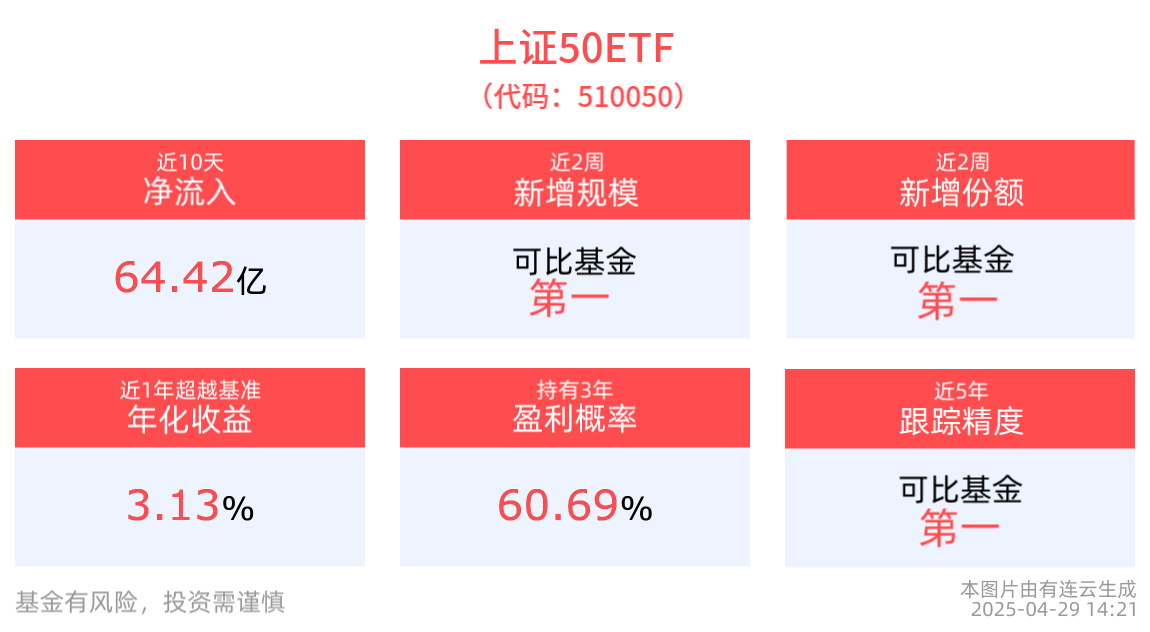
重要会议释放积极信号,上证50ETF(510050)近10个交易日净流入64.42亿元
Xin Lang Cai Jing· 2025-04-29 07:07
Group 1 - The Shanghai Composite Index fell by 0.23% as of April 29, 2025, with mixed performance among constituent stocks, led by Weir Shares up 4.58% and Wuxi AppTec up 4.39% [3] - The Politburo meeting highlighted three key signals regarding the economic situation: a recognition of external economic challenges, a focus on stabilizing employment and market expectations, and an acceleration of policy implementation, particularly in technology, consumption, and foreign trade [3] - The government plans to enhance policy measures to support key sectors and ensure employment stability as a primary goal [3] Group 2 - According to Dongwu Securities, the "national team" has shifted its investment strategy from individual stocks to passive index tools, with over 100 billion yuan allocated to ETFs tracking the Shanghai 50 Index by the end of last year [4] - As of March 31, 2025, the top ten weighted stocks in the Shanghai 50 Index accounted for 49.84% of the index, with Kweichow Moutai, China Ping An, and China Merchants Bank being the top three [4] - The Shanghai 50 ETF closely tracks the Shanghai 50 Index, with significant holdings in major blue-chip companies [4]
国泰君安期货政治局会议点评:步步为营
Guo Tai Jun An Qi Huo· 2025-04-28 11:13
1. Report Industry Investment Rating - Not provided in the content 2. Core Viewpoints of the Report - The Politburo meeting on April 25, 2025, basically continued the wording of previous meetings but emphasized implementation and accelerating efforts. It showed a policy approach of speeding up the implementation of existing policies while reserving room for incremental policies to deal with "international economic and trade struggles" [2][4]. 3. Summary by Relevant Catalogs 3.1 Policy Overall Tone - The meeting affirmed the 5.4% GDP growth in Q1 and the resilience of the stock market. It adopted an attitude of not rushing to increase policies, focusing on implementing policies from previous meetings. However, it required policies to be "accelerated, intensified, and fully utilized", with accelerated implementation being a practical measure for stable growth [4]. - Although there were not many new incremental policies, the policy - makers were worried about the external situation. They added a paragraph on future policy space, indicating that reserve policies would be introduced according to the actual situation [5]. 3.2 Main Policy Orientations - The overall policy tone and specific measures in the monetary and fiscal fields generally continued from previous meetings, but with an emphasis on accelerating implementation. For example, in the "local government special bonds and ultra - long - term special treasury bonds", the requirement of "accelerating issuance and use" was added [7][8]. 3.3 Outlook on Potential Policy Space Monetary Policy - In terms of aggregate tools, the short - term probability of comprehensive liquidity injection is low as the base money gap is not large. However, if external pressure increases or economic data deteriorates, aggregate monetary policies may be implemented. If the Fed cuts interest rates in the second half of the year, it will open up room for domestic easing [10]. - For structural tools, since the meeting directly mentioned creating new structural monetary policy tools, it is likely to be implemented in Q2, targeting weak areas such as foreign trade and domestic demand [10]. Fiscal Policy - In the first half of the year, the "Two Sessions" announced quotas will be mainly used. In the second half, the annual budget deficit may be increased depending on fiscal revenue and actual deficits, possibly at the NPC Standing Committee meetings in even - numbered months. Fiscal investment is expected to tilt towards foreign trade and consumption. Budget - external fiscal tools may be implemented in Q2 [11]. Real Estate Policy - The meeting basically continued the previous tone, focusing on long - term system construction, acquisitions, and urban village renovation. If domestic economic downward pressure increases, real estate policies are likely to be strengthened [12]. 3.4 Key Areas of Future Work - The meeting put forward "Four Stabilities": "stabilize employment, enterprises, markets, and expectations", with stabilizing employment and enterprises at the forefront. Many employment - stabilizing measures were proposed, and promoting service consumption was also emphasized as a way to increase employment [14]. - The meeting continued to attach importance to technological innovation, mentioning "cultivating new productive forces", key core technology research, and the "AI +" action. It also proposed to launch a "technology board" in the bond market to support key areas [14].
湘财证券晨会纪要-20250428
Xiangcai Securities· 2025-04-28 05:39
Macro Strategy and North Exchange - The macro policy remains stable with LPR unchanged at 3.10% for 1-year and 3.60% for 5-year [5] - Industrial enterprise profits showed a year-on-year increase of 2.60% in March, marking the first positive growth since the previous year [5] - The Central Political Bureau emphasized the need for high-quality development to address international economic and trade struggles, focusing on "Four Stabilities" [7][8] - The government plans to accelerate the issuance of special bonds and long-term bonds, with a deficit rate set at around 4% and a total deficit scale of 5.66 trillion yuan, an increase of 1.6 trillion yuan from 2024 [8] - Monetary policy will include timely reductions in reserve requirements and interest rates, along with new structural monetary policy tools to support innovation and consumption [10][11] A-Share Market Overview - From April 21 to April 27, 2025, most A-share indices rose, with the Shanghai Composite Index increasing by 0.56% and the Shenzhen Component Index by 1.38% [15] - The market is expected to maintain a narrow fluctuation state due to the recent "reciprocal tariffs" imposed by the US and the upcoming May Day holiday [15][23] - The report indicates a "slow bull" market trend for A-shares in 2025, with a focus on technology, green energy, consumption, and infrastructure sectors [23] North Exchange Market Overview - As of April 25, 2025, the North Exchange had 265 listed stocks, with an average total market value of 755.47 billion yuan, an increase of 1.53% from the previous week [24] - The liquidity in the North Exchange decreased, with average trading volume dropping by 9.79% to 1.384 billion shares [25] - The North Exchange's 50 Index closed at 1300.19 points, down 2.16% from the previous week [26] Industry Insights: Food and Beverage - Salted Fish reported a revenue of 5.304 billion yuan and a net profit of 640 million yuan for 2024, reflecting a year-on-year increase of 28.89% and 26.53% respectively [34] - The company is focusing on core product categories with strong growth, particularly in spicy snacks and baked goods, with significant revenue increases [35] - Salted Fish is accelerating its overseas expansion, with a projected revenue of 6.678 billion yuan in 2025, growing at 25.9% year-on-year [38] Industry Insights: Medical Devices - The sales of ultrasound imaging devices showed a significant recovery in Q1 2025, with sales revenue increasing by 87.95% year-on-year [40] - The report highlights a shift towards domestic brands, with domestic sales accounting for 37.79% of the market share in 2024, up from 34.20% in 2023 [42] - The report suggests a positive outlook for domestic ultrasound device manufacturers like Mindray and KAILI Medical, as the market for these devices is expected to continue recovering [48]