多元资产配置

Search documents
银行理财周度跟踪(2025.11.10-2025.11.16):理财公司密集“换帅”,股权投资探索新实践-20251119
HWABAO SECURITIES· 2025-11-19 08:56
Investment Rating - The report does not explicitly provide an investment rating for the industry Core Insights - Recent leadership changes in multiple wealth management companies have drawn significant attention within the industry, indicating a response to structural challenges posed by low interest rates and regulatory pressures [2][10][11] - Wealth management firms are increasingly exploring alternative investment paths, such as customized financial products combined with non-standard equity investments, to support technology-driven enterprises [3][12] - The introduction of new product systems by wealth management companies, focusing on cash management, pension products, and diversified asset strategies, reflects a shift towards meeting diverse client needs in a low-yield environment [3][14] Summary by Sections Regulatory and Industry Dynamics - A wave of high-level executive changes has occurred in several wealth management firms, including 招银理财, 信银理财, 交银理财, and 北银理财, highlighting the industry's response to dual structural challenges [2][10] - The industry faces pressure from low interest rates and regulatory demands for enhanced risk management and compliance, prompting firms to seek leaders with cross-industry experience to improve investment capabilities [10][11] Innovation in the Industry - 建信理财 has successfully launched a non-standard equity investment business, utilizing a model that combines customized financial products with equity investments to channel funds into technology enterprises [3][12] - 交银理财 has unveiled a comprehensive upgrade of its product system, emphasizing three innovative product categories: "活钱+", pension products, and "多元精选" multi-asset strategies, aimed at addressing various client needs [3][14] Yield Performance - For the week of November 10-16, 2025, cash management products recorded a 7-day annualized yield of 1.29%, remaining stable compared to the previous week, while money market funds saw a slight increase to 1.17% [4][15] - The yield on pure fixed-income products generally declined across all maturities, while fixed-income plus products mostly saw increases, indicating a mixed performance in the bond market [4][18] Net Value Tracking - The net value ratio of bank wealth management products decreased to 0.56%, down 0.17 percentage points week-on-week, with credit spreads also tightening, suggesting limited value for investors [5][23][24]
美联储吹奏降息号角 亚洲资产配置正当时
中国基金报· 2025-11-16 23:57
Group 1 - The Federal Reserve announced a 25 basis point cut in the federal funds rate, marking the second reduction this year and bringing the target range to 3.75% to 4.00%, the lowest level in three years [1] - This decision is interpreted as a sign of renewed global liquidity, amidst a backdrop of slowing economic growth and declining interest rates, leading to a "search for yield" dilemma among investors [1][3] - Multi-asset allocation is increasingly viewed as a key strategy to hedge against market uncertainties, with Asian assets gaining prominence in this context [1][3] Group 2 - In a low-interest and high-uncertainty market, the logic of multi-asset allocation becomes clearer, allowing investors to reduce overall portfolio volatility and optimize risk-return profiles [3] - Historical market cycles demonstrate that no single asset can consistently outperform, reinforcing the importance of diversified asset allocation over timing and stock selection [3] - Diversified portfolios tend to exhibit stronger risk resilience and more attractive risk-adjusted returns compared to single-asset strategies [3] Group 3 - The acceleration of the Fed's rate-cutting cycle is reshaping global capital flows, with a weakening dollar likely to benefit emerging markets, particularly in Asia [5] - Historically, periods of dollar weakness have led to outperformance of emerging markets compared to developed markets, as concerns over the U.S. fiscal deficit grow [5] - The dual environment of declining rates and a weaker dollar enhances the attractiveness of Asian bonds and equities, with Asian dollar-denominated investment-grade corporate bonds becoming a focal point for investors [7][10] Group 4 - The Asia-Pacific region is projected to experience a GDP growth rate of 4.5% by 2025, significantly higher than the global average of 3.0%, driven by domestic demand in countries like China, India, and Indonesia [7][10] - The resilience of Asia is attributed to diverse industries and strong regional cooperation, with key players like Japan, Taiwan, and South Korea positioned well in global supply chains [7][10] - The low correlation of assets within the Asian market provides ample diversification opportunities for investors, enhancing portfolio resilience [8] Group 5 - HSBC's Asia Multi-Asset High Income Fund focuses on a diversified asset allocation strategy, investing primarily in high-yield stocks (42.24%), high-yield bonds (21.19%), and investment-grade bonds (11.64%) [12] - The fund aims to balance dividend income and capital appreciation, leveraging the significant role of dividends in total returns in the Asian market [12] - The current macroeconomic environment presents a new asset allocation window, with the fund positioned to capture growth opportunities in Asia while managing portfolio volatility [12][10]


五载深耕,行稳致远!汇华理财:首家合资理财公司的全球视野与本土实践之路
Zhong Guo Zheng Quan Bao· 2025-11-15 01:29
Core Viewpoint - 汇华理财, as the first joint venture wealth management company in China, has successfully navigated market fluctuations and industry transformations over the past five years, focusing on sustainable growth rather than rapid expansion [1][3][7] Group 1: Company Development - Established in 2020, 汇华理财 quickly gained traction in a favorable market environment, marked by high deposit rates and a booming stock market, leading to a "glorious start" [3] - The company faced a challenging market adjustment period from 2022 to September 2024, characterized by increased stock market volatility and declining interest rates, with the one-year interbank certificate of deposit rate dropping to around 1.6% [3][4] - To adapt to market changes, 汇华理财 implemented a new absolute return investment framework and diversified its product offerings, achieving a "transformation" and doubling its asset management scale by 2025 [4][5] Group 2: Investment Strategy - 汇华理财's core competitive advantage lies in its unique joint venture background and precise positioning, focusing on "global allocation, diversified enhancement, and professional standing" [4][6] - The company has expanded its product offerings from solely RMB to include USD, EUR, and HKD, with notable products like "Time Friend" and "Wealth Lighthouse" achieving significant performance metrics [4][5] - In a low-interest-rate environment, 汇华理财 has successfully enhanced returns and hedged risks through a multi-asset approach, achieving a domestic fixed income annualized return exceeding the index by over 100 basis points and an equity return of 32% [5][6] Group 3: Future Outlook - Looking ahead, 汇华理财 aims to prioritize steady returns and customer reputation, avoiding blind expansion and focusing on conservative strategies during unfavorable market conditions [1][6][7] - The company plans to strengthen its absolute return capabilities, deepen global allocation, and enhance investor engagement, reflecting a commitment to long-term wealth management principles [7] - 汇华理财 is positioned to leverage its international perspective and advanced foreign experiences to drive innovation in investment solutions and comprehensive services, contributing to the development of Shanghai as an international financial center [6][7]
力争严控回撤,景顺长城和熙稳进FOF打造稳健配置新体验
Xin Lang Ji Jin· 2025-11-13 23:34
Group 1 - The core viewpoint of the articles highlights the recovery of Fund of Funds (FOF) in 2023, with a positive average return of 14.29% for 477 FOFs established for over six months as of October 31 [1] - The total market size of FOFs reached 187.147 billion yuan by the end of Q3, reflecting an increase of 57 billion yuan compared to the end of the previous year, indicating a trend towards diversified asset allocation for investors [1] - Historical data shows low correlation among various asset classes, which supports the strategy of multi-asset allocation in FOFs to enhance returns and reduce volatility [1] Group 2 - The proposed FOFs, such as the Invesco Great Wall and Xie Wenjin's three-month holding period FOF, aim to balance risk and return by employing a "fixed income + multi-asset" strategy, with a focus on 90% fixed income and 10% equity assets [1] - The fund manager Jiang Hong emphasizes a "stability first, then diversification" approach, with a focus on risk control and volatility management, leading to a 6.52% increase in the bond-oriented FOF index over the past year [2] - Jiang Hong maintains a positive outlook on the equity market, suggesting a focus on sectors like technology, high-dividend stocks, pharmaceuticals, and turnaround opportunities, while also advocating for leveraging strategies in the bond market [2]
罕见!FOF基金频出小爆款
Sou Hu Cai Jing· 2025-11-13 10:45
Core Viewpoint - The FOF (Fund of Funds) market is experiencing unexpected popularity, with significant fundraising success for new products, indicating a shift in investor interest and market dynamics [3][5]. FOF Fundraising Success - The newly established FOF funds have seen impressive fundraising figures, with 富国智悦稳健90天持有 FOF raising 1.793 billion yuan in just 19 days, and 华泰柏瑞盈泰稳健 raising 5.577 billion yuan in one day [3][4]. - As of November 12, 2025, the total number of FOFs established has surpassed 60, with a cumulative fundraising scale exceeding 56 billion yuan, a significant increase of over 400% compared to the previous year [4]. Market Dynamics - The FOF market is characterized by a duality: while the overall scale has just crossed 200 billion yuan, it remains small compared to the total public fund scale of over 36 trillion yuan [4][8]. - More than 60% of FOF products have a scale of less than 200 million yuan, leading to operational challenges and limited bargaining power for smaller funds [8]. Performance and Strategy - FOF products have shown strong performance, with stock-type and mixed-type FOFs achieving average annual returns exceeding 26%, significantly outperforming the 18% increase of the CSI 300 index [5][7]. - The strategy of FOFs has evolved to better meet market demands, with a focus on mixed-asset allocation and the inclusion of diverse asset classes such as US dollar bonds and REITs [7]. Investment Recommendations - The top-performing stock-type FOFs have yielded returns over 30% this year, with 国泰优选领航一年持有 A achieving a remarkable 70% return [9][11]. - Investors are advised to align their investment choices with their risk profiles, selecting appropriate FOF types based on their investment goals [12]. Challenges and Future Outlook - Despite the recent success, the FOF market faces challenges such as limited asset allocation to international markets and a perception of double fees among investors [8][12]. - The potential for FOFs to transition from niche products to mainstream investment tools is contingent on improved investor education and enhanced cross-market allocation capabilities [12].

FOF基金再现小“爆款”年内募集规模增超4倍
Zheng Quan Shi Bao· 2025-11-12 22:23
Core Viewpoint - The FOF (Fund of Funds) market has seen significant growth in 2023, with a notable increase in both the number and scale of newly established funds, driven by a favorable stock market environment and diverse asset allocation strategies [1][2][6]. Group 1: FOF Market Growth - In 2023, the total scale of FOFs surpassed 200 billion yuan, with 17 funds raising over 1 billion yuan each [1][2]. - The number of newly established FOFs exceeded 60, significantly higher than the 35 established in the entirety of 2024, with total fundraising exceeding 56 billion yuan, marking an increase of over 400% compared to 2024 [2][3]. - Notable FOFs include the 富国智悦稳健90天持有FOF, which raised 17.93 billion yuan, and the 华泰柏瑞盈泰稳健3个月持有FOF, which raised 55.77 billion yuan [2][3]. Group 2: Diversification and Asset Allocation - FOFs have expanded their investment scope from primarily active funds to include passive index funds and REITs, reflecting a trend towards multi-asset allocation [4][5]. - As of the end of Q3, the most favored index funds by FOFs included gold ETFs and bond ETFs, with significant increases in holdings compared to previous quarters [4][5]. - The top ten index funds held by FOFs are predominantly bond ETFs, indicating a strategic focus on fixed-income assets [5]. Group 3: Performance and Challenges - Despite the growth, FOFs still represent a small portion of the overall fund market, which exceeds 36 trillion yuan, with over 60% of FOFs having a scale of less than 200 million yuan [7][8]. - The performance of some FOFs has been underwhelming, leading to a high rate of fund closures, with 72 FOFs liquidated since 2017, 31 of which occurred in 2025 [7]. - Challenges include a lack of investor understanding of FOF structures, concerns over dual fee mechanisms, and a need for improved investment quality and research capabilities [7][8].
科技牛结束了?
表舅是养基大户· 2025-11-12 13:35
Group 1 - The article suggests that instead of implementing large-scale consumption subsidies, promoting spring and autumn holidays could serve as a long-term mechanism to stimulate consumption [2][3][4] - The implementation of spring and autumn holidays can alleviate psychological pressure on students and create a more conducive environment for parents to take leave without the stigma associated with it [3][4] - By staggering holiday schedules across different regions, the tourism experience can be improved, leading to a more balanced flow of visitors throughout the year [3][4] Group 2 - Recent market trends indicate a divergence in performance among major stock indices, with the U.S. market showing mixed results while Asian markets exhibit varied responses [6][7][9] - There is a notable increase in southbound capital investing in Hong Kong bank stocks, particularly Agricultural Bank of China, which has reached a new market capitalization high [11][13] - The price-to-book ratio of Agricultural Bank of China has risen to 1.1, indicating a significant premium compared to other major banks, suggesting potential overvaluation [17][18] Group 3 - The article discusses the weakening correlation between stocks and bonds in the domestic market, reflecting a broader trend observed since the 2008 financial crisis [26][28] - It emphasizes the importance of multi-asset allocation strategies as investors mature, suggesting that this approach will become increasingly popular among individual investors [28]


面对全球市场波动 农银理财以多元资产配置破局
Jin Rong Shi Bao· 2025-11-11 08:36
Core Insights - In 2025, various assets exhibited distinct performance driven by macroeconomic policies, market sentiment, and structural transformations after experiencing volatility due to tariff shocks [1][2] - The bond yield in China has been rising from historical lows, while global equity risk assets have rebounded significantly, and precious metals have shown even more pronounced gains as safe-haven assets [1][2] Asset Performance - The bond market faced headwinds this year, with factors like new bond tax rates and fund redemption fees contributing to rising yields [2] - The performance of safe-haven assets, particularly gold, has been strong, reflecting heightened investor risk aversion and concerns over the U.S. dollar's credit system amid increasing trade tensions [2][3] Equity Market Dynamics - The weakening U.S. dollar has alleviated external debt pressures for emerging markets, leading to a rebound in equity markets after the tariff shocks in April [3] - The A-share market has reached a nearly 10-year high, driven by improved confidence in China's industrial upgrades and supportive policies [3] Fixed Income and Multi-Asset Strategies - The "fixed income plus" products are gaining traction as they address the challenges of low interest rates and volatility by incorporating diverse asset classes to enhance overall returns [4][5] - Companies are innovating within the "fixed income plus" strategy, offering products that combine stable income with growth opportunities, such as the "dividend growth dual enjoyment" strategy [6][8] Multi-Asset Allocation - The "multi-asset allocation" approach is becoming a strategic focus for financial institutions, moving away from reliance on single asset performance to mitigate market volatility [8] - The "multi-dimensional balance enjoyment" series products utilize risk parity theory to equalize risk contributions from various assets, suitable for investors seeking long-term stable returns [8]
灵活捕捉多资产机遇 富国智恒稳健90天持有期FOF正式发行
Quan Jing Wang· 2025-11-11 01:53
Core Viewpoint - The launch of the multi-asset FOF (Fund of Funds) on November 10 aims to address the challenges of low returns and market volatility in the current investment landscape, providing investors with a robust option for wealth management in a low-interest-rate environment [1][6]. Product Logic - The product employs a "shield and spear" strategy to balance stability and opportunity, addressing the complexities of rapid asset rotation and frequent style shifts in the market [2]. - The FOF focuses on a diversified asset allocation, including equities, bonds, overseas assets, and gold, to capture market opportunities while hedging against risks [3]. Professional Support - The FOF's success relies on a comprehensive support system encompassing fund selection, risk control, and team expertise, ensuring effective risk management and stable performance [4]. - A rigorous selection process for underlying funds is implemented, utilizing a "three-dimensional" evaluation system to assess fund companies, products, and managers, emphasizing stability [4]. - The risk control framework includes a "risk budget and deviation backtracking" mechanism to manage overall portfolio risk and ensure alignment with the low-volatility objective [4]. Team Strength - The fund manager, with 18 years of experience and a strong track record in FOF management, provides credibility to the product, supported by a well-established investment team [5]. - The 90-day holding period design encourages long-term investment strategies, reducing the impact of short-term market fluctuations on investor behavior [5][6].
在多元资产间寻找高“性价比” FOF舵手陈文扬的资产配置哲学
Zhong Guo Ji Jin Bao· 2025-11-10 06:15
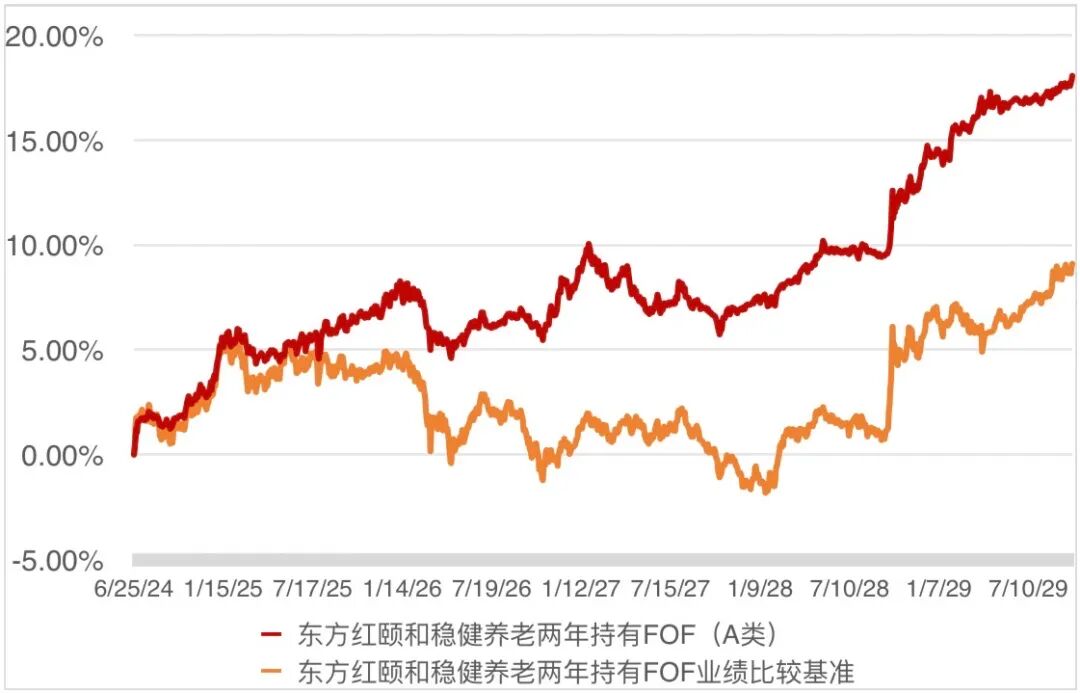
Core Viewpoint - The article highlights the expertise of Chen Wenyang, a fund manager at Dongfanghong Asset Management, in multi-asset allocation through FOF (Fund of Funds) strategies, aiming for long-term stable performance while navigating market fluctuations [1][2][14]. Group 1: Investment Strategy - Chen Wenyang emphasizes the importance of multi-asset allocation as a foundation for FOF investment management, advocating for diversification to achieve a higher risk-return ratio [7][12]. - The FOF team at Dongfanghong employs a comprehensive process for strategy design, asset selection, and fund management, leveraging team collaboration to enhance research capabilities [2][12]. - Chen's approach involves identifying assets with high odds and reasonable win rates, focusing on those with upward trends to optimize returns [11][9]. Group 2: Performance Metrics - The "Dongfanghong Yihe Stable Pension Two-Year FOF" managed by Chen has ranked 5th out of 25 and 8th out of 61 in its category for five-year and three-year returns, respectively, showcasing its competitive performance [3][15]. - The fund's performance metrics indicate a net value growth rate of 4.26% in 2020, 3.40% in 2021, and a recovery of 6.57% in 2024, reflecting its resilience through various market conditions [15][16]. Group 3: Asset Allocation Insights - Chen's strategy includes a mix of domestic and international assets, such as overseas bond funds and gold ETFs, to enhance risk-return profiles [9][10]. - The FOF's top holdings as of Q3 2025 include multiple gold ETFs and S&P 500 ETFs, indicating a strategic focus on global asset diversification [10][9]. Group 4: Fund Management Philosophy - The article underscores the significance of a robust investment philosophy, where Chen prioritizes stable returns over high-risk, high-reward strategies, particularly in fixed-income fund selection [13][11]. - The FOF team utilizes both quantitative and qualitative research methods to evaluate fund managers, ensuring a thorough understanding of their investment logic and consistency [12][13].