
多边贸易体制

Search documents
以开放促发展 以合作谋共赢 从第八届进博会看中国对外开放新实践
Jin Rong Shi Bao· 2025-11-14 02:03
对外开放是中国的基本国策。长期以来,中国坚持开放合作、互利共赢,为全球经济增长作出了重要贡 献。 正是因为进博会坚持平等互利原则,因此对众多展客商都具有强大的吸引力。 "本届进博会共组建43个交易团和700多个交易分团。"吴政平介绍说,进博会期间,重要采购商选品会 开展农食、消费品和医疗领域对接1300轮次;贸易投资对接会吸引超过5000家企业和园区,达成合作意 向超300项;集中签约活动达成合作意向近600项。 党的二十届四中全会审议通过的《中共中央关于制定国民经济和社会发展第十五个五年规划的建议》提 出,扩大高水平对外开放,开创合作共赢新局面。稳步扩大制度型开放,维护多边贸易体制,拓展国际 循环,以开放促改革促发展,与世界各国共享机遇、共同发展。积极扩大自主开放。推动贸易创新发 展。拓展双向投资合作空间。高质量共建"一带一路"。 第八届中国国际进口博览会(以下简称"进博会")是党的二十届四中全会胜利召开后举办的首场重要经 济外交活动。《金融时报》记者在11月10日召开的进博会闭幕新闻通气会上了解到,本届进博会成交活 跃,按一年计意向成交额达834.9亿美元,比上届增长4.4%,创历史新高。 "与此同时,第 ...
中国—爱尔兰经贸混委会第14次会议在都柏林举行
Shang Wu Bu Wang Zhan· 2025-11-13 08:56
Core Viewpoint - The 14th meeting of the China-Ireland Economic and Trade Joint Committee highlighted the strengthening of the strategic partnership between China and Ireland, emphasizing mutual benefits in trade and investment, and the commitment to free trade and multilateral trade systems [1] Group 1: Economic Cooperation - The meeting was co-hosted by China's Vice Minister of Commerce and Ireland's Minister for Enterprise, Trade and Employment, indicating high-level engagement between the two countries [1] - Both countries support the development of a balanced bilateral trade relationship, with China being Ireland's largest trading partner in Asia [1] Group 2: Areas of Collaboration - China is willing to enhance strategic alignment with Ireland, focusing on cooperation in digital economy, green energy, biomedicine, technological innovation, and financial services [1] - The "14th Five-Year Plan" period will see China expanding its service sector, providing ample opportunities for Irish enterprises to invest in China [1] Group 3: Global Economic Impact - The economic development of China is seen as a source of certainty for global economic growth, reinforcing the importance of the China-Ireland trade relationship [1] - Ireland's open and free economy is positioned to welcome Chinese enterprises and financial institutions for investment and joint research and development, facilitating integration into the global value chain [1]
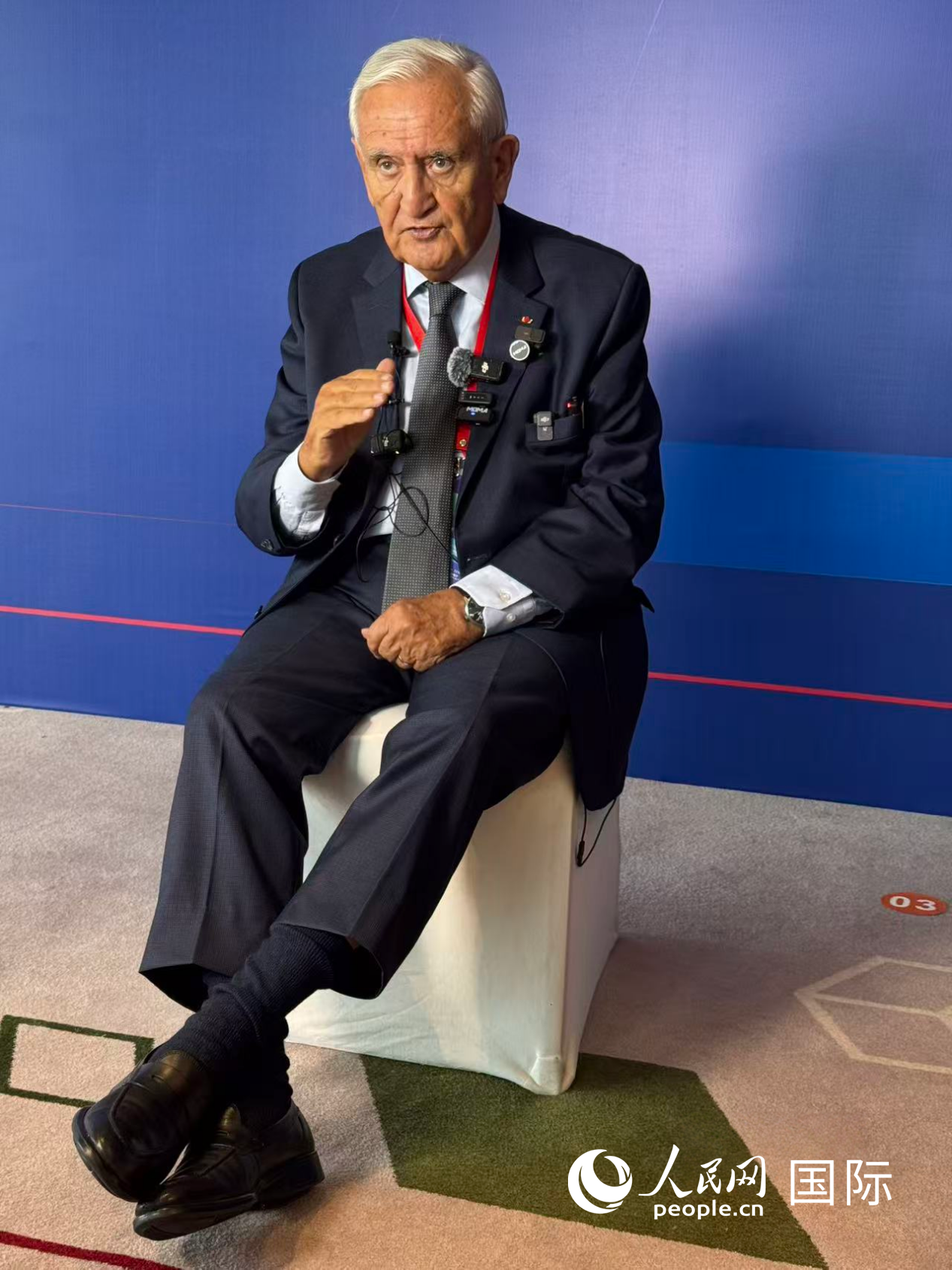
法国前总理拉法兰:为世界合作共赢提供新机遇
人民网-国际频道 原创稿· 2025-11-13 02:10
Core Viewpoint - Former French Prime Minister Jean-Pierre Raffarin highly praises China's commitment to open cooperation and long-term planning, asserting that the "14th Five-Year Plan" will not only drive China's high-quality development but also provide new opportunities for global cooperation and win-win outcomes [3][4] Group 1: China's Development Strategy - Raffarin emphasizes the core value of the "14th Five-Year Plan" is to focus on future development rather than being distracted by current turmoil, highlighting the importance of strategic planning in an uncertain world [3] - He notes that the phrase "concentrate efforts on doing our own things well" in the plan reflects China's successful experience in achieving rapid development through reform and opening up [3] - The people-centered planning approach is seen as key to addressing current global uncertainties [3] Group 2: Open Cooperation and Global Trade - Raffarin agrees with the plan's call for "expanding high-level opening up and creating a new situation of win-win cooperation," stating that "closure inevitably leads to decline, while openness brings growth, development, and wealth" [3][4] - He commends China's commitment to steadily expanding institutional openness and maintaining a multilateral trade system, which he believes will inject stability into global trade [4] - The current rise of unilateralism and protectionism makes China's path of open cooperation and mutual benefit essential for global economic globalization [4] Group 3: Sino-French Cooperation - As a witness and promoter of Sino-French friendship, Raffarin suggests that cooperation between China and France can inspire international collaboration during the "14th Five-Year Plan" period [4] - He mentions existing nuclear cooperation in the UK and potential future collaborations in sectors like aviation, transportation, agricultural products, and healthcare, as well as exploring third-country markets [4] - Raffarin emphasizes that past trade was one-way, while future international cooperation should focus on joint creation [4] Group 4: Role of Youth in Global Cooperation - Raffarin expresses hope for global youth to break regional barriers and engage in cooperation in cultural exchange, environmental protection, and technological innovation [4] - He believes that young people are the bridge between the present and the future, and their actions will determine the direction of global development [4] - The "14th Five-Year Plan" is viewed not only as a blueprint for China's development but also as an invitation for global cooperation [4]

涂红:以务实行动坚定践行多边主义
Jing Ji Ri Bao· 2025-11-13 00:14
Core Points - The article emphasizes China's commitment to multilateralism and the maintenance of a multilateral trade system, as articulated by President Xi Jinping during the APEC meeting [1][2] - It outlines China's initiatives to foster an open regional economic environment, enhance global supply chain resilience, promote trade digitalization and green transformation, and support inclusive global development [3][4][5] Group 1: Multilateral Trade System - China actively participates in global governance reforms and emphasizes the importance of multilateral platforms such as BRICS, SCO, WTO, and APEC [2] - Xi Jinping's call for countries to practice multilateralism and work towards a shared future reflects China's strategic approach to global trade [2] Group 2: Open Regional Economic Environment - China is committed to high-level institutional openness and aims to create an equitable and inclusive regional economic environment [3] - The implementation of the Regional Comprehensive Economic Partnership (RCEP) has established the world's largest regional free trade area, enhancing trade efficiency and transparency [3] Group 3: Global Supply Chain Resilience - China focuses on enhancing the resilience and security of global supply chains amid ongoing restructuring [4] - Initiatives such as the China-ASEAN Free Trade Area 3.0 and infrastructure projects under the Belt and Road Initiative aim to improve supply chain connectivity [4] Group 4: Trade Digitalization and Green Transformation - China promotes the integration of digital technology into international trade, advocating for a digital trade rule system that facilitates cross-border data flow [5] - The country opposes green trade barriers and emphasizes cooperation in green industries and clean energy technology sharing [5] Group 5: Inclusive Global Development - China is dedicated to human-centered development, assisting developing countries in overcoming infrastructure challenges through initiatives like the Belt and Road Initiative [5] - Policies aimed at enhancing inclusivity in international trade, such as tariff reductions and technology transfer, are part of China's strategy to foster global prosperity [5]
王毅同挪威外交大臣艾德会谈
Xin Hua She· 2025-11-11 08:43
Core Viewpoint - The meeting between Wang Yi, China's Foreign Minister, and Norway's Foreign Minister, emphasizes the importance of China-Norway relations and the commitment to mutual respect and cooperation in various sectors [1] Group 1: China-Norway Relations - China views Norway as an important and stable partner in Europe, aiming to enhance bilateral relations [1] - Both countries are encouraged to implement the important consensus reached by their leaders, focusing on mutual respect for core interests and major concerns [1] Group 2: Trade and Economic Cooperation - Norway has adopted a zero-tariff policy for Chinese electric vehicles, indicating a fully open market for this sector [1] - The two countries share a commitment to uphold the spirit of the UN Charter and support a rules-based multilateral trading system [1]
金观平:坚定推进高水平对外开放
Jing Ji Ri Bao· 2025-11-11 05:24
Core Viewpoint - The article emphasizes that openness is a distinctive feature and a necessary requirement of Chinese-style modernization, highlighting the importance of expanding high-level openness to promote reform and development [1] Group 1: Economic Performance - Since the 14th Five-Year Plan, China has implemented a more proactive opening strategy, leading to a new pattern of high-level openness, evidenced by the total goods trade remaining the world's largest for several consecutive years and service trade exceeding $1 trillion for the first time, ranking second globally [1] - China's export share in the world has stabilized at over 14%, while the import share has increased from 9.7% in 2012 to 10.5% in 2024 [1] Group 2: Institutional Opening - The quality of bilateral investment has steadily improved, with a continuous reduction in the negative list for foreign investment access, and the removal of restrictions in the manufacturing sector [1] - The first batch of pilot measures for free trade zones has been fully implemented, showcasing China's commitment to embracing the world with an open stance [1] Group 3: Challenges and Opportunities - The article acknowledges the challenges posed by rising anti-globalization sentiments and increasing instability in global economic growth, emphasizing the need to expand high-level openness to counter these uncertainties [1][2] - It highlights the importance of actively engaging with international high-standard economic and trade rules, particularly in the service sector, and participating in the formulation of rules in emerging fields like digital trade and artificial intelligence [2] Group 4: Reform and Mechanism Improvement - There is a need to eliminate systemic barriers and promote mutual reinforcement between reform and opening, as deep reforms in domestic service industries and cross-regional openings face bottlenecks [3] - Issues such as "invisible barriers" faced by private and foreign enterprises, inadequate regulatory frameworks for new business models, and low standards for intellectual property protection need to be addressed to create a favorable market environment for innovation and investment [3] Group 5: Confidence in Openness - The confidence in advancing high-level openness stems from China's strong economic foundation, resilient potential, and advantages such as a complete industrial system, a vast market, and abundant talent resources [3] - The goal is to establish a new pattern of openness that is broader, deeper, and more extensive, injecting "open momentum" into Chinese-style modernization [3]
坚定推进高水平对外开放
Jing Ji Ri Bao· 2025-11-11 00:55
Group 1 - The core viewpoint emphasizes that openness is a distinctive feature and a necessary requirement of Chinese-style modernization, with a strong signal for high-level opening up and cooperation for mutual benefit [1] - Since the 14th Five-Year Plan, China has implemented a more proactive opening strategy, leading to a new high-level opening pattern, evidenced by significant trade data [1] - China's total goods trade has remained the world's largest for several consecutive years, with service trade exceeding $1 trillion for the first time, ranking second globally [1] Group 2 - The article highlights the need to steadily expand institutional openness and enhance the ability to manage high-level foreign openness amid rising unilateralism and protectionism [2] - It calls for active participation in the formulation of international high-standard trade rules, particularly in the service sector and emerging fields like digital trade and artificial intelligence [2] - The importance of maintaining a multilateral trade system and expanding international cooperation is emphasized, alongside accelerating regional and bilateral trade investment agreements [2] Group 3 - The need to eliminate institutional and mechanism barriers to promote mutual reinforcement between reform and opening is discussed, particularly in the service sector and cross-regional openness [3] - The article points out existing challenges such as "invisible barriers" faced by private and foreign enterprises, and the need for improved regulatory frameworks for new business models [3] - It stresses the importance of building a favorable market environment for innovation and investment, leveraging China's strong economic foundation and large market size [3]
和音:始终做推动全球发展的行动派——读懂中国的确定性⑤
Ren Min Ri Bao· 2025-11-10 07:41
Group 1 - The core message emphasizes China's commitment to sustainable development and global cooperation, advocating for the implementation of the UN 2030 Agenda to bridge development gaps and enhance people's well-being [1] - China positions itself as a key player in global development, actively promoting development cooperation and taking concrete actions to support developing countries [2] - The "14th Five-Year Plan" period showcases China's achievements in modernization, providing new opportunities for global development through initiatives like the Belt and Road Initiative and various cooperation frameworks with developing regions [1][2] Group 2 - China aims to expand institutional openness and maintain a multilateral trade system, countering the rise of protectionism that threatens the development environment for developing countries [3] - The World Bank projects that by 2030, initiatives related to the Belt and Road could lift 7.6 million people out of extreme poverty and 32 million out of moderate poverty in participating countries [3] - China is committed to being a contributor to global development, ensuring that development benefits are shared more equitably among nations, and promoting inclusive economic globalization [3]
始终做推动全球发展的行动派——读懂中国的确定性⑤(和音)
Ren Min Ri Bao· 2025-11-07 22:43
Group 1 - The core viewpoint emphasizes China's commitment to inclusive development and its role in promoting global modernization, advocating for no country to be left behind in the modernization process [1][2] - China is actively engaging in international cooperation, particularly with developing countries, to implement the "common prosperity" concept and build a community with a shared future for mankind [2][3] - The country is focused on expanding its institutional openness and maintaining a multilateral trade system, which is crucial for the development of developing nations [3] Group 2 - During the "14th Five-Year Plan" period, China is providing new opportunities for global development through its unique modernization achievements and initiatives like the Belt and Road Initiative [2] - The World Bank projects that by 2030, the Belt and Road Initiative could help lift 7.6 million people out of extreme poverty and 32 million out of moderate poverty in participating countries [3] - China aims to enhance its role as a contributor to global development by promoting inclusive economic globalization and ensuring that development benefits are shared more equitably among nations [3]
(第八届进博会)进博会与会专家探讨严峻挑战下全球贸易重构
Zhong Guo Xin Wen Wang· 2025-11-07 06:49
Core Insights - The global trade landscape is undergoing significant restructuring due to various challenges, including rising trade protectionism and geopolitical tensions [1][2]. Group 1: Global Trade Challenges - Trade protectionism is increasing, raising global production costs and threatening the stability of global supply chains [2]. - Experts noted a trend towards diversification and fragmentation in global trade, with a shift in trade destinations from the U.S. to the EU, RCEP countries, and Belt and Road Initiative nations [2]. - Companies are adopting diversified strategies to mitigate risks associated with geopolitical issues and trade frictions [2]. Group 2: Emerging Growth Areas - New technologies, particularly artificial intelligence, are reshaping the future of global economy and international trade [3]. - The global digital trade export scale is projected to grow from $4.59 trillion in 2020 to $7.23 trillion by 2024, with an annual growth rate of 12.1%, surpassing the overall global trade growth rate of 9.7% [3]. - Digital transformation is driving structural adjustments in global trade product chains, with significant potential in service trade areas like cloud computing and big data [3]. Group 3: Strengthening Multilateral Trade Systems - A rules-based multilateral trade system is essential for providing stability and predictability in global trade, and reforms are necessary to keep the system relevant [4]. - The World Trade Organization (WTO) must continue to play a crucial role in global trade by promoting reforms and balancing efficiency, fairness, and security [4]. - China is committed to expanding high-level openness and deepening reforms, countering unilateralism and protectionism [4]. Group 4: Role of Developing Countries - Developing countries, particularly those in the "Global South," are becoming key drivers of global multipolarity, transitioning from passive rule-takers to active participants and leaders in global economic governance [5].