
权益投资

Search documents
五大上市险企如何闯过低利率周期?
Sou Hu Cai Jing· 2025-08-31 16:02
Core Insights - The low interest rate environment is reshaping investment strategies for insurance companies, prompting a shift towards equity investments, particularly high-dividend assets [1][5][6] - As of June 30, 2023, the total investment assets of five major A-share listed insurance companies reached 19.73 trillion yuan, reflecting a year-on-year growth of 7.52% [2][4] - The performance of investment returns varied among companies, with China Life achieving a total investment return rate of 3.29%, while China Pacific Insurance saw a decline of 0.4 percentage points to 2.3% [2][4] Investment Strategy Adjustments - Insurance companies are increasingly focusing on equity investments to enhance returns, with China Ping An's equity investment ratio rising to 10.5% from 7.6% year-on-year [4][6] - The emphasis on high-dividend stocks is becoming a key part of investment strategies, as these assets provide stable cash flow and align with the long-term investment needs of insurance funds [5][6][7] - Companies are also exploring diverse asset classes, including innovative high-quality assets like ABS and public REITs, to optimize their portfolios [8] Market Outlook - The outlook for the capital market is optimistic, with expectations of continued recovery in A-shares and a focus on sectors such as technology innovation and advanced manufacturing [4][5] - China Life is particularly optimistic about the Hong Kong stock market, which has shown strong recovery and offers valuable investment opportunities in new economy and high-dividend assets [9] Unique Investment Trends - A notable trend is the phenomenon of insurance companies investing in each other, with China Ping An acquiring stakes in China Pacific Insurance and China Life, guided by principles of reliability, growth potential, and sustainable dividends [7] - The establishment of private equity funds by insurance companies indicates a strategic move towards long-term investments in stable and well-governed companies [7]





金融中报观|稳固收、抓股息、寻成长,五大上市险企详解低利率周期应对之策
Bei Jing Shang Bao· 2025-08-31 13:28
Core Viewpoint - The low interest rate environment is reshaping investment strategies for insurance companies, leading to a significant focus on equity investments and high-dividend assets to enhance returns [1][5][6]. Investment Performance - As of June 30, 2023, the total investment assets of five major A-share listed insurance companies reached 19.73 trillion yuan, a year-on-year increase of 7.52% [3]. - Investment returns for several companies improved significantly in the first half of 2023, with China Life achieving a total investment return of 3.29%, while China Pacific Insurance saw a decline of 0.4 percentage points to 2.3% [3][4]. Asset Allocation Strategies - Insurance companies are increasing their allocation to equity investments, with China Ping An's stock investment ratio rising to 10.5% from 7.6% year-on-year [4]. - China Life's equity financial assets reached 1.43 trillion yuan, with stock assets increasing by 1.19 billion yuan [4]. Focus on High-Dividend Stocks - In the current low interest rate environment, insurance companies are prioritizing high-dividend stocks that provide stable cash flow and align with their long-term investment strategies [5][6]. - Companies like China Life and China Pacific Insurance are actively seeking opportunities in high-dividend and growth sectors, emphasizing the importance of stable returns [6][7]. Diversification of Assets - Insurance companies are exploring diverse asset classes beyond traditional fixed income, including innovative quality assets like ABS and public REITs [8]. - China Life is also focusing on overseas markets, particularly the Hong Kong stock market, which has shown strong recovery and offers valuable investment opportunities [9].

半年股票持仓增加四千亿,A股上市险企这样布局资本市场
Di Yi Cai Jing· 2025-08-31 12:38
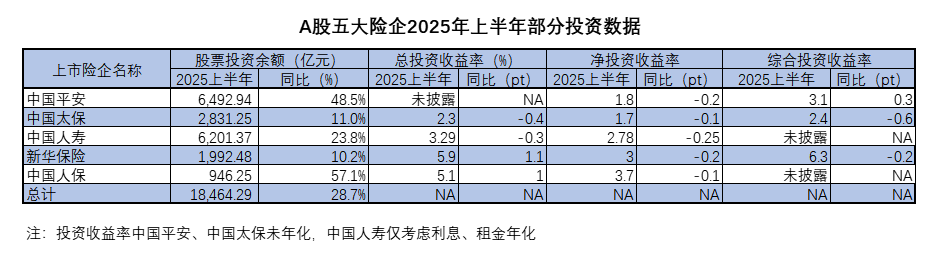
Core Viewpoint - The five major listed insurance companies in A-shares have significantly increased their stock investments, with a total increase of 411.86 billion yuan, representing a growth of 28.7% compared to the end of last year [1][6]. Group 1: Investment Performance - As of the end of the first half of the year, the total investment assets of the five A-share listed insurance companies reached 19.7 trillion yuan, an increase of 7.5% from the end of last year, accounting for 54.4% of the total insurance funds [2]. - The total investment return rates of various insurance companies showed a mixed performance, with China Pacific Insurance and China Life experiencing a year-on-year decline, while New China Life and China Reinsurance saw an increase of about 1 percentage point [4]. - The net investment return rates generally decreased by 0.1 to 0.25 percentage points, attributed to the decline in bond interest income in a low-interest-rate environment [6]. Group 2: Stock Investment Trends - The stock investment balance of the five major listed insurance companies reached 1.8 trillion yuan at the end of the first half, with an increase of 411.86 billion yuan, marking a growth of 28.7% [6]. - China Re and China Ping An saw stock investment increases of around 50%, while China Pacific Insurance and New China Life had smaller increases of 11% and 10.2%, respectively [6]. - New China Life had the highest proportion of stock investments in total investment assets at 11.6%, while China Ping An and China Pacific Insurance had lower proportions around 15% [6]. Group 3: Future Investment Strategies - Insurance companies plan to continue increasing their investments in the capital market, focusing on high-dividend stocks and growth stocks as part of their investment strategy [8][9]. - The companies expressed confidence in the capital market, citing regulatory support and favorable policies as key factors for optimism [8][9]. - The insurance companies are also participating in long-term investment pilot programs, with several funds already established to invest in stocks, focusing on companies with stable dividends and growth potential [11][12][13].
提升权益配置!中国平安透露最新打法
券商中国· 2025-08-31 05:00
Core Viewpoint - China Ping An has released its first half-year performance report as the leading A-share listed insurance company, highlighting its strategic focus on product development and investment strategies in response to changing market conditions [1][2]. Product Strategy - The company has completed the development of multiple new key products, which will be launched in batches starting in September. The new maximum guaranteed interest rates for various insurance products are set at 2.0% for ordinary life insurance, 1.75% for participating insurance, and 1.0% for universal insurance [3]. - The product strategy will focus on transitioning to participating insurance, expanding annuity insurance, and strengthening medical insurance offerings. The proportion of participating insurance in new individual policies has increased to around 40% in the first half of the year [3][4]. Investment Strategy - As of the first half of the year, the company's investment scale reached 6.2 trillion yuan, an increase of 8.2% from the beginning of the year. The allocation to stocks and equity funds rose from 9.9% to 12.6%, a 2.7 percentage point increase [5]. - The investment strategy emphasizes two main directions: high-dividend value stocks as a substitute for declining fixed-income returns and growth-oriented industries supported by policies, such as technology and high-end manufacturing [5][6]. - The company is actively increasing its equity allocation while managing risks, with a focus on stable, high-dividend stocks, particularly from large state-owned enterprises, which are characterized by strong operations and stable dividends [8][7]. Market Outlook - The domestic equity market is showing increased stability and positive prospects, driven by government support for capital markets and the emergence of new investment opportunities in sectors like artificial intelligence and high-end manufacturing [6][7]. - The company anticipates that the adjustment in interest rates will enhance the value of new products, contributing to the stability of profitability for life insurance companies [4].

中国人保半年报公布,A股股价今年以来涨超30%
Guan Cha Zhe Wang· 2025-08-29 08:32
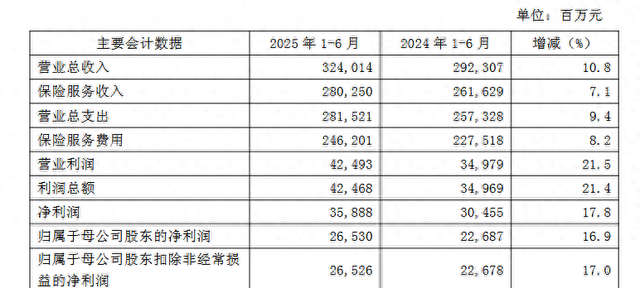
| 主要会计数据 | 2025年6月30 | 2024年12月31日 | 增减(%) | | --- | --- | --- | --- | | | 日 | | | | 总资产 | 1, 878, 495 | 1, 766, 384 | 6. 3 | | 总负债 | 1, 489, 039 | 1. 399. 158 | 6.4 | | 净资产 | 389, 456 | 367, 226 | 6.1 | | 归属于母公司股东的股东权益 | 285, 111 | 268, 733 | 6.1 | | 总股本 | 44, 224 | 44, 224 | | | 每股净资产(元/股) | 6.4 | 6.1 | 6.1 | 8月27日,中国人民保险集团股份有限公司(以下简称为中国人保)发布2025年半年度报告。 报告显示,中国人保上半年实现净利润359亿元,同比增长17.8%;归属于母公司股东净利润265亿元, 同比增长16.9%。2025年上半年实现保险服务收入2803亿元,同比增长7.1%;原保险保费收入4546亿 元,同比增长6.4%。总投资收益415亿元,增长42.7%。 | | | | 主要会计数据 | ...

中国人保“A股操盘”细节曝光,寿险未来收益率“定档”4%
Hua Er Jie Jian Wen· 2025-08-29 07:51
Core Insights - China Pacific Insurance reported a net profit of 26.53 billion yuan for the first half of the year, representing a year-on-year increase of 16.9% [1] - The company achieved premium income of 454.6 billion yuan, up 6.4% year-on-year, with property insurance premiums at 323.3 billion yuan (up 3.6%) and life insurance premiums at 131.2 billion yuan (up 13.8%) [1] - The company’s first-year premium income for life insurance reached a historical high for the same period [1] Investment Strategy - China Pacific Insurance has been approved for a 10 billion yuan quota to establish a private fund management company, focusing primarily on A-shares with an emphasis on long-term investment value and stable dividend returns [2] - As of the end of June, the company's A-share investment assets grew by 26.1% compared to the beginning of the year, increasing its proportion in total investment assets by 1.2 percentage points [2] Equity Investment Performance - The company has increased its investment in high-dividend stocks under OCI, with the investment scale growing by 60.7% year-to-date, outperforming the CSI 300 Dividend Index by 7.8 percentage points [3] - The company aims to optimize its TPL asset structure and has achieved a return ranking in the top 30% among comparable public funds [3] Response to Market Trends - The management noted that recent increases in high-dividend stock investments by insurance peers reflect a broader investment strategy, with a focus on stable returns amid declining traditional fixed-income asset yields [4] - The company plans to enhance its investment in high-dividend stocks to stabilize overall investment returns [4] Future Investment Plans - The company intends to diversify its equity investment strategies and strengthen research on quality targets, with plans to increase investment through methods such as private placements and strategic investments [5] - Different investment return assumptions have been set for life and health insurance segments, with life insurance at 4% and health insurance at 3.5% [6] Performance Highlights - The company has led in fulfilling national strategic responsibilities, with a compound growth rate of over 20% in insurance liability amounts during the 14th Five-Year Plan period [7] - The company has innovated in risk reduction services and established a digital service platform, providing risk reduction services 4.5 million times in the first half of the year [7] - The company has maintained a high level of asset management, with an annualized total investment return of 5.1% [7] Health Insurance Market Outlook - The health insurance sector is expected to grow rapidly, driven by aging population needs and the development of a multi-tiered medical security system [9] - New growth opportunities in health insurance are anticipated, particularly in long-term care and disability insurance, as the demand for such products increases [9]
保险板块大涨超4% 领涨行业板块
Shang Hai Zheng Quan Bao· 2025-08-29 03:30
Core Viewpoint - The insurance sector is experiencing significant growth, with a 4.28% increase in the industry index, driven by major companies like Xinhua Insurance and China Life Insurance showing substantial stock price gains [1] Group 1: Market Performance - The insurance sector (Shenwan secondary industry classification) rose by 4.28%, leading industry sectors [1] - Xinhua Insurance increased by 9.66%, China Life Insurance by 4.73%, and China Ping An by 3.47% [1] Group 2: Investment Trends - Dongguan Securities notes that the rapid growth of insurance funds, combined with a "slow bull" market and long-term market entry policies, is leading to an increased proportion of equity investments [1] - Insurance capital is deepening its layout in the equity market to share in the economic transformation and market upturn [1] Group 3: Financial Drivers - High dividend assets are providing a foundation, while growth sectors enhance yield elasticity, making equity investment a core driver of asset-side revenue growth [1] - The insurance industry is currently in a phase of "β attribute-driven valuation repair + solidifying the foundation of the liability side transformation + enhancing returns through asset-side equity efforts" [1] Group 4: Outlook on Valuation - Guotai Haitong Securities indicates that the insurance industry's liability side is seeing stable premium growth, and the reduction in the preset interest rate is beneficial for improving interest spread losses [1] - With increased equity allocation and accelerated inflow of new funds, the outlook for insurance stock valuation recovery is positive [1]

上半年A股五大上市险企共赚近1782亿元 归母净利润“四升一降”
Zheng Quan Ri Bao· 2025-08-28 23:29
Core Insights - The five major A-share listed insurance companies reported a total net profit attributable to shareholders of 178.19 billion yuan for the first half of 2025, representing a year-on-year increase of 3.7% [1] - The overall performance of A-share listed insurance companies showed a "four increases and one decrease" trend in net profit, with notable growth in new business value for life insurance [2] Group 1: Financial Performance - China Ping An achieved the largest net profit of 68.05 billion yuan, while China Life reported a net profit of 40.93 billion yuan, up 6.9% year-on-year [2] - China Pacific Insurance's net profit reached 27.88 billion yuan, growing by 11%, and China People's Insurance reported a net profit of 26.53 billion yuan, up 16.9% [2] - New China Life Insurance saw the highest growth rate in net profit at 14.8 billion yuan, with a year-on-year increase of 33.5% [2] Group 2: New Business Value - The new business value for life insurance across listed companies showed significant improvement, with China Life's new business value increasing by 20.3% year-on-year to 28.55 billion yuan [2] - China Ping An's new business value for life and health insurance grew by 39.8%, with a new business value rate increasing by 9.0 percentage points [2] - New China Life achieved a new business value of 6.18 billion yuan, up 58.4%, while China Pacific Insurance's new business value reached 9.54 billion yuan, growing by 32.3% [3] Group 3: Underwriting Business - The comprehensive cost ratio for property insurance among China People's Insurance, China Ping An, and China Pacific Insurance all showed a year-on-year decline, indicating improved underwriting profits [3][4] - China People's Insurance's property insurance comprehensive cost ratio was 95.3%, the best level in nearly a decade [4] - China Ping An's overall comprehensive cost ratio was 95.2%, down 2.6 percentage points, attributed to effective cost control and the use of technology [4] Group 4: Investment Strategies - Listed insurance companies increased their equity investment proportion, achieving better investment returns while supporting the recovery of the capital market [5] - China Life's equity investment scale increased by over 150 billion yuan compared to the beginning of the year, with a net investment yield of 2.78% and a total investment yield of 3.29% [6] - China People's Insurance reported a 26.1% growth in A-share investment assets, with an increase in the proportion of total investment assets [6]
加大资金入市力度!中国人保透露A股投资动向
Zhong Guo Zheng Quan Bao· 2025-08-28 23:28
Core Viewpoint - China Pacific Insurance (601319) is optimistic about the growth potential of its overseas auto insurance business, particularly in the new energy vehicle (NEV) sector, which is expected to become a new growth highlight for the company [1][4]. Investment Strategy - The company has increased its investment in A-shares, with A-share investment assets growing by 26.1% year-to-date, and the proportion of A-shares in total investment assets rising by 1.2 percentage points [2]. - The company aims to build an equity investment portfolio that balances stable investment returns with opportunities for excess market returns [2]. - The investment in OCI (Other Comprehensive Income) high-dividend stocks has increased by 60.7% year-to-date, outperforming the CSI 300 Dividend Index by 7.8 percentage points [2]. Future Outlook - The company plans to continue enriching its equity investment model and strengthen research reserves for high-quality targets, focusing on investments that align with national strategic directions and have strong growth potential [3]. Overseas Expansion - The NEV auto insurance project is a key part of the company's international strategy, with expectations for significant growth in overseas auto insurance business [4]. - The company has successfully launched its first NEV auto insurance policy in Hong Kong and has insured over a thousand Chinese brand NEV vehicles in the region, with a current claims ratio of approximately 50% [4]. Stock Performance - In the first half of the year, the company's A-shares reached a six-year high, while its H-shares achieved a 13-year high, and China Pacific Insurance's H-shares reached a 22-year high [5]. - The increase in stock price is attributed to multiple factors, including high-quality economic development in China, improving development environment, and the company's strong fundamentals [5]. - The company emphasizes the importance of market communication and shareholder return capabilities in its ongoing market value management efforts [5].
中国人保:丰富权益投资模式加大资金入市力度
Zhong Guo Zheng Quan Bao· 2025-08-28 20:17
● 本报记者 陈露 此外,今年3月,人保寿险及人保资产获批100亿元参与保险资金长期投资改革试点。8月14日,金融监 管总局批复同意人保资产设立私募基金管理公司事项。才智伟表示,基金投资策略将以A股为主,重点 关注具有长期投资价值、稳定股息回报、较好成长潜力的优质标的,同时将关注投资风险管控,致力于 实现长期稳定的投资回报。 巩固提高市值管理能力 "结合在中国香港及泰国的落地经验,公司推动项目顺利落地的关键在于'创新合作模式,输出经营能 力',主要包括三个方面:一是实现定价能力输出,二是推动管理能力输出,三是构建再保合作模 式。"于泽说。 于泽表示,未来,公司将以中国香港、泰国项目经验作为支点,深化全球保险合作,继续积极探索新能 源车险业务在其他东南亚国家保险市场,欧洲、南美洲主要保险市场落地,不断推动公司定价与管理能 力的国际化输出。 A股投资资产规模和占比稳步提升 上半年,中国人保加大资金入市力度,稳步提升A股投资资产规模和占比。展望未来,中国人保副总裁 才智伟表示,中国人保将持续丰富权益投资模式,加强对优质标的研究储备,对于符合国家战略导向、 长期经营业绩稳健、具备较强发展潜力的投资标的,适时通过定增、 ...