
绿色化

Search documents
聚乙烯:供给现状及展望
Xin Lang Cai Jing· 2026-01-22 02:09
Core Viewpoint - The polyethylene (PE) industry in China is experiencing explosive capacity growth driven by integrated refining strategies, the rise of private refining, and foreign investment, leading to a supply-demand imbalance characterized by "overcapacity, structural imbalance, and regional concentration" [2][15]. Group 1: Domestic Polyethylene Supply Status - China's polyethylene capacity has expanded significantly, with a total capacity expected to reach 41.14 million tons per year by the end of 2025, marking a 15 percentage point increase in growth rate compared to 2024 [3][16]. - The market structure has shifted from being dominated by state-owned enterprises to a more diversified competition, with private companies accounting for 58% of new capacity in 2025 [4][17]. - The import dependency of polyethylene has decreased, with total imports dropping by 50.36 thousand tons in the first eleven months of 2025, leading to a reduction in import dependency to 28% [4][19]. Group 2: Raw Material Diversification - The raw material structure for polyethylene has evolved into a triad of oil-based, coal-based, and light hydrocarbon-based processes, with oil-based polyethylene accounting for nearly two-thirds of production [5][20]. - Coal-based polyethylene has seen rapid development since 2016, with a production capacity concentrated in coal-rich regions, benefiting from lower costs compared to oil-based processes [6][21]. - The light hydrocarbon-based route is emerging as a significant growth area, although it faces challenges due to reliance on imported feedstock [6][22]. Group 3: Regional Distribution and Structural Optimization - Polyethylene production is concentrated in four major regions: South China, North China, East China, and Northwest China, which together account for over 95% of total capacity [8][23]. - The uneven distribution of capacity has led to supply-demand mismatches, with overcapacity in the Northwest and high demand in South and East China [9][24]. - The market is transitioning to a more efficient logistics model that combines local production and consumption, moving away from traditional transportation methods [8][23]. Group 4: Future Outlook for Polyethylene Supply - The polyethylene industry is expected to continue its capacity expansion cycle from 2026 to 2030, with an anticipated addition of over 500 thousand tons in 2026 alone [10][11]. - The focus will shift from quantity to quality, with an emphasis on high-end products to fill existing supply gaps, particularly in LDPE and specialty grades [12][27]. - The maturation of the polyethylene futures market will enhance its role in stabilizing supply and guiding industry development, providing better risk management tools for companies [13][28].


大连普兰店木制品产业 蓄力前行焕新颜
Sou Hu Cai Jing· 2026-01-22 02:03
Group 1 - The wood products industry in Pulandian District has developed into a key regional industry since its inception in 1969, contributing significantly to local economic development [1] - As of November 2025, there are 486 wood product-related enterprises in Pulandian District, indicating a transformation from fragmented operations to large-scale development, with major companies like Dalian Meisen Wood Industry Co., Ltd. leading the industry cluster [1] - The annual sales revenue of the wood products industry reaches 4 billion yuan, with domestic sales growing at an average rate of 10% due to expanding market demand, and products being exported to various countries and regions including Europe, America, Japan, South Korea, and Southeast Asia [1] Group 2 - The wood products industry in Pulandian District is focusing on smart, green, and integrated development as part of its transformation and upgrade, aligning with the "14th Five-Year" and "15th Five-Year" planning requirements [2] - The local tax bureau is leveraging big data to analyze the current state of the wood products industry, aiming to strengthen the tax base and support high-quality economic development in the region [2]
税收数据显示2025年我国制造业智能化、绿色化、融合化加快发展
Ren Min Ri Bao· 2026-01-22 01:55
Core Insights - The manufacturing sector in China is projected to have a sales revenue growth rate that exceeds the national average by 1.7 percentage points by 2025, with a manufacturing share of 29.7% of total sales, an increase of 0.5 percentage points from the previous year [1] Group 1: Intelligent Upgrading - The procurement of automation and digital equipment by manufacturing enterprises is expected to grow by 11.3% and 10% year-on-year respectively in 2025, indicating a rapid advancement in the intelligent transformation and digital renovation of the manufacturing sector [1] - The sales revenue of the intelligent equipment manufacturing industry is anticipated to increase by 28.1% year-on-year in 2025, driven by the intelligent upgrades in manufacturing [1] Group 2: Green Transformation - The sales revenue of high-energy-consuming manufacturing industries is projected to decrease by 1.1 percentage points as a share of total manufacturing, reflecting an ongoing optimization of the industrial structure [1] - The amount spent by manufacturing enterprises on environmental governance services is expected to grow by 7.3% year-on-year, with high-energy-consuming sectors seeing a 14.6% increase in spending on environmental governance services, indicating a significant rise in green investment [1] Group 3: Digital Integration - The sales revenue of the digital product manufacturing industry is forecasted to grow by 9.4% year-on-year in 2025, showcasing the deepening integration of the digital economy with the real economy [1] - The procurement of digital technologies by manufacturing enterprises is expected to increase by 10.4% year-on-year, further emphasizing the trend of digital integration within the manufacturing sector [1]
2025年我国制造业智能化、绿色化、融合化加快发展
Ren Min Ri Bao· 2026-01-22 00:56
Core Insights - The core viewpoint of the article highlights the accelerated development of China's manufacturing industry towards intelligence, greenness, and integration by 2025, with significant growth in sales revenue and structural optimization [1] Group 1: Intelligent Upgrading - By 2025, the sales revenue of the manufacturing sector is expected to grow 1.7 percentage points faster than the overall national sales growth [1] - The procurement of automation and digital equipment by manufacturing enterprises is projected to increase by 11.3% and 10% year-on-year, respectively, indicating a rapid advancement in intelligent transformation and digital renovation [1] - The sales revenue of the intelligent equipment manufacturing industry is anticipated to grow by 28.1% year-on-year, driven by the intelligent upgrading of the manufacturing sector [1] Group 2: Green Transformation - The sales revenue of high-energy-consuming manufacturing industries is expected to decrease by 1.1 percentage points as a proportion of total manufacturing, reflecting ongoing structural optimization [1] - The amount spent by manufacturing enterprises on environmental governance services is projected to increase by 7.3% year-on-year, with high-energy-consuming sectors seeing a 14.6% increase in spending on environmental governance services [1] Group 3: Digital Integration - The sales revenue of the digital product manufacturing industry is expected to grow by 9.4% year-on-year, indicating a deepening integration of the digital economy with the real economy [1] - The procurement of digital technologies by manufacturing enterprises is projected to increase by 10.4% year-on-year, further emphasizing the trend of digital integration [1]
近期工程机械用钢产销存分析
Xin Lang Cai Jing· 2026-01-21 10:25
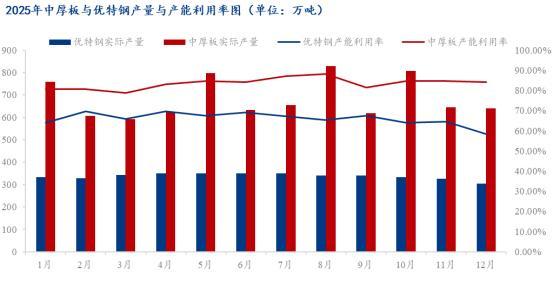
Group 1 - The core viewpoint of the article highlights the steady increase in the market for engineering machinery steel, driven by the recovery of downstream infrastructure and manufacturing industries, as well as the simultaneous growth in both domestic and overseas markets [1][17] Group 2 - The production of engineering machinery steel shows differentiation, with medium-thick plates maintaining over 80% utilization, while special steel utilization fluctuates around 60% [4][19] - By 2025, the actual production of medium-thick plates and special steel is expected to reach 122 million tons, with engineering machinery steel accounting for approximately 40% of this total [4][19] - Major steel companies like Baowu Group, Ansteel, and Hunan Huai Steel have increased their market share to 63%, benefiting from technological advantages and strong customer relationships [4][19] Group 3 - The production of high-strength steel (Q690 and above) is projected to be around 8.6 million tons in 2025, only meeting 82% of market demand, indicating a significant gap in high-end products [5][20] - Ordinary structural steel faces oversupply, while high-strength wear-resistant steel and alloy structural steel are in short supply, leading to intense price competition in basic products [5][20] Group 4 - The estimated sales volume of engineering machinery steel in 2025 is 49.3 million tons, reflecting a year-on-year growth of 6.8%, with export sales increasing by 16.1% [10][25] - The sales distribution remains concentrated, with the Yangtze River Delta region accounting for 43% of total sales, supported by local supply chain advantages [10][25] Group 5 - The average price of Q550D low-alloy high-strength steel is projected to be 4,390 yuan per ton in 2025, showing a slight year-on-year decline of 1.39%, while high-end products like Q960E and NM600 have stable prices [14][29] - The price differentiation is attributed to the lower production difficulty of common materials, leading to increased supply and price drops, while high-end products remain less volatile due to limited market resources [14][29] Group 6 - The overall inventory of engineering machinery steel is expected to be around 4 million tons by the end of 2025, with a turnover cycle of 20-30 days, indicating improved market liquidity [15][30] - High-end product inventories are relatively low, while ordinary product inventories face significant pressure, particularly in regions with concentrated production capacity [15][30] Group 7 - The engineering machinery steel market is experiencing optimization in production, sales, and inventory due to policy benefits and demand recovery, with a shift towards high-end, green, and globalized development [17][32] - Short-term factors such as increased domestic infrastructure investment and equipment renewal, along with a recovery in overseas markets, are expected to support steady market growth [17][32]
针对性化解供强需弱矛盾
Xin Lang Cai Jing· 2026-01-21 10:21
Economic Overview - The total economic output of China has reached a new milestone of 140 trillion yuan, with the manufacturing value added ranking first globally for 16 consecutive years, and the urbanization rate of the permanent resident population increasing by 0.89 percentage points compared to the previous year [2] Development Goals and Strategies - The National Development and Reform Commission (NDRC) summarized the past year's economic achievements, highlighting stable economic operation and enhanced resilience, with a focus on high-quality development [3] - Looking ahead to 2026, significant potential for growth is expected in consumption, investment, technology, and regional development [3] Technological and Industrial Advancements - New technologies, products, and scenarios are emerging, with sectors such as new energy, new materials, and aerospace poised for growth [3] - The NDRC is planning to advance a series of major high-tech industry projects during the 14th Five-Year Plan period [3] Supply and Demand Dynamics - The NDRC emphasized the need to address the prominent contradiction of strong supply and weak demand, focusing on achieving a dynamic balance and healthy circulation of supply and demand [4] - Key strategies include strengthening domestic circulation, enhancing the real economy, and promoting a unified national market [4] Policy Initiatives - The NDRC is set to develop a strategic implementation plan for expanding domestic demand from 2026 to 2030, aiming to leverage new demand to drive new supply [4] - Policies will focus on intelligent, green, and integrated development, fostering emerging and future industries [4] Consumer and Market Dynamics - Efforts to enhance consumer income are crucial for expanding domestic demand, with plans for actions to stabilize employment and increase urban and rural residents' income [5] - The NDRC is working on optimizing project conditions and standards to lower investment thresholds in equipment updates and improve the consumer goods replacement program [5] Price Stability and Inflation Control - Maintaining stable prices for essential goods is a key macroeconomic goal, with recent trends showing a rise in both the Consumer Price Index (CPI) and the Producer Price Index (PPI) [6] - The NDRC plans to implement more proactive fiscal policies and moderately loose monetary policies to promote reasonable price recovery [6][7]
税收数据显示:中国制造业智能化、绿色化、融合化步伐加快
Zhong Guo Xin Wen Wang· 2026-01-21 07:42
Group 1 - The core viewpoint of the article highlights the accelerated pace of intelligent, green, and integrated development in China's manufacturing industry, with manufacturing sales revenue expected to grow faster than the national average by 1.7 percentage points by 2025 [1] - The manufacturing sector's share of total national sales is projected to reach 29.7% in 2025, an increase of 0.5 percentage points from the previous year, underscoring its role as an economic stabilizer [1] - The implementation of the "Artificial Intelligence + Manufacturing" initiative is driving significant growth in the procurement of automation and digital equipment, with year-on-year increases of 11.3% and 10% respectively [1] Group 2 - The sales revenue of high-energy-consuming manufacturing industries is expected to decrease by 1.1 percentage points compared to the previous year, indicating ongoing optimization of the industrial structure [2] - Investment in environmental governance services by manufacturing enterprises has increased by 7.3%, with high-energy-consuming sectors seeing a 14.6% rise in spending on such services, reflecting a commitment to green governance [2] - The sales revenue of the new energy vehicle manufacturing industry and lithium-ion battery manufacturing is projected to grow by 14.3% and 25.1% respectively, highlighting the rapid development of related industries [2] Group 3 - The sales revenue of digital product manufacturing is expected to grow by 9.4%, with manufacturing enterprises increasing their procurement of digital technologies by 10.4%, a 3.5 percentage point acceleration from the previous year [2] - The automotive manufacturing and computer communication equipment manufacturing sectors are leading in digital technology procurement, with increases of 24.5% and 11.8% respectively, indicating a deepening integration of the digital economy with the real economy [2] - The National Taxation Administration emphasizes the importance of implementing tax and fee incentives to support the transformation and upgrading of the manufacturing sector, ensuring that policy benefits reach enterprises effectively [2]
半两财经|2025年税收数据显示:数字产品制造业销售收入同比增9.4%
Sou Hu Cai Jing· 2026-01-21 06:42
Group 1 - The core viewpoint of the articles indicates that by 2025, China's manufacturing industry is expected to see a sales revenue growth rate that exceeds the national average by 1.7 percentage points, with manufacturing accounting for 29.7% of total national sales, an increase of 0.5 percentage points from the previous year [1][2] Group 2 - The acceleration of intelligent upgrades in manufacturing is highlighted, with a projected year-on-year increase of 11.3% in the purchase of automation equipment and 10% in digital equipment by manufacturing enterprises in 2025. This transformation is expected to drive related industries, with intelligent equipment manufacturing sales projected to grow by 28.1% [1] - The green transformation is also emphasized, with high-energy-consuming manufacturing sales revenue expected to decrease by 1.1 percentage points in proportion to total manufacturing. Investments in environmental governance services are projected to increase by 7.3%, with high-energy-consuming sectors seeing a 14.6% increase [1] - The deepening of digital integration is noted, with digital product manufacturing sales expected to grow by 9.4% and the procurement of digital technologies by manufacturing enterprises projected to increase by 10.4%, with notable growth in the automotive and computer communication equipment sectors [2] - The tax authority plans to optimize tax and fee services to ensure that policy benefits reach enterprises effectively, contributing to the high-quality development of the manufacturing sector [2]
稳、进、新、活 2025年工业和信息化发展呈现四大特点
Zhong Guo Xin Wen Wang· 2026-01-21 06:40
Core Viewpoint - The development of the industrial and information technology sectors in 2025 is characterized by four main features: stability, progress, innovation, and vitality, reflecting a commitment to high-quality development and the achievement of key economic goals. Group 1: Stability - The industrial economy has maintained a stable growth trajectory, with the added value of industrial enterprises above designated size increasing by 5.9% year-on-year, and the manufacturing sector's contribution to GDP remaining stable [1] - The telecommunications business volume grew by 9.1% year-on-year, contributing over 40% to overall economic growth, reinforcing its role as an economic stabilizer [1] Group 2: Progress - The pace of high-quality development has accelerated, with the added value of equipment manufacturing and high-tech manufacturing increasing by 9.2% and 9.4% year-on-year, respectively, outpacing overall industrial growth by 3.3 and 3.5 percentage points [2] - The establishment of over 35,000 basic-level and 8,200 advanced-level smart factories has been achieved, alongside the cultivation of 15 leading smart factories, indicating solid progress in the digital transformation of manufacturing [2] Group 3: Innovation - Significant advancements in technology and industry innovation have been made, with breakthroughs in major equipment such as ultra-large diameter shield machines and heavy-duty gas turbines, and over 300 key technologies developed in the first phase of 6G testing [3] - The added value of integrated circuits and electronic materials increased by 26.7% and 23.9% year-on-year, respectively, while the production of industrial robots rose by 28%, and new energy vehicle sales reached 16.49 million, up 28.2% [3] Group 4: Vitality - Reforms in key areas have been accelerated, with actions taken to reduce corporate burdens and clear overdue payments, creating a more vibrant business environment [4] - The cultivation of specialized and innovative small and medium-sized enterprises has seen over 140,000 such firms established, with high-tech enterprises reaching 504,000, indicating a robust growth in the industrial sector [4]
中孚实业:电解铝业务成本下降及销售价格上涨 预计2025年净利润同比增长120.27%-141.59%
Zhong Zheng Wang· 2026-01-21 06:37
Core Viewpoint - The company, Zhongfu Industrial, anticipates a significant increase in its net profit for the year 2025, projecting a growth of 120.27% to 141.59% compared to the previous year [1] Financial Performance - The expected net profit attributable to shareholders is between 1.55 billion to 1.7 billion yuan [1] - The projected non-recurring net profit is estimated to be between 1.52 billion to 1.67 billion yuan, reflecting a year-on-year growth of 156.32% to 181.61% [1] Growth Drivers - The primary reasons for the anticipated performance improvement include the company's focus on "green, digital, and intelligent" initiatives, alongside ongoing cost reduction and management enhancement efforts [1] - The growth in performance is mainly attributed to the decrease in costs and the increase in sales prices within the electrolytic aluminum business [1]
