GDP增长

Search documents
韩国央行周四料维持利率不变,多重内外因素制约宽松政策空间
Sou Hu Cai Jing· 2025-11-24 01:09
Core Viewpoint - Moody's analysis predicts that the Bank of Korea will maintain the benchmark interest rate at 2.5% during the monetary policy meeting on the 28th, due to a complex macroeconomic environment and multiple policy constraints [1] Internal Pressures - The Bank of Korea is cautious about further easing monetary policy, primarily due to three internal pressures: high household debt levels, upward risks in the real estate market, and recent signs of rising inflation [1] - These factors collectively strengthen financial stability considerations, limiting the space for interest rate cuts [1] External Environment - The external environment also diminishes the necessity for an immediate shift to a more accommodative policy [1] - The weakening of the Korean won raises concerns about imported inflation [1] - Additionally, South Korea's GDP growth in the third quarter exceeded expectations, indicating some inherent economic resilience, which reduces the urgency for rate cuts to stimulate growth [1]
研究结果显示:特朗普“大漂亮法案”将提振增长,但美联储维持高利率恐令效果打折
Sou Hu Cai Jing· 2025-11-20 16:02
Core Insights - The analysis indicates that the Trump administration's significant fiscal legislation will drive economic growth next year, although this impact will be partially offset by the Federal Reserve maintaining higher interest rates than would otherwise be the case [1] - The federal deficit is projected to overshadow GDP growth [1] - An estimated additional $100 billion in tax refunds expected early next year is anticipated to contribute approximately 0.4 percentage points to economic growth in the first half of the year [1]
美联储会议纪要:GDP增长预期上调,年末降息概率大降
Sou Hu Cai Jing· 2025-11-19 23:26
相较于9月会议的预测,10月的预测显示截至2028年的实际GDP增长总体小幅增强,这主要反映了预期 潜在产出增长的提升以及金融条件预计将提供更大支撑。2025年后,随着关税上升带来的拖累减弱, GDP增长预计将保持高于潜在水平的态势直至2028年,金融条件将转变为支出的顺风因素。因此,失业 率预计在今年之后逐步下降,随后稳定在略低于工作人员对自然失业率估计值的水平。通胀预测与为9 月会议准备的预测基本相似,预计关税上调将在2025年和2026年对通胀构成上行压力。此后,通胀预计 将回归此前的反通胀趋势。工作人员继续认为预测面临的高度不确定性,理由包括劳动力市场降温、通 胀仍处高位、政府政策变化及其对经济影响的不确定性加剧,以及政府停摆导致的数据获取受限。 美联储最新政策会议纪要显示,尽管多位官员对劳动力市场疲软表示担忧,但认为在年内剩余时间维持 利率稳定可能是适宜之举。 咨询公司RSM首席经济学家JosephBrusuelas解读称,这份纪要"清晰揭示了鹰鸽两派的分歧,文本暗示 鹰派略占上风,他们围绕通胀固化风险提出了具有说服力的论据"。自10月会议以来,经济背景已发生 变化:美国政府停摆结束,就业与通胀等关 ...
欧元区3季度GDP环比增长0.2%
Shang Wu Bu Wang Zhan· 2025-11-19 04:43
欧盟统计局公布数据显示,2025年第三季度欧元区GDP环比增长0.2%,欧盟整体增长0.3%。与去年同 期相比,欧元区和欧盟GDP分别增长1.4%和1.6%,经济保持平稳扩张。 (原标题:欧元区3季度GDP环比增长0.2%) ...
国际金融市场早知道:11月18日
Xin Hua Cai Jing· 2025-11-18 00:06
Group 1 - Federal Reserve officials warn of employment risks and call for cautious interest rate cuts [1] - South Korea tightens retail investors' overseas leveraged ETF investment thresholds to enhance risk awareness [2] - Eurozone economic outlook upgraded, but rising defense spending poses medium-term risks to government debt and fiscal deficits [2] Group 2 - Japan's Q3 GDP unexpectedly shrinks by 0.4% quarter-on-quarter, annualized contraction of 1.8%, primarily due to high U.S. tariffs and weak domestic housing investment [2] - Switzerland's Q3 GDP contracts by 0.5%, driven by weak performance in the chemical and pharmaceutical sectors and sluggish service industry growth [2] - Singapore Exchange to launch Bitcoin and Ethereum perpetual futures contracts on November 24, marking a significant move towards digital asset derivatives in Asia [3] Group 3 - U.S. stock indices decline, with the Dow Jones Industrial Average down 1.18% to 46,590.24 points, S&P 500 down 0.92% to 6,672.41 points, and Nasdaq Composite down 0.84% to 22,708.07 points [4] - COMEX gold futures drop 1.20% to $4,045.10 per ounce, while silver futures decrease by 1.25% to $50.05 per ounce [5] - U.S. dollar index rises by 0.25% to 99.54, while the euro and British pound decline against the dollar [5]
泰国第三季度GDP同比增长1.2% 市场预期为1.6%
Mei Ri Jing Ji Xin Wen· 2025-11-17 02:37
(文章来源:每日经济新闻) 11月17日,泰国第三季度GDP同比增长1.2%,市场预期为1.6%。 ...
泰国第三季度GDP同比增长1.2%,市场预期为1.6%
Mei Ri Jing Ji Xin Wen· 2025-11-17 02:36
每经AI快讯,11月17日,泰国第三季度GDP同比增长1.2%,市场预期为1.6%。 ...
GDP全球第二,为何老百姓还是不敢花钱?刘元春揭秘消费低迷真相
Sou Hu Cai Jing· 2025-11-16 02:15
Core Insights - The essence of the issue is a strong government, wealthy enterprises, and impoverished residents, leading to high mandatory savings and low income distribution for residents, which directly results in low consumption rates [2][5]. Consumption Data Comparison - China's final consumption rate is approximately 55%, while developed countries average around 80%. Government consumption accounts for 30%, but private consumption is below 70%. The share of household consumption in GDP is less than 40%, lower than the global average of 55% [3]. Consumption Growth Performance - Despite a low consumption rate, consumption growth has been significant, with an average increase of 8.24% over the past 20 years, more than three times that of the U.S. In 2024, consumption is expected to contribute 44.5% to economic growth, remaining the primary driver of China's economy [5]. Distribution Imbalance - The core issue of low consumption is linked to a decline in consumption growth, which is becoming disconnected from GDP growth. The initial distribution of national income shows that the household sector accounts for only 60.6%, which is 5.5 percentage points lower than the global average, while the corporate sector is 5.6 percentage points higher [5][7]. Social Security and Wealth Gap - The inadequacy of the social security system contributes to a persistent wealth gap, with China's Gini coefficient reflecting a modest reduction of 12%, compared to a 40% reduction in Europe. High housing prices and insufficient affordable housing force low- and middle-income individuals to allocate savings to real estate, limiting funds available for daily consumption [5][7]. Short-term Consumption Weakness - Recent years have seen a worsening of consumption shortfalls, with household income growth lagging behind nominal GDP. Despite a GDP growth of 5.2% in the first three quarters, retail sales only grew by 4.5%, indicating a weak recovery in consumption [7]. Structural Reform Recommendations - To address the consumption gap, estimated at 6% of GDP (approximately 2.9 trillion yuan annually), structural reforms are necessary rather than temporary measures like vouchers or discounts [7][8]. Six Structural Reform Directions 1. Transition the government from an investment-focused model to a service-oriented one, enhancing social security, healthcare, education, and elderly care [8]. 2. Increase the return of state-owned enterprise profits to society, preventing excessive reinvestment of profits [8]. 3. Reform income distribution to raise the share of household income in national income [8]. 4. Strengthen social security systems to alleviate the pressure of precautionary savings on residents [8]. 5. Adjust housing policies to provide more affordable housing for low- and middle-income groups [8]. 6. Restore confidence in income and asset expectations, as all three elements are essential [8]. Historical Opportunity and Fundamental Path - The current period is seen as a critical window for China to transition from a wealthy nation to one that enriches its citizens. Improving household income and restoring consumption capacity are vital for making consumption the engine of China's economic internal circulation [10].



【环球财经】欧盟统计局:2025年第三季度欧元区GDP环比增长0.2%
Xin Hua Cai Jing· 2025-11-14 12:06
Core Insights - The Eurozone and EU economies experienced moderate growth in Q3 2025, with Eurozone GDP increasing by 0.2% and EU GDP by 0.3% on a quarter-on-quarter basis [1] - Year-on-year, Eurozone GDP grew by 1.4% and EU GDP by 1.6% in Q3 2025 [1] Economic Performance - Eurozone's quarter-on-quarter growth of 0.2% in Q3 2025 is slightly higher than the previous quarter's growth of 0.1% [1] - EU's quarter-on-quarter growth of 0.3% also surpasses the previous quarter's growth of 0.2% [1] Employment Market - Eurozone employment numbers increased by 0.1% quarter-on-quarter, remaining stable compared to the previous quarter [1] - EU employment numbers rose by 0.2% quarter-on-quarter, slightly above the previous quarter's growth of 0.1% [1] - Year-on-year, Eurozone employment grew by 0.5% and EU employment by 0.6% [1] Member States Performance - Economic performance among major member states showed divergence, with Germany and Italy recording a quarter-on-quarter growth rate of 0.0%, indicating economic stagnation [1] - In contrast, France and Spain achieved more robust growth rates of 0.5% and 0.6%, respectively [1]
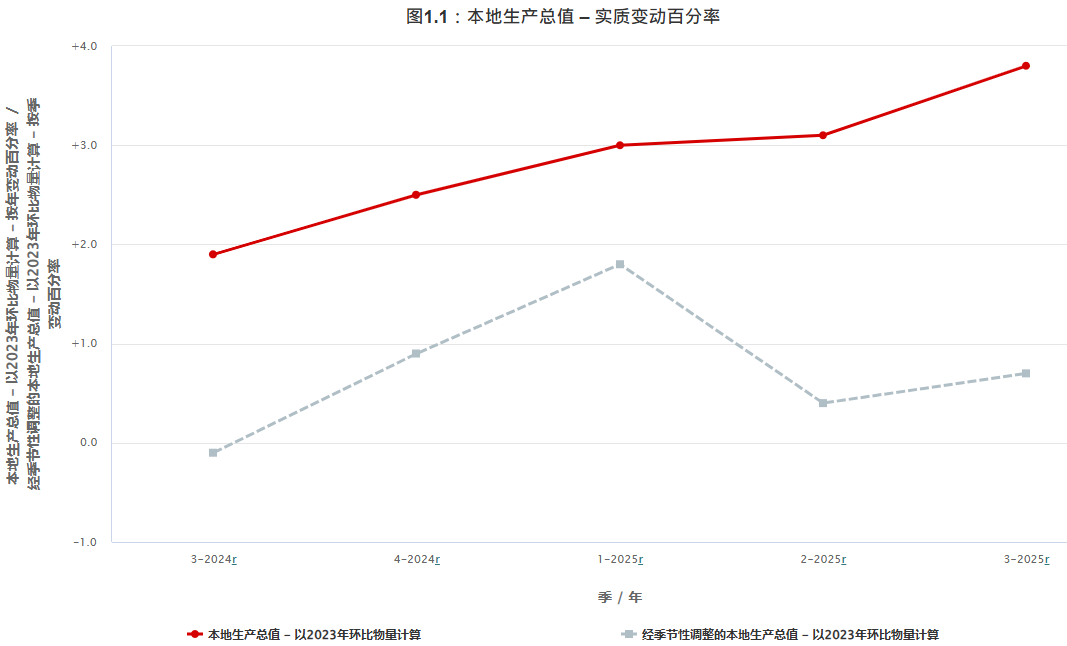
香港三季度GDP同比实质增长3.8%
Zhi Tong Cai Jing· 2025-11-14 09:00
Core Viewpoint - The Hong Kong economy showed a real GDP growth of 3.8% in Q3 2025 compared to the same period last year, an increase from the previous quarter's growth of 3.1% [1] Group 1: GDP Components - All components of GDP recorded real growth in Q3 2025. Private consumption expenditure rose by 2.1% year-on-year, up from 1.9% in the previous quarter [1] - Government consumption expenditure increased by 1.9%, down from 2.5% in the previous quarter [1] - Gross fixed capital formation further increased by 4.3%, compared to a 1.9% rise in the previous quarter [1] Group 2: Exports and Imports - Goods exports recorded a real increase of 12.1% year-on-year in Q3 2025, up from 11.5% in the previous quarter [2] - Service output rose by 6.3%, down from an 8.6% increase in the previous quarter [2] - Goods imports increased by 11.7% year-on-year, slightly lower than the 12.6% growth in the previous quarter [3] - Service inputs rose by 2.6%, down from 7.3% in the previous quarter [3]