
上市公司治理

Search documents
海默科技: 东方证券股份有限公司关于海默科技(集团)股份有限公司2025年度持续督导培训工作报告
Zheng Quan Zhi Xing· 2025-08-15 09:17
Group 1 - The core viewpoint of the news is the ongoing supervisory training conducted by Dongfang Securities for Haimer Technology (Group) Co., Ltd. in accordance with relevant regulations and guidelines for the year 2025 [1][2] - The training covered key rules such as the Shenzhen Stock Exchange's Growth Enterprise Market Stock Listing Rules (2025 Revision) and self-regulatory guidelines for listed companies, focusing on corporate governance, information disclosure, and the proper use of raised funds [1][2] - The training aimed to enhance the understanding of the actual controller, directors, senior management, and securities affairs representatives regarding the regulations set by the China Securities Regulatory Commission and the Shenzhen Stock Exchange [2] Group 2 - The training was prompted by the completion of the share transfer from the original controlling shareholder, Shandong New Journey Energy Co., Ltd., to the new actual controller, Fan Zhonghua, which necessitated a focus on the behavior norms of the new controlling shareholder [2] - The training was deemed successful, achieving its intended goals and resulting in a better understanding of the compliance requirements for listed companies among the training participants [2]


亏损期逆势提薪引争议:伯朗特董事长200万天价薪酬提案遭否,触碰上市公司治理准则底线
Sou Hu Cai Jing· 2025-08-14 11:56
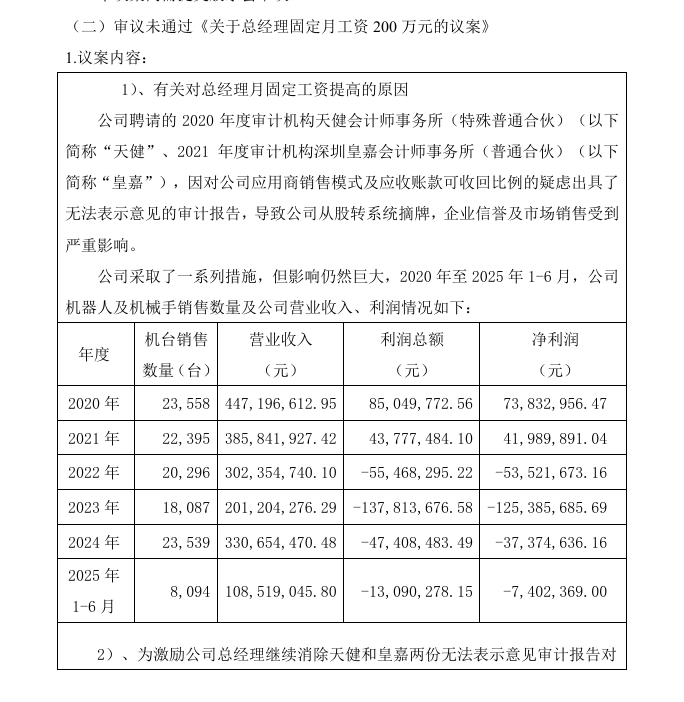
Core Viewpoint - The controversy surrounding the salary proposal of Yoon Yong-jo, chairman of the robotics company Berante, highlights the increasing scrutiny of executive compensation in loss-making companies amid regulatory reforms aimed at improving corporate governance [1][5][12]. Group 1: Salary Proposal and Board Rejection - Yoon Yong-jo proposed a fixed monthly salary of 2 million yuan and an annual bonus based on "company profit - 1 yuan," which was rejected by the board [1][3]. - The board's rejection was influenced by the company's current loss status, with directors arguing that salary increases should only be considered after the company returns to profitability [3][5]. Group 2: Financial Performance - Berante's financial performance has been declining, with a reported revenue of 177.36 million yuan in the first half of 2025, a decrease of 17.84% year-on-year, and a net loss of 39.42 million yuan [4][3]. - The company has faced significant losses in recent years, with net profits of -125.39 million yuan in 2023 and -55.47 million yuan in 2022 [2][3]. Group 3: Regulatory Context - The controversy occurs against the backdrop of the China Securities Regulatory Commission's new guidelines aimed at tightening executive compensation structures, particularly for loss-making companies [5][7]. - The revised corporate governance guidelines emphasize that executive compensation should align with company performance and sustainability, particularly for companies reporting losses [7][12]. Group 4: Shareholder Concerns and Governance Issues - Shareholders, particularly minority shareholders, have expressed concerns over governance issues, including the perceived self-serving nature of Yoon Yong-jo's salary proposal [8][9]. - A significant shareholder has called for amendments to the company's articles of association to restore normal governance structures and address the concentration of power within the company [8][9]. Group 5: Historical Context and Company Background - Berante, founded in 2008, has faced challenges in recent years, including being delisted from the New Third Board due to audit issues [10]. - The company has a history of receiving "unable to express an opinion" audit reports, which has severely impacted its market reputation and operational performance [10].

东方雨虹向实控人李卫国提供资金6950万元,北京证监局出具警示函
Jin Rong Jie· 2025-08-13 04:53
Core Viewpoint - The company Dongfang Yuhong has been involved in non-operational fund occupation amounting to 69.5 million yuan, which was not disclosed in a timely manner, leading to regulatory actions against its executives [1] Group 1: Company Actions and Responses - Dongfang Yuhong provided funds to its actual controller Li Weiguo through various means, constituting non-operational fund occupation [1] - The company announced plans to improve its internal control system, establish a sound internal supervision mechanism, and enhance fund management practices [1] - The company aims to strengthen compliance with relevant laws and regulations to improve the quality of financial accounting and information disclosure [1] Group 2: Regulatory Environment - The Beijing Securities Regulatory Bureau issued warning letters to the company and its executives, including Chairman Li Weiguo and General Manager Zhang Zhiping, and recorded these actions in their integrity files [1] - The Shenzhen Stock Exchange issued a regulatory letter and publicly criticized the company for its actions [1] - Multiple listed companies have faced regulatory penalties this year for issues related to fund occupation and information disclosure violations, indicating a tightening regulatory environment [1]

惩防并举强化上市公司治理
Zheng Quan Ri Bao· 2025-08-12 16:09
Core Viewpoint - Regulatory authorities are intensifying scrutiny on non-operational fund occupation and related violations among listed companies, aiming to enhance corporate governance and protect investor interests [1][2][3]. Group 1: Regulatory Actions - Beijing Oriental Yuhong Waterproof Technology Co., Ltd. received warnings from the Beijing Securities Regulatory Bureau and the Shenzhen Stock Exchange for non-operational fund occupation and financial irregularities [1]. - Nearly 40 companies have faced penalties this year due to fund occupation, with significant cases involving undisclosed non-operational fund occupation by related parties [2]. - Regulatory measures include administrative penalties and warnings, with a focus on improving corporate governance and compliance with fundraising regulations [1][4]. Group 2: Fund Occupation Issues - The primary reasons for penalties include undisclosed non-operational fund occupation by related parties and large-scale fund occupation by controlling shareholders [2]. - Companies like Weichuang Group and *ST Huamei have faced fines and corrective measures for failing to disclose fund occupation in a timely manner [2]. - The regulatory framework has been strengthened to prevent fund occupation and ensure proper use of raised funds, with new rules emphasizing transparency and accountability [3][4]. Group 3: Corporate Governance - Good corporate governance is essential for high-quality listed companies, ensuring decision-making transparency and protection of shareholder rights [5]. - The China Securities Regulatory Commission (CSRC) has introduced new guidelines to enhance governance standards, including restrictions on controlling shareholders' access to company assets [3][4]. - Analysts emphasize the need for improved governance capabilities among management and the importance of independent directors and auditors in maintaining market confidence [5].
燕京啤酒: 董事、高级管理人员培训管理制度(2025年8月)
Zheng Quan Zhi Xing· 2025-08-10 08:16
Core Viewpoint - The training management system for directors and senior management of Beijing Yanjing Beer Co., Ltd. aims to enhance compliance, governance, and operational standards through structured training programs based on relevant laws and regulations [1][2]. Group 1: Training Objectives and Applicability - The purpose of the training is to strengthen self-discipline and improve corporate governance by ensuring that directors and senior management understand relevant laws and regulations [1][2]. - The training applies to all directors and senior management, including the chairman, vice-chairman, general manager, and other key positions, with the possibility of including other management personnel as needed [1][2]. Group 2: Training Content and Requirements - Training for the chairman and general manager includes understanding capital market conditions, disclosure requirements, governance principles, and the latest policies on financing and mergers [2][3]. - Directors (excluding independent directors) will focus on the legal framework of listed companies, their rights and responsibilities, and policies on related transactions and refinancing [2][3]. - Independent directors will be trained on the latest laws, accounting standards, and their specific rights and responsibilities [2][3]. - The chief accountant's training will cover the legal framework, accounting standards, and disclosure rules for public offerings [3]. - The board secretary's training will include governance frameworks, responsibilities, and operational practices related to refinancing and mergers [3]. Group 3: Training Organization and Format - Training will consist of both external and internal sessions, with external training organized by regulatory bodies like the China Securities Regulatory Commission (CSRC) [3][4]. - Internal training will be organized by the board office or through hired intermediaries, ensuring that all directors and senior management participate in required training [4][5]. Group 4: Training Management - The board office is responsible for managing training records, ensuring attendance, and maintaining training archives for all directors and senior management [5][6]. - Directors and senior management are required to participate in at least one CSRC-organized training within their first year of service [5][6]. - The board secretary must pass a qualification exam and participate in ongoing training every two years [6]. Group 5: Financial Responsibility and Implementation - The company will cover all costs related to training, including fees and travel expenses incurred during participation in regulatory training [7]. - The training management system will be effective upon approval by the board and will be subject to updates as necessary [7].

公募迈入“积极股东”新时代 有效推动上市公司治理水平提升
Zhong Guo Zheng Quan Bao· 2025-08-08 07:19
Core Viewpoint - The introduction of the "Management Rules for Publicly Raised Securities Investment Fund Managers Participating in Listed Company Governance" marks a significant reform in China's capital market, aiming to enhance the governance of listed companies through active participation of fund managers [1][6]. Group 1: Regulatory Framework - The new rules consist of 6 chapters and 27 articles, outlining the methods and processes for fund managers to engage in corporate governance [1]. - The rules are a key supporting system for the "Action Plan for Promoting High-Quality Development of Public Funds" released by the China Securities Regulatory Commission (CSRC) [1][6]. - The rules establish five fundamental principles for fund managers: prioritizing the interests of fund shareholders, avoiding control pursuits, preventing conflicts of interest, maintaining professional independence, and ensuring legal compliance [2]. Group 2: Institutional Requirements - Fund managers are required to enhance their internal governance frameworks, including developing policies for participating in corporate governance and establishing standards for such participation [3]. - Specific internal control measures must be implemented, including appointing dedicated personnel and potentially forming specialized teams for governance participation [3]. Group 3: Voting Obligations - Fund managers must actively exercise their voting rights, with mandatory conditions for exercising these rights when their managed funds hold 5% or more of a company's circulating shares [4]. - The rules specify thirteen critical matters for which fund managers must vote, transforming voting from an optional to a mandatory action in significant holdings [4]. Group 4: Information Disclosure - Fund managers are required to publicly disclose their voting activities annually by the end of April, detailing the companies, proposals, voting opinions, and reasons for their decisions [4][5]. - This disclosure aims to enhance transparency and accountability, allowing for broader oversight by fund shareholders and the public [4]. Group 5: Market Impact - The rules are expected to strengthen the role of institutional investors in corporate governance, aligning with practices in mature capital markets [6]. - The increase in equity fund size from 7 trillion yuan to 8.3 trillion yuan since September indicates a growing influence of public funds in corporate governance [6]. - The implementation of these rules is anticipated to foster a healthier shareholder structure and improve the overall governance of the capital market [7].
新经典: 控股股东、实际控制人行为规范(2025年8月)
Zheng Quan Zhi Xing· 2025-08-07 10:14
新经典文化股份有限公司 (以 下简称"《公司章程》")的有关规定,结合公司实际情况,制定本规范。 第二条 控股股东是指持有公司股份占公司股本总额 50%以上的股东,或者 持有股份的比例虽然不足 50%,但依其持有的股份所享有的表决权已足以对股东 会的决议产生重大影响的股东。 实际控制人是指虽不是公司股东,但通过投资关系、协议或者其他安排,能 够实际控制、影响公司行为的自然人、法人或其他组织。 第二章 上市公司治理 第三条 控股股东、实际控制人应当遵守诚实信用原则,依法行使股东权利、 履行股东义务,不得隐瞒其控股股东、实际控制人身份,逃避相关义务和责任。 控股股东和实际控制人应当维护公司独立性,不得滥用股东权利、控制地位损害 公司和其他股东的合法权益,不得利用对公司的控制地位牟取非法利益。 控股股东、实际控制人行为规范 (2025 年 8 月修订) 第一章 总则 第一条 为了进一步规范新经典文化股份有限公司(以下简称"公司")控 股股东、实际控制人行为,完善公司治理结构,保证公司规范、健康发展,根据 《中华人民共和国公司法》《中华人民共和国证券法》《上市公司治理准则》《上 海证券交易所股票上市规则》《上海证券交 ...

仙鹤股份: 仙鹤股份有限公司独立董事工作细则(2025年8月修订)
Zheng Quan Zhi Xing· 2025-08-06 11:13
Core Points - The document outlines the working rules for independent directors at Xianhe Co., Ltd, aiming to enhance corporate governance and ensure independent decision-making [1][2][3] - Independent directors are defined as those who do not hold other positions within the company and have no significant relationships that could affect their judgment [2][3] - The company is required to have at least three independent directors, making up no less than one-third of the board, including at least one accounting professional [2][4] Summary by Sections General Provisions - The rules are established to improve the governance structure of Xianhe Co., Ltd and to regulate the behavior of independent directors [1][2] - Independent directors owe a duty of loyalty and diligence to the company and all shareholders, and must act independently without influence from major shareholders or actual controllers [2][3] Qualifications of Independent Directors - Independent directors must meet various legal and regulatory requirements, including those set by the Company Law and the China Securities Regulatory Commission [5][6] - Candidates must possess relevant experience and knowledge, including at least five years in legal, accounting, or economic fields [6][7] Nomination, Election, and Replacement of Independent Directors - The board or shareholders holding more than 1% of shares can nominate independent director candidates, who must be approved by the shareholders' meeting [11][12] - Independent directors serve a term aligned with other board members, with a maximum continuous service of six years [8][9] Responsibilities and Performance of Independent Directors - Independent directors are responsible for participating in board decisions, supervising potential conflicts of interest, and providing professional advice [18][19] - They must maintain independence and can request external audits or consultations when necessary [19][20] Support for Independent Directors - The company must provide necessary working conditions and support for independent directors to fulfill their duties effectively [38][39] - Independent directors are entitled to equal access to information and resources as other board members [39][40] Compensation and Insurance - The company is responsible for covering costs related to the hiring of professional institutions by independent directors and must provide appropriate compensation [26][42] - A liability insurance system for independent directors may be established to mitigate risks associated with their duties [26][42]

河北证监局:进一步提升审计委员会履职能力 强化上市公司内部治理效能
Qi Huo Ri Bao Wang· 2025-08-06 06:38
Core Viewpoint - The training for audit committee members of Hebei listed companies is crucial for enhancing corporate governance and ensuring the quality of financial information in light of recent regulatory changes [1][2][3] Group 1: Training Overview - The "Hebei Listed Companies Audit Committee Specialized Training" was successfully held in Shijiazhuang, attended by over 330 members from 82 listed companies [1] - The training utilized a hybrid format of online and offline participation, featuring experts from the China Listed Companies Association and the National Accounting Institute of Beijing [1] Group 2: Importance of Audit Committees - The audit committee serves as a vital link between the board of directors, internal audit, and external audit, playing a key role in safeguarding financial information quality and protecting investors' rights [2] - The effectiveness of the audit committee directly impacts corporate governance and investor confidence in the capital market [2] Group 3: Key Requirements for Audit Committees - Five key work requirements were outlined for audit committees: 1. Strengthen responsibility awareness and uphold the "gatekeeper" role 2. Focus on core responsibilities to ensure the quality of financial information 3. Ensure audit independence and enhance the timeliness of audit supervision 4. Enhance professional learning to improve performance capabilities 5. Strengthen supervision and accountability to enforce responsibilities [2] Group 4: Impact of Regulatory Changes - The training is timely as it coincides with significant changes in corporate governance structures, where the audit committee assumes the roles previously held by the supervisory board [3] - The training aims to provide practical guidance for audit committee members to better understand regulatory requirements and enhance their performance capabilities [3]
国机重装: 国机重装2025第三次临时股东大会会议材料
Zheng Quan Zhi Xing· 2025-08-05 16:32
国机重型装备集团股份有限公司 会 议 国机重型装备集团股份有限公司 2025 年第三次临时股东大会会议材料 国机重型装备集团股份有限公司 会议时间:2025 年 8 月 11 日 会议地点:国机重型装备集团股份有限公司第三会议室 (四川省德阳市珠江东路 99 号) 五、签署会议决议及会议记录 材 料 二〇二五年八月十一日 四川·德阳 国机重型装备集团股份有限公司 2025 年第三次临时股东大会会议材料 - 2 - 国机重型装备集团股份有限公司 2025 年第三次临时股东大会会议材料 议案一 关于修订公司章程的议案 各位股东、股东代表: 根据《中华人民共和国公司法》(2023 年修订),中国证监会、上海证券交易 所于 2025 年修订印发了《上市公司章程指引》《上海证券交易所股票上市规则》 等系列配套管理制度。为落实上市公司监管最新要求,保障公司规范运作,结合监 事会改革要求以及公司内部管理实际,公司拟对《公司章程》进行修订(修订内容 详见公司 2025 年 7 月 25 日在上海证券报、中国证券报、证券时报、证券日报和上 海证券交易所网站:www.sse.com.cn 披露的《国机重装关于修订公司章程的公告》 ...
